Visual reference
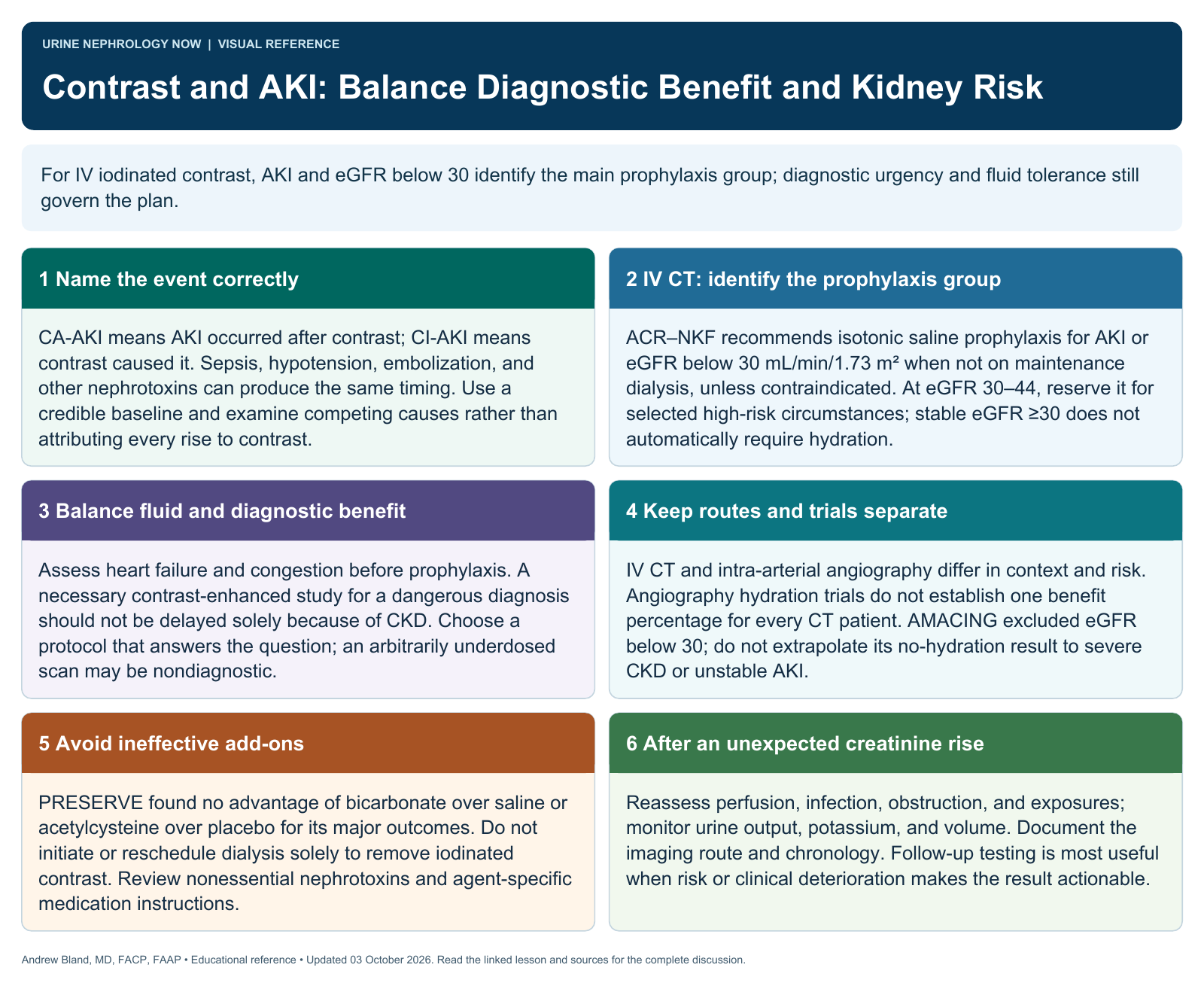
Browse the visual reference library · Download lesson Markdown
🔍 Definition & Recognition
Contrast-Associated AKI (CA-AKI) = AKI occurring after contrast media administration.
⚠️ Critical Teaching Point
Always consider the differential diagnosis — post-contrast AKI may have other causes (PP 4.7.1). Not all AKI occurring after contrast administration IS contrast nephropathy. Correlation is not causation. The patient may have developed AKI from sepsis, hypotension, other nephrotoxins, or cholesterol embolization during the same procedure.
📊 Risk Assessment Framework (Figure 12)
Screen for preexisting kidney impairment in all patients before contrast exposure
❤️ Cardiac Procedures (Intra-arterial)
- Use validated risk models (e.g., Mehran score)
- Higher contrast volumes and intra-arterial delivery increase risk
- Coronary intervention carries higher CA-AKI risk than diagnostic catheterization
💻 Other Procedures (IV Contrast)
- Use eGFR + additional risk factors (Table 37)
- IV contrast carries lower risk than intra-arterial
- Risk may be overestimated in many clinical scenarios
🚦 Risk-Based Triage
✔️ Proceed with contrast
⚖️ Assess benefit vs. harm
If benefit > harm, proceed with CA-AKI prevention
📈 CA-AKI Risk Factors (Table 37)
Most important risk factor
Especially with CKD
Reduced cardiac output
Correctable risk factor
Hypotension, shock, IABP
Dose-dependent toxicity
Higher risk than IV
NSAIDs, aminoglycosides
Reduced renal reserve
Impaired oxygen delivery
🔬 Contrast Media Selection
PP 4.9.1.2 (1B)
Use iso-osmolar or low-osmolar iodinated contrast media. Avoid high-osmolar agents.
PP 4.9.1.3
Use the lowest possible dose to achieve adequate diagnostic or therapeutic imaging quality.
💧 Prevention — Hydration
PP 4.9.2.1
Incorporate volume status assessment before contrast exposure
Rec 4.9.2.1 (1B)
0.9% saline preferred over hypotonic solutions, sodium bicarbonate, or no hydration
PP 4.9.2.2
Hold diuretics (if no volume overload) during isotonic crystalloid prophylaxis
⚡ Practice-Changing Medication Recommendations
These recommendations challenge or reverse prior common practices
💊 RASi Before Contrast
Rec 4.9.3.1 (2C)
Do NOT routinely withhold RASi (ACEi/ARB) before contrast procedures
This reverses prior common practice of holding ACEi/ARB pre-contrast
🩹 RASi for Surgery
Rec 4.10.1 (2B–2D)
Do NOT routinely withhold RASi for elective cardiac or non-cardiac surgery
Another departure from traditional peri-operative practice
💊 Metformin Management
No need to stop before contrast
No need to recheck GFR after
Stop metformin
Hold ≥48h post-contrast
Restart only when GFR stable
💊 Other Nephrotoxic Agents
Withdraw nonessential agents 24–48h before and 48h after contrast in CKD G3a–G5:
- NSAIDs
- Aminoglycosides
- Amphotericin B
- Platins (cisplatin, carboplatin)
- Zoledronate
- Methotrexate
🚫 What Does NOT Work — Myth Busting
Interventions with no consistent evidence of benefit for CA-AKI prevention
NO consistent benefit. Multiple RCTs and meta-analyses negative.
NO consistent benefit.
NO consistent benefit for prevention.
NO consistent benefit. "Renal dose dopamine" is a myth.
NO consistent benefit.
NO consistent benefit.
⚠️ Potentially HARMFUL
Prophylactic peri-contrast hemodialysis: NOT recommended. May be harmful. Does not prevent CA-AKI and exposes patients to unnecessary procedural risk.
🤒 Sick Day Protocols
Rec 4.11.1 (2D) Temporarily stop specific drugs during acute illness
- Must have clear documented plan for restart
- Communicate plan to patient AND healthcare team
- Monitor kidney function during illness and recovery
🎯 Key Learning Points
🔍 Diagnosis
- CA-AKI = AKI after contrast, but always rule out other causes
- Not all post-contrast AKI is contrast nephropathy
- Risk is often overestimated for IV contrast
💧 Prevention
- Isotonic saline is the only proven preventive strategy
- NAC does NOT work — stop ordering it
- Prophylactic dialysis is harmful, not helpful
⚡ Practice-Changing
- Do NOT hold ACEi/ARB before contrast or surgery
- Metformin safe with eGFR >30 and no AKI
- Use iso-/low-osmolar contrast at lowest effective dose
📋 Management
- Assess volume status before and after contrast
- Risk-stratify: low/intermediate/high
- Sick day protocols: temporarily stop vulnerable drugs
- Always have a documented plan for medication restart
📚 References
- KDIGO 2026 draft Clinical Practice Guideline for Acute Kidney Injury and Acute Kidney Disease
- Recommendations 4.7.1, 4.9.1.2, 4.9.1.3, 4.9.2.1, 4.9.2.2, 4.9.3.1, 4.10.1, 4.11.1
- Practice Points PP 4.7.1, 4.9.1.2, 4.9.1.3, 4.9.2.1, 4.9.2.2, 4.3.2
- Figure 12: Risk assessment algorithm for contrast procedures
- Table 37: Risk factors for contrast-associated AKI