📋 Executive Summary
Antibiotics represent one of the most common causes of drug-induced kidney injury in clinical practice. Understanding the unique characteristics of antibiotic-induced kidney injury is essential for early detection, appropriate prevention, and optimal management of this significant clinical challenge.
Key Insight: Recent advances include NLRP3 inflammasome activation with vancomycin, PARP1-mediated parthanatos with aminoglycosides, and the recognition that AUC-guided vancomycin dosing reduces nephrotoxicity by 33-45%.
Visual reference
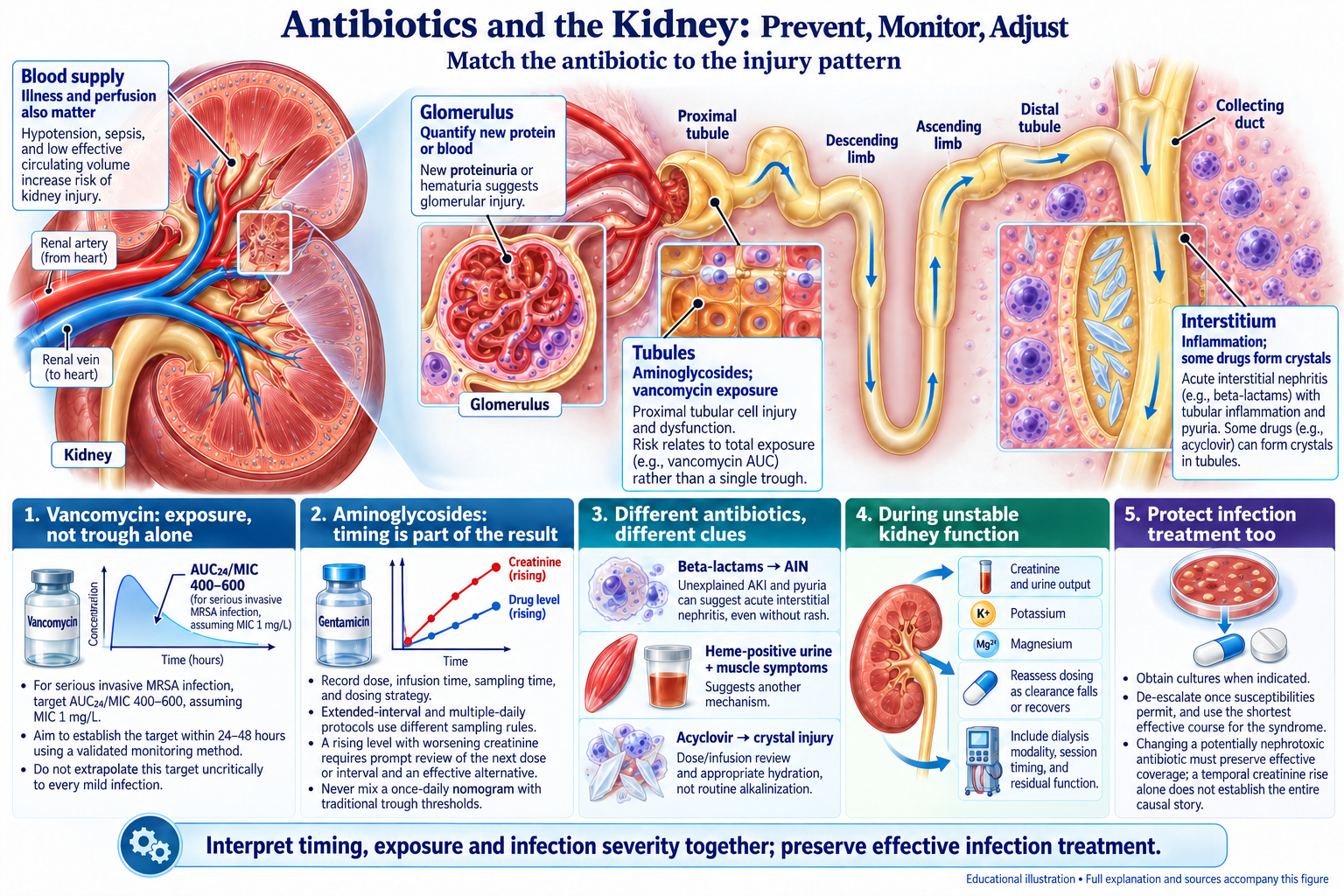
Browse the visual reference library · Download lesson Markdown
🧬 Aminoglycosides: The Charge-Toxicity Paradigm
Aminoglycoside nephrotoxicity directly correlates with molecular structure and positive charge - a groundbreaking discovery that has transformed our understanding of structure-activity relationships in nephrotoxicity.
| Aminoglycoside | Relative Nephrotoxicity | Number of Amino Groups | Positive Charges | Clinical Application | Prevention Strategy |
|---|---|---|---|---|---|
| Neomycin | Highest (5/5) | 6 | +6 | Topical/gut decontamination only | Avoid systemic use |
| Gentamicin | High (4/5) | 5 | +5 | First-line for serious infections | Extended-interval dosing, TDM |
| Tobramycin | Moderate to High (3/5) | 5 | +5 | Preferred for Pseudomonas | Extended-interval dosing, duration ≤7 days |
| Kanamycin | Moderate (3/5) | 4 | +4 | Limited use (resistance) | Consider alternatives |
| Amikacin | Moderate (2/5) | 4 | +4 | Reserved for resistant organisms | Once-daily dosing, limited duration |
| Netilmicin | Low to Moderate (2/5) | 3 | +3 | Less nephrotoxic alternative | Consider when toxicity is primary concern |
| Streptomycin | Lowest (1/5) | 2 | +2 | Anti-TB, special infections | Monitor ototoxicity > nephrotoxicity |
🔬 Molecular Mechanisms of Charge-Related Toxicity
1. Enhanced Membrane Binding
Higher positive charge leads to stronger binding to negatively charged phospholipids in proximal tubular cell membranes.
2. Increased Cellular Uptake
Greater positive charge enhances megalin-mediated endocytosis, leading to higher intracellular accumulation.
3. Enhanced Lysosomal Retention
Highly charged aminoglycosides accumulate extensively in lysosomes, causing greater disruption of lysosomal function.
4. Mitochondrial Interference
Greater positive charge enhances binding to mitochondrial ribosomes, interfering with energy production and cellular function.
⚠️ Section under revision
🏥 Vancomycin: From Trough-Based to AUC-Guided Dosing
The evolution of vancomycin dosing represents one of the most significant advances in reducing antibiotic-associated nephrotoxicity.
| Dosing Strategy | Target Parameter | AKI Incidence | Risk Reduction | Evidence Level |
|---|---|---|---|---|
| Traditional Trough-Guided | Trough 15-20 mg/L | 15-35% | Baseline | Historical standard |
| AUC-Guided Dosing | AUC/MIC 400-600 mg·h/L | 8-14% | 33-45% reduction | Multiple RCTs, meta-analyses |
| Continuous Infusion | Steady-state concentration | 10-18% | 28% reduction | Meta-analysis evidence |
🎯 Evidence: Abdelmessih 2022 Meta-Analysis
Design: Systematic review and meta-analysis of AUC-guided vs. trough-guided vancomycin dosing
Results: Pooled odds ratio 0.625 (95% CI 0.469–0.834) for AKI with AUC-guided dosing — approximately 37.5% relative reduction
Source: Abdelmessih E et al. Pharmacotherapy 2022;42(9):741-753. PMID: 35869689
⚠️ Section under revision
⚠️ Section under revision
⚠️ High-Risk Antibiotic Combinations: Mechanisms & Management
🔥 Vancomycin + Piperacillin-Tazobactam: The "Perfect Storm"
- Combination therapy: 21-40% AKI
- Vancomycin alone: 8-13% AKI
- Pip-tazo alone: 9-11% AKI
- Number needed to harm: 8-10 patients
- Enhanced NLRP3 inflammasome activation
- Competitive drug transport interactions
- Synergistic inflammatory response
- Complementary tubular damage patterns
- AUC-guided vancomycin dosing (target 400–600 mg·h/L)
- Extended-infusion piperacillin-tazobactam
- Early de-escalation when culture-driven alternatives are available
- Vancomycin + cefepime
- Vancomycin + meropenem
- Consider daptomycin for MRSA
- Early culture-based de-escalation
⚡ Vancomycin + Aminoglycosides: Historic High-Risk Combination
- AKI Risk: 25-40%
- Risk factors: Higher doses, extended duration
- Pre-existing CKD multiplies risk
- Dialysis requirement: 5-10%
- Vancomycin enhances aminoglycoside uptake
- Different subcellular targets
- Additive oxidative stress
- Enhanced inflammatory response
- Avoid combination when possible
- If necessary: shortest possible duration
- Daily creatinine monitoring
- Enhanced biomarker surveillance
- Extended-interval aminoglycoside dosing
- AUC-guided vancomycin
- Consider therapeutic alternatives
- Early infectious disease consultation
💀 Polymyxins + Vancomycin: Extreme Risk Combination
- AKI Risk: 40-60%
- Reserved for XDR organisms only
- High mortality in AKI cases
- Often ICU population
- Dual membrane damage pathways
- Additive oxidative stress
- Mitochondrial dysfunction
- Daily creatinine and electrolytes
- Urinary biomarker monitoring
- Early nephrology consultation
- RRT preparation
- Optimal polymyxin dosing
- AUC-guided vancomycin
- Antioxidant supplementation (experimental)
- Consider newer agents when available
🔵 Beta-Lactams: Acute Interstitial Nephritis Paradigm
Beta-lactams represent the classic example of immune-mediated acute interstitial nephritis, with specific clinical and histologic patterns.
🎯 Clinical Recognition
- Classic Triad (10% of cases): Fever + Rash + Eosinophilia
- Common presentation: Isolated AKI with sterile pyuria
- Timeline: 10-14 days after initiation
- Urine findings: WBC casts, eosinophiluria (variable)
🧬 Pathophysiologic Mechanism
- Type IV hypersensitivity: T-cell mediated delayed reaction
- Hapten formation: Drug-protein complexes in tubular basement membrane
- T-cell infiltration: Predominantly helper T cells
- Cytokine cascade: Pro-inflammatory mediator release
⚕️ Evidence-Based Treatment
- Immediate discontinuation: First-line intervention
- Corticosteroids: Consider with nephrology after weighing diagnostic certainty, infection risk, severity and kidney biopsy findings.
- Evidence: A retrospective cohort associated earlier steroid treatment with better recovery; it was not a randomized demonstration of a 48% benefit. Fernandez-Juarez et al., 2018.
- Duration: Individualize with the treating specialist; longer treatment is not automatically better.
⏰ Recovery Timeline
- Recovery onset: 3-7 days after drug discontinuation
- Complete recovery: 70-85% within 2-6 weeks
- Persistent dysfunction: 10-15% develop CKD
- Steroid benefit: May accelerate recovery
🔬 Novel Diagnostic Approaches
Moledina et al. (2019) studied urinary TNF-α and IL-9 as biomarkers for acute interstitial nephritis. These research findings do not establish a routine replacement for kidney biopsy. PubMed
Future Direction: Urinary biomarkers (TNF-α, IL-9) may differentiate AIN from ATN without requiring biopsy
Clinical Need: Current laboratory tests provide insufficient distinction between AIN and other AKI causes
⏰ Temporal Patterns of Antibiotic Nephrotoxicity
Understanding onset timing is crucial for early recognition and intervention
Immediate to 3 Days: Crystal Nephropathy
Drugs: Sulfonamides (high-dose), Acyclovir (IV)
Mechanism: Intratubular precipitation, crystalluria
Management: Stop or adjust the implicated drug, review dose and infusion rate, and restore appropriate hydration while monitoring for overload. Urine-pH treatment is drug-specific; routine alkalinization is not recommended for acyclovir crystal injury.
Recovery: Usually rapid with appropriate intervention
5-7 Days: Early ATN
Drugs: Polymyxins, Amphotericin B
Mechanism: Direct membrane damage, oxidative stress
Management: Dose optimization, enhanced monitoring, supportive care
Recovery: Variable, may be incomplete
5-10 Days: Vancomycin & Complex ATN
Drugs: Vancomycin, combination therapies
Mechanism: NLRP3 inflammasome, mitochondrial dysfunction
Management: AUC-guided dosing, avoid high-risk combinations
Recovery: Good with early intervention
7-10 Days: Classic Aminoglycoside ATN
Drugs: Gentamicin, Tobramycin, Amikacin
Mechanism: Lysosomal disruption, mitochondrial damage, PARP1-mediated parthanatos
Management: Extended-interval dosing, therapeutic drug monitoring
Recovery: 60-80% complete recovery within 2-4 weeks
10-14 Days: Immune-Mediated AIN
Drugs: Beta-lactams, PPIs, Fluoroquinolones
Mechanism: T-cell mediated hypersensitivity, immune complex formation
Management: Drug withdrawal, corticosteroids for severe cases
Recovery: 70-85% complete recovery, steroids may accelerate healing
⚠️ Section under revision: Recent Advances in Antibiotic Nephrotoxicity
🧮 Antibiotic Nephrotoxicity Risk Calculator
Assess risk based on drug selection, patient factors, and combination therapy
🎯 Essential Antibiotic Nephrotoxicity Pearls
🧬 Structure-Function
- Aminoglycoside toxicity ∝ positive charge
- Neomycin (+6) > Gentamicin (+5) > Netilmicin (+3)
- PARP1-mediated parthanatos pathway
- Extended-interval dosing reduces risk 30-50%
💉 Vancomycin Evolution
- AUC-guided dosing: 33-45% ↓ nephrotoxicity
- NLRP3 inflammasome activation mechanism
- Mitochondrial dysfunction and impaired mitophagy
- Target AUC/MIC 400-600 mg·h/L
⚠️ High-Risk Combinations
- Vanc + Pip-Tazo: 21-40% AKI (NNH 8-10)
- Vanc + Aminoglycosides: 25-40% AKI
- Polymyxin + Vanc: 40-60% AKI (extreme risk)
- Each additional nephrotoxin: +60% risk
🔵 AIN Recognition
- Classic triad only in 10% of cases
- Beta-lactams: 10-14 days onset
- Early steroids reduce persistent dysfunction
- T-cell signatures may enable non-invasive diagnosis
⏰ Temporal Patterns
- Crystals: Hours to days
- ATN: 5-10 days (cumulative damage)
- AIN: 10-14 days (immune sensitization)
- Biomarkers precede creatinine by 2-5 days
🛡️ Prevention Strategies
- Protocol-driven monitoring: 32% ↓ AKI
- Electronic alerts: 38% ↓ AKI
- Shortest effective duration
- Emerging nephroprotectants show promise