🔥 The NSAID-CKD Controversy: Challenging Absolute Contraindications
Traditional View: "NSAIDs are absolutely contraindicated in patients with chronic kidney disease"
NSAIDs in CKD: Kidney, cardiovascular, gastrointestinal, and electrolyte risks require individual assessment. Avoid routine use in patients with active AKI, volume depletion, or high-risk interacting drugs; if considered in selected stable patients, use the lowest effective dose for the shortest time with monitoring. Baker and Perazella, 2020
⚖️ The Core Dilemma
Blanket prohibitions may lead to inadequate pain control and potentially harmful reliance on alternative medications with their own significant risks, particularly opioids. Evidence demonstrates disproportionately high opioid use in the CKD population due to limited availability of non-pharmacological treatment options.
Visual reference
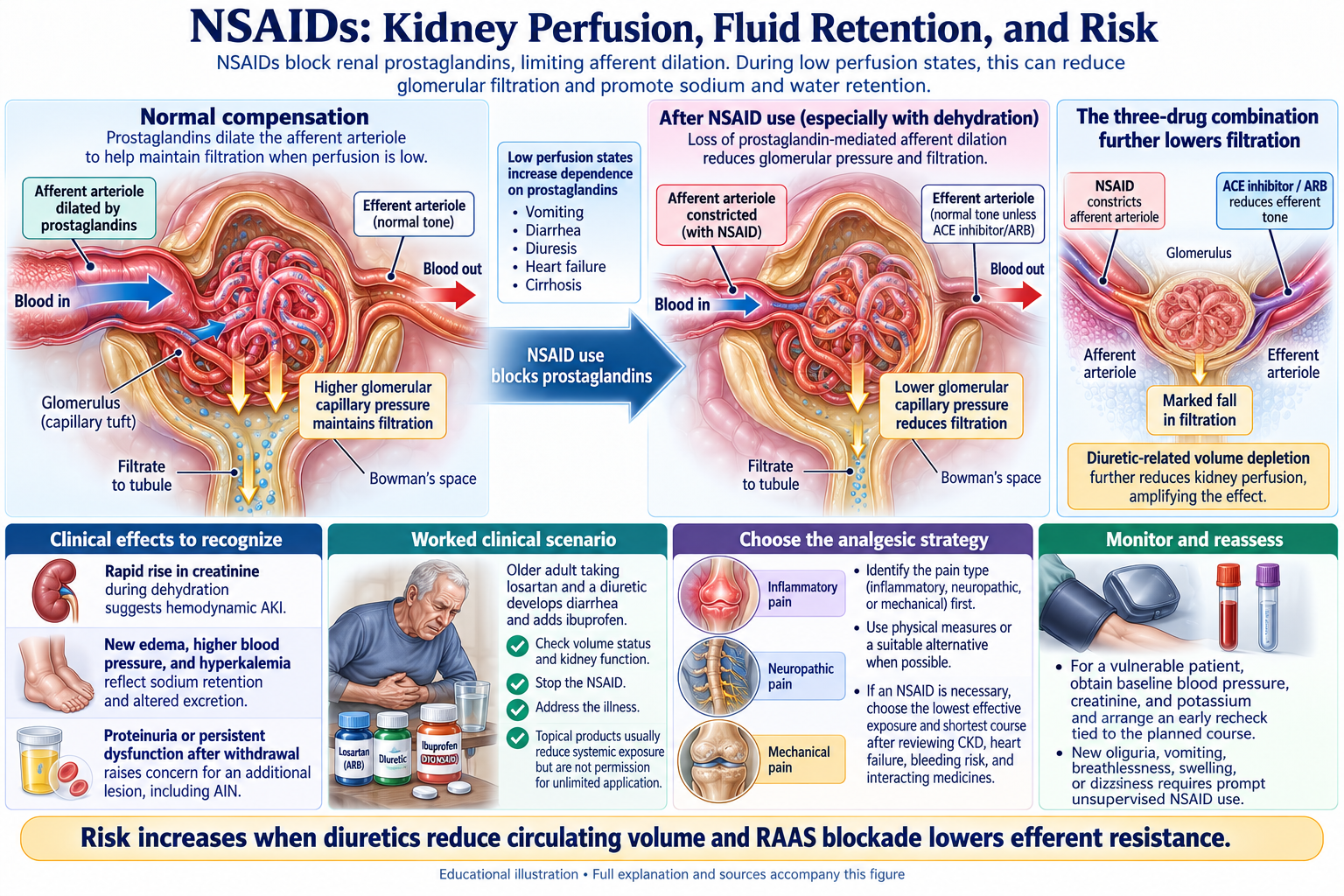
Browse the visual reference library · Download lesson Markdown
📊 Evidence Summary: NSAIDs and Kidney Disease
🚫 Traditional Absolute Contraindication
Meta-Analysis Evidence:
- AKI Risk: 73% increased odds (OR 1.73, 95% CI 1.44-2.07)
- Elderly patients: 2.5× higher risk (OR 2.51)
- CKD progression: High-dose use increases risk (OR 1.26)
- Dose-dependent: Regular dose safe, high dose harmful
Supporting Guidelines:
- KDIGO 2024: Nephrotoxin stewardship
- NKF: Avoid if eGFR <60 mL/min/1.73m²
- Safety concerns in heart failure, hypertension
✅ Risk-Benefit Individualized Approach
Supporting Evidence:
- CKD Stages 1-3: Short-term use (≤5 days) acceptable with monitoring
- CKD Stage 4: Low doses, short half-life preparations with close monitoring
- Topical NSAIDs: 5-17× lower systemic exposure
- Opioid crisis: 3.2× higher opioid use in CKD patients
Clinical Rationale:
- Alternatives have weak evidence, strong harm
- Pain burden high in CKD population
- Short-term risk may be acceptable
- Patient-centered decision making
🔬 Pathophysiologic Mechanisms of NSAID Nephrotoxicity
1. Cyclooxygenase Inhibition and Renal Hemodynamics
Maintains baseline physiologic functions including kidney perfusion, platelet aggregation, and gastric mucosal protection
Upregulated in response to inflammation, growth factors, and cytokines. Largely responsible for increased prostaglandin production under stress
PGE2, PGI2, and PGD2 cause afferent arteriolar vasodilation, enhancing renal perfusion and maintaining GFR
NSAID inhibition eliminates compensatory vasodilation, particularly dangerous in prostaglandin-dependent states
2. Hemodynamically-Mediated Acute Kidney Injury
Primary mechanism: Reversible reduction in GFR through disruption of prostaglandin-mediated compensation
Low prostaglandin synthesis, NSAIDs have minimal impact on kidney function
Increased prostaglandin secretion preserves renal perfusion and GFR
Elimination of compensatory mechanism → reduced perfusion → ischemic injury
Usually reversible with drug discontinuation if caught early
3. Acute Interstitial Nephritis (AIN)
Idiosyncratic immune reaction: T-cell mediated delayed-type hypersensitivity
Mechanism: Drug acts as hapten → T-cell activation → Lymphocytic infiltration → Cytokine release → Interstitial damage
Risk: ~2-fold increase but absolute risk remains very low
Clinical Challenge: Occurs independently of dose and duration, making prevention difficult
⚡ "Triple Whammy" Effect: Mechanism & Risk Quantification
Definition: Concurrent use of ACE-I/ARB + Diuretic + NSAID
🚰 Mechanism 1: Diuretics
Effect: Reduce plasma volume
Result: Reduced renal blood flow
Compensation: RAAS activation
🔽 Mechanism 2: ACE-I/ARB
Effect: Inhibit efferent arteriolar vasoconstriction
Result: Lower glomerular filtration pressure
Compensation: Prostaglandin-mediated afferent dilation
🩹 Mechanism 3: NSAIDs
Effect: Inhibit prostaglandin synthesis
Result: Afferent arteriolar constriction
Consequence: Complete loss of autoregulation
💀 Combined Effect
AKI Rate Ratio: 1.31 overall, 1.82 in first 30 days
Fatality Rate: ~10% when AKI develops
Population Risk: 4.7-7.9% of patients in general practice
⚠️ Risk Factors for NSAID-Induced Kidney Injury
| Risk Category | Specific Factors | Mechanism | Risk Magnitude | Clinical Management |
|---|---|---|---|---|
| Prostaglandin-Dependent States | Heart failure, cirrhosis, nephrotic syndrome | High baseline prostaglandin dependence | Very High | Absolute contraindication |
| Volume Depletion | Dehydration, bleeding, diuretics | Reduced effective circulating volume | High | Correct volume status first |
| Chronic Kidney Disease | eGFR <60, proteinuria | Reduced renal reserve | Moderate-High | Individualized risk-benefit |
| Advanced Age | Age >65, especially >75 | Reduced GFR, comorbidities | Moderate | Lower doses, shorter duration |
| Concurrent Medications | ACE-I/ARB + diuretics | Triple whammy effect | High | Avoid combination when possible |
⚖️ Evidence-Based Risk-Benefit Assessment for CKD Patients
🟢 CKD Stages 1-3: Acceptable with Precautions
- Short-term use (≤5 days) has acceptably low nephrotoxic risk
- Risk primarily in setting of additional factors
- Regular-dose NSAIDs don't significantly affect CKD progression
- Topical formulations have minimal systemic exposure
- Ensure stable kidney function (no recent AKI)
- Optimize volume status
- Avoid concurrent "triple whammy" medications
- Use lowest effective dose for shortest duration
- Monitor creatinine within 2-3 weeks
🟡 CKD Stage 4: Judiciously with Enhanced Monitoring
- Low doses of short half-life preparations
- Maximum 5 days duration
- Close monitoring within treatment period
- Patient education on warning signs
- Consider topical alternatives first
- Ensure adequate blood pressure control
- No concurrent volume depletion
- Avoid combination nephrotoxins
- Daily creatinine monitoring if high risk
- Immediate discontinuation if AKI develops
🔴 CKD Stage 5: Generally Avoided
Recommendation: Never use except under circumstances prioritizing palliation over prolongation of life
Rationale: Risk for lethal renal complications is high despite absence of definitive data
Alternatives: Focus on non-pharmacological approaches, topical therapies, opioid alternatives with appropriate precautions
🎯 Topical NSAIDs: Evidence for Safer Alternative
| Parameter | Oral NSAIDs | Topical NSAIDs | Clinical Advantage |
|---|---|---|---|
| Systemic Exposure | 100% (reference) | 5-17× lower | Dramatically reduced systemic effects |
| Peak Plasma Concentration | 100% (reference) | 158× lower | Minimal systemic drug levels |
| Kidney-Related Adverse Effects | Significant | Minimal | Safe in most CKD patients |
| Local Efficacy | Systemic distribution | Direct target delivery | Effective for localized pain |
| CKD Stage 5 Use | Contraindicated | With close monitoring | Viable option with precautions |
📋 Clinical Recommendations for Topical NSAIDs
All patients with CKD, particularly stages 4-5, for musculoskeletal and arthritic pain
Even with topical use in CKD 4-5, close monitoring at onset recommended
Proper application techniques, avoid occlusive dressings, watch for skin irritation
Most effective for superficial joints (knees, hands), less effective for deep structures
💊 Comparative Safety Among Different NSAIDs
🔬 COX-2 Selective vs. Non-Selective NSAIDs
Key Finding: Both celecoxib and rofecoxib can cause sodium retention and decrease GFR to a similar extent as nonselective NSAIDs in patients at risk for adverse renal effects.
Clinical Implication: COX-2 inhibitors do NOT offer renal safety benefits over nonselective NSAID therapies
Recommendation: All NSAIDs, including COX-2-selective inhibitors, share similar risk for adverse renal effects
| NSAID | Relative Kidney Risk | Half-Life | Special Characteristics | CKD Suitability |
|---|---|---|---|---|
| Ibuprofen | Lowest risk | Short (2-4 hours) | Well-tolerated, rapid clearance | Preferred for short-term use |
| Diclofenac | Low risk | Short (1-2 hours) | Potent COX-2 inhibitor, rapid onset | Well-tolerated in CKD |
| Celecoxib | Moderate risk | Intermediate (11 hours) | COX-2 selective, no renal advantage | No special benefit for CKD |
| Other NSAIDs | Variable | Variable | Class effect for nephrotoxicity | Similar precautions needed |
| Etoricoxib | Highest risk | Long (22 hours) | Associated with highest adverse kidney outcomes | Avoid in CKD patients |
🧮 Advanced NSAID Nephrotoxicity Risk Calculator
Comprehensive risk assessment incorporating patient factors, NSAID selection, and clinical context
🎯 Essential NSAID Nephrotoxicity Pearls
⚖️ Risk-Benefit Evolution
- Absolute contraindication being challenged
- Individualized risk assessment preferred
- Short-term use may be acceptable in CKD 1-3
- Patient-centered decision making essential
🔬 Mechanism Understanding
- Prostaglandin inhibition → hemodynamic AKI
- Greatest risk in prostaglandin-dependent states
- COX-2 inhibitors NO safer for kidneys
- AIN pattern: idiosyncratic, dose-independent
⚡ Triple Whammy
- ACE-I/ARB + Diuretic + NSAID = danger
- Disrupts all three autoregulation mechanisms
- 1.82× risk in first 30 days
- 10% fatality rate when AKI develops
🎯 Topical Advantage
- 5-17× lower systemic exposure
- 158× lower peak plasma concentration
- Safe in most CKD patients
- First-line for localized musculoskeletal pain
📊 Evidence-Based Dosing
- Lowest effective dose, shortest duration
- Regular dose safe, high dose harmful
- Ibuprofen and diclofenac lowest risk
- Etoricoxib highest risk (avoid in CKD)
⚠️ High-Risk Populations
- Heart failure, cirrhosis (absolute contraindication)
- Volume depletion (correct first)
- Age >75 (increased vigilance)
- Recent AKI (avoid until recovery)