🔥 The PPI-Kidney Disease Controversy
The Central Question: Do proton pump inhibitors cause chronic kidney disease, or do we have a classic case of correlation versus causation?
📊 The Evidence Paradox
Consistent associations: 20-70% increased CKD risk across multiple large cohorts
Mixed results: COMPASS trial shows modest but significant eGFR decline
Biologically plausible: Acute interstitial nephritis well-documented
Widespread use, proven benefits vs. potential but uncertain kidney risks
🧭 COMPASS Trial: The Definitive RCT Evidence
Design: Large (17,598 participants), international, double-blind, placebo-controlled randomized trial
📋 Study Characteristics
🎯 Original RCT Conclusion vs Post-Hoc Re-Analysis
- Pantoprazole 8,791 vs placebo 8,807, 3-year follow-up
- Authors' conclusion: pantoprazole was safe with no signal of CKD, dementia, fracture, MI, or cancer; only enteric infections increased (OR 1.33, 95% CI 1.01–1.75)
- CKD specifically reported as similar between groups
- Source: Moayyedi P et al. Gastroenterology 2019;157(3):682-691.e2. PMID 31152740
- eGFR slope: pantoprazole −1.64 vs placebo −1.41 mL/min/1.73m²/year
- Adjusted between-group difference 0.27 mL/min/1.73m²/year (95% CI 0.11–0.43)
- CKD outcome OR 1.11 (95% CI 0.98–1.25) — non-significant but in the direction of harm
- Source: Pyne L et al. JASN 2024;35(6):779-789. PMID 38602780
🤔 Interpretation Challenges
Clinical Significance: The 0.27 mL/min/1.73m² per year excess decline is roughly equivalent to, but in the opposite direction of, the beneficial effect of renin-angiotensin system blockade.
Statistical vs Clinical: While statistically significant, the clinical relevance of this modest decline in patients with relatively preserved kidney function remains debatable.
Study Limitation: Kidney outcomes were not primary endpoints, raising questions about power and design optimization for nephrotoxicity detection.
Visual reference
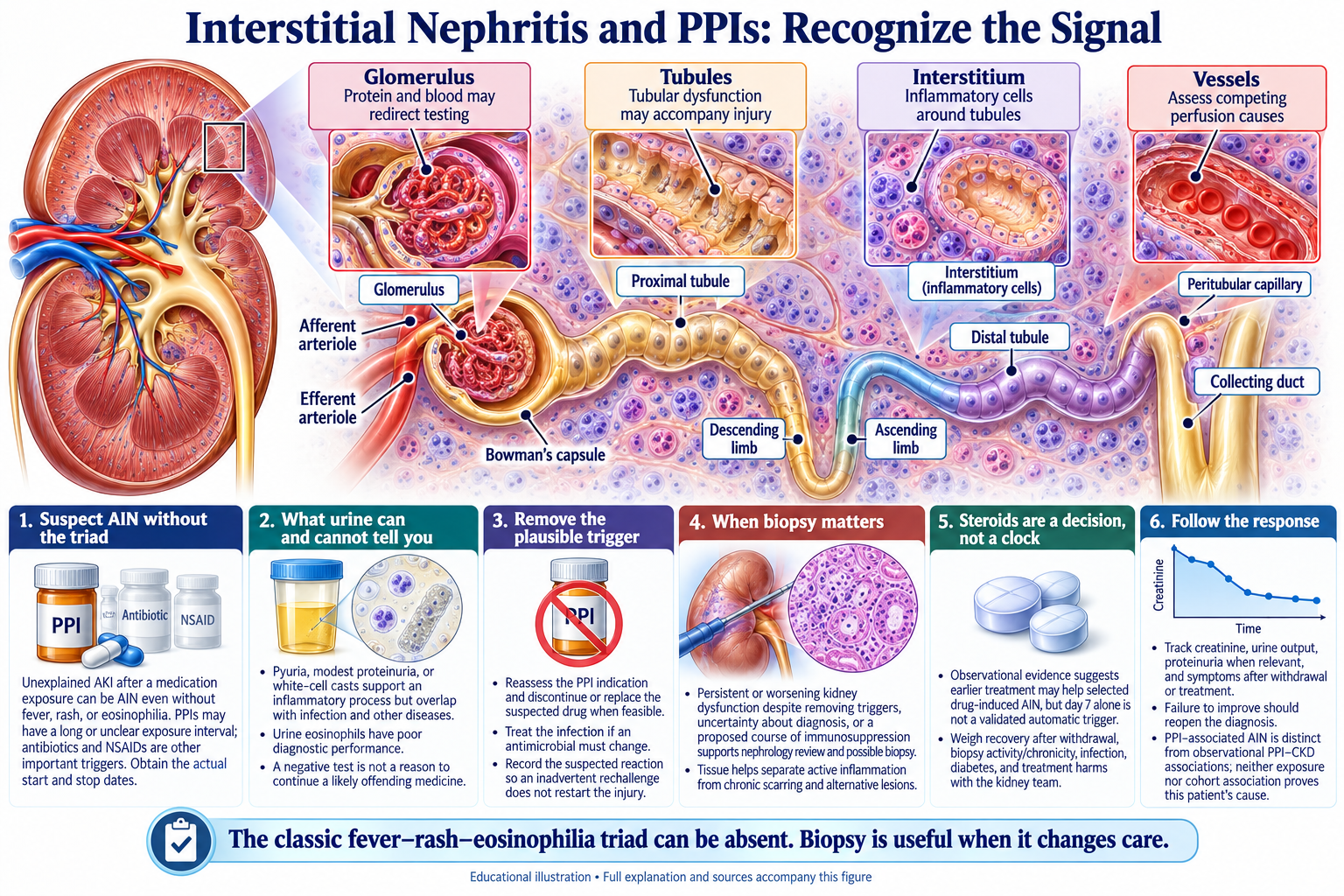
Browse the visual reference library · Download lesson Markdown
📚 Comprehensive Evidence Review
🔍 Observational Study Evidence
Major Studies & Findings:
- ARIC Study (>10,000 adults): 20-50% higher CKD risk
- ELSA-Brasil (13,909 participants): Increased CKD risk with >6 months use
- Meta-analysis (700,125 participants): RR 1.72 for CKD
- FDA Adverse Event Analysis: Strong signals for both AKI and CKD
Strengths:
- Large sample sizes, real-world populations
- Consistent associations across studies
- Dose-response relationships observed
Limitations:
- Residual confounding bias
- Selection bias (indication bias)
- Cannot establish causation
🧪 Randomized Controlled Trial Evidence
COMPASS Trial Results:
- Primary safety analysis (Moayyedi 2019, PMID 31152740): No CKD signal — authors concluded pantoprazole was safe; only enteric infections increased
- Post-hoc eGFR analysis (Pyne 2024, PMID 38602780): Pantoprazole −1.64 vs placebo −1.41 mL/min/1.73m²/year; between-group difference 0.27 (95% CI 0.11–0.43); CKD OR 1.11 (95% CI 0.98–1.25), non-significant
- Clinical context: Cardiovascular disease population (n=17,598)
Significance:
- Largest and only RCT data
- Unconfounded evidence
- Modest but measurable effect
Limitations:
- Post hoc analysis for eGFR
- Kidney outcomes not primary
- Specific population (CVD)
🔄 Contradictory Evidence
Studies Showing No Increased Risk:
- Propensity-matched study: Similar CKD incidence vs H2RA (HR 0.68)
- Electronic health record meta-analysis: No significant CKD risk (HR 1.03)
- Bradford Hill criteria analysis: Fails to support causation
Critical Assessment Points:
- Methodological variations in studies
- Definition differences for outcomes
- Population heterogeneity
- Follow-up duration variations
Expert Conclusions:
- No consistent relationship established
- Study quality concerns
- Bias assessment reveals limitations
🔬 Acute Interstitial Nephritis: The Established Mechanism
Established Fact: PPIs are the second most common cause of drug-induced acute interstitial nephritis after antibiotics
📊 Clinical Epidemiology
5-15% of hospitalized AKI cases
14% of drug-induced AIN cases
Omeprazole (12%), Amoxicillin (8%), Ciprofloxacin (8%)
Older patients, longer drug exposure, delayed recognition
🧬 Pathophysiologic Mechanism
Involves interstitium and renal tubules with initial tubule epithelial cell injury followed by lymphocytic inflammatory infiltrate containing predominantly T cells
Helper-inducer and suppressor-cytotoxic T lymphocytes suggest T-cell mediated hypersensitivity reactions and cytotoxic T-cell injury
Repeated episodes of acute kidney injury may precipitate chronic kidney disease through persistent renal impairment and chronic interstitial nephritis
PPI treatment increases serum indoxyl sulfate levels through enhanced liver CYP2E1 protein, potentially explaining CKD risk
🩺 Clinical Diagnosis of PPI-Induced AIN
Clinical Challenge: Classic findings of fever, rash, and arthralgias may be absent in up to two-thirds of patients
🔍 Clinical Presentation Patterns
- Older patients
- Less symptomatic presentation
- Longer duration of drug exposure
- Longer delays in biopsy and treatment
- Proteinuria (mild, 1+ typically)
- Leukocyte esterase positivity (2+)
- WBC count >5 cells/hpf (often 13+)
- Urinary eosinophils >6%
- Dense lymphocyte infiltrates
- Eosinophilic infiltrations
- Interstitial involvement
- Sparing of glomeruli
- Eosinophilia (uncommon in PPI cases)
- None of the PPI-induced AIN cases demonstrated eosinophilia in case series
🧪 Novel Diagnostic Approaches
- Urine TNF-α: Differentiates AIN from ATN
- Interleukin-9: Rule-in/rule-out diagnostic tool
- IL-9 <0.41: Rules out AIN (posttest probability 0.07)
- IL-9 >2.53: Rules in AIN (posttest probability 0.84)
- Urine eosinophils: Poor sensitivity/specificity
- Clinical features: Insufficient for distinction
- Renal biopsy: Gold standard but invasive
- Gallium scanning: Suggestive but unreliable
⚖️ PPI vs H2RA: Effectiveness and Safety Comparison
| Parameter | Proton Pump Inhibitors | H2 Receptor Antagonists | Clinical Significance |
|---|---|---|---|
| Mechanism | Irreversible H+/K+-ATPase inhibition | Competitive, reversible H2 blockade | PPIs more comprehensive acid suppression |
| Acid Suppression | Intensive, 15-21 hours daily | ~70% inhibition, 4-8 hours | PPIs superior for acid-related disorders |
| GERD Healing Rate | Superior (RR 1.59, 95% CI 1.44-1.75) | Less effective, especially severe esophagitis | PPIs first-choice for GERD |
| Tolerance Development | No clinically significant tolerance | Significant decrease over time | H2RAs require dose escalation |
| Onset of Action | Up to 4 days for full effect | 1-3 hours | H2RAs better for immediate relief |
| Kidney Disease Risk | Potential association (controversial) | No significant association | Safety consideration in high-risk patients |
🎯 Clinical Decision Points
- Erosive esophagitis (all grades)
- Peptic ulcer disease
- H. pylori eradication
- NSAID gastroprotection
- Refractory GERD symptoms
- Mild, infrequent GERD (≤2 episodes/week)
- PPI intolerance
- Rapid onset requirement
- Patients with high kidney disease risk
- Short-term symptom control
⏰ Temporal Patterns of PPI-Associated Kidney Disease
Understanding the timeline helps distinguish between acute interstitial nephritis and potential chronic kidney disease progression
Acute Interstitial Nephritis Pattern
Onset: Typically days to weeks after PPI initiation
Mechanism: Immune-mediated hypersensitivity reaction
Clinical Features: Often subtle, may lack classic triad
Diagnosis: Requires high index of suspicion, may need biopsy
Recovery: Usually reversible with drug discontinuation
Subacute Injury Pattern
COMPASS Trial Findings: Detectable eGFR decline within study period
Mechanism: Unclear - possibly cumulative subclinical injury
Clinical Significance: Modest but measurable effect (0.27 mL/min/1.73m²/year)
Reversibility: Unknown from current data
Chronic Kidney Disease Pattern
Observational Studies: Increased CKD risk with long-term use
ELSA-Brasil: Increased risk with >6 months use
Proposed Mechanism: Repeated episodes of subclinical AIN leading to chronic fibrosis
Causation Question: Remains unproven despite consistent associations
Pharmacovigilance Timeline
AKI Median Time: 23 days from PPI use to event
CKD Median Time: 177 days from PPI use to event
Signal Strength: Significant for both AKI (ROR 3.95) and CKD (ROR 8.80)
Interpretation: Post-marketing surveillance suggests both acute and chronic patterns
⚕️ Evidence-Based Clinical Decision Making
🎯 Risk Assessment Approach
Core Principle: Balance proven benefits against potential but incompletely characterized kidney risks
- Advanced CKD (eGFR <30)
- History of drug-induced AIN
- Multiple concurrent nephrotoxins
- Advanced age with multiple comorbidities
Strategy: Consider H2RA alternatives, shorter PPI courses, enhanced monitoring
- Clear PPI indication
- Normal to mild CKD
- No prior AIN history
- Limited concurrent nephrotoxins
Strategy: Use PPIs as indicated, appropriate duration, routine monitoring
📋 Monitoring Recommendations
- Serum creatinine and eGFR
- Complete urinalysis
- Review PPI indication and duration
- Annual eGFR monitoring for long-term users
- More frequent if high-risk features
- Urinalysis if AKI suspected
- Rising creatinine without other cause
- New-onset sterile pyuria
- Unexplained decline in eGFR
- Consider PPI discontinuation
- Nephrology consultation if needed
- Evaluate for AIN if appropriate
💊 Deprescribing Strategies
Tapering Approach: Reduce PPI maintenance dose by 50% in 1-2 week intervals to avoid rebound acid hypersecretion
- No clear ongoing indication
- Extended use beyond recommended duration
- Developing kidney function concerns
- Patient preference after risk discussion
- Week 1-2: Reduce dose by 50%
- Week 3-4: Further reduction or alternate days
- Week 5+: Complete discontinuation
- Monitor for symptom recurrence
🔬 Future Research Priorities
🎯 Critical Research Gaps
- Direct vs indirect nephrotoxicity mechanisms
- Role of CYP2E1 and indoxyl sulfate
- Subclinical AIN detection methods
- Genetic susceptibility factors
- Dedicated RCTs with kidney endpoints
- Dose-response relationships
- Reversibility of kidney function decline
- Long-term outcomes after discontinuation
- Early detection of subclinical injury
- Non-invasive AIN diagnosis
- Risk stratification tools
- Recovery prediction models
- Electronic health record integration
- Decision support tools
- Population health surveillance
- Cost-effectiveness analyses
🎯 Essential PPI Nephrotoxicity Pearls
🎭 The Controversy
- Observational studies: consistent associations
- RCT evidence: modest but significant effect
- Causation vs correlation remains debated
- Clinical significance uncertain
🧭 COMPASS Trial
- Largest RCT: 17,598 participants
- 0.27 mL/min/1.73m²/year excess decline
- Statistically significant, clinically modest
- Post hoc analysis limitation
🔬 AIN Mechanism
- Second most common drug cause of AIN
- T-cell mediated hypersensitivity
- Often subtle presentation in elderly
- Novel biomarkers may improve diagnosis
⚖️ PPI vs H2RA
- PPIs superior for acid-related disorders
- No tolerance development with PPIs
- H2RAs no proven kidney safety advantage
- Clinical context guides selection
⏰ Temporal Patterns
- AKI: Days to weeks (median 23 days)
- CKD: Months to years (median 177 days)
- Different mechanisms likely involved
- Reversibility unclear for chronic effects
🎯 Clinical Guidance
- Balance proven benefits vs potential risks
- Annual eGFR monitoring for long-term users
- Careful deprescribing when appropriate
- Enhanced vigilance in high-risk patients
🍦 Correlation vs Causation: The Ice Cream Analogy
Critical Thinking Exercise: Understanding why association does not equal causation in the PPI-CKD relationship
🌆 The Classic Teaching Example
Observation: In New York City, there's a strong positive correlation between ice cream consumption and murder rates
📊 The Observed Association
- Summer Months: High ice cream sales + High murder rates
- Winter Months: Low ice cream sales + Low murder rates
- Statistical Correlation: Strong positive relationship (r > 0.7)
- Naive Conclusion: "Ice cream causes violence!"
🌡️ The True Explanation
- Confounder: Ambient outside temperature
- Mechanism 1: Hot weather → More people outside → More ice cream sales
- Mechanism 2: Hot weather → More people outside → More interpersonal interactions → More opportunities for conflict
- Reality: Temperature drives both variables independently
💡 Key Teaching Points from the Ice Cream Example
- Correlation ≠ Causation: Strong statistical associations can be completely non-causal
- Confounders are powerful: Third variables can drive both outcomes simultaneously
- Biological plausibility matters: Ice cream causing violence makes no mechanistic sense
- Context is crucial: Consider what other factors might explain the relationship
- Randomized trials matter: They eliminate confounding by balancing known and unknown factors
💊 The PPI-CKD Parallel: Obesity as the "Temperature"
The Confounding Variable: PPI users tend to be obese, and obesity drives multiple pathways to kidney disease
📊 The Observed PPI-CKD Association
- Consistent Finding: PPI users have 20-70% higher CKD risk
- Dose-Response: Longer use = higher risk
- Multiple Studies: Replicated across populations
- Naive Conclusion: "PPIs must cause CKD!"
🍔 The Obesity Confounding Pathway
- Primary Driver: Obesity epidemic parallels PPI use increase
- GERD Connection: Obesity strongly predisposes to GERD → PPI prescription
- Comorbidity Cluster: Obese patients develop the "deadly quartet"
- Independent CKD Risk: Each comorbidity damages kidneys separately
🚨 The "Deadly Quartet" of Obesity-Related Comorbidities
- Cardiorenal syndrome
- Reduced renal perfusion
- RAAS activation
- Volume overload cycles
- Diabetic nephropathy
- Glomerular hyperfiltration
- Advanced glycation end products
- Progressive proteinuria
- Nephrosclerosis
- Glomerular injury
- Accelerated atherosclerosis
- Renal artery stenosis risk
- Direct obesity nephropathy
- Glomerular hyperfiltration
- Inflammation and oxidative stress
- Progression acceleration
🔄 The Confounding Cycle: How Obesity Links PPIs to CKD
- Obesity develops → Increases intra-abdominal pressure and metabolic dysfunction
- GERD symptoms emerge → Mechanical (hiatal hernia) and chemical (delayed gastric emptying) factors
- PPI prescription → Effective symptom control leads to long-term use
- Comorbidities develop → DM, HTN, HF emerge independently from obesity
- CKD progression → Multiple nephrotoxic pathways converge
- Statistical association → PPI use correlates with CKD, but obesity drives both
🔍 Why Observational Studies Can't Separate These Effects
- Residual Confounding: Impossible to perfectly adjust for all obesity-related factors
- Unmeasured Variables: Lifestyle, diet, exercise, genetic factors not captured
- Selection Bias: Sicker patients more likely to receive and continue PPIs
- Indication Bias: Conditions requiring PPIs may independently increase CKD risk
- Time-Varying Confounding: Comorbidities develop and worsen over time during PPI exposure
- Healthy User Effect: Patients who discontinue PPIs may be healthier overall
🎯 Clinical Implications of the Confounding Hypothesis
❓ If Obesity is the True Cause:
- PPI cessation won't prevent CKD progression
- Focus should be on weight management
- Comorbidity control becomes paramount
- GERD treatment remains important for quality of life
✅ If PPIs Truly Cause CKD:
- Risk-benefit analysis for each patient
- Enhanced monitoring protocols needed
- Alternative acid suppression strategies
- Earlier discontinuation in appropriate patients
🔍 The Hybrid Reality:
- Both mechanisms may contribute
- Individual patient susceptibility varies
- Address all modifiable risk factors
- Personalized medicine approach
⚠️ Why This Matters for Clinical Practice
- Avoid therapeutic nihilism: Don't assume PPIs are automatically harmful without considering confounders
- Focus on proven interventions: Weight loss, diabetes control, blood pressure management have clear kidney benefits
- Individualized risk assessment: Consider each patient's full clinical picture, not just PPI use
- Informed consent: Discuss both proven benefits and potential but uncertain risks
- Holistic approach: Address the underlying conditions that led to PPI prescription
- Evidence-based decisions: Use the best available evidence while acknowledging limitations
🏁 Clinical Bottom Line
The relationship between PPI use and kidney disease remains complex and controversial. While multiple large observational studies demonstrate consistent associations, the COMPASS trial provides the first high-quality RCT evidence of a modest but statistically significant effect. The clinical significance of this finding remains debatable.
Practical Approach: Continue appropriate PPI use for clear indications while implementing cautious monitoring strategies. The key is informed, shared decision-making that acknowledges both the proven benefits of PPI therapy and the potential but incompletely characterized kidney risks.
Future Outlook: Larger, longer-term RCTs specifically designed to evaluate kidney outcomes are needed to definitively resolve the causation question. Until then, vigilant but balanced clinical practice remains the standard of care.