Visual reference
Browse the visual reference library · Download lesson Markdown
⏱️ RRT Initiation — Deferred Strategy
This recommendation is grounded in three landmark trials demonstrating no benefit (and potential harm) from early RRT initiation:
N=2,927. No mortality benefit with accelerated vs. standard strategy. More adverse events with early RRT.
N=620. Delayed strategy: 49% of patients never needed RRT. No mortality difference.
N=488. Early RRT in septic shock: no mortality benefit. Stopped early for futility.
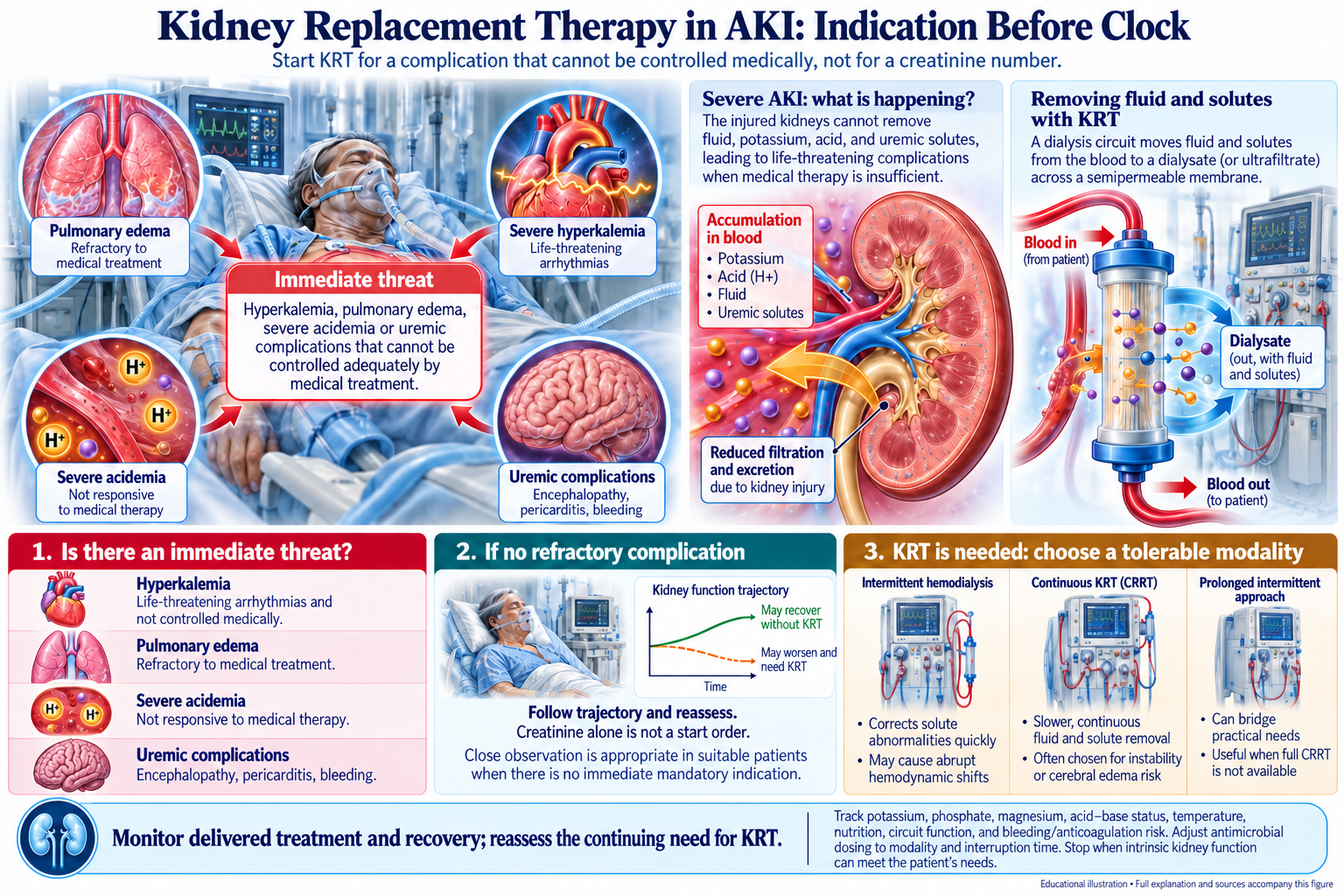
🚨 Indications for RRT Initiation (Deferred Strategy)
🔴 Absolute Indications
- Refractory fluid overload
- Refractory hyperkalemia
- Severe metabolic acidosis (refractory to medical therapy)
- Uremic complications — encephalopathy, pericarditis, bleeding
⚠️ Special Situations
- Consider CRRT for hepatic encephalopathy ≥grade 2 with hyperammonemia even without conventional AKI indications
- Time-limited trial of RRT can be started if uremic/metabolic complications are plausibly confounding neurological evaluation (PP 5.1.5)
🔄 RRT Modality Selection
| Feature | CRRT | IRRT (IHD) | PIRRT (SLED) | Acute PD |
|---|---|---|---|---|
| Hemodynamic Stability | Best | Worst | Good | Good |
| Solute Clearance | Continuous | Intermittent high | Intermediate | Lower |
| Preferred For | Unstable, brain injury, liver failure | Stable patients | Alternative to CRRT | Resource-limited, select peds |
| Anticoagulation | Citrate preferred | UFH / LMWH | UFH / LMWH | None |
📋 Key Modality Recommendations
💉 RRT Dose-Intensity
CRRT Dose (Rec 5.3.1, 1B)
Effluent volume target
Use ideal or adjusted body weight for BMI ≥30
IRRT / PIRRT Dose (Rec 5.3.1, 1B)
Minimum delivered dose target
Review adequacy before each IRRT session
Acute Peritoneal Dialysis
18–24 L PD fluid per day
Review adequacy daily for CRRT, before each IRRT session
🚫 AGAINST High-Volume Hemofiltration (HVHF) in Sepsis (Rec 5.3.2, 1B)
KDIGO 2026 draft recommends against high-volume hemofiltration (>35–45 mL/kg/h) in sepsis and septic shock.
- HVHF was proposed to remove inflammatory cytokines in sepsis
- Evidence does NOT support a mortality benefit
- IVOIRE trial: No survival benefit with HVHF vs. standard dose
- ATN trial: Intensive dose (35 mL/kg/h) = standard dose (20 mL/kg/h)
- RENAL trial: Higher intensity CRRT did not reduce mortality
- Increased electrolyte losses (hypokalemia, hypophosphatemia)
- Enhanced antibiotic clearance → subtherapeutic levels
- Greater nursing workload and cost
🩸 Vascular Access for RRT
📋 Catheter Management
- Use standardized care bundles for catheter insertion and maintenance
- No routine or scheduled catheter changes
- Replace poorly performing catheters via new venipuncture or guidewire exchange (individualize decision)
🔌 AV Fistula / Graft Use
- Existing AV fistulas and grafts are suitable for IRRT
- AVOID using AV access for CRRT — dislodgement risk with continuous use
🔄 Tunneled Catheter Transition
- Transition to tunneled dialysis catheter if low probability of AKI resolution
- Also consider when preparing for discharge with ongoing RRT need
💊 Anticoagulation for RRT
🧪 Regional Citrate (Preferred for CRRT)
- Chelates calcium in the circuit → prevents clotting
- Calcium infused separately to patient
- Longer circuit life vs. heparin
- Lower bleeding risk
- Also preferred in HIT (PP 5.5.5)
💉 Alternatives When Citrate Contraindicated
- Unfractionated heparin (UFH)
- Epoprostenol (prostacyclin)
- Nafamostat (serine protease inhibitor)
🩸 Heparin-Induced Thrombocytopenia (HIT)
- Argatroban (direct thrombin inhibitor)
- Danaparoid
- Bivalirudin
- Regional citrate also preferred in HIT (PP 5.5.5)
🧫 Hemofilters & Solutions
🧬 Membrane Selection
- Use biocompatible membranes
- Synthetic membranes (polysulfone, polyethersulfone) preferred
⏳ Maximize Circuit Life (Non-Pharmacologic)
- Optimal catheter tip position — right atrium
- Use predilution mode when possible
- Prefer CVVHD or CVVHDF over CVVH (convection-only modes clot faster)
🧪 Solution Specifications
- Bicarbonate buffer (not lactate) in shock, liver failure, lactic acidemia
- Use sterile CRRT solutions
- Use AAMI-compliant solutions for IRRT
✅ RRT Discontinuation
Discontinue RRT when kidney function is adequate for clinical needs, or per patient/family preference aligned with goals of care.
📊 Predictors of Successful Discontinuation
💊 Diuretics Around Discontinuation
- Diuretics may augment urine output
- However, diuretics are NOT proven to facilitate AKI resolution
- Use for volume management, not to "kick-start" kidneys
🎯 Key Learning Points — RRT in AKI
⏱️ Timing
- Deferred strategy preferred (STARRT-AKI, AKIKI, IDEAL-ICU)
- Initiate for refractory complications, not arbitrary thresholds
- Plan ahead if RRT likely needed
- Shared decision-making essential
🔄 Modality
- CRRT for hemodynamic instability, brain injury, liver failure
- PIRRT is acceptable alternative to CRRT
- Transition CRRT → IRRT when stable
- PD for resource-limited settings
💉 Dose & Anticoagulation
- CRRT: 20–25 mL/kg/h (standard, not high-volume)
- HVHF does NOT improve outcomes in sepsis
- Regional citrate preferred for CRRT
- Bicarbonate buffer in shock and liver failure
✅ Discontinuation
- UOP >450 mL/24h (no diuretics) predicts success
- 2h CrCl ≥23 mL/min also predictive
- Diuretics augment UOP but don't resolve AKI
- Tunneled catheter if prolonged need expected