Visual reference
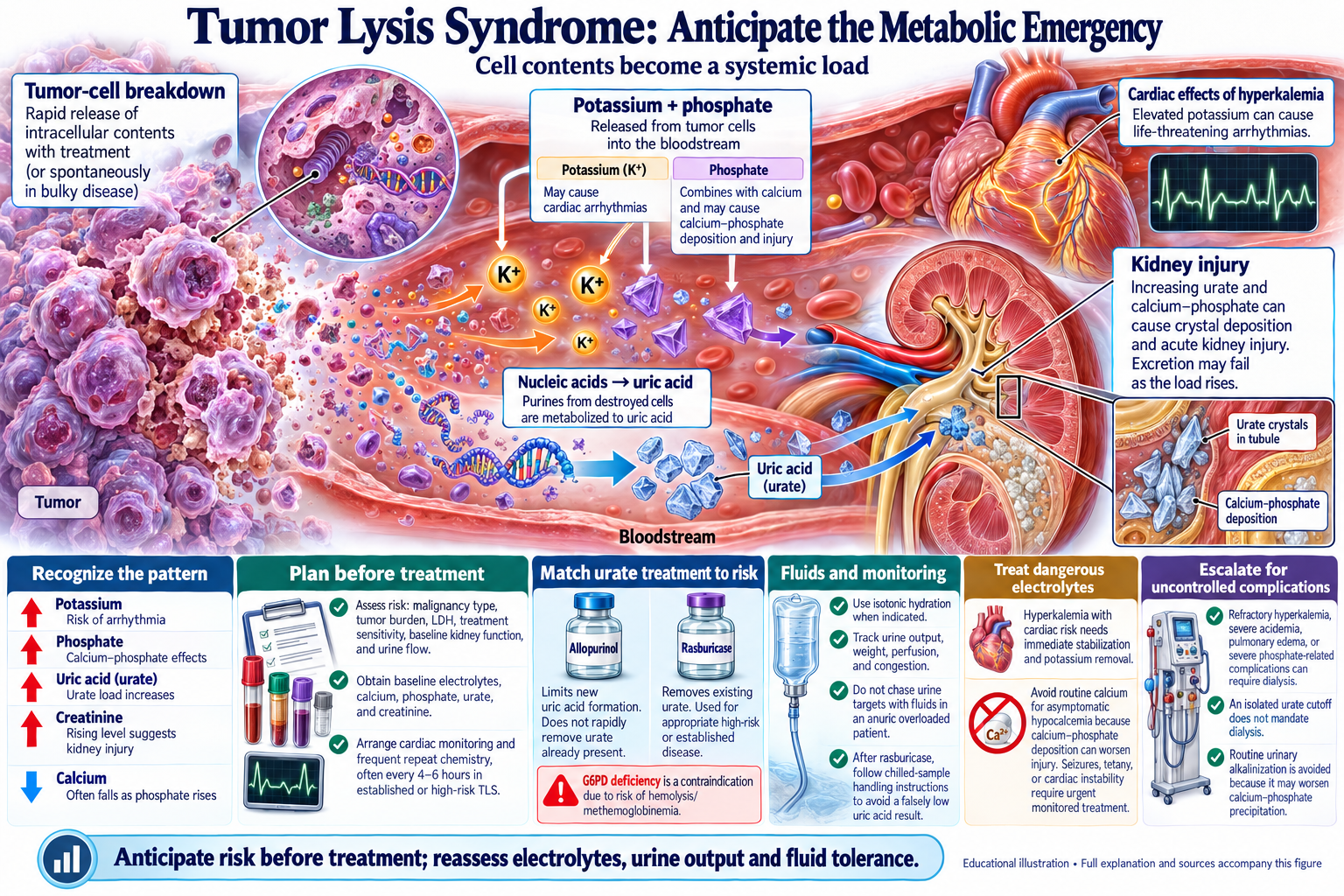
Browse the visual reference library · Download lesson Markdown
🧬 Tumor Lysis Syndrome
A life-threatening oncologic emergency requiring immediate recognition and intervention
🚨 CRITICAL RECOGNITION ALERT
TLS kills through hyperkalemia-induced cardiac arrest. This is a time-sensitive emergency where delay in recognition and treatment can be fatal within hours.
🚨 Immediate Action Required If:
- Recent chemotherapy (0-7 days) in high-risk patient
- Potassium >6.0 mEq/L with cardiac changes
- Rising creatinine with electrolyte abnormalities
- Oliguria or anuria post-chemotherapy
- Neurological changes (confusion, seizures)
🧬 Definition & Pathophysiology
Tumor Lysis Syndrome (TLS) is a constellation of metabolic abnormalities that result from the rapid breakdown of tumor cells, leading to the release of intracellular contents into circulation.
💥 Cellular Destruction
Trigger: Chemotherapy, radiation, or spontaneous tumor breakdown
- Massive cell lysis releases intracellular contents
- High-grade malignancies most susceptible
- Peak risk 12-72 hours post-treatment
- Can occur spontaneously in rapidly growing tumors
🧪 Metabolic Consequences
The "Big Four" Abnormalities:
- Hyperuricemia: Purine metabolism → uric acid
- Hyperkalemia: Release of intracellular K+
- Hyperphosphatemia: DNA/RNA breakdown
- Hypocalcemia: Ca-PO4 precipitation
🫘 Kidney Injury Mechanisms
Multiple pathways leading to AKI:
- Uric acid crystalluria: Tubular obstruction
- Calcium-phosphate precipitation: Nephrocalcinosis
- Volume depletion: Poor oral intake, vomiting
- Direct cytotoxic effects: Inflammatory cascades
⚡ Life-Threatening Complications
Immediate threats to life:
- Cardiac arrhythmias: Hyperkalemia (most common cause of death)
- Seizures: Hypocalcemia, uremia
- Acute kidney injury: Requiring dialysis
- Multi-organ dysfunction: Electrolyte chaos
📊 Cairo-Bishop Classification Criteria
Gold standard for TLS diagnosis - distinguishes laboratory TLS from clinical TLS
🧪 Laboratory TLS Criteria
Two or more of the following within 3 days before or 7 days after chemotherapy:
| Parameter | Laboratory TLS Threshold | Clinical Significance | Normal Range |
|---|---|---|---|
| Uric Acid | ≥8 mg/dL OR 25% increase | Crystal formation, AKI risk | 2.4-6.0 mg/dL |
| Potassium | ≥6.0 mEq/L OR 25% increase | Cardiac arrhythmias, death | 3.5-5.0 mEq/L |
| Phosphorus | ≥4.5 mg/dL OR 25% increase | Ca-PO4 precipitation | 2.5-4.5 mg/dL |
| Calcium | ≤7 mg/dL OR 25% decrease | Neuromuscular irritability | 8.5-10.5 mg/dL |
🏥 Clinical TLS Criteria
Laboratory TLS PLUS one or more of the following:
🫘 Acute Kidney Injury
- Creatinine ≥1.5× upper limit of normal
- Rising creatinine from baseline
- Oliguria or anuria
⚡ Cardiac Arrhythmia
- New arrhythmias
- ECG changes (peaked T waves)
- Sudden cardiac death
🧠 Seizures
- Hypocalcemia-induced
- Uremia-related
- Electrolyte imbalance
🎯 TLS Risk Stratification
Risk assessment guides prevention strategies and monitoring intensity
🔴 HIGH RISK (15-20% incidence)
🩸 Hematologic Malignancies
- Burkitt lymphoma (highest risk)
- Acute lymphoblastic leukemia with WBC >100,000
- High-grade NHL with bulky disease
- Acute myeloid leukemia with WBC >100,000
📊 High-Risk Features
- WBC count >100,000/μL
- LDH >2× upper normal
- Bulky disease (>10 cm lymph nodes)
- Elevated baseline uric acid (>7.5 mg/dL)
🟡 INTERMEDIATE RISK (1-5% incidence)
🎗️ Hematologic
- NHL with LDH <2× normal
- ALL with WBC <100,000
- AML with WBC 25,000-100,000
- CLL with bulky disease
🦴 Solid Tumors
- Germ cell tumors (testicular, ovarian)
- Small cell lung cancer
- Breast cancer with high proliferation
- Neuroblastoma in children
🟢 LOW RISK (<1% incidence)
🎗️ Hematologic
- Multiple myeloma
- CLL without bulky disease
- Low-grade lymphomas
- Hodgkin lymphoma
🦴 Most Solid Tumors
- Colon cancer
- Lung adenocarcinoma
- Renal cell carcinoma
- Most carcinomas
🧪 Laboratory Interpretation & Clinical Correlations
📈 Typical Laboratory Timeline
| Parameter | Peak Time | Critical Values | Clinical Significance | Emergency Action |
|---|---|---|---|---|
| Uric Acid | 6-12 hours | >12 mg/dL | AKI, crystal formation | Rasburicase immediately |
| Potassium | 12-24 hours | >6.5 mEq/L | Fatal arrhythmias | Cardiac monitoring, stabilization |
| Phosphorus | 24-48 hours | >6.5 mg/dL | Ca-PO4 precipitation | Phosphate binders, avoid calcium |
| Calcium | 24-72 hours | <7.0 mg/dL | Neuromuscular irritability | Careful calcium replacement |
| Creatinine | 24-72 hours | 2× baseline | Oliguric AKI | Nephrology consultation, consider RRT |
🚨 Critical Laboratory Alert Values
⚡ Hyperkalemia Emergency Management Protocol
Hyperkalemia is the most immediately life-threatening complication of TLS
IMMEDIATE ASSESSMENT (0-5 minutes)
- 12-lead ECG immediately - Look for peaked T waves, widened QRS
- Confirm K+ level - Repeat if >6.5 mEq/L
- Continuous cardiac monitoring
- IV access - Large bore for emergency medications
MEMBRANE STABILIZATION (5-10 minutes)
- Calcium gluconate 1-2 grams IV (10-20 mL of 10% solution)
- Onset: 1-3 minutes, Duration: 30-60 minutes
- May repeat every 5-10 minutes if persistent ECG changes
- Does NOT lower K+ but prevents arrhythmias
POTASSIUM SHIFTING (10-30 minutes)
- Insulin 10 units IV + D50 25 grams IV (if glucose <250 mg/dL)
- Albuterol 10-20 mg via nebulizer (or 0.5 mg IV if available)
- Sodium bicarbonate 50 mEq IV (if acidotic, pH <7.20)
- Effect: 0.5-1.0 mEq/L K+ reduction, Duration: 4-6 hours
POTASSIUM ELIMINATION (30+ minutes)
- Sodium zirconium cyclosilicate (Lokelma) 10 g PO (preferred)
- Patiromer (Veltassa) 25.2 g PO (alternative)
- Sodium polystyrene sulfonate (older agent, GI concerns)
- Urgent dialysis assessment for severe or refractory hyperkalemia; stabilize and shift potassium promptly while arranging definitive removal
⚠️ Special Considerations in TLS
- Hyperkalemic ECG changes require immediate IV calcium, even with hyperphosphatemia. Avoid routine calcium replacement for asymptomatic hypocalcemia because of calcium-phosphate precipitation. TLS review
- Monitor glucose closely - Insulin can cause severe hypoglycemia
- Serial K+ monitoring - Every 1-2 hours until <6.0 mEq/L
- Early dialysis consideration - Don't wait for refractory hyperkalemia
💊 Rasburicase (Urate Oxidase) Therapy
Revolutionary treatment for hyperuricemia - Rapidly converts uric acid to allantoin
🧬 Mechanism of Action
- Recombinant urate oxidase enzyme
- Converts uric acid → allantoin
- Allantoin 5-10× more soluble than uric acid
- Bypasses purine catabolism pathway
- Produces H2O2 as byproduct
🎯 Indications
- High-risk TLS prevention
- Treatment of established TLS
- Uric acid >8 mg/dL with clinical TLS
- Failed allopurinol therapy
- Contraindication to allopurinol
💉 Dosing & Administration
- FDA-label dose: 0.2 mg/kg IV daily for up to 5 days (Elitek package insert)
- Single-dose / weight-based abbreviated regimens (e.g., flat 3 mg, 6 mg, or 7.5 mg) are off-label dose-finding strategies — not an FDA maximum
- Dilute in 50 mL normal saline
- Infuse over 30 minutes
- Repeat daily as needed; reassess uric acid before each dose
⚡ Clinical Effects
- Onset: 4 hours
- Peak effect: 4-24 hours
- Uric acid reduction: 85-95%
- Duration: 12-24 hours
- Superior to allopurinol
🚨 Critical Contraindications
❌ Absolute Contraindications
- G6PD deficiency (risk of severe hemolysis)
- Pregnancy (safety not established)
- Previous severe hypersensitivity
⚠️ Relative Contraindications
- History of asthma (bronchospasm risk)
- History of atopy (hypersensitivity risk)
- Previous allergic reactions
🧪 G6PD Deficiency - Critical Safety Alert
- Mechanism: H2O2 byproduct causes oxidative stress in G6PD-deficient RBCs
- Result: Severe hemolysis, methemoglobinemia, can be fatal
- Testing: G6PD level MUST be checked before first dose
- Prevalence: 10-15% African males, Mediterranean populations
- Alternative: Allopurinol + aggressive hydration if G6PD deficient
📊 Monitoring Parameters
- G6PD level (mandatory)
- Baseline uric acid
- CBC with hemolysis markers
- Methemoglobin level
- Uric acid at 4 hours
- CBC for hemolysis
- LDH, haptoglobin
- Methemoglobin if indicated
⚠️ Lower-Risk TLS Management (KDIGO 2026 draft PP 3.7.2)
When rasburicase is contraindicated (G6PD deficiency) or inaccessible, xanthine oxidase inhibitors (allopurinol or febuxostat) may be used as alternative urate-lowering therapy for TLS prevention and treatment.
- Allopurinol 300-600 mg/day: Blocks new uric acid production (does NOT break down existing uric acid)
- Febuxostat: Alternative xanthine oxidase inhibitor, may be used when allopurinol is not tolerated
- Key limitation: These agents only prevent NEW uric acid formation — they cannot reduce already-elevated uric acid levels like rasburicase
🩺 Renal Replacement Therapy (RRT) in TLS
Early consideration of RRT can be life-saving - Don't wait for traditional dialysis indications
🚨 Absolute Indications
- Refractory hyperkalemia (K+ >6.5 mEq/L despite treatment)
- Life-threatening arrhythmias
- Severe acidosis (pH <7.20)
- Volume overload with pulmonary edema
- Uremic complications (encephalopathy, pericarditis)
⚠️ Relative Indications
- Creatinine >4 mg/dL with oliguria
- Phosphorus >8 mg/dL
- Symptomatic hypocalcemia with high PO4
- Persistent severe TLS with worsening AKI or uncontrolled complications despite appropriate treatment; an isolated urate concentration is not an automatic dialysis indication
- Multiple electrolyte abnormalities
🎯 Modality Selection
- CRRT preferred if hemodynamically unstable
- Intermittent HD if stable and urgent correction needed
- Higher efficiency for rapid electrolyte correction
- Avoid rapid fluid/osmolality changes
📊 Monitoring During RRT
- Electrolytes every 2-4 hours
- Continuous cardiac monitoring
- Phosphorus removal rate
- Volume status assessment
- Calcium-phosphate product
💡 RRT Clinical Pearls for TLS
- Early intervention is better than late: Consider RRT when 2+ absolute indications present
- Phosphorus is poorly dialyzed: Use phosphate-free dialysate, consider extended treatments
- Calcium supplementation during dialysis: Monitor Ca×PO4 product carefully
- Rebound phenomenon: Electrolytes may worsen after stopping RRT
- Duration: Usually 2-7 days until kidney recovery and tumor response
🛡️ TLS Prevention Strategies
Prevention is superior to treatment - Risk stratification guides intervention intensity
🔴 High-Risk Prevention
- Rasburicase 0.2 mg/kg IV - Start before chemotherapy
- Aggressive IV crystalloid hydration: 3-4 L/day (if tolerated)
- No urinary alkalinization (KDIGO 2026 draft PP 3.7.1)
- Intensive monitoring: Q6-8h electrolytes
- Nephrology consultation before treatment
- Admit to monitored setting (ICU/step-down)
🟡 Intermediate-Risk Prevention
- Allopurinol 300-600 mg daily
- Adequate hydration: 2-3 L/day
- Monitor electrolytes Q12h × 48h
- Rasburicase if lab TLS develops
- Avoid nephrotoxic agents
- Consider inpatient monitoring
🟢 Low-Risk Prevention
- Maintain hydration: 1.5-2 L/day
- Monitor electrolytes at 24-48h
- Consider allopurinol if bulky disease
- Patient education on warning signs
- Outpatient monitoring acceptable
💧 Volume Expansion Protocol (KDIGO 2026 draft PP 3.7.1)
- Intravenous crystalloids (normal saline or balanced crystalloid)
- Avoid potassium-containing fluids
- No sodium bicarbonate for alkalinization
- Urine output >2 mL/kg/hr
- Specific gravity <1.010
- Avoid volume overload
- Daily weights
- I/O balance
- Signs of CHF
⏰ TLS Monitoring Timeline
Structured monitoring approach based on risk stratification and clinical presentation
• Risk assessment and stratification • G6PD testing if rasburicase planned • Baseline labs: CBC, CMP, uric acid, LDH, phosphorus • Hydration initiation • Prophylactic therapy as indicated
• Continuous cardiac monitoring if high-risk • Electrolytes at 4-6 hours • Urine output monitoring • Early signs assessment • Rasburicase if indicated
• Electrolytes Q6-8h if high-risk • Q12h if intermediate risk • Nephrology consultation if abnormal • Aggressive intervention for lab TLS • Monitor for clinical TLS development
• Peak risk for clinical complications • Q8-12h labs if stable • Daily weights and I/O • Assess for AKI development • RRT consideration if indicated
• Daily labs if improving • Q12-24h if stable • Monitor kidney recovery • Plan for discharge • Long-term nephrology follow-up
🧮 TLS Risk Assessment Calculator
Comprehensive risk stratification tool incorporating tumor factors, patient characteristics, and laboratory values
🎯 Essential TLS Learning Points
🚨 Emergency Recognition
- Hyperkalemia most immediately lethal
- Peak risk 12-72 hours post-chemo
- Cairo-Bishop criteria for diagnosis
- High-grade lymphomas highest risk
💊 Rasburicase Revolution
- Converts uric acid to soluble allantoin
- 85-95% uric acid reduction
- Contraindicated in G6PD deficiency
- Superior to allopurinol in high-risk
⚡ Emergency Management
- Calcium for membrane stabilization
- Insulin/D50 + albuterol for K+ shifting
- Give IV calcium immediately for hyperkalemic ECG changes regardless of phosphate. Avoid routine calcium for asymptomatic hypocalcemia. Source
- Early RRT saves lives
🛡️ Prevention Focus
- Risk stratification guides prevention
- Aggressive hydration essential
- Prophylactic rasburicase in high-risk
- Prevention superior to treatment
🩺 RRT Indications
- Refractory hyperkalemia absolute
- CRRT preferred if unstable
- Early initiation better than late
- Phosphorus poorly dialyzed
📊 Clinical Pearls
- Laboratory vs clinical TLS distinction
- Ca×PO4 product >70 dangerous
- Tumor burden predicts risk
- Multidisciplinary approach essential