Visual reference
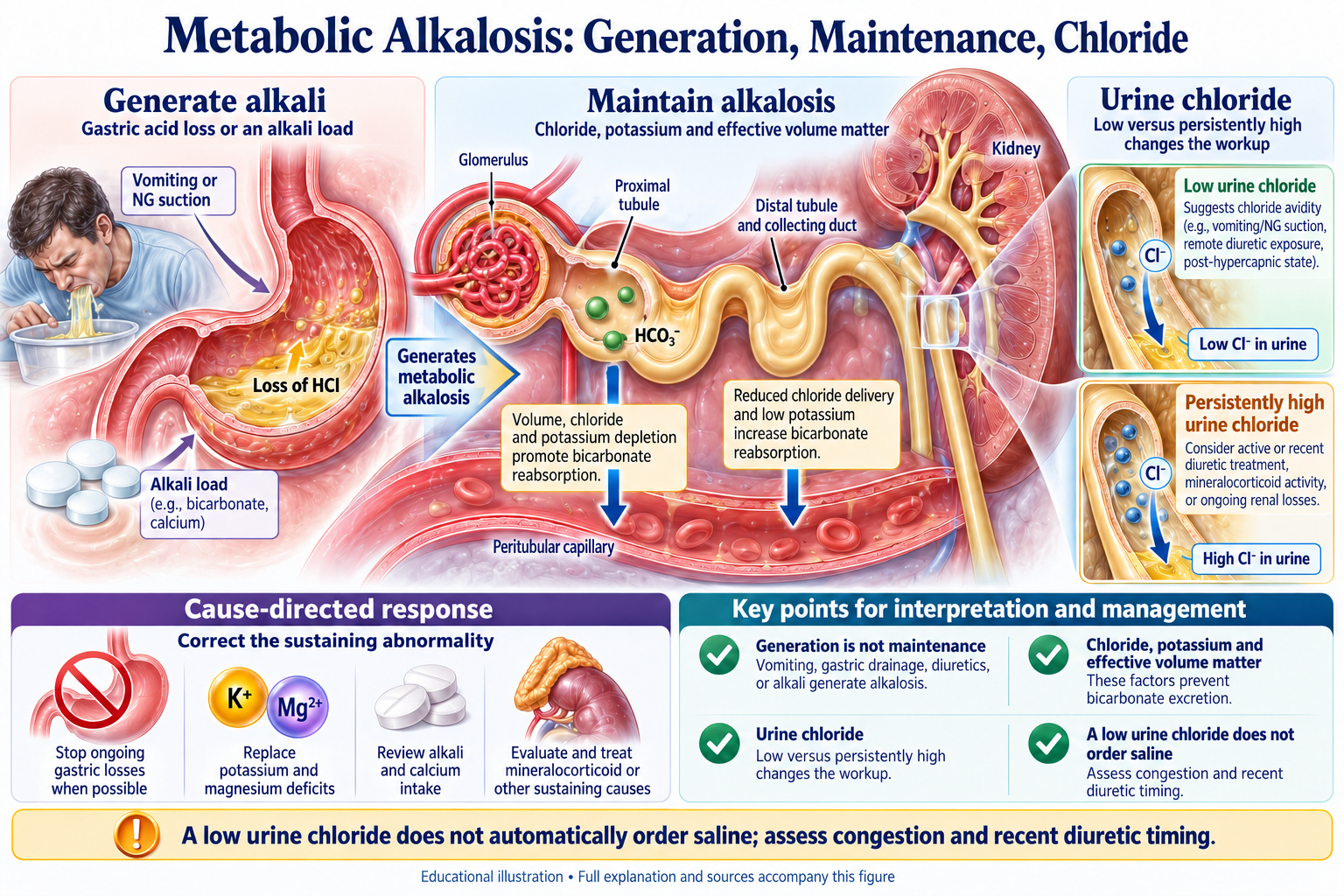
Browse the visual reference library · Download lesson Markdown
📊 Metabolic Alkalosis: Definition & Recognition
Diagnostic Criteria
HCO₃⁻ > 26 mEq/L + pH > 7.40
Mild Alkalosis
HCO₃⁻ 26-30 mEq/L
pH 7.40-7.45
Moderate Alkalosis
HCO₃⁻ 30-40 mEq/L
pH 7.45-7.55
Severe Alkalosis
HCO₃⁻ > 40 mEq/L
pH > 7.55
⚠️ Clinical Consequences
Cardiovascular
- Arrhythmias (especially with hypokalemia)
- Coronary vasoconstriction
- Increased digitalis toxicity
Neurological
- Altered mental status
- Seizures (severe cases)
- Muscle cramps and weakness
Metabolic
- Hypokalemia (almost universal)
- Hypocalcemia (ionized)
- Hypomagnesemia
- Hypophosphatemia
🔬 Pathophysiology: Generation vs Maintenance
🔬 Two-Step Process
1. Generation of Alkalosis
- Net acid loss (vomiting, gastric suction)
- Net alkali gain (bicarbonate, citrate)
- Contraction around fixed bicarbonate
- Kidney generates new bicarbonate
2. Maintenance of Alkalosis
- Volume depletion → ↑ sodium reabsorption
- Chloride depletion → non-Cl⁻ anion reabsorption
- Hypokalemia → ↑ H⁺ secretion
- Mineralocorticoid excess → ↑ H⁺ secretion
💧 Contraction Alkalosis: Key Mechanism
The Process:
- Volume loss (diuretics, vomiting) with relatively more sodium and chloride loss than bicarbonate
- ECF contraction concentrates the remaining bicarbonate
- Volume depletion stimulates renin-angiotensin system
- ↑ Aldosterone → ↑ sodium reabsorption with H⁺/K⁺ loss
- Hypokalemia → intracellular H⁺ shift and ↑ renal H⁺ secretion
- Chloride depletion → bicarbonate reabsorption instead of chloride
🔑 Urine Chloride: A Contextual Diagnostic Guide
Urine Chloride: Start with the Clinical Context
In confirmed metabolic alkalosis, urine chloride below 20 mEq/L supports a chloride-responsive pattern; 20 mEq/L or above directs attention to renal chloride loss or a chloride-resistant pattern. This is a practical classification threshold, not an absolute diagnostic or treatment rule. Active or recent diuretics can raise urine chloride despite volume and chloride depletion; interpret sampling time, blood pressure, volume status, potassium, and treatment history, and repeat when needed. Urine electrolyte cutoffs are not diagnostic in stage 4–5 CKD. Give saline only when volume assessment supports it; a low result alone does not justify fluid in a congested patient. Sources: Core Curriculum 2022; Cervantes et al., 2022; Merck Manual: metabolic alkalosis.
🔹 Urine Cl⁻ < 20 mEq/L
CHLORIDE-RESPONSIVE
Pathophysiology: Volume and/or chloride depletion
Kidney response: Conserving sodium and chloride
Treatment: Saline administration
Prognosis: Readily correctable
🔸 Urine Cl⁻ ≥Ð mEq/L
CHLORIDE-RESISTANT
Pathophysiology: Ongoing mineralocorticoid activity
Kidney response: Continuing to waste sodium and chloride
Treatment: Address underlying cause
Prognosis: Persistent until cause corrected
🔹 Chloride-Responsive (UCl < 20)
GI Losses
- Vomiting/gastric suction (most common)
- Villous adenoma
- Congenital chloridorrhea
- Cystic fibrosis
Previous Diuretic Use
- Loop diuretics (after effect wears off)
- Thiazide diuretics (after effect wears off)
- Post-hypercapnic alkalosis
Other Causes
- Low chloride intake (rare)
- Sweat losses with hypotonic fluid replacement
- Recovery from starvation
Mechanism: Provides volume and chloride, allowing kidney to excrete excess bicarbonate
🔸 Chloride-Resistant (UCl ≥Ð)
Hyperaldosteronism
- Primary hyperaldosteronism (Conn's syndrome)
- Adrenal adenoma
- Bilateral adrenal hyperplasia
- Glucocorticoid-remediable aldosteronism
Secondary Hyperaldosteronism
- Renal artery stenosis
- Malignant hypertension
- Renin-secreting tumor
- Renovascular disease
Other Causes
- Current diuretic use
- Bartter/Gitelman syndrome
- Severe hypokalemia (< 2.0 mEq/L)
- Hypercalcemia
- Hypermagnesemia
Note: Saline alone will NOT correct the alkalosis
🫁 Respiratory Compensation: The Protective Response
Expected Respiratory Response
For every 1 mEq/L ↑ in HCO₃⁻
pCO₂ ↑ by 0.7 mmHg
Normal Compensation
- Mechanism: Hypoventilation to retain CO₂
- Limitation: Limited by hypoxemic drive
- Maximum: pCO₂ rarely > 55 mmHg
- Time course: Hours to days
Inadequate Compensation
- Lung disease: COPD, restrictive disease
- CNS depression: Sedatives, neurologic disease
- Neuromuscular: Weakness, paralysis
- Mechanical ventilation: Fixed rate/volume
Contraction vs Compensation
Contraction Alkalosis:
- Primary problem: Volume/chloride loss
- Compensation: Appropriate respiratory response
- Treatment: Saline administration
vs Primary Respiratory Acidosis:
- Primary problem: CO₂ retention
- Compensation: Renal HCO₃⁻ generation
- Treatment: Improve ventilation
🧮 Interactive Metabolic Alkalosis Calculator
💊 Treatment Algorithms
🔹 Chloride-Responsive (UCl < 20) Treatment
Step-by-Step Treatment Protocol
- Calculate chloride deficit: 0.2 × weight(kg) × (103 - current Cl⁻)
- Give normal saline: Replace 50-75% of deficit over 12-24 hours
- Correct hypokalemia: Essential - often requires large amounts
- Correct hypomagnesemia: Must be >1.7 mg/dL for K⁺ correction
- Monitor response: UCl should increase >20 mEq/L when responding
Saline Therapy
- Mild alkalosis: 0.9% NaCl at maintenance rate
- Severe alkalosis: More aggressive replacement
- Monitor: Volume status, electrolytes q6-8h
- Endpoint: UCl ≥Ð mEq/L, normalizing HCO₃⁻
Potassium Replacement
- Preferred form: KCl (provides both K⁺ and Cl⁻)
- Severe depletion: May need 200-400 mEq total
- Rate: 10-20 mEq/hr max (central line)
- Goal: K⁺ >3.5 mEq/L for alkalosis correction
🔸 Chloride-Resistant (UCl ≥Ð) Treatment
Address Underlying Cause
- Hyperaldosteronism: Spironolactone, amiloride
- Current diuretics: Discontinue if possible
- Bartter/Gitelman: High-dose K⁺ and Mg²⁺ supplementation
- Severe hypokalemia: Aggressive K⁺ replacement
🚨 Severe Alkalosis (pH > 7.55) Emergency Treatment
Consider Acid Administration (Rare!)
- pH > 7.55 with life-threatening symptoms
- Inability to correct underlying cause rapidly
- Severe complications (arrhythmias, seizures)
HCl Administration
- Concentration: 150 mEq/L in D5W
- Route: Central line only
- Rate: 25-50 mEq/hr max
- Goal: Reduce HCO₃⁻ by 5-10 mEq/L
Alternative: Hemodialysis
- Low bicarbonate bath (< 25 mEq/L)
- Safer than acid infusion
- Consider for: Refractory cases
- Advantage: Also corrects volume overload
📋 Clinical Case Studies
Case 1: Pyloric Stenosis
Patient: 3-month-old infant with projectile vomiting
Labs: pH 7.52, HCO₃⁻ 38, pCO₂ 48, Na 135, K 2.1, Cl 88, UCl 5
Physical: Dehydrated, palpable "olive"
Analysis:
- Metabolic alkalosis with appropriate respiratory compensation
- UCl < 20 = chloride-responsive
- Severe hypokalemia and hypochloremia
- Classic presentation of pyloric stenosis
Treatment: IV fluids (NS), aggressive KCl replacement, surgical pyloromyotomy
Case 2: Primary Hyperaldosteronism
Patient: 45F with hypertension, muscle weakness
Labs: pH 7.48, HCO₃⁻ 32, pCO₂ 46, K 2.4, UCl 45
Additional: Aldosterone 35 ng/dL, PRA suppressed
Analysis:
- Metabolic alkalosis with hypertension
- UCl ≥Ð = chloride-resistant
- Severe hypokalemia
- Elevated aldosterone with suppressed PRA = primary hyperaldosteronism
Treatment: Spironolactone, aggressive K⁺ replacement, imaging for adenoma
Case 3: Post-Diuretic Alkalosis
Patient: 78M, CHF, on furosemide 80mg BID
Labs: pH 7.46, HCO₃⁻ 34, K 2.9, UCl 12 (24h after last dose)
Clinical: Volume depleted, stopped diuretics yesterday
Analysis:
- Contraction alkalosis from chronic diuretic use
- UCl now <20 (was >20 when on diuretics)
- Volume and chloride depletion
- Need to balance CHF management with alkalosis correction
Treatment: Careful saline administration, KCl, consider acetazolamide
🎯 Key Learning Points
Urine Chloride Needs Context
- UCl < 20: Volume/chloride depletion → Saline responsive
- UCl ≥Ð: Ongoing mineralocorticoid activity → Address cause
- Repeat UCl when medication timing or changing treatment obscures interpretation
- Remember timing: Check UCl when not on active diuretics
Contraction Alkalosis
- Volume loss concentrates existing bicarbonate
- Chloride depletion prevents bicarbonate excretion
- RAAS activation perpetuates the alkalosis
- Saline provides both volume and chloride for correction
Treatment Essentials
- Always correct hypokalemia and hypomagnesemia
- Chloride-responsive: Replace chloride and potassium; saline if volume depleted
- Chloride-resistant: Saline alone won't work
- Severe alkalosis (pH >7.55): Consider emergency measures