Visual reference
Browse the visual reference library · Download lesson Markdown
The Complete Skeleton Key Philosophy
Just as a skeleton key can open many locks, the BMP + Calcium + Magnesium + Phosphorus unlocks virtually all electrolyte disorders
➕ Essential Additions: Calcium, Magnesium & Phosphorus
8.5-10.5 mg/dL
Bone & nerve
1.7-2.6 mg/dL
The forgotten
2.5-4.5 mg/dL
Energy & CKD
- Calcium: Neuromuscular function
- Magnesium: Required for K+/Ca++ homeostasis
- Phosphorus: Cellular energy (ATP)
- Hypomagnesemia → refractory hypokalemia
- Calcium correction needs albumin
- Phosphorus → CKD-MBD complications
🎯 Systematic BMP Interpretation
1️⃣ Sodium (135-145 mEq/L)
- Water Balance Indicator: Reflects ADH activity
- Hyponatremia: Most common electrolyte disorder
- Hypernatremia: Free water deficit
- Key Test: Urine osmolality
- Clinical Context: Volume status crucial
2️⃣ Potassium (3.5-5.0 mEq/L)
- Cardiac Safety: Monitor ECG changes
- Hypokalemia: Check magnesium first!
- Hyperkalemia: Stabilize → Shift → Remove
- Medications: Major cause of abnormalities
- Muscle Function: Weakness, paralysis
3️⃣ Chloride (98-107 mEq/L)
- Anion Gap: Na - (Cl + CO2)
- Metabolic Alkalosis: Urine chloride key
- Volume Status: Tracks with sodium
- Diarrhea: Normal AG acidosis
- Diuretics: Chloride losses
4️⃣ CO2/Bicarbonate (22-28 mEq/L)
- Acid-Base Status: Metabolic component
- Acidosis: Low CO2, check anion gap
- Alkalosis: High CO2, check chloride
- Compensation: Respiratory response
- Critical Values: <15 or >35 concerning
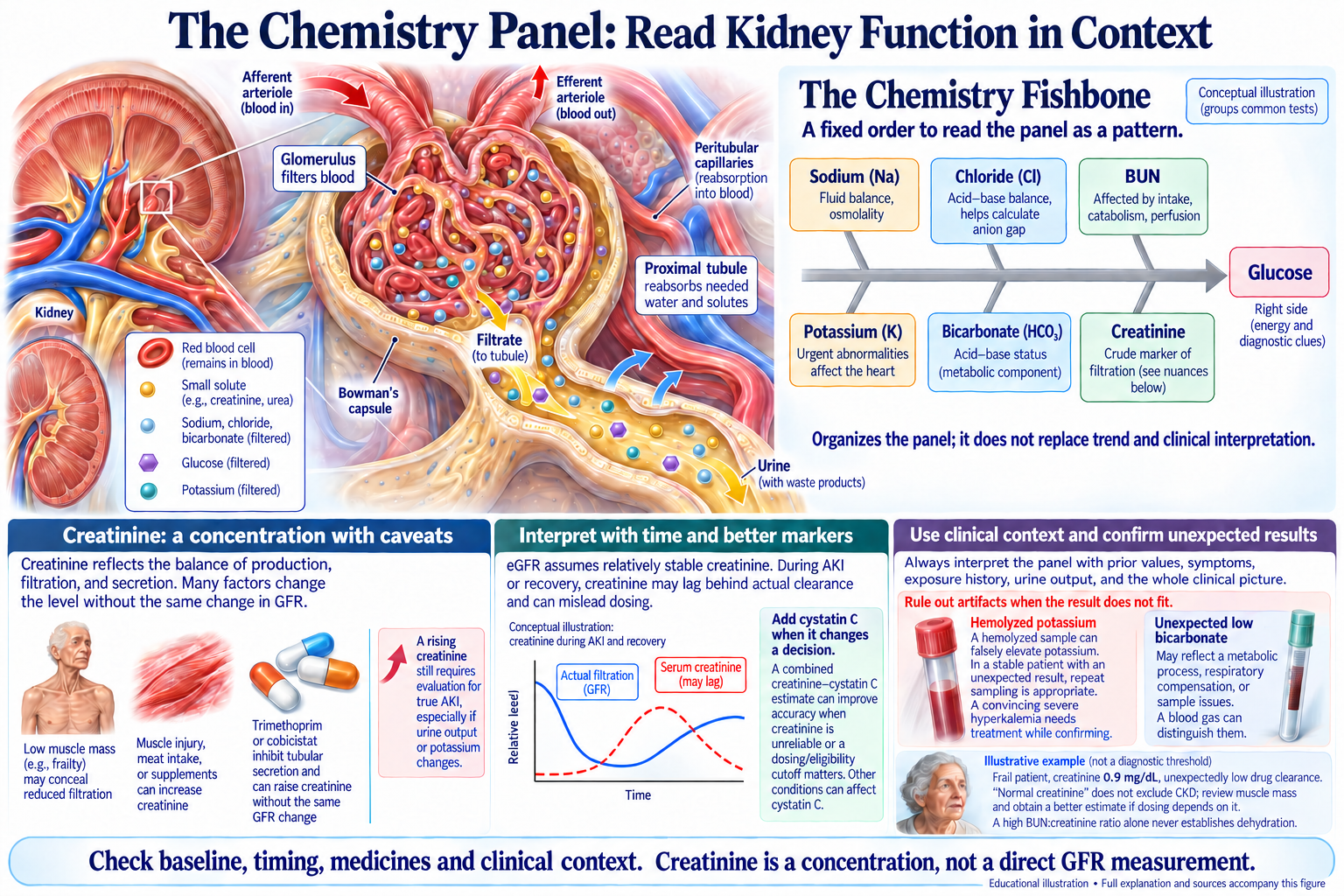
5️⃣ BUN/Creatinine
- Kidney Function: eGFR calculation
- BUN/Cr Ratio: >20 suggests prerenal
- Acute Changes: AKI evaluation
- Chronic Elevation: CKD staging
- Uremic Symptoms: BUN >100 mg/dL
6️⃣ Glucose (70-99 mg/dL)
- Osmotic Effects: Affects sodium levels
- Hyperglycemia: Osmotic diuresis
- DKA: High glucose + anion gap
- Hypoglycemia: Emergency treatment
- Steroid Effects: Drug-induced elevation
7️⃣ Calcium (8.5-10.5 mg/dL)
- Albumin Correction: Add 0.8 per 1g/dL albumin drop
- Hypocalcemia: Check magnesium first
- Hypercalcemia: Malignancy vs hyperparathyroidism
- Emergency Signs: Chvostek, Trousseau, QT changes
- Ca × PO₄ Product: Risk >55 mg²/dL²
8️⃣ Phosphorus (2.5-4.5 mg/dL)
- Cellular Energy: ATP production essential
- Hypophosphatemia: Refeeding syndrome risk
- Hyperphosphatemia: CKD most common cause
- Ca × PO₄ Product: Monitor for calcifications
- Associated Deficiencies: Often with Mg++, vitamin D
🔍 Clinical Decision Framework
🎯 The SKELETON KEY Approach
🔬 S - Systematic Review
- Look at ALL electrolytes, not just one
- Include magnesium in assessment
- Consider interactions between electrolytes
🩺 K - Kidney Function First
- eGFR affects electrolyte handling
- AKI changes treatment approach
- Adjust dosing for renal function
⚡ E - Emergency Assessment
- Life-threatening abnormalities first
- ECG for K+ abnormalities
- Neurologic symptoms for Na+ disorders
🧬 L - Laboratory Context
- Trending more valuable than single values
- Rule out lab errors (hemolysis)
- Consider timing of blood draw
🏥 E - Etiology Investigation
- Medication review essential
- Volume status assessment
- Underlying disease processes
📊 T - Treatment Planning
- Address most critical abnormality first
- Consider electrolyte interactions
- Monitor response to therapy
🔄 O - Ongoing Monitoring
- Serial measurements during treatment
- Adjust therapy based on response
- Prevent overcorrection
🎯 N - Next Steps
- Plan follow-up monitoring
- Address underlying causes
- Prevent future episodes
⚡ Emergency Priorities
🚨 Life-Threatening Electrolyte Abnormalities
⚡ Hyperkalemia
Critical: K+ >6.5 or ECG changes
Action: Calcium → Insulin/D50 → Remove
Timeline: Minutes matter
🌊 Severe Hyponatremia
Critical: Na+ <115 with symptoms
Action: 3% saline bolus (RIB protocol)
Timeline: Target symptom relief
🔻 Severe Hypocalcemia
Critical: Ca++ <7.0 with symptoms
Action: Calcium gluconate IV
Timeline: Seizure prevention
🔍 Severe Acidosis
Critical: pH <7.1 or HCO3 <10
Action: Address underlying cause
Timeline: Cardiovascular collapse risk
💡 Common Clinical Scenarios
🏥 Post-Operative Patient
- Hyponatremia: SIADH from pain, nausea
- Hypokalemia: Poor intake, IV fluids
- Hypomagnesemia: Often forgotten
- AKI: Hypotension, contrast, drugs
- Hyperglycemia: Stress, steroids
🏃 Heart Failure Patient
- Hyponatremia: Volume overload paradox
- Hypokalemia: Diuretic-induced
- Worsening Renal Function: Cardiorenal syndrome
- Medication Effects: ACE-I, diuretics
- Fluid Restriction: Concentrated abnormalities
🩺 ICU Patient
- Multiple Abnormalities: Complex interactions
- Medication Overload: Polypharmacy effects
- Nutritional Issues: Refeeding syndrome
- Stress Response: Hyperglycemia, Na+ retention
- Organ Dysfunction: Multi-system effects
👵 Elderly Patient
- Medication Sensitivity: Enhanced drug effects
- Volume Depletion: Poor thirst mechanism
- Polypharmacy: Drug interactions
- Comorbidities: CKD, DM, CHF common
- Frailty: Less physiologic reserve
🎓 Master the Basics, Handle the Complex
The BMP + Calcium + Magnesium + Phosphorus truly serves as your complete skeleton key to electrolyte disorders. Master the systematic approach to interpretation, understand the interactions between all electrolytes and minerals, and always consider the clinical context. With this comprehensive foundation, you'll be prepared to handle even the most complex electrolyte emergencies with confidence.