🚨 EMERGENCY HYPERCALCEMIA PROTOCOL (Ca++ ≥ 14 mg/dL)
⚡ IMMEDIATE (First Hour)
- Normal saline 200-300 mL/hr
- Calcitonin 4 IU/kg IM/SC q12h
- Monitor cardiac rhythm
- Neuro checks q2h
🏥 WITHIN 4-6 HOURS
- Bisphosphonate (zoledronic acid)
- Continue aggressive hydration
- Furosemide if volume overloaded
- Avoid thiazides and calcium
🔍 WORKUP PRIORITIES
- PTH level (stat)
- PTHrP if PTH suppressed
- 25-OH vitamin D, 1,25-OH vitamin D
- CBC, CMP, phosphorus
⚠️ Calcium >14 mg/dL is life-threatening - Treat aggressively! ⚠️
🎯 CRITICAL: Calcium >13 mg/dL = High Suspicion for MALIGNANCY
📊 Statistical Reality
- Ca++ >13 mg/dL: 80-90% malignancy
- Ca++ >14 mg/dL: >95% malignancy
- Inpatient hypercalcemia: Malignancy #1 cause
- Outpatient hypercalcemia: Primary hyperparathyroidism #1
🔬 Immediate Workup
- PTH level (should be suppressed)
- PTHrP (parathyroid hormone-related protein)
- Chest X-ray, CT chest/abdomen/pelvis
- Protein electrophoresis, SPEP/UPEP
- 25-OH and 1,25-OH vitamin D
🚨 Don't delay cancer workup when Ca++ >13 - Time is critical! 🚨
Visual reference
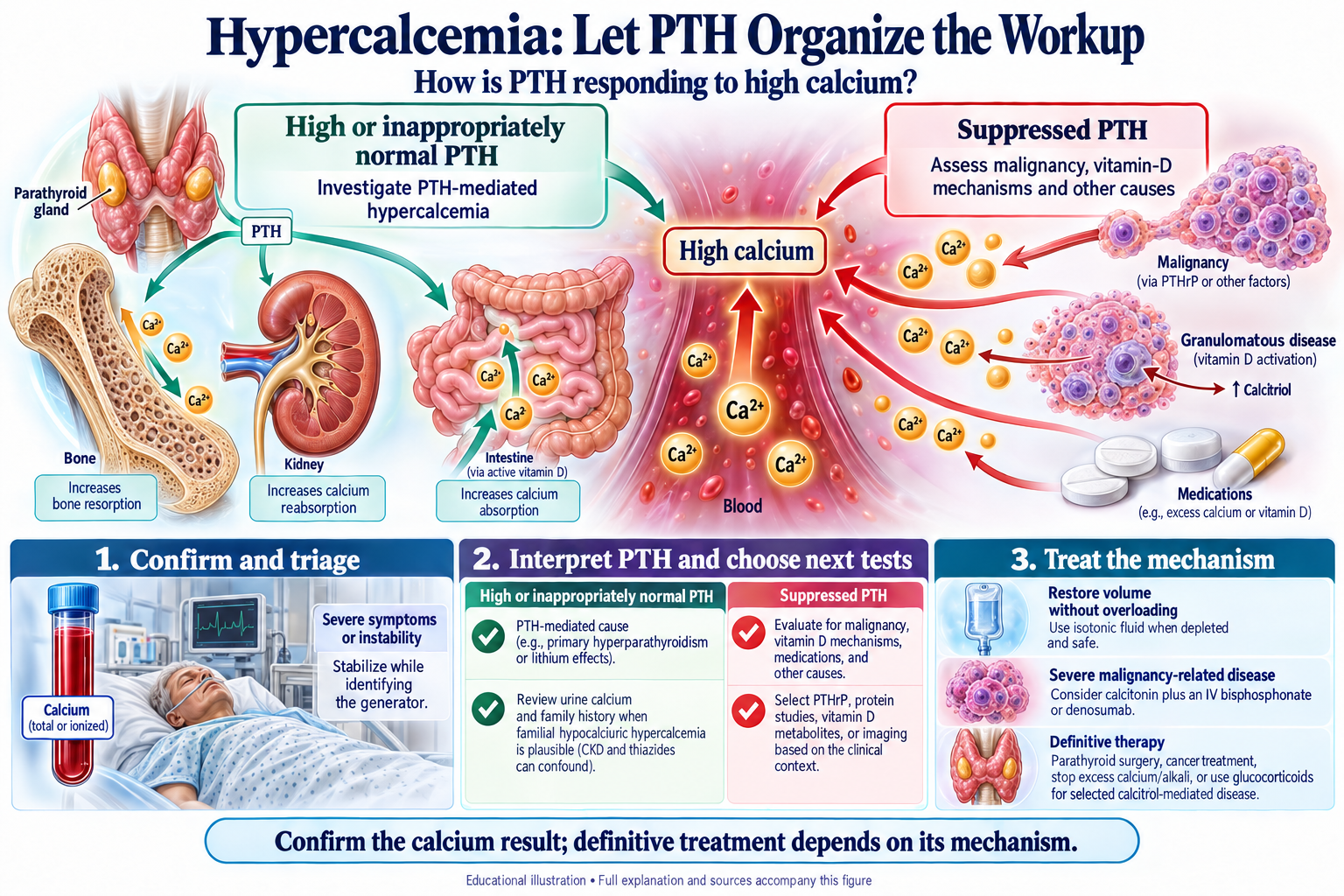
Browse the visual reference library · Download lesson Markdown
🔍 Diagnostic Approach: PTH-Dependent vs PTH-Independent
⚡ PTH-Guided Diagnostic Algorithm
📈 PTH ELEVATED or INAPPROPRIATELY NORMAL
PTH-Dependent Hypercalcemia
- Primary Hyperparathyroidism (85%):
- Adenoma (80-85%)
- Hyperplasia (10-15%)
- Carcinoma (<5%)
- Tertiary Hyperparathyroidism: CKD, post-transplant
- FHH (Familial Hypocalciuric Hypercalcemia):
- Check 24h urine calcium
- Ca/Cr clearance ratio <0.01
- Lithium-induced: Chronic lithium therapy
Next Step: Neck ultrasound, Tc-99m sestamibi scan
📉 PTH SUPPRESSED (<20 pg/mL)
PTH-Independent Hypercalcemia
- Malignancy (90% of cases):
- PTHrP-mediated (80%)
- Osteolytic metastases (20%)
- 1,25(OH)2D production (lymphoma)
- Granulomatous Diseases:
- Sarcoidosis, histoplasmosis
- Extra-renal 1α-hydroxylase
- Endocrine: Thyrotoxicosis, adrenal insufficiency
- Medications: Vitamin D, thiazides, calcium
Next Step: PTHrP, imaging for malignancy
🩸 Lymphoma-Associated Hypercalcemia: Comprehensive Analysis
🎯 Lymphoma Subtypes & Hypercalcemia Risk
🧬 HODGKIN LYMPHOMA
- Classical Subtypes: Nodular sclerosis (most common)
- Hypercalcemia Incidence: 10-15% of cases
- Reed-Sternberg Cells: Express CD30, CD15
- Cytokines: IL-1, TNF-α, IL-6 production
- Age Groups: Bimodal distribution (20s, >55y)
- B-symptoms: Fever, night sweats, weight loss
- Staging: Often localized at presentation
🧬 NON-HODGKIN LYMPHOMA
- High-Risk Subtypes: DLBCL, Burkitt, PTCL
- B-cell Lymphomas: 85% of NHL cases
- Hypercalcemia Rate: 5-20% depending on subtype
- Extra-nodal Disease: 40% have extra-nodal involvement
- Aggressive Course: Rapidly progressive
- CNS Involvement: Higher risk in aggressive subtypes
- Bone Marrow: Frequent involvement
🩸 ADULT T-CELL LEUKEMIA/LYMPHOMA (ATLL)
- HTLV-1 Associated: Retroviral oncogenesis
- Hypercalcemia Rate: 50-70% of acute/lymphoma types
- Geographic Distribution: Japan, Caribbean, South America
- Clinical Subtypes: Acute, lymphoma, chronic, smoldering
- PTHrP Production: Common mechanism
- Skin Lesions: Characteristic feature (70%)
- Prognosis: Poor (median survival 6-10 months)
🧬 BURKITT LYMPHOMA
- MYC Translocation: t(8;14), t(2;8), t(8;22)
- Hypercalcemia Rate: 10-25% of cases
- Variants: Endemic (Africa), sporadic, immunodeficiency
- Rapid Growth: Doubling time 24-48 hours
- EBV Association: Strong in endemic variant
- Tumor Lysis Risk: Very high with treatment
- CNS Involvement: 15-20% at presentation
🔬 Mechanism: Extra-Renal 1α-Hydroxylase in Lymphomas
Cellular Source
- Tumor-Associated Macrophages: M2 phenotype activation
- Lymphoma Cells: Direct 1α-hydroxylase expression
- Cytokine Milieu: IFN-γ, TNF-α, IL-2 upregulation
- CYP27B1 Gene: Upregulated in tumor microenvironment
Biochemical Pattern
- 25(OH)D: Normal or low (substrate consumption)
- 1,25(OH)2D: Markedly elevated (>100 pg/mL)
- PTH: Appropriately suppressed (<10 pg/mL)
- FGF23: May be elevated as compensatory response
📊 Clinical Presentation & Diagnostic Workup
🎯 Clinical Features
- Constitutional Symptoms: B-symptoms in 30-50%
- Lymphadenopathy: Mediastinal, abdominal, peripheral
- Organomegaly: Splenomegaly (40%), hepatomegaly (30%)
- Hypercalcemia Symptoms: Often early presentation
- Performance Status: Often decreased at presentation
- Age Distribution: Variable by subtype
🔬 Laboratory Workup
- Complete Metabolic Panel: Calcium, phosphorus, renal function
- PTH: Suppressed (<20 pg/mL)
- 25(OH)D & 1,25(OH)2D: Elevated 1,25 diagnostic
- Lactate Dehydrogenase: Often markedly elevated
- Uric Acid: May be elevated (tumor burden)
- Flow Cytometry: Blood and bone marrow
📷 Imaging Studies
- CT Chest/Abdomen/Pelvis: Staging assessment
- PET-CT: Gold standard for staging lymphoma
- Brain MRI: If CNS symptoms or high-risk histology
- Bone Marrow Biopsy: Staging for most subtypes
- Tissue Biopsy: Core needle or excisional
- Lumbar Puncture: High-risk cases (Burkitt, DLBCL)
⚗️ Molecular/Genetic Testing
- Immunohistochemistry: CD20, CD30, CD15, etc.
- Flow Cytometry: Surface markers, clonality
- Cytogenetics: Chromosomal translocations
- FISH Studies: MYC, BCL2, BCL6 rearrangements
- NGS Panels: Mutation analysis for prognosis
- HTLV-1 Testing: If T-cell lymphoma suspected
📊 Treatment Approach: Lymphoma-Associated Hypercalcemia
🚑 EMERGENCY MANAGEMENT
- Hydration: NS 200-300 mL/hr immediately
- Glucocorticoids: Prednisone 40-60 mg daily (first-line)
- Calcitonin: 4 IU/kg q12h (rapid effect)
- Bisphosphonates: Zoledronic acid 4mg IV
- Monitor Closely: Tumor lysis syndrome risk
- Dialysis: If severe hypercalcemia + renal failure
💊 STEROID THERAPY (PREFERRED)
- Mechanism: Suppresses extra-renal 1α-hydroxylase
- Dosing: Prednisone 40-60 mg daily
- Response Time: 24-72 hours typically
- Dual Benefit: Treats lymphoma AND hypercalcemia
- Monitoring: Blood glucose, infections
- Duration: Continue until chemotherapy initiated
🧬 LYMPHOMA-SPECIFIC THERAPY
- Hodgkin: ABVD, BEACOPP regimens
- DLBCL: R-CHOP or R-EPOCH
- Burkitt: Intensive regimens (R-CODOX-M/IVAC)
- ATLL: Combination therapy, often poor response
- Timing: Start within 48-72 hours if possible
- TLS Prophylaxis: Allopurinol, hydration, rasburicase
🚨 COMPLICATIONS & MONITORING
- Tumor Lysis Syndrome: High risk with treatment
- Renal Failure: From hypercalcemia or TLS
- CNS Involvement: Requires intrathecal therapy
- Hypercalcemic Crisis: Neurologic emergency
- Response Monitoring: Daily calcium, phosphorus
- Long-term: May need vitamin D supplementation
⚠️ CRITICAL PEARLS: Lymphoma Hypercalcemia
- 🔴 Glucocorticoids are FIRST-LINE therapy (unlike other hypercalcemia)
- 🔴 Dual mechanism: Treats both lymphoma and hypercalcemia
- 🔴 1,25(OH)2D elevation is diagnostic hallmark
- 🔴 High TLS risk: Prevent with allopurinol/rasburicase
- 🔴 Rapid progression: Don't delay systemic therapy
- 🔴 Poor prognosis: Especially with hypercalcemia at presentation
🔤 VITAMINS TRAP: Complete Hypercalcemia Differential
📚 VITAMINS TRAP: Comprehensive Hypercalcemia Mnemonic
🆅 - VITAMIN D INTOXICATION
- Excessive Supplementation: >50,000 IU daily
- 25(OH)D Level: >100 ng/mL (toxicity)
- 1,25(OH)2D: Elevated (conversion overload)
- Mechanism: ↑ intestinal Ca absorption
- Treatment: Stop vitamin D, glucocorticoids
🅸 - IMMOBILIZATION
- Paget's Disease: Especially with immobilization
- Young Patients: Spinal cord injury, fractures
- Bone Turnover: ↑ resorption vs formation
- Time Course: Weeks to months of bedrest
- Treatment: Early mobilization, bisphosphonates
🅣 - THIAZIDE DIURETICS
- Prevalence: 8-10% of patients
- Mechanism: ↑ distal Ca reabsorption
- Unmasking: May reveal hyperparathyroidism
- Reversible: Usually within days of stopping
- Testing: Stop drug, recheck in 2-4 weeks
🅰 - VITAMIN A INTOXICATION
- Chronic Toxicity: >25,000 IU daily for months
- Acute Toxicity: >300,000 IU single dose
- Symptoms: Hepatotoxicity, bone pain
- Mechanism: ↑ bone resorption
- Diagnosis: Elevated retinol levels
🅼 - MALIGNANCY
- PTHrP (80%): Squamous cell, lung, H&N, RCC
- Osteolytic (20%): Breast, multiple myeloma
- Lymphomas: Extra-renal 1α-hydroxylase
- Ca++ >13 mg/dL: 80-90% malignancy
- Prognosis: Median survival 2-3 months
🅸 - INTOXICATIONS
- Milk-Alkali Syndrome: Ca + absorbable alkali
- Aluminum Hydroxide: With Ca supplements
- Theophylline: Overdose (rare)
- Calcium Supplements: Excessive intake
- Lithium: Affects CaSR, ↑ PTH
🅽 - NEOPLASM (LYMPHOMAS)
- Hodgkin Lymphoma: Classical subtype
- Non-Hodgkin: B-cell lymphomas
- ATLL: HTLV-1 associated T-cell
- Mechanism: Macrophage 1α-hydroxylase
- 1,25(OH)2D: Markedly elevated
🆂 - SARCOIDOSIS & GRANULOMAS
- Sarcoidosis: 10-20% develop hypercalcemia
- Histoplasmosis: Ohio/Mississippi valleys
- Tuberculosis: Miliary TB especially
- Coccidioidomycosis: Southwest US
- Treatment: Glucocorticoids first-line
🅣 - THYROTOXICOSIS
- Prevalence: 20% of hyperthyroid patients
- Mechanism: ↑ bone resorption via osteoclasts
- T3/T4 Effects: Direct bone effects
- Reversible: With treatment of hyperthyroidism
- Mild: Usually Ca <12 mg/dL
🆁 - RENAL FAILURE
- Tertiary HPT: Autonomous parathyroid glands
- Post-Transplant: 30-50% develop hypercalcemia
- Aluminum Toxicity: In dialysis patients
- Recovery Phase: AKI with bone remineralization
- Treatment: Cinacalcet, parathyroidectomy
🅰 - ADRENAL INSUFFICIENCY
- Addison's Disease: Primary adrenal failure
- Mechanism: Volume depletion, ↓ renal excretion
- Associated: Hyperkalemia, hyponatremia
- Diagnosis: Cortisol stimulation test
- Treatment: Glucocorticoid replacement
🅿 - PRIMARY HYPERPARATHYROIDISM
- Adenoma (85%): Single gland disease
- Hyperplasia (15%): Multiple glands
- Carcinoma (<1%): Very rare
- PTH: Elevated or inappropriately normal
- Treatment: Parathyroidectomy (cure >95%)
🎯 VITAMINS TRAP Clinical Application
PTH-Independent Causes (PTH <20)
- Vitamin D, Vitamin A
- Malignancy (most common)
- Intoxications
- Neoplasm (lymphomas)
- Sarcoidosis & granulomas
- Thyrotoxicosis
- Adrenal insufficiency
PTH-Dependent Causes (PTH ≥20)
- Primary hyperparathyroidism
- Renal failure (tertiary HPT)
- Thiazide diuretics (unmasking)
- Immobilization (with hyperparathyroidism)
- FHH (Familial Hypocalciuric Hypercalcemia)
- Lithium-induced hyperparathyroidism
🔬 Comprehensive Laboratory Differential Diagnosis
Hypercalcemia laboratory patterns by mechanism
Read calcium, phosphate, alkaline phosphatase, both vitamin D metabolites, PTH and PTHrP together. Patterns vary with kidney function, assay, treatment and coexisting disease.
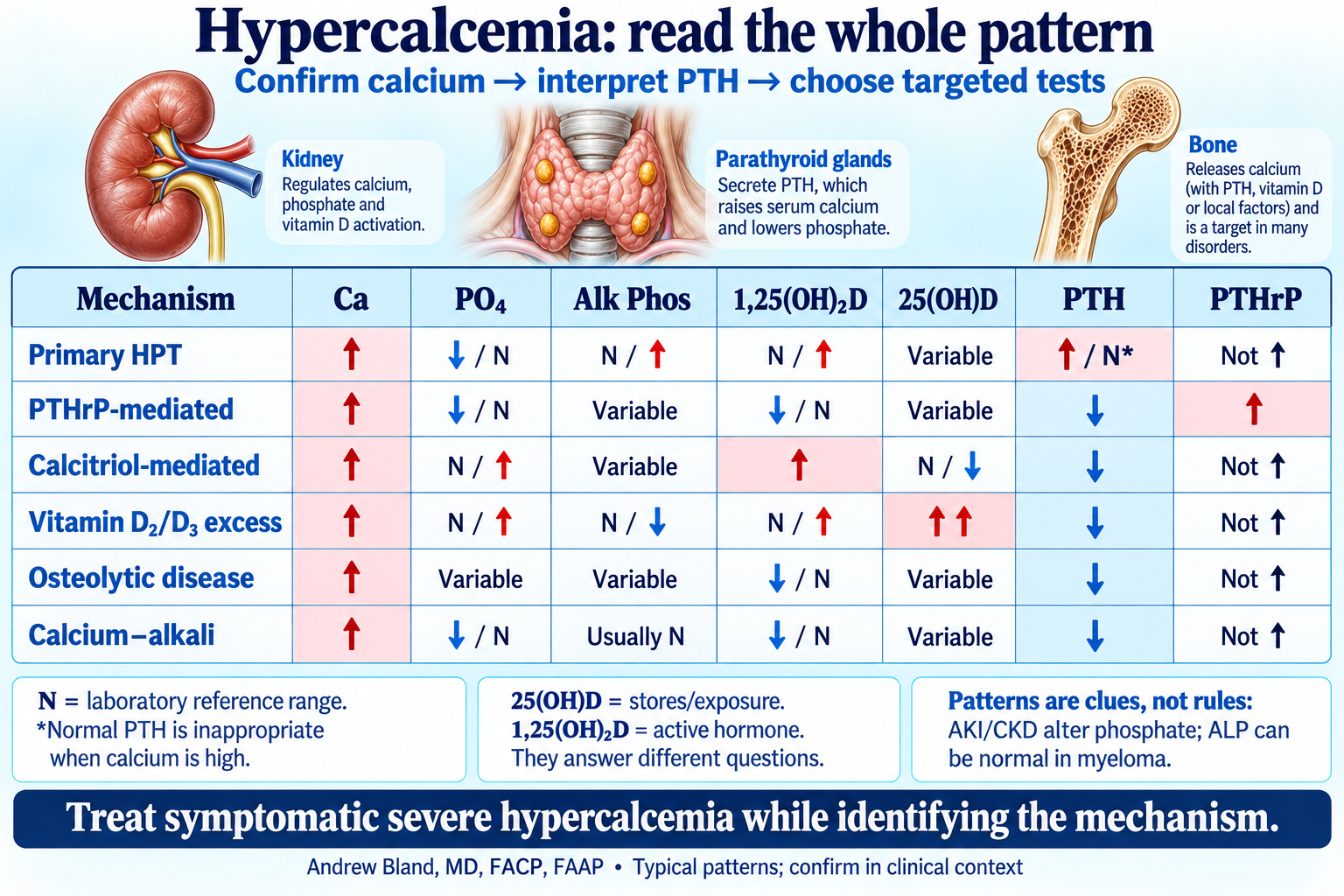
Ca, phosphate, alkaline phosphatase, both vitamin D metabolites, PTH and PTHrP.
| Mechanism | Ca | PO₄ | Alk Phos | 1,25(OH)₂D | 25(OH)D | PTH | PTHrP | Interpretation |
|---|---|---|---|---|---|---|---|---|
| Primary hyperparathyroidism | ↑ | ↓ or N | N or ↑ | N or ↑ | Variable | ↑ or inappropriately N | Not elevated | PTH should be suppressed by high calcium; check urine calcium in the appropriate setting. |
| PTHrP-mediated malignancy | ↑ | ↓ or N | Variable | ↓ or N | Variable | ↓ | ↑ | PTHrP mimics some PTH effects. An abnormal SPEP is not required. |
| Calcitriol-mediated disease | ↑ | N or ↑ | Variable | ↑ | N or ↓ | ↓ | Usually not elevated | Consider lymphoma or granulomatous disease; the lab pattern does not identify which. |
| Vitamin D₂/D₃ excess | ↑ | N or ↑ | N or ↓ | N or ↑ | Markedly ↑ | ↓ | Not elevated | Excess nutritional vitamin D raises 25(OH)D; active-vitamin-D medications are a different exposure. |
| Osteolytic malignancy / myeloma | ↑ | Variable | Variable; often N in myeloma | ↓ or N | Variable | ↓ | Usually not elevated | ALP can remain normal despite lytic lesions; evaluate monoclonal protein when indicated. |
| Calcium–alkali syndrome | ↑ | ↓ or N; affected by kidney function/intake | Usually N | ↓ or N | Variable | ↓ | Not elevated | Calcium/alkali exposure, alkalosis and AKI; medication history matters. |
| Tertiary hyperparathyroidism | ↑ | Often ↑ in advanced CKD; may fall after transplant | Variable | Variable; often low in advanced CKD | Variable | Markedly ↑ | Not elevated | Longstanding secondary HPT becomes autonomous; CKD alone does not prove this diagnosis. |
| Familial hypocalciuric hypercalcemia | Usually mildly ↑ | N or ↓ | Usually N | Variable | Variable | N or mildly ↑ | Not elevated | Lifelong/familial pattern and relative hypocalciuria; CKD, low vitamin D and thiazides confound urine calcium. |
Start with PTH in the context of calcium
A PTH inside its reference interval is not necessarily appropriate: high calcium should suppress it. A clearly suppressed PTH directs the workup toward PTH-independent causes. Use the assay and clinical context rather than a universal cutoff.
The vitamin D tests answer different questions
25-hydroxyvitamin D reflects stores and exposure. 1,25-dihydroxyvitamin D is the active hormone; an elevated value with suppressed PTH can suggest extrarenal production. A low 25-hydroxy level does not exclude calcitriol-driven hypercalcemia.
Phosphate and alkaline phosphatase are supporting clues
AKI and CKD can raise phosphate and blur a typical phosphaturic pattern. Total alkaline phosphatase includes liver and bone sources; normal ALP does not exclude myeloma or lytic bone disease. These tests help interpret a mechanism but cannot identify one alone.
The table is a pattern guide, not an order set
Not every patient needs all seven tests at once. Confirm calcium, assess symptoms and volume, interpret PTH, then choose PTHrP, vitamin D metabolites and monoclonal-protein testing as indicated. Mixed mechanisms and drug exposures can coexist.
Additional causes remain part of the differential
Thiazides can unmask primary hyperparathyroidism; lithium can shift calcium sensing. Vitamin A excess, immobilization, thyrotoxicosis, adrenal insufficiency and pediatric syndromes require the appropriate history and targeted tests. None has a single obligatory seven-test signature.
- ARUP Laboratories: hypercalcemia testing algorithm
- Fifth International Workshop: primary hyperparathyroidism (2022)
- Endocrine Society: hypercalcemia of malignancy guideline
- Society for Endocrinology: emergency management of acute hypercalcaemia
- Alkaline phosphatase in myeloma and solid cancers with bone lesions
- Vitamin D intoxication and hypercalcemia
🧬 PTHrP-Mediated Malignancy: Specific Cancer Types
🎯 Malignancies That Cause PTHrP Elevation
PTHrP (Parathyroid Hormone-Related Protein): Mimics PTH action, causing calcium reabsorption and phosphate wasting
🫁 Lung Cancers (40% of PTHrP)
- Squamous Cell: Most common overall
- Large Cell: High PTHrP production
- Adenocarcinoma: Less common but possible
- Small Cell: Rarely causes PTHrP
🦴 Head & Neck Cancers (20%)
- Squamous Cell: Oral, laryngeal, pharyngeal
- Salivary Gland: Adenoid cystic carcinoma
- Thyroid: Anaplastic, medullary (rare)
🏥 Genitourinary Cancers (15%)
- Renal Cell Carcinoma: Clear cell type
- Bladder Cancer: Squamous and transitional
- Ovarian: Clear cell, squamous
- Cervical: Squamous cell carcinoma
🔬 Other Malignancies (25%)
- Breast Cancer: Especially with bone mets
- Esophageal: Squamous cell type
- Skin: Squamous cell carcinoma
- Neuroendocrine: Pancreatic islet cell
🧪 PTHrP vs PTH Laboratory Differentiation
PTHrP-Mediated (Malignancy)
- PTH: Suppressed (<20 pg/mL)
- PTHrP: Elevated (>4.2 pmol/L)
- Phosphorus: Low (PTHrP mimics PTH)
- 1,25(OH)2D: Low or normal
- Alkaline phosphatase: Often elevated
Primary Hyperparathyroidism
- PTH: Elevated or inappropriately normal
- PTHrP: Normal (<4.2 pmol/L)
- Phosphorus: Low
- 1,25(OH)2D: High or high-normal
- 24h urine calcium: Elevated
🌿 Granulomatous Diseases & Lymphoma: Vitamin D Pathway
🔬 Extra-Renal 1α-Hydroxylase Activity
Mechanism: Activated macrophages and granuloma cells produce 1α-hydroxylase, converting 25(OH)D to active 1,25(OH)2D
🫁 Sarcoidosis (Most Common)
- 10-20% develop hypercalcemia
- 50% have hypercalciuria
- More common in summer (sun exposure)
- Bilateral hilar lymphadenopathy on CXR
- ACE level often elevated
🦠 Infectious Granulomas
- Histoplasmosis: Ohio/Mississippi valleys
- Coccidioidomycosis: Southwest US
- Tuberculosis: Especially miliary TB
- Blastomycosis: Great Lakes region
🩸 Lymphomas & Hematologic Malignancies
- Hodgkin Lymphoma: Classical nodular sclerosis subtype
- Aggressive B-cell NHL: DLBCL, Burkitt lymphoma
- Adult T-cell Leukemia/Lymphoma: HTLV-1 associated
- Plasmacytoma: Extra-medullary plasma cell tumor
- Prevalence: 10-25% of lymphoma patients
- Extra-nodal sites: GI, CNS, bone marrow
🧪 Laboratory Pattern
- PTH: Suppressed
- 25(OH)D: Normal or low
- 1,25(OH)2D: ELEVATED (key finding)
- Hypercalciuria prominent
- Nephrolithiasis common
💊 Treatment of Granulomatous Hypercalcemia
First-Line Therapy
- Corticosteroids: Prednisone 20-40 mg daily
- Mechanism: Suppresses 1α-hydroxylase
- Response: Usually within 7-10 days
- Duration: Taper slowly over weeks
Adjunct Measures
- Avoid sun exposure and vitamin D
- Low calcium diet (800-1000 mg/day)
- Treat underlying infection if present
- Monitor for steroid side effects
🦴 Clinical Manifestations: "Stones, Bones, Groans, and Psychiatric Moans"
🎯 Classic Symptom Complex by Calcium Level
🗿 STONES (Nephrolithiasis)
- Kidney Stones (20-30%): Calcium oxalate/phosphate
- Nephrocalcinosis: Calcium deposition in tubules
- Polyuria/Polydipsia: Nephrogenic diabetes insipidus
- Progressive CKD: From chronic hypercalciuria
- Mechanism: ↑ calcium excretion, ↓ concentrating ability
Occurs at Ca++ >11.5 mg/dL
🦴 BONES (Skeletal Effects)
- Osteoporosis: Especially in hyperparathyroidism
- Osteitis Fibrosa Cystica: "Brown tumors"
- Pathologic Fractures: Vertebral, hip, wrist
- Bone Pain: Generalized aching
- Joint Stiffness: Morning stiffness
Long-term consequence of chronic elevation
😫 GROANS (Gastrointestinal)
- Nausea and Vomiting: Common early symptom
- Constipation: Decreased bowel motility
- Abdominal Pain: Cramping, peptic ulcer disease
- Anorexia: Loss of appetite, weight loss
- Ileus: Severe hypercalcemia (>14 mg/dL)
Occurs at Ca++ >12 mg/dL
🧠 PSYCHIATRIC MOANS (Neuropsychiatric)
- Depression: Most common psychiatric symptom
- Cognitive Impairment: Memory loss, confusion
- Psychosis: Paranoia, hallucinations
- Personality Changes: Irritability, apathy
- Coma: Severe hypercalcemia (>15 mg/dL)
Can occur with mild elevation
⚠️ SEVERE HYPERCALCEMIA MANIFESTATIONS (Ca++ ≥14 mg/dL)
💓 Cardiac
- QT shortening
- Arrhythmias
- AV blocks
- Cardiac arrest
🧠 Neurologic
- Stupor/coma
- Seizures
- Muscle weakness
- Hyporeflexia
🏥 Other
- Acute kidney injury
- Severe dehydration
- Hypercalcemic crisis
- Death (untreated)
💧 Hypercalcemia-Induced Nephrogenic Diabetes Insipidus
🎯 Mechanism: How Hypercalcemia Causes Nephrogenic DI
🔬 Cellular Mechanisms
- Aquaporin-2 (AQP2) Downregulation:
- Hypercalcemia reduces AQP2 expression
- Decreased water channel insertion
- Impaired water reabsorption
- ADH Receptor Dysfunction:
- Calcium interferes with V2 receptor
- Disrupted cAMP signaling
- Reduced ADH responsiveness
- Medullary Damage:
- Calcium deposition (nephrocalcinosis)
- Chronic tubulointerstitial nephritis
- Loss of concentrating gradient
📊 Clinical Threshold & Presentation
- Threshold: Ca++ >11.5 mg/dL consistently
- Polyuria: >3L/day urine output
- Polydipsia: Compensatory increased thirst
- Urine Osmolality: <300 mOsm/kg (inappropriately dilute)
- Dehydration Risk: If water access limited
- Hypernatremia: Common complication
⚠️ Key Clinical Point
Reversibility: NDI usually reverses within days to weeks after calcium normalization, but chronic cases may have permanent damage
💊 Treatment Strategy for Hypercalcemic NDI
🎯 Primary Goal
- Normalize Calcium: Treat underlying cause
- Aggressive Hydration: NS 200-300 mL/hr
- Bisphosphonates: Zoledronic acid 4mg IV
- Calcitonin: 4 IU/kg q12h (rapid onset)
💧 NDI-Specific Measures
- Free Water Access: Ensure adequate intake
- Thiazide Diuretics: May help concentration
- Amiloride: If lithium co-factor
- Monitor Closely: Na+, urine output, volume status
💊 Comprehensive Treatment Protocol
• Goal: Restore intravascular volume, increase calcium excretion • Monitor for volume overload • Continue until volume replete
• ONLY after adequate hydration • Increases calcium excretion • Replace losses with 0.45% saline • Monitor electrolytes closely
• Onset: 2-4 hours • Peak effect: 4-6 hours • Duration: 6-8 hours • TEMPORARY effect (tachyphylaxis in 48-72h)
💀 BISPHOSPHONATES: Definitive Long-Term Therapy
🥇 First-Line: Zoledronic Acid
- Dose: 4 mg IV over 15-30 minutes
- Onset: 24-48 hours
- Peak: 4-7 days
- Duration: 2-4 weeks
- Efficacy: Most potent available
🥈 Alternative: Pamidronate
- Dose: 60-90 mg IV over 2-4 hours
- Onset: 24-72 hours
- Peak: 5-7 days
- Duration: 1-3 weeks
- Use: If zoledronic acid unavailable
⚠️ BISPHOSPHONATE CONTRAINDICATIONS & WARNINGS
Absolute Contraindications
- Severe renal impairment (CrCl <30)
- Hypocalcemia
- Pregnancy/breastfeeding
- Known hypersensitivity
Monitoring & Precautions
- Pre-infusion: CBC, CMP, Ca, Phos, Mg
- Dental exam before long-term use
- Monitor for osteonecrosis of jaw
- Atypical fracture risk (rare)
• Corticosteroids for granulomatous disease (prednisone 20-40 mg daily) • Dialysis for severe cases with renal failure • Cinacalcet for hyperparathyroidism • Gallium nitrate (rare use)
🧮 Interactive Hypercalcemia Calculator
Comprehensive Diagnostic & Treatment Calculator
📋 Key Learning Points Summary
🎯 Essential Clinical Pearls
🔍 Diagnostic Priorities
- Ca++ >13 mg/dL = 80-90% malignancy
- PTH guides workup: elevated vs suppressed
- PTHrP elevated in 80% of malignancy cases
- 1,25(OH)2D elevated in granulomatous disease
💊 Treatment Essentials
- Hydration first: NS 200-300 mL/hr
- Calcitonin rapid but temporary (tachyphylaxis)
- Bisphosphonates definitive therapy
- Furosemide only AFTER volume restoration
⚠️ Critical Complications
- Nephrogenic DI at Ca++ >11.5 mg/dL
- Cardiac arrhythmias, QT shortening
- Nephrocalcinosis and chronic kidney disease
- Hypercalcemic crisis at Ca++ ≥14 mg/dL