Visual reference
Browse the visual reference library · Download lesson Markdown
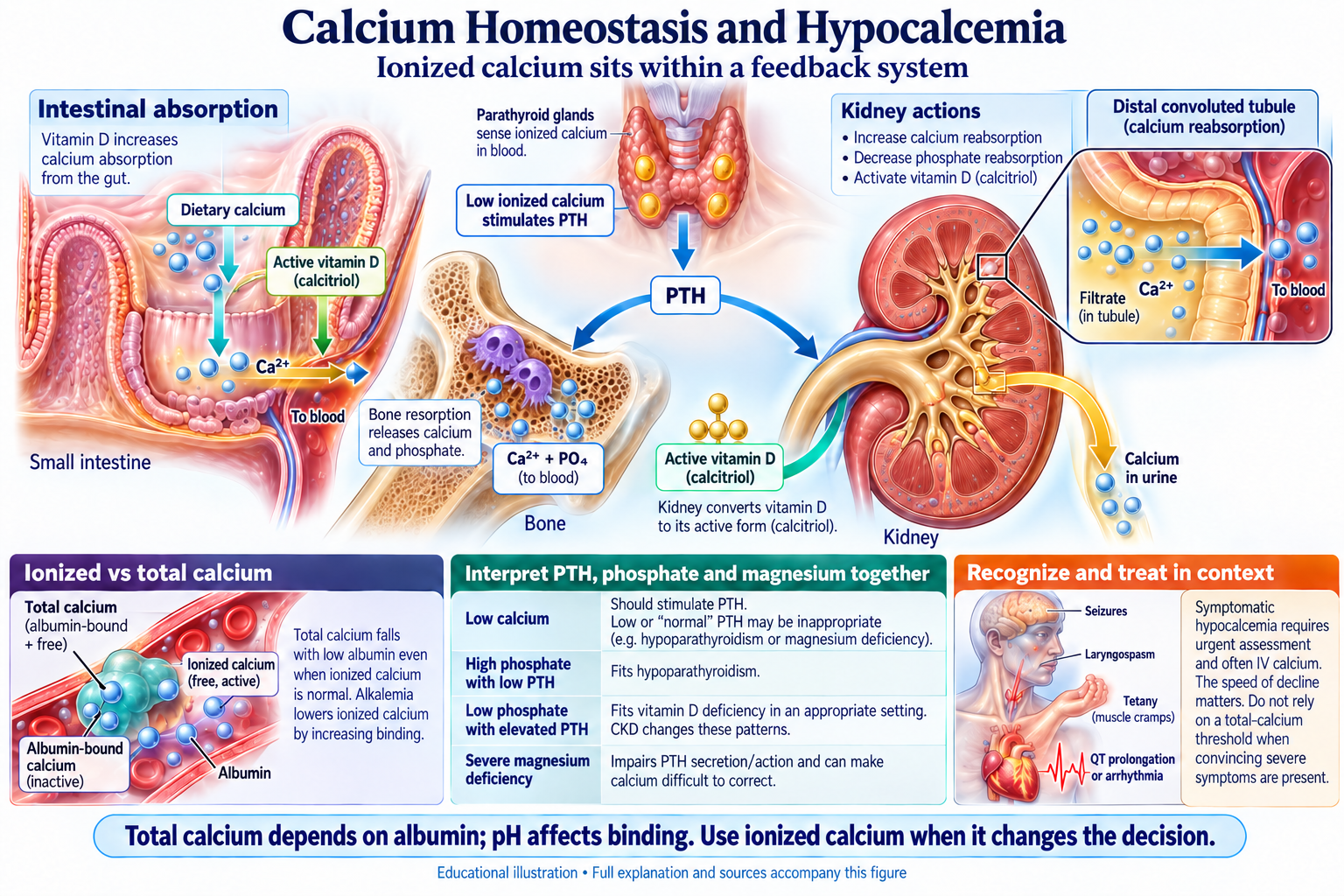
🔬 Calcium-Phosphate Homeostasis Overview
Understanding the System: Hypocalcemia results from disruption of the regulatory pathways shown above. The kidneys (red) are crucial for calcium reabsorption and calcitriol synthesis. Loss of PTH, vitamin D deficiency, or kidney disease commonly cause hypocalcemia.
🚨 EMERGENCY PROTOCOL: Symptomatic Hypocalcemia
1
IV Calcium Gluconate: 1-2 ampules (90-180 mg elemental Ca) in 50-100 mL NS over 10-20 min
2
Continuous Infusion: 50-100 mg elemental Ca/hr in NS or D5W
3
Check & Replace Magnesium: IV MgSO₄ 2-4 g over 20 min if low
4
Cardiac Monitoring: Essential, especially if on digoxin
5
Avoid Bicarbonate: Worsens hypocalcemia by ↑Ca-albumin binding
⚠️ Warning Signs: Tetany, seizures, laryngospasm, QT prolongation → TREAT IMMEDIATELY!
📊 Clinical Presentation
Neuromuscular Manifestations (Most Common)
Chvostek's Sign
Facial twitch with tapping
Trousseau's Sign
Carpopedal spasm with BP cuff
Paresthesias
Perioral, fingers, toes
Tetany
Muscle cramps, spasms
Seizures
Generalized tonic-clonic
Laryngospasm
Life-threatening stridor
Cardiovascular
- QT prolongation (most important ECG finding)
- Heart failure (reversible)
- Hypotension
- Torsades de pointes (rare)
Chronic Manifestations
- Basal ganglia calcification
- Cataracts
- Dental abnormalities
- Dry skin, brittle nails
🔍 Etiology and Pathophysiology
| Category | Specific Causes | Mechanism | Key Features |
|---|---|---|---|
| PTH Deficiency |
• Post-surgical (75%) • Autoimmune • DiGeorge syndrome • Infiltrative (hemochromatosis) • Radiation |
↓PTH → ↓Ca reabsorption, ↓calcitriol, ↑PO₄ | Low/absent PTH, high phosphate |
| PTH Resistance |
• Pseudohypoparathyroidism • Hypomagnesemia • CKD |
End-organ resistance to PTH | High PTH, Albright's osteodystrophy |
| Vitamin D Disorders |
• Deficiency (dietary, malabsorption) • 1α-hydroxylase deficiency (Type 1) • Receptor defects (Type 2) • CKD (↓calcitriol synthesis) |
↓Intestinal Ca absorption | ↑PTH (secondary), rickets/osteomalacia |
| Critical Illness |
• Sepsis (50-70% of ICU patients) • Pancreatitis • Rhabdomyolysis • Tumor lysis syndrome |
Cytokine suppression, chelation, shifts | Multiple mechanisms, poor prognosis |
| Medications |
• Bisphosphonates (IV > oral) • Denosumab • Cinacalcet • Cisplatin • PPIs (via hypomagnesemia) |
Various (↓resorption, ↓PTH, renal loss) | Temporal relationship to drug |
| Other |
• Hungry bone syndrome • Hyperphosphatemia • Massive transfusion (citrate) • Acute alkalosis |
Sequestration, precipitation, binding | Context-specific |
🔬 Diagnostic Approach
Systematic Evaluation
1
Confirm True Hypocalcemia:
- Albumin-corrected Ca or ionized Ca
- Rule out lab error, EDTA contamination
2
Essential Labs:
- PTH: Key branch point
- Phosphate: High in hypoparathyroidism, low in vitamin D deficiency
- Magnesium: MUST check and replace
- 25-OH Vitamin D: Screen for deficiency
- Creatinine: Assess kidney function
3
Interpretation by PTH Level:
- Low/Undetectable PTH: Hypoparathyroidism
- High PTH: Secondary hyperparathyroidism (vitamin D deficiency, CKD, pseudohypoparathyroidism)
- Normal PTH: Inappropriately normal = partial hypoparathyroidism or hypomagnesemia
4
Additional Testing (as indicated):
- 1,25(OH)₂ Vitamin D (if 25-OH D normal)
- 24-hour urine calcium
- Genetic testing (DiGeorge, CaSR mutations)
- ECG (QT interval)
🧮 Calcium Replacement Calculator
Calcium Deficit: 140 mg elemental calcium
IV Calcium Gluconate 10%: ~1.5 ampules
IV Calcium Chloride 10%: ~0.5 ampules
IV Calcium Gluconate 10%: ~1.5 ampules
IV Calcium Chloride 10%: ~0.5 ampules
💊 Treatment Strategies
📌 Acute Management
IV Calcium Administration
- Calcium Gluconate 10%: Preferred (less tissue necrosis if extravasates)
- 1 ampule = 10 mL = 90 mg elemental calcium
- Calcium Chloride 10%: 3× more elemental Ca but caustic
- 1 ampule = 10 mL = 270 mg elemental calcium
- Rate: 50-100 mg elemental Ca/hour
- Dilution: In NS or D5W (NOT in bicarb or phosphate)
⚠️ Critical: MUST replace magnesium concurrently or calcium won't correct!
📌 Chronic Management by Etiology
Hypoparathyroidism
| Calcium Supplements | 1-3 g elemental calcium daily in divided doses Calcium carbonate (40% elemental) with food Calcium citrate (21% elemental) - better if achlorhydria |
| Active Vitamin D | Calcitriol 0.25-2 mcg daily Alfacalcidol 0.5-3 mcg daily (Bypass need for renal conversion) |
| Goals | Ca 8-8.5 mg/dL (low-normal) 24hr urine Ca <300 mg (avoid stones) Ca × PO₄ product <55 |
| Monitoring | Ca, PO₄, Cr q3-6 months 24hr urine Ca annually Renal ultrasound if hypercalciuria |
| PTH Replacement | Recombinant PTH(1-84) for refractory cases Reduces pill burden but ↑hypercalcemia risk |
Vitamin D Deficiency
Replacement Protocol:
- Loading: 50,000 IU weekly × 8 weeks
- Maintenance: 1,500-2,000 IU daily
- Obesity/Malabsorption: 2-3× higher doses
- Goal: 25-OH Vitamin D >30 ng/mL
CKD-Related
- Phosphate control first (prevents Ca × PO₄ precipitation)
- Calcitriol or vitamin D analogs
- Calcium-based phosphate binders (if Ca low)
- Careful monitoring to avoid vascular calcification
🎯 Key Clinical Pearls
- Hypomagnesemia MUST be corrected first - Ca won't normalize otherwise
- Check phosphate: High = hypoparathyroidism, Low = vitamin D deficiency
- QT prolongation is the most important ECG finding - risk of torsades
- Chvostek's sign: 10% false positives in normal patients
- Trousseau's sign: More specific than Chvostek's
- Post-thyroidectomy: Check Ca daily × 48-72 hours
- Hungry bone syndrome: Severe hypocalcemia post-parathyroidectomy
- IV calcium + digoxin = ↑↑risk of toxicity (slow infusion, cardiac monitoring)
- Alkalosis worsens symptoms by ↓ionized Ca (avoid hyperventilation)
- Vitamin D deficiency is pandemic - check in all hypocalcemia patients
- PPIs can cause hypomagnesemia → secondary hypocalcemia
- Critical illness hypocalcemia often doesn't need treatment unless symptomatic
📚 Special Considerations
Post-Surgical
- Risk after thyroid/parathyroid surgery
- Check Ca q6h × 48-72h post-op
- Prophylactic Ca + calcitriol if high risk
- Permanent in 1-5% of total thyroidectomies
Pregnancy/Lactation
- ↑Ca demands (fetal skeleton, breast milk)
- May unmask subclinical hypoparathyroidism
- Increase Ca + vitamin D supplementation
- Monitor closely postpartum
Neonates
- Early: Maternal hyperparathyroidism → suppressed fetal PTH
- Late: DiGeorge, vitamin D deficiency
- Check maternal history
- Consider 22q11 deletion testing
🔄 Monitoring and Follow-up
Outpatient Monitoring Schedule
Initial (Weekly × 1 month): Ca, PO₄, Mg, Cr
Stable (q3-6 months): Ca, PO₄, Cr, 25-OH Vitamin D
Annual: 24hr urine Ca, renal imaging if hypercalciuria
Dose Adjustments: Based on symptoms and Ca levels, not just labs