Visual reference
Browse the visual reference library · Download lesson Markdown
🔬 Calcium-Phosphate Homeostasis Overview
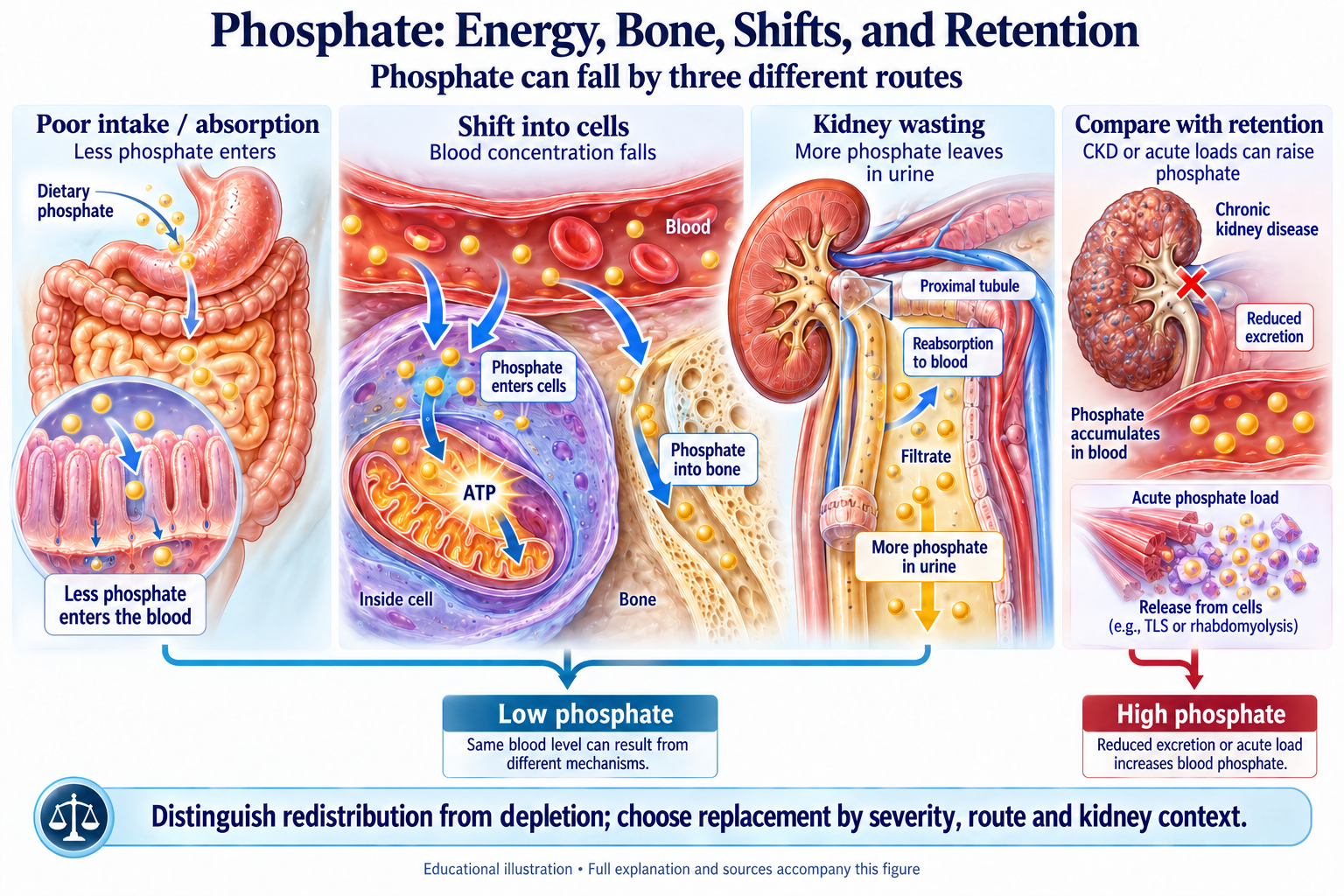
Understanding the System: Hyperphosphatemia disrupts calcium homeostasis through calcium-phosphate precipitation. The kidneys (red) normally excrete 85-90% of dietary phosphate. Loss of renal function is the primary cause of hyperphosphatemia. FGF23 rises early in CKD to maintain phosphate balance.
🚨 EMERGENCY PROTOCOL: Severe Hyperphosphatemia with Hypocalcemia
1
Treat Hypocalcemia First: IV calcium gluconate if symptomatic
2
Volume Expansion: NS + loop diuretics if preserved renal function
3
Emergency Dialysis: For severe cases, renal failure, or TLS
4
Phosphate Binders: Start immediately with meals
5
Monitor Ca × PO₄ Product: Keep <55 to prevent precipitation
⚠️ Critical: Ca × PO₄ >70 → Tissue calcification risk!
📊 Definition and Clinical Consequences
Acute vs Chronic Effects
Acute Effects
- Calcium-phosphate precipitation
- Acute hypocalcemia
- Tetany, seizures
- Soft tissue calcification
- Acute kidney injury
Chronic Effects (CKD)
- Vascular calcification
- ↑Cardiovascular mortality (18-35% per 1 mg/dL)
- Secondary hyperparathyroidism
- Renal osteodystrophy
- Calciphylaxis (rare but severe)
🔍 Phosphate Retention in CKD Stages
Stage 1-2
GFR >60
Normal PO₄
↑FGF23 maintains balance
Stage 3a-3b
GFR 30-59
Normal/↑PO₄
↑↑FGF23, ↑PTH
Stage 4
GFR 15-29
↑PO₄ Common
Maximal FGF23/PTH
Stage 5
GFR <15
↑↑PO₄
Requires binders/dialysis
💀 Complications of Hyperphosphatemia
Vascular Calcification
- Medial arterial calcification
- Coronary artery disease
- Valvular calcification
- ↑Pulse pressure, LVH
- Major cause of CV death in CKD
CKD-MBD
- Secondary hyperparathyroidism
- Adynamic bone disease
- Osteitis fibrosa cystica
- Mixed uremic osteodystrophy
- Fractures, bone pain
Soft Tissue Calcification
- Corneal/conjunctival deposits
- Periarticular calcification
- Skin (pruritus)
- Visceral organs
- Calciphylaxis (rare, fatal)
🔬 Etiology and Pathophysiology
Decreased Excretion (Most Common)
- CKD: Primary cause (90% of cases)
- AKI: Sudden loss of filtration
- Hypoparathyroidism: ↓PTH → ↓PO₄ excretion
- Pseudohypoparathyroidism: PTH resistance
- Acromegaly: ↑GH → ↑PO₄ reabsorption
Increased Load
- Tumor Lysis Syndrome: Massive cell death
- Rhabdomyolysis: Muscle breakdown
- Hemolysis: RBC phosphate release
- Exogenous: Phosphate enemas, IV phosphate
- Vitamin D intoxication: ↑Absorption
Transcellular Shifts
- Metabolic acidosis: H⁺/PO₄ exchange
- Respiratory acidosis: Cell efflux
- DKA treatment: Reveals total body depletion
- Catabolism: Cell breakdown
⚠️ Tumor Lysis Syndrome - High Risk Features
- High-grade lymphomas, acute leukemias
- High tumor burden (WBC >100k, bulky disease)
- ↑LDH, ↑uric acid pre-treatment
- Pre-existing renal insufficiency
- Develops 12-72 hours after chemotherapy
Prevention: Hydration, allopurinol/rasburicase, frequent monitoring
🔬 Diagnostic Approach
Evaluation Algorithm
1
Confirm Hyperphosphatemia: PO₄ >4.5 mg/dL (fasting preferred)
2
Assess Renal Function: Creatinine, eGFR
3
Calculate Fractional Excretion:
- FePO₄ = (UPO₄ × SCr)/(SPO₄ × UCr) × 100
- <5% suggests ↑reabsorption or ↓filtered load
- >5% suggests appropriate renal response
4
Additional Labs:
- Calcium (often low)
- PTH (secondary hyperparathyroidism in CKD)
- 25-OH Vitamin D
- If TLS suspected: Uric acid, K⁺, LDH
🧮 Calcium-Phosphate Product Calculator
Ca × PO₄ Product: 58.5 mg²/dL²
⚠️ ELEVATED - Risk of calcification!
⚠️ ELEVATED - Risk of calcification!
💊 Treatment Strategies
Acute Management
1
Enhanced Elimination (if renal function preserved):
- IV normal saline hydration
- Loop diuretics (enhance phosphaturia)
- Limited efficacy if GFR <30
2
Dialysis Indications:
- Severe hyperphosphatemia (>10 mg/dL)
- Symptomatic hypocalcemia
- Ca × PO₄ product >70
- Tumor lysis syndrome
- Removes 30-50 mg/dL over 4 hours
Chronic Management in CKD
Step 1: Dietary Phosphate Restriction
HIGH Phosphate (Avoid)
- Processed foods
- Dark sodas
- Dairy products
- Organ meats
- Nuts, beans
MEDIUM Phosphate (Limit)
- Meat, poultry
- Fish
- Eggs
- Whole grains
LOW Phosphate (Prefer)
- Fresh fruits
- Vegetables
- Rice, pasta
- Bread (white)
Goal: 800-1000 mg/day (difficult to achieve; normal diet ~1500 mg/day)
Step 2: Phosphate Binders
| Binder Type | Examples | Advantages | Disadvantages | Dosing |
|---|---|---|---|---|
| Calcium-Based | Calcium carbonate Calcium acetate |
• Inexpensive • Effective • Treats hypocalcemia |
• ↑Ca load • Vascular calcification • GI upset |
500-1500 mg TID with meals |
| Sevelamer | Sevelamer carbonate Sevelamer HCl |
• No Ca load • ↓LDL cholesterol • ↓Inflammation |
• Expensive • GI side effects • Drug interactions |
800-1600 mg TID with meals |
| Lanthanum | Lanthanum carbonate | • Potent • Chewable • No Ca load |
• Expensive • GI upset • Bone accumulation |
500-1000 mg TID with meals |
| Iron-Based | Sucroferric oxyhydroxide Ferric citrate |
• Treats anemia • Lower pill burden • No Ca load |
• Discolored stools • GI upset • Iron overload risk |
500 mg TID with meals |
| Aluminum | Aluminum hydroxide | • Potent • Short-term use only |
• Aluminum toxicity • Dementia, osteomalacia • Avoid in CKD |
300-600 mg TID (max 4 weeks) |
KDIGO Recommendations
- Restrict Ca-based binders if serum Ca elevated
- Limit elemental Ca from binders to 1500 mg/day
- Choose binder based on Ca, cost, pill burden
- Target PO₄ toward normal range (not strict targets)
- Monitor Ca, PO₄ monthly initially, then q3 months
Novel Therapies
Tenapanor
- NHE3 inhibitor
- ↓Paracellular PO₄ absorption
- Add-on therapy
- Main side effect: diarrhea
Nicotinamide
- Inhibits NaPi cotransporters
- ↓Intestinal PO₄ absorption
- Under investigation
- May cause thrombocytopenia
🎯 Key Clinical Pearls
- Phosphate rises late in CKD - FGF23 and PTH compensate until GFR <30
- Ca × PO₄ product >55 → vascular calcification risk; >70 → critical
- Each 1 mg/dL ↑PO₄ → 18-35% ↑mortality in dialysis patients
- Dietary restriction alone rarely sufficient - binders usually needed
- "Hidden" phosphate in processed foods (additives) - 100% absorbed
- Natural phosphate (meat, dairy) - only 40-60% absorbed
- Take binders WITH meals - ineffective if taken separately
- Avoid Ca-based binders if Ca >10.2 or on active vitamin D
- Aluminum binders: Potent but toxic - max 4 weeks in severe cases
- Dialysis removes ~800 mg per session (3×/week = 2400 mg/week)
- Normal dietary intake ~1500 mg/day = 10,500 mg/week (net positive balance)
- Check phosphate fasting - can rise 1-2 mg/dL postprandially
📚 Special Populations
Dialysis Patients
- Target PO₄ 3.5-5.5 mg/dL (KDIGO)
- Requires binders + dietary restriction
- Adjust binders based on meals
- Consider dialysate PO₄ concentration
- Monitor monthly
Kidney Transplant
- PO₄ often normalizes post-transplant
- May have transient hypophosphatemia
- Persistent ↑PO₄ suggests graft dysfunction
- Wean binders carefully
Pediatric CKD
- Growth concerns with restriction
- Balance PO₄ control with nutrition
- Age-specific normal ranges
- Monitor growth parameters