Visual reference
Browse the visual reference library · Download lesson Markdown
🔬 Calcium-Phosphate Homeostasis Overview
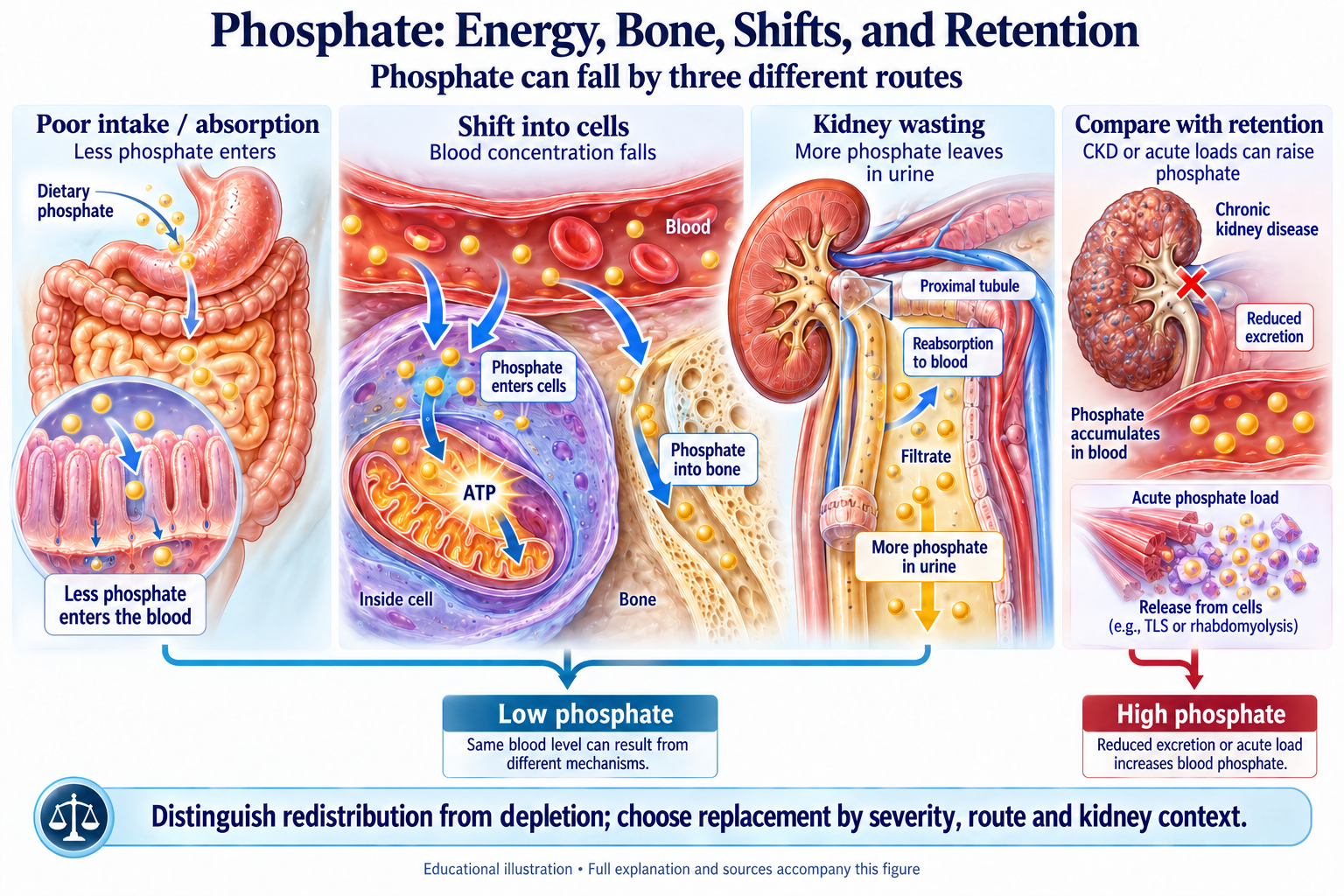
Understanding the System: Hypophosphatemia results from decreased intestinal absorption, increased renal losses (via PTH or FGF23), or intracellular shifts. The kidneys (red) reabsorb 85-90% of filtered phosphate. FGF23 disorders cause severe phosphate wasting and rickets/osteomalacia.
🚨 EMERGENCY PROTOCOL: Severe Hypophosphatemia (<1.0 mg/dL)
1
IV Phosphate: 0.08-0.16 mmol/kg over 6 hours (max 0.24 mmol/kg)
2
Monitor Closely: Check PO₄, Ca, K, Mg q4-6h
3
Watch for Complications: Hypocalcemia, hyperkalemia, renal failure
4
Correct Other Electrolytes: K⁺, Mg²⁺ often low
5
Respiratory Support: Monitor for muscle weakness
⚠️ Critical Manifestations: Respiratory failure, rhabdomyolysis, hemolytic anemia, cardiac dysfunction!
📊 Clinical Presentation by Severity
Mild (2.0-2.5 mg/dL)
- Usually asymptomatic
- Mild fatigue
- Bone pain (chronic)
Moderate (1.0-2.0 mg/dL)
- Weakness, myalgias
- Impaired leukocyte function
- Paresthesias
- Confusion
Severe (<1.0 mg/dL)
- Respiratory failure
- Rhabdomyolysis
- Hemolytic anemia
- Seizures, coma
- Heart failure
🔬 Clinical Manifestations
🫁 Respiratory
- Diaphragm weakness
- Respiratory failure
- Difficulty weaning ventilator
💪 Muscular
- Proximal myopathy
- Rhabdomyolysis
- Dysphagia
🩸 Hematologic
- Hemolytic anemia
- ↓2,3-DPG (↓O₂ delivery)
- Impaired WBC function
- Platelet dysfunction
🦴 Skeletal
- Osteomalacia (adults)
- Rickets (children)
- Bone pain
- Fractures
🧠 Neurologic
- Confusion, irritability
- Paresthesias
- Seizures (rare)
- Metabolic encephalopathy
❤️ Cardiac
- Cardiomyopathy
- Heart failure
- Arrhythmias
🔍 Etiology and Pathophysiology
📉 Decreased Absorption
- Malnutrition/Alcoholism (most common)
- Malabsorption syndromes
- Chronic diarrhea
- Vitamin D deficiency
- Phosphate binders (excessive)
- Antacids (aluminum, magnesium)
🚰 Increased Renal Losses
- Primary hyperparathyroidism
- FGF23 disorders (XLH, TIO)
- Fanconi syndrome
- Post-kidney transplant
- Volume expansion
- Diuretics
- Glucocorticoids
➡️ Intracellular Shifts
- Refeeding syndrome
- Insulin administration
- Respiratory alkalosis
- Hungry bone syndrome
- Rapid cell proliferation
- Treatment of DKA
⚠️ REFEEDING SYNDROME - High Risk Patients
Risk Factors:
- BMI <16 kg/m²
- Weight loss >15% in 3-6 months
- Little/no intake for >10 days
- Low baseline K⁺, PO₄, or Mg²⁺
- Chronic alcoholism
- Anorexia nervosa
Prevention Protocol:
- Start feeding at 10-20 kcal/kg/day
- Increase slowly over 4-7 days
- Thiamine 200-300 mg daily BEFORE feeding
- Monitor PO₄, K⁺, Mg²⁺ daily × 1 week
- Supplement prophylactically
🧬 FGF23-Mediated Disorders
X-Linked Hypophosphatemia (XLH)
- PHEX gene mutation
- ↑FGF23 → renal PO₄ wasting
- Rickets, short stature, bone deformities
- Dental abscesses
- Treatment: Burosumab (anti-FGF23 antibody)
Tumor-Induced Osteomalacia (TIO)
- Mesenchymal tumors secrete FGF23
- Severe muscle weakness, bone pain
- Often occult tumors (difficult to locate)
- Treatment: Tumor resection if possible
- Burosumab if unresectable
Common Features: ↑FGF23, ↓1,25(OH)₂D (inappropriately low), renal phosphate wasting, normal PTH/calcium
🔬 Diagnostic Approach
Step-by-Step Evaluation
1
Confirm Hypophosphatemia: PO₄ <2.5 mg/dL (fasting preferred)
2
Check Urine Phosphate:
- 24hr urine PO₄ <100 mg = GI losses/shifts
- 24hr urine PO₄ >100 mg = renal losses
- FePO₄ >5% = inappropriate renal wasting
3
If Renal Losses, Check:
- PTH: ↑ in hyperparathyroidism
- 25-OH Vitamin D: Screen for deficiency
- 1,25(OH)₂ Vitamin D: Inappropriately low in FGF23 disorders
- FGF23: ↑ in XLH, TIO
4
Additional Testing:
- Glucose, aminoaciduria (Fanconi syndrome)
- Imaging for tumors if TIO suspected
- Genetic testing for hereditary disorders
🧮 Phosphate Replacement Calculator
Estimated Deficit: 7.0 mmol
IV Dose: 0.10 mmol/kg = 7.0 mmol over 6 hours
Oral: Neutra-Phos 2 packets TID × 2-3 days
IV Dose: 0.10 mmol/kg = 7.0 mmol over 6 hours
Oral: Neutra-Phos 2 packets TID × 2-3 days
💊 Treatment Strategies
Acute Replacement
| Route | Formulation | Dosing | Considerations |
|---|---|---|---|
| IV (Severe) | Sodium phosphate Potassium phosphate |
0.08-0.16 mmol/kg over 6 hrs Max: 0.24 mmol/kg |
• Monitor Ca, K q4-6h • Risk: hypocalcemia, hyperkalemia • Use K-phos if K low |
| Oral (Mild-Moderate) | Neutra-Phos K-Phos Fleet Phospho-soda |
1-2 g (32-64 mmol) daily Divided TID-QID |
• GI upset common (diarrhea) • Take with meals • Slower correction |
Chronic Management by Etiology
Nutritional Deficiency
- Diet: High phosphate foods (dairy, meat, nuts, beans)
- Supplements: 1-3 g daily in divided doses
- Vitamin D: If deficient (enhances absorption)
- Address underlying: Alcoholism, malabsorption
Primary Hyperparathyroidism
- Definitive: Parathyroidectomy
- Medical: Phosphate supplements (limited efficacy)
- Monitor: Can worsen hypercalcemia
X-Linked Hypophosphatemia (XLH)
Traditional Therapy:
- Phosphate 1-3 g/day in 4-5 doses
- Calcitriol 0.5-1 mcg/day
- Monitor for nephrocalcinosis
- Suboptimal outcomes
Burosumab (Game Changer):
- Anti-FGF23 monoclonal antibody
- 0.4-2.0 mg/kg SC q2 weeks
- Normalizes phosphate
- Improves growth, rickets, pain
- FDA approved for XLH and TIO
Tumor-Induced Osteomalacia
- Localize tumor: Octreotide scan, FDG-PET, MRI
- Surgical resection: Curative if tumor found
- If unresectable: Burosumab or phosphate + calcitriol
- Monitor: FGF23 levels post-resection
🎯 Key Clinical Pearls
- Symptoms appear at PO₄ <2.0 mg/dL; severe at <1.0 mg/dL
- Respiratory muscle weakness → difficulty weaning from ventilator
- Rhabdomyolysis risk highest when PO₄ <1.0 mg/dL
- Refeeding syndrome: Most common in malnourished patients - PREVENT!
- Always give thiamine BEFORE feeding malnourished patients
- Check urine phosphate to distinguish GI vs renal losses
- FePO₄ >5% = inappropriate renal wasting (should conserve if low)
- Primary hyperparathyroidism: Most common cause of renal losses
- FGF23 disorders: Low 1,25(OH)₂D despite hypophosphatemia (paradox!)
- IV phosphate: Never exceed 0.24 mmol/kg - risk of acute hypocalcemia
- Oral phosphate causes diarrhea - divide doses, take with meals
- Alcoholics: Triple threat - poor intake, ↑renal losses, vitamin D deficiency
- Post-parathyroidectomy: Hungry bone syndrome can cause severe hypophosphatemia
- Burosumab revolutionized treatment of XLH - consider for refractory cases
📚 Special Populations
Critical Care
- Common in ICU (30-50%)
- Ventilator weaning difficulty
- Check before extubation
- IV replacement if <1.5 mg/dL
- Monitor for refeeding syndrome
Post-Transplant
- Persistent hyperparathyroidism
- FGF23 remains elevated
- Usually resolves in months
- Oral supplements usually sufficient
Pediatric
- Rickets presentation
- Growth retardation
- Consider genetic causes
- XLH most common inherited form
- Burosumab if XLH confirmed
🔄 Monitoring and Follow-up
Replacement Monitoring
During IV Replacement: PO₄, Ca, K, Mg q4-6h
Oral Replacement: Daily × 3-5 days, then weekly
Chronic Therapy: Monthly initially, then q3-6 months
XLH on Burosumab: PO₄ monthly, adjust dose to maintain normal