🔑 CRITICAL FIRST STEP
Check Magnesium Level!
Mg++ must be >1.7 mg/dL for K+ replacement to work effectively*
⚠️ Refractory hypokalemia is often due to concurrent hypomagnesemia
Visual reference
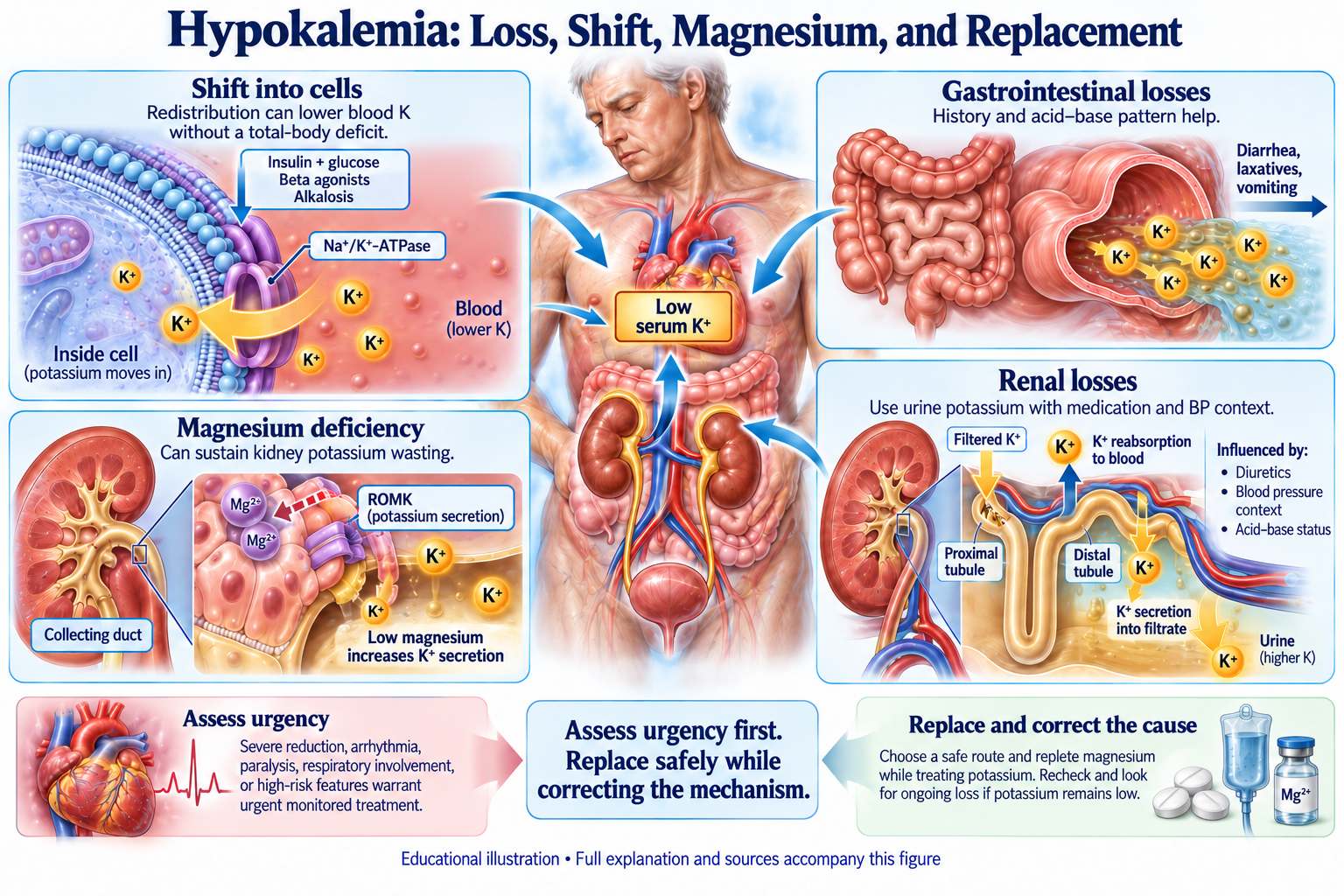
Browse the visual reference library · Download lesson Markdown
🔍 Systematic Diagnostic Approach
📊 Initial Assessment
- Check Magnesium: ALWAYS measure Mg++ level
- Medication Review: Diuretics, insulin, beta-agonists
- Clinical Context: GI losses, poor intake
- Acid-Base Status: pH affects K+ distribution
🎯 Etiology by Mechanism
- Increased Losses: Most common cause
- Decreased Intake: Dietary, NPO status
- Transcellular Shift: Into cells (insulin, alkalosis)
- Dilutional: Massive fluid resuscitation
- Medications: Many drug-induced causes
⚠️ Clinical Manifestations
- Cardiovascular: Arrhythmias, prolonged QT
- Muscular: Weakness, cramping, paralysis
- GI: Ileus, constipation
- Renal: Concentrating defect, polyuria
- Metabolic: Glucose intolerance
🔄 Etiology Classification
💧 Increased Losses
Renal Losses:
- Diuretics (thiazides, loop diuretics)
- Hyperaldosteronism (1° or 2°)
- Bartter/Gitelman syndrome
- Magnesium deficiency
- Medications (aminoglycosides, cisplatin)
GI Losses:
- Diarrhea (most common GI cause)
- Villous adenoma
- Fistulas, ileostomy
- Laxative abuse
🔄 Transcellular Shift
- Insulin: Drives K+ into cells
- Beta-2 Agonists: Albuterol, epinephrine
- Alkalosis: Each 0.1 pH ↑ = 0.5 mEq/L K+ ↓
- Anabolic States: Refeeding, B12/folate therapy
- Hypothermia: Rewarming causes shift
- Familial Periodic Paralysis: Genetic channelopathy
📉 Decreased Intake
- Poor Dietary Intake: Elderly, eating disorders
- NPO Status: Prolonged fasting
- Tea and Toast Diet: Classic presentation
- Malnutrition: Protein-energy malnutrition
- Clay Ingestion: Binds potassium
Note: Kidneys conserve K+ well, so dietary deficiency alone rarely causes severe hypokalemia
💊 Treatment Protocol
🎯 Step-by-Step Replacement Strategy
1
CHECK MAGNESIUM: Must be >1.7 mg/dL before K+ replacement
• If Mg++ low: Replace simultaneously • 2g MgSO4 IV over 4 hours
• If Mg++ low: Replace simultaneously • 2g MgSO4 IV over 4 hours
2
CHOOSE ROUTE: PO preferred over IV when possible
• PO: Safer, better tolerated • IV: Only if severe, NPO, or malabsorption
• PO: Safer, better tolerated • IV: Only if severe, NPO, or malabsorption
3
CALCULATE DEFICIT: Estimate total body K+ deficit
• Each 1 mEq/L ↓ = ~200-400 mEq total deficit** • More in chronic cases
• Each 1 mEq/L ↓ = ~200-400 mEq total deficit** • More in chronic cases
4
REPLACE SAFELY: Avoid rapid correction
• PO: 40-100 mEq/day divided • IV: ≤10 mEq/hr peripheral, ≤20 mEq/hr central
• PO: 40-100 mEq/day divided • IV: ≤10 mEq/hr peripheral, ≤20 mEq/hr central
💊 Replacement Options & Dosing
Oral vs IV Replacement
💊 Oral Replacement (Preferred)
Advantages:
- Safer (no risk of cardiac arrest)
- Better tolerated
- More physiologic
- Cost-effective
Options:
- KCl tablets: 10-20 mEq TID
- KCl liquid: 20-40 mEq BID
- K-Dur: 20 mEq BID (extended release)
Total Daily Dose: 40-100 mEq/day
💉 IV Replacement (When Necessary)
Indications:
- Severe hypokalemia (<2.5 mEq/L)
- Symptomatic (arrhythmias, paralysis)
- NPO status
- Malabsorption
Safety Rules:
- Peripheral line: ≤10 mEq/hr
- Central line: ≤20 mEq/hr
- Cardiac monitoring required
- Check K+ every 4-6 hours
🧮 Interactive Potassium Calculator
Hypokalemia Replacement Calculator
Calculating potassium replacement plan...
⚠️ Special Considerations
🚫 Common Mistakes
- Ignoring Magnesium: #1 cause of refractory hypokalemia
- Too Rapid IV Replacement: Risk of cardiac arrest
- Inadequate Dosing: Underestimating total deficit
- Stopping Too Early: Not achieving target levels
- Missing Ongoing Losses: Continuing diuretics
🔍 Refractory Cases
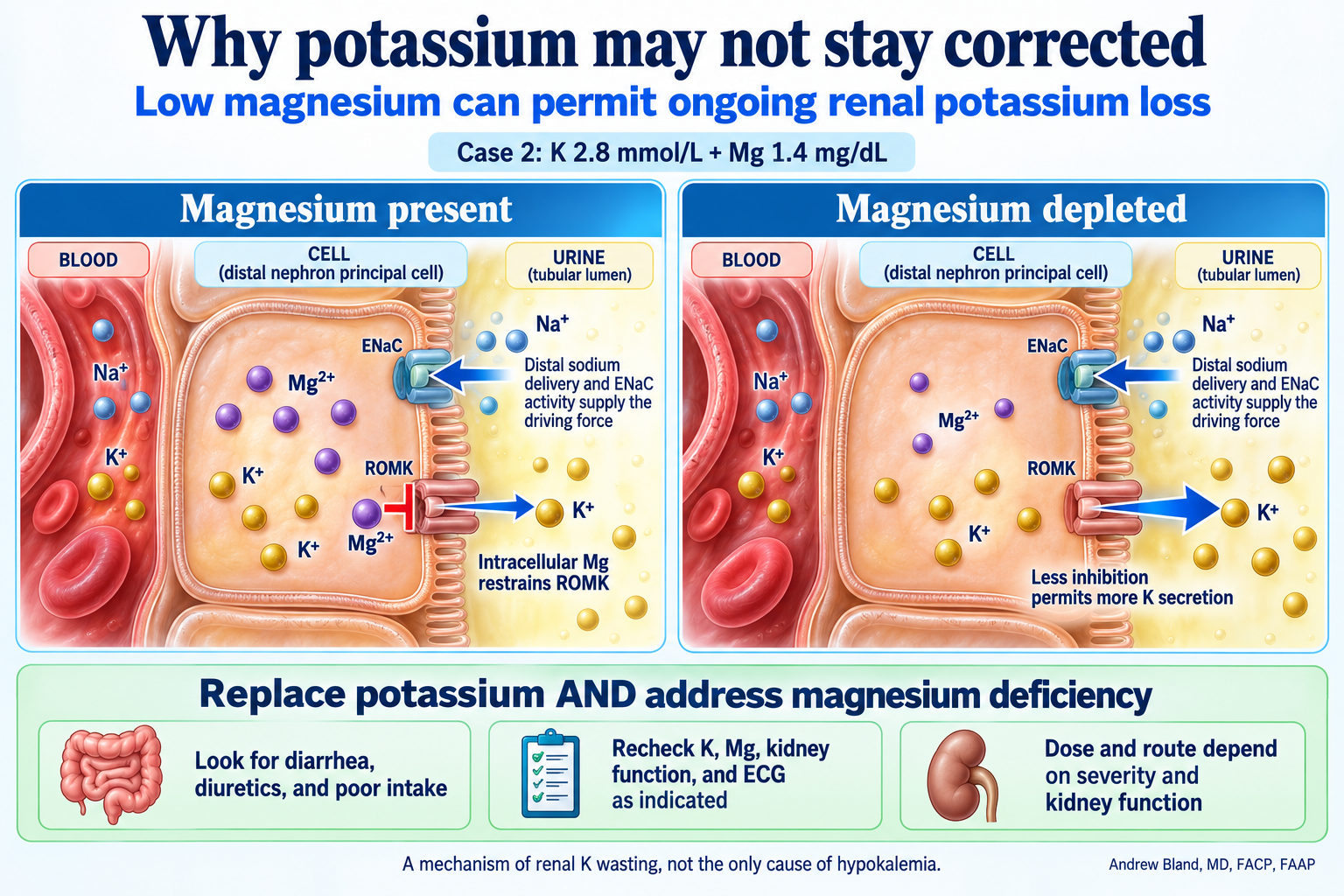
Low magnesium can permit ongoing renal potassium loss
- Check Magnesium Again: Most common cause
- Ongoing Losses: Diarrhea, diuretics
- Medication Review: Hidden K+-wasting drugs
- Endocrine Workup: Hyperaldosteronism
- Genetic Testing: Gitelman, Bartter syndrome
📊 Monitoring Parameters
- Serum K+: Every 4-6 hours during replacement
- Magnesium: Recheck if initially low
- ECG: If arrhythmias or severe hypokalemia
- Daily Weights: Monitor volume status
- Renal Function: Ensure adequate urine output
📚 Sources
- Whang R, Whang DD, Ryan MP. Refractory potassium repletion: a consequence of magnesium deficiency. Arch Intern Med. 1992;152(1):40-45. PMID: 1728927. — Foundational paper establishing that hypomagnesemia impairs potassium repletion. The 1.7 mg/dL threshold is clinical practice convention; not RCT-derived but consistent with this mechanism.
- Sterns RH, Grieff M, Bernstein PL. Treatment of hyperkalemia: something old, something new. Kidney Int. 2016;89(3):546-554. PMID: 26880451. — Comprehensive review of K+ disorders treatment with mechanistic foundations.
- Kovesdy CP. Updates in hyperkalemia: outcomes and therapeutic strategies. Rev Endocr Metab Disord. 2017;18(1):41-47. PMID: 27600582. — Outcomes and management framework; relevant baseline for hypokalemia counterpart.
- Cohn JN, Kowey PR, Whelton PK, Prisant LM. New guidelines for potassium replacement in clinical practice: a contemporary review by the National Council on Potassium in Clinical Practice. Arch Intern Med. 2000;160(16):2429-2436. PMID: 10979053. — Guidance on K+ replacement, deficit estimation; supports the 200-400 mEq deficit per 1 mEq/L drop teaching estimate.
🎯 Key Learning Points
🔑 Critical First Steps
- ALWAYS check magnesium level first
- Replace Mg++ if <1.7 mg/dL
- Review medications for K+-wasting drugs
💊 Treatment Priorities
- PO replacement preferred when possible
- IV replacement: ≤10 mEq/hr peripheral
- Estimate 200-400 mEq total deficit
⚠️ Safety Considerations
- Cardiac monitoring for IV replacement
- Recheck K+ every 4-6 hours
- Address ongoing losses