Visual reference
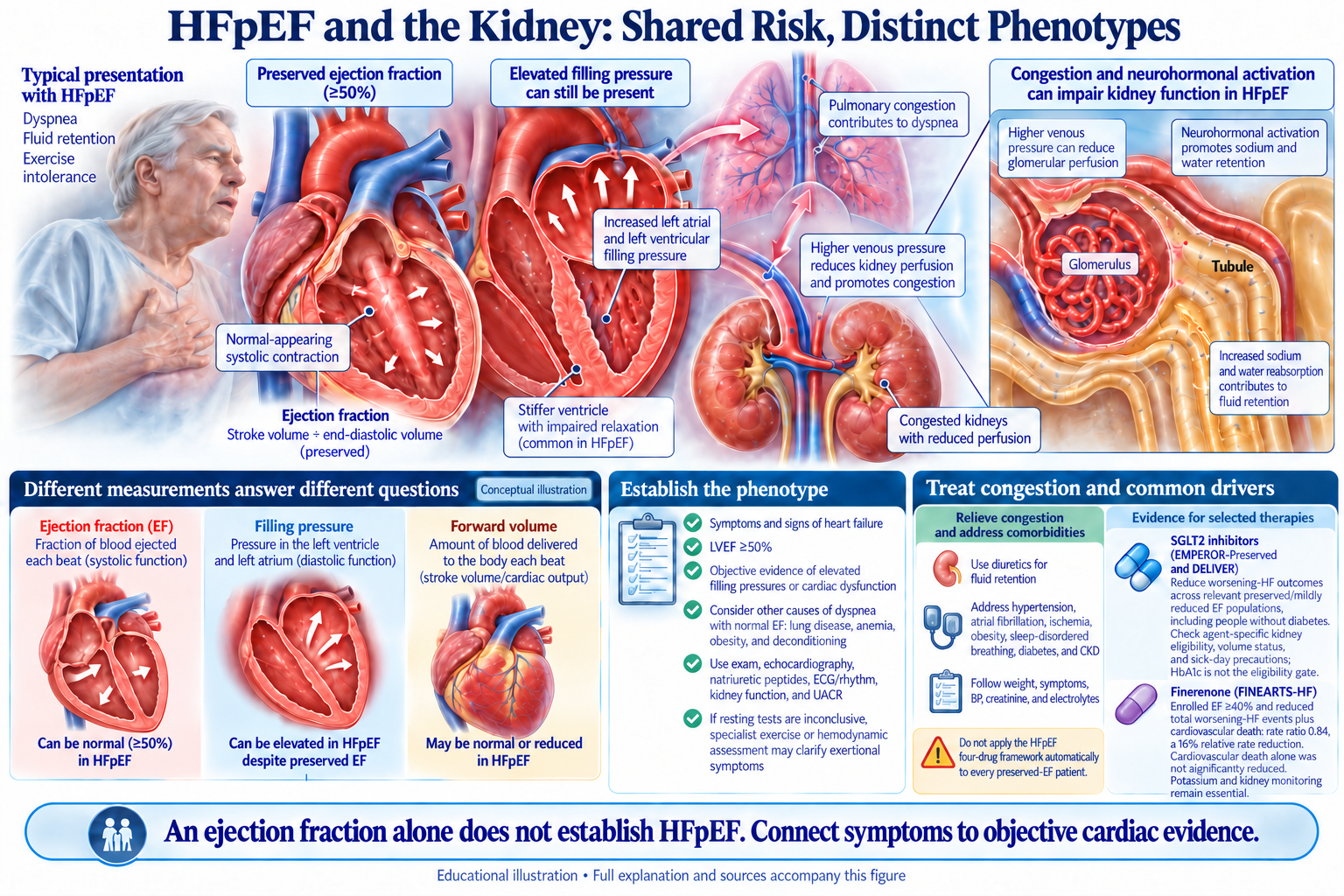
Browse the visual reference library · Download lesson Markdown
📖 About These Reports
What You'll Find in These Materials
Report 1 (HTML + PDF, 82 references) provides comprehensive analysis of the cardiorenal syndrome, including detailed comparative efficacy data on RAAS inhibitors, the evolution of mineralocorticoid receptor antagonists, SGLT2 inhibitor mechanisms, and practical implementation strategies including diuretic resistance management and sick day protocols.
Report 2 (HTML + PDF, 30 references) focuses on neurohormonal modulation with particular emphasis on phenotype-specific MRA selection, natriuretic peptide resistance frameworks, and confidence matrices for clinical recommendations. Use the source trials and endpoint-specific interpretation below when comparing the evidence.
📄 Report 1: Comprehensive Management of Cardiorenal Disease
An evidence-based synthesis of modern guideline-directed medical therapy covering cardiorenal mechanisms, phenotype-specific therapies, monitoring, and practical implementation.
Download Cardiorenal Report (PDF)Read the corrected report online · October 3, 2026 edition
📄 Report 2: Neurohormonal Modulation in Heart Failure
Optimizing treatment strategies across the heart failure spectrum with detailed focus on comparative efficacy, phenotype-specific considerations, and evidence-based timing of therapeutic interventions.
Download Heart Failure Report (PDF)Read the corrected report online · October 3, 2026 edition
📄 Comprehensive Management of Cardiorenal Disease
The HFrEF Medication Framework
🎯 RAAS / Neprilysin Pathway
Use the evidence for the specific agent and comparator. Sacubitril/valsartan outperformed enalapril in PARADIGM-HF. This does not establish a universal ARNI > ACE inhibitor > ARB ranking across all diseases and outcomes.
💊 SGLT2 Inhibitors
These agents have disease-specific heart-failure and kidney evidence. Check the indication, kidney-function criteria, volume status, and sick-day precautions; one percentage reduction or eGFR threshold does not describe every trial or label.
⚗️ Mineralocorticoid Receptor Antagonists
Spironolactone and eplerenone have HFrEF outcome evidence. Finerenone has evidence in selected CKD/type 2 diabetes and LVEF ≥40% heart-failure populations. Monitor potassium and kidney function with any MRA.
💓 Evidence-Based Beta-Blockers
Carvedilol, sustained-release metoprolol succinate, and bisoprolol have HFrEF evidence. A beta-blocker may have another indication in HFpEF, but HFrEF mortality effects should not be transferred automatically.
What PARADIGM-HF Actually Compared
Among 8442 patients with reduced EF, the primary cardiovascular-death or HF-hospitalization outcome occurred in 21.8% with sacubitril/valsartan and 26.5% with enalapril over median follow-up of 27 months (HR 0.80, 95% CI 0.73–0.87). All-cause mortality was 17.0% versus 19.8% (HR 0.84). Hypotension and nonserious angioedema were more frequent with sacubitril/valsartan. PARADIGM-HF.
Separate the absolute event proportions, relative hazard, follow-up duration, and endpoint. Comparing NNTs from different historical trials cannot establish ACE-inhibitor superiority over ARBs or a universal cost-effectiveness ranking. Combined-treatment projections likewise require explicit model assumptions and a defined population.
Congestion and Intercurrent Illness
Assess symptoms, examination, weight trajectory, urine response, blood pressure, electrolytes, and kidney function when adjusting diuretics. Urine sodium can help assess response in a suitable protocol, but no universal nurse-directed escalation schedule or eight-fold weight-loss promise follows from this summary. Refractory congestion warrants reassessment and specialist management.
Medication plans during acute illness must distinguish dehydration from persistent congestion and account for hypotension, AKI, hyperkalemia, and ketoacidosis risk. An MRA is not automatically safe to continue while all other agents are held. Give a documented temporary-hold, reassessment, and restart plan tailored to the patient.
Implementing Treatment
Start and titrate indicated therapies without unnecessary delay, while respecting hemodynamic stability, contraindications, interactions, access, and laboratory follow-up. Benefits from distinct trials support comprehensive care, but do not validate a universal NNT of four, a fixed number of lives saved per population, or a guaranteed return on investment.
📄 Neurohormonal Modulation in Heart Failure
FINEARTS-HF: Recurrent Events Matter
FINEARTS-HF randomized 6001 patients with symptomatic HF and LVEF ≥40% to finerenone or placebo. The primary outcome combined total first and recurrent worsening-HF events with cardiovascular death. Over median follow-up of 32 months, the rate ratio was 0.84 (95% CI 0.74–0.95): a 16% relative rate reduction. The cardiovascular-death component alone was not significantly reduced; hyperkalemia increased. FINEARTS-HF primary report.
A recurrent-event rate ratio is not an individual absolute-risk reduction. A conventional patient-level NNT cannot be obtained by taking its reciprocal. Any NNT presentation requires a specified patient-level endpoint, time horizon, and appropriate absolute-risk estimate.
The 2024 MRA Individual-Patient Meta-Analysis
The analysis included four trials and 13,846 participants: RALES, EMPHASIS-HF, TOPCAT, and FINEARTS-HF. Its primary endpoint was time to first HF hospitalization or cardiovascular death, distinct from the recurrent-event primary endpoint of FINEARTS-HF. Relative effects were greater in the HFrEF trials; hospitalization benefit extended to the HFmrEF/HFpEF trials. Jhund and colleagues, Lancet 2024.
This synthesis does not directly randomize steroidal against nonsteroidal MRAs. Agent, EF phenotype, background therapy, and trial population are intertwined. Select an agent with evidence for the patient's indication and monitor safety; do not claim universal finerenone superiority or a proven lower hyperkalemia rate from unmatched trials.
Foundational HFrEF MRA Trials
RALES studied spironolactone in severe HFrEF; EMPHASIS-HF studied eplerenone in patients with milder symptoms and reduced EF. Both support MRA use in their eligible populations. Their different baseline risks and endpoints make simple cross-trial NNT rankings misleading. RALES; EMPHASIS-HF.
CONFIDENCE: An Albuminuria Endpoint
CONFIDENCE compared finerenone, empagliflozin, and their simultaneous combination in people with CKD, type 2 diabetes, albuminuria, and background RAAS inhibition. At 180 days, combination treatment produced greater UACR reduction than either monotherapy. This trial's primary endpoint was albuminuria change; it did not establish a reduction in mortality, dialysis, or HF hospitalization from simultaneous initiation. CONFIDENCE primary report.
Natriuretic Peptides and Treatment Timing
PIONEER-HF studied in-hospital sacubitril/valsartan versus enalapril after hemodynamic stabilization in HFrEF and found greater NT-proBNP reduction. It does not validate an NT-proBNP cutoff or cGMP:BNP ratio for diagnosing “irreversible peptide resistance” or determining who should receive an ARNI. PIONEER-HF.
Interpret natriuretic peptides with symptoms, rhythm, body size, kidney function, and treatment. Do not wait for a speculative receptor-resistance stage to offer indicated therapy, or bypass stabilization and the ACE-inhibitor washout because treatment is urgent.
Interpreting Evidence Strength
Assess randomized treatment effects separately from subgroup analyses, biomarker changes, mechanistic hypotheses, and economic models. A confidence label is useful only when its method and outcome are specified. Biological plausibility alone cannot upgrade an unvalidated threshold into a clinical rule.
📎 Applying the Evidence to Roundtable Questions
- Identify the HF phenotype and confirm which comorbidities influence treatment eligibility and safety.
- Name the trial population and comparator before quoting an effect.
- Distinguish first-event risk, recurrent-event rate, biomarker change, and mortality.
- Choose therapy using indication-specific evidence, monitoring needs, and patient preferences.
- Document follow-up, medication transition requirements, and an individualized illness/restart plan.
📌 Read the Endpoint with the Number
Primary Studies and Guideline
- Heidenreich PA, Bozkurt B, Aguilar D, et al. 2022 AHA/ACC/HFSA Guideline for the Management of Heart Failure: A Report of the American College of Cardiology/American Heart Association Joint Committee on Clinical Practice Guidelines. Circulation. 2022;145(18):e895-e1032. PubMed PMID 35363499
- McMurray JJ, Packer M, Desai AS, et al. Angiotensin-neprilysin inhibition versus enalapril in heart failure. N Engl J Med. 2014;371(11):993-1004. PubMed PMID 25176015
- Solomon SD, McMurray JJV, Vaduganathan M, et al. Finerenone in Heart Failure with Mildly Reduced or Preserved Ejection Fraction. N Engl J Med. 2024;391(16):1475-1485. PubMed PMID 39225278
- Jhund PS, Talebi A, Henderson AD, et al. Mineralocorticoid receptor antagonists in heart failure: an individual patient level meta-analysis. Lancet. 2024;404(10458):1119-1131. PubMed PMID 39232490
- Pitt B, Zannad F, Remme WJ, et al. The effect of spironolactone on morbidity and mortality in patients with severe heart failure. Randomized Aldactone Evaluation Study Investigators. N Engl J Med. 1999;341(10):709-17. PubMed PMID 10471456
- Zannad F, McMurray JJ, Krum H, et al. Eplerenone in patients with systolic heart failure and mild symptoms. N Engl J Med. 2011;364(1):11-21. PubMed PMID 21073363
- Agarwal R, Green JB, Heerspink HJL, et al. Finerenone with Empagliflozin in Chronic Kidney Disease and Type 2 Diabetes. N Engl J Med. 2025;393(6):533-543. PubMed PMID 40470996
- Velazquez EJ, Morrow DA, DeVore AD, et al. Angiotensin-Neprilysin Inhibition in Acute Decompensated Heart Failure. N Engl J Med. 2019;380(6):539-548. PubMed PMID 30415601
Teaching summary and corrected reports updated October 3, 2026. The corrected editions supersede the July 24, 2025 reports.