Visual reference
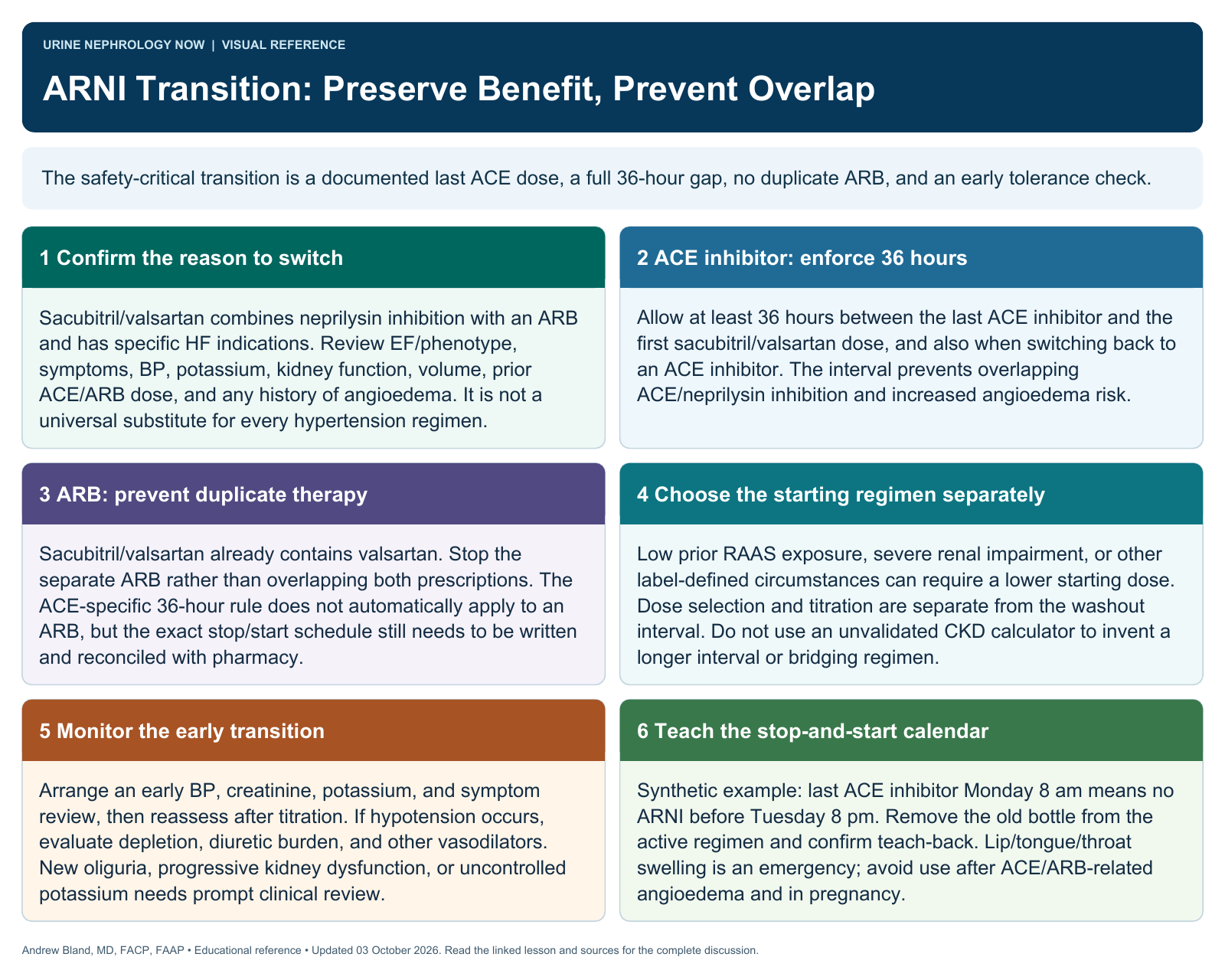
Browse the visual reference library · Download lesson Markdown
🚨 Critical Safety Warning
💊 Understanding ARNI: Sacubitril/Valsartan
🎯 Mechanism of Action and Clinical Benefits
Angiotensin Receptor-Neprilysin Inhibitor (ARNI) therapy represents a paradigm shift in heart failure management, combining angiotensin II receptor blockade with neprilysin inhibition to provide superior cardiovascular outcomes compared to ACE inhibitor monotherapy.
Dual Mechanism Benefits:
🛡️ Angiotensin II Receptor Blockade
- Vascular effects: Vasodilation and reduced afterload
- Cardiac remodeling: Prevention of maladaptive changes
- Aldosterone suppression: Reduced sodium retention
- Blood pressure reduction: Consistent antihypertensive effect
⚡ Neprilysin Inhibition
- Natriuretic peptide enhancement: Increased BNP and ANP activity
- Improved hemodynamics: Enhanced venous and arterial dilation
- Diuretic synergy: Augmented natriuresis and diuresis
- Anti-fibrotic effects: Reduced myocardial fibrosis
PARADIGM-HF Trial Results:
The landmark PARADIGM-HF trial demonstrated superior outcomes with sacubitril/valsartan compared to enalapril in heart failure patients with reduced ejection fraction.
Key Clinical Outcomes (vs. Enalapril):
20% relative reduction
3.4% absolute reduction
21% relative reduction (HR 0.79)
approximately 2.8% absolute reduction
(rate 12.8% vs 15.6%)
16% relative reduction
2.8% absolute reduction
⚠️ Angioedema Risk and Washout Requirements
🧬 Pathophysiology of Dual Inhibition Risk
The combination of ACE inhibition and neprilysin inhibition creates a synergistic risk for angioedema through complementary pathways affecting bradykinin metabolism and clearance.
Mechanism of Enhanced Angioedema Risk:
- ACE inhibition: Reduces bradykinin degradation by blocking angiotensin-converting enzyme
- Neprilysin inhibition: Further reduces bradykinin clearance through blocked neutral endopeptidase
- Synergistic effect: Dual pathway blockade dramatically increases bradykinin levels
- Clinical consequence: Substantially elevated angioedema risk compared to monotherapy
Clinical Evidence of Risk:
Concurrent ACE inhibition and neprilysin inhibition increase angioedema risk. ARNI must not overlap an ACE inhibitor; use at least 36 hours of separation in either direction as specified by labeling.
Kidney impairment: separate exposure from the labeled safeguard
Renal impairment can increase exposure to renally cleared ACE inhibitors and influences ARNI starting-dose selection and follow-up. It does not establish a validated drug-by-eGFR table of 3-30-day washout intervals. Follow the minimum 36-hour separation, assess the individual clinically, and use the product-specific starting dose.
📋 Evidence-Based Washout Protocols
🎯 Risk-Stratified Washout Guidelines
Safe transition requires the labeled minimum interval, a separately selected starting dose, medication reconciliation, and clinical follow-up. No pharmacokinetic multiplier in this lesson defines a validated longer washout.
Separate timing from dose selection
The labeled timing safeguard remains at least 36 hours. A longer apparent elimination half-life is not a validated clinical angioedema calculator. Severe kidney impairment, low prior RAAS exposure, BP, and volume status affect the starting dose and monitoring independently.
Medication continuity during transition
Write the last ACE inhibitor dose, the first permitted ARNI dose, and which prescriptions to remove. ARNI already contains valsartan: do not continue a separate ARB. Do not routinely add an ARB simply to bridge a fabricated prolonged washout.
Worked timing example: Last ACE inhibitor Monday 8 am means no ARNI before Tuesday 8 pm. The treating clinician selects the starting dose separately; severe renal impairment generally calls for half the usual starting dose. Arrange early BP, creatinine, potassium, and symptom review. Official prescribing information.
👥 Patient Selection and Safety Considerations
📋 Comprehensive Assessment Framework
Appropriate patient selection for ARNI therapy requires careful evaluation of benefits, risks, and individual patient characteristics, particularly in the chronic kidney disease population.
Ideal Candidates for ARNI Transition:
- Heart failure with reduced ejection fraction: EF ≤40% on guideline-directed medical therapy
- Symptomatic patients: NYHA Class II-IV despite optimal ACE inhibitor therapy
- Stable renal function: No recent acute kidney injury or dialysis dependence
- Adequate blood pressure: Systolic BP ≥100 mmHg consistently
- Hyperkalemia tolerance: Ability to maintain K+ <5.2 mmol/L
Absolute Contraindications:
- History of angioedema: Any cause, particularly ACE inhibitor or ARB-related
- Concurrent ACE inhibitor use: Must complete appropriate washout period
- Pregnancy: Teratogenic risk with ARB component
- Bilateral renal artery stenosis: Risk of acute kidney injury
- Severe hypotension: Systolic BP <90 mmHg consistently
Relative Contraindications and Cautions:
- Advanced CKD (eGFR <15 mL/min): Limited experience, require specialist consultation
- Hyperkalemia history: Chronic K+ >5.0 mmol/L, require enhanced monitoring
- Age >85 years: Increased hypotension risk, start with lower doses
- Recent hospitalization: Wait for clinical stability before transition
- Multiple antihypertensive agents: Complex interaction management
📊 Post-Transition Monitoring and Safety
🔍 Comprehensive Surveillance Strategy
Successful ARNI implementation requires systematic monitoring protocols to ensure safety and optimize therapeutic benefits, particularly during the initial transition period.
Monitoring Timeline:
| Timepoint | Clinical Assessment | Laboratory Monitoring | Safety Focus | Dose Optimization |
|---|---|---|---|---|
| 1-3 days | Symptoms, BP, HR | Not routinely required | Angioedema surveillance | Assess tolerance |
| 1-2 weeks | Functional status, BP | Creatinine, K+, BUN | Hypotension, renal function | Consider dose increase |
| 4-6 weeks | NYHA class, exercise tolerance | Complete metabolic panel | Electrolyte stability | Target dose achievement |
| 3 months | QOL assessment, hospitalizations | BNP/NT-proBNP trend | Long-term safety | Maximal tolerated dose |
Patient Education Components:
- Angioedema recognition: Facial swelling, difficulty breathing, throat tightness
- Emergency protocols: When to seek immediate medical attention
- Hypotension awareness: Dizziness, lightheadedness, fall risk
- Medication adherence: Twice-daily dosing importance
- Interaction awareness: NSAIDs, potassium supplements, salt substitutes
🧮 ARNI Transition Safety Checklist
📊 Review the Transition Safeguards
Review the minimum interval and safety checks; these inputs do not calculate an individualized treatment order:
📚 Sources
- McMurray JJV, Packer M, Desai AS, et al; PARADIGM-HF Investigators. Angiotensin-Neprilysin Inhibition versus Enalapril in Heart Failure. N Engl J Med. 2014;371(11):993-1004. PMID: 25176015. [Source for: PARADIGM-HF primary composite HR 0.80 (20% RRR), CV death HR 0.80, HHF HR 0.79 (21%), all-cause mortality HR 0.84 (16%); N=8,442; sacubitril-valsartan vs enalapril.]
- Makani H, Messerli FH, Romero J, et al. Meta-analysis of randomized trials of angioedema as an adverse event of renin-angiotensin system inhibitors. Am J Cardiol. 2012;110(3):383-391. PMID: 22521308. [Source for: ACE-I angioedema 0.30%, ARB 0.11%, baseline rates that inform the dual-inhibition risk discussion.]
- Solomon SD, McMurray JJV, Vaduganathan M, et al; FINEARTS-HF Committees and Investigators. Finerenone in Heart Failure with Mildly Reduced or Preserved Ejection Fraction. N Engl J Med. 2024;391(16):1475-1485. PMID: 39225278. [Source for: HFmrEF/HFpEF MRA evidence relevant to ARNI selection in non-HFrEF populations; primary RR 0.84 = 16% RRR.]
- Hoyer J, Schulte KL, Lenz T. Clinical pharmacokinetics of angiotensin converting enzyme (ACE) inhibitors in renal failure. Clin Pharmacokinet. 1993;24(3):230-254. PMID: 8462229. [Source for: lisinopril, enalapril, ramipril half-life prolongation in CKD describing drug accumulation; this does not establish longer ARNI washout intervals.]
- Heidenreich PA, Bozkurt B, Aguilar D, et al. 2022 AHA/ACC/HFSA Guideline for the Management of Heart Failure. J Am Coll Cardiol. 2022;79(17):e263-e421. PMID: 35379503. [Source for: 2022 HF guideline ARNI Class 1 recommendation in HFrEF; 36-hour minimum washout from ACE-I; preferred over ACE-I or ARB monotherapy.]
- Vukadinović D, Vukadinović AN, Lavall D, et al. Rate of Cough During Trials of ACE Inhibitors and Angiotensin Receptor Blockers: A Meta-Analysis. Clin Pharmacol Ther. 2019;105(3):652-660. PMID: 29330882. [Source for: ACE-I cough rates in head-to-head ACE-vs-ARB context; cough is the most common reason for transition.]
Sacubitril/valsartan must not overlap an ACE inhibitor. Follow the labeled minimum 36-hour separation and individualized specialist assessment.