Visual reference
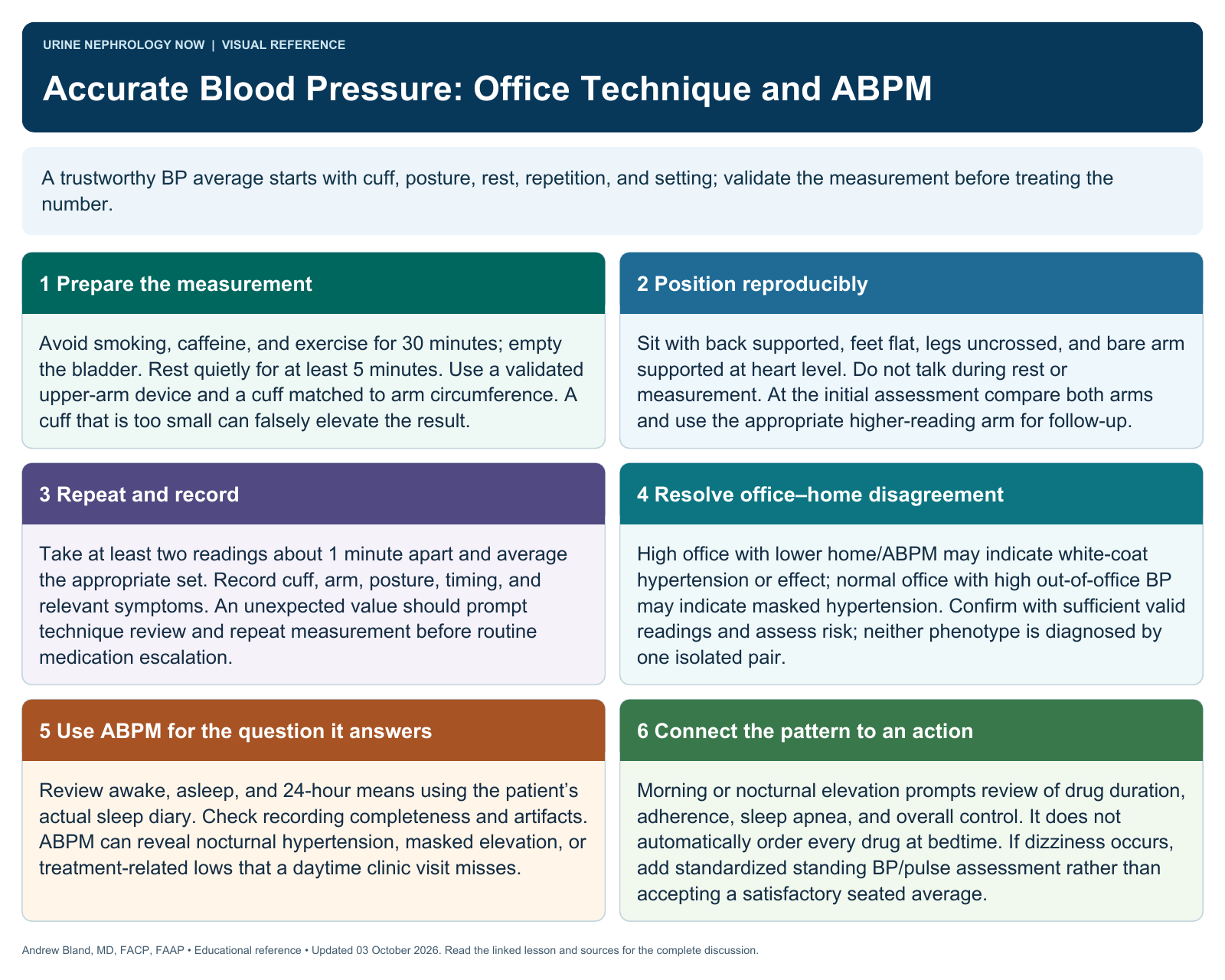
Browse the visual reference library · Download lesson Markdown
🎯 Measurement Precision Drives Diagnostic Accuracy
Diagnostic accuracy fundamentally determines treatment appropriateness. The 2025 guidelines elevate measurement standardization to unprecedented importance, recognizing that proper technique is the foundation of evidence-based hypertension management.
🏥 Standardized Office BP Measurement Protocol
Empty bladder • Avoid caffeine, exercise, smoking • No talking during measurement
Quiet environment • Feet flat on floor • Back supported • Avoid conversation
Arm at heart level • Appropriate cuff size • Bare skin contact • Support arm
Two readings 1-2 minutes apart • Average if difference >5 mmHg • Third reading if needed
Record all readings • Note cuff size used • Document patient position • Time of day
🔧 Device Selection and Validation
Class 1: Automated Oscillometric Devices
Preferred over auscultatory methods. Superior reproducibility, elimination of terminal digit bias, and reduced inter-observer variability. Must be validated per established protocols.
Class 2a: Auscultatory Methods
Reasonable when automated devices unavailable. Requires training, standardized technique, and awareness of terminal digit preference.
Class 3 (Harm): Cuffless Devices
Not recommended for clinical decisions. Absence of standardized validation protocols and unacceptable measurement variability despite consumer proliferation.
🏠 Out-of-Office Monitoring: Essential Diagnostic Component
📊 Ambulatory BP Monitoring (ABPM)
- 24-hour recordings capture diurnal variation
- Nocturnal dipping patterns assessment
- Morning surge phenomena detection
- Superior cardiovascular outcome prediction
- Eliminates white-coat effect completely
ABPM Thresholds:
- 📅 24-hour average: ≥130/80 mmHg
- ☀️ Daytime average: ≥135/85 mmHg
- 🌙 Nighttime average: ≥120/70 mmHg
🏠 Home BP Monitoring (HBPM)
- Equal recommendation when ABPM unavailable
- 7-day protocol with standardized timing
- Patient engagement and adherence benefits
- Cost-effective long-term monitoring
- Real-world BP assessment
HBPM Protocol:
- 📋 7 consecutive days of measurements
- 🗑️ Discard day 1 readings
- 🌅 Duplicate morning and evening readings
- 📈 Average remaining values
- 🎯 Threshold: ≥130/80 mmHg
📊 Diagnostic Thresholds by Measurement Method
| BP Category | Office BP (mmHg) |
ABPM 24-hr (mmHg) |
ABPM Daytime (mmHg) |
ABPM Nighttime (mmHg) |
Home BP (mmHg) |
|---|---|---|---|---|---|
| Normal | <120/80 | <115/75 | <120/80 | <100/65 | <120/80 |
| Elevated | 120-129/<80 | 115-124/75-79 | 120-129/80-84 | 100-109/65-69 | 120-129/<80 |
| Stage 1 HTN | 130-139/80-89 | 125-134/75-84 | 130-139/80-89 | 110-119/65-79 | 130-139/80-89 |
| Stage 2 HTN | ≥140/90 | ≥135/85 | ≥140/90 | ≥120/70 | ≥140/90 |
🎭 Hypertension Phenotypes: Recognition and Management
✅ True Normotensive
Definition: Normal office BP (<130/80) + Normal out-of-office BP
Prevalence: 60-70% of patients with normal office readings
Management: Lifestyle optimization, periodic monitoring, cardiovascular risk assessment
🥼 White-Coat Hypertension
Definition: Elevated office BP (≥130/80) + Normal out-of-office BP
Prevalence: 15-30% of patients with elevated office readings
Class 2a Recommendation: Exclude before diagnosis when office BP 130-159/80-99 mmHg
Management: Avoid unnecessary treatment, monitor for progression, address cardiovascular risk factors
🎭 Masked Hypertension
Definition: Normal office BP (<130/80) + Elevated out-of-office BP
Prevalence: 10-15% of patients with normal office readings
Class 2b Recommendation: Screen in high-risk patients
Risk Factors for Masked HTN:
- Male sex, obesity, diabetes, CKD
- Obstructive sleep apnea
- High-normal office BP (120-129/75-84 mmHg)
- Occupational or environmental stress
Management: Treat as sustained hypertension - comparable target organ damage risk
🔴 Sustained Hypertension
Definition: Elevated office BP (≥130/80) + Elevated out-of-office BP
Prevalence: 60-75% of patients with elevated office readings
Management: Standard hypertension treatment per guidelines, lifestyle modifications, pharmacotherapy
🎯 Interactive Hypertension Phenotype Classifier
Enter blood pressure readings to determine the hypertension phenotype and appropriate management approach.
📋 Management Recommendation:
Avoid unnecessary antihypertensive treatment. Monitor for progression to sustained hypertension. Address modifiable cardiovascular risk factors through lifestyle modifications.
📚 Sources
- Muntner P, Shimbo D, Carey RM, et al. Measurement of Blood Pressure in Humans: AHA Scientific Statement. Hypertension. 2019;73(5):e35-e66. PMID: 30827125.
- Whelton PK, et al. 2017 ACC/AHA HTN Guideline. Hypertension. 2018;71(6):e13-e115. PMID: 29133356.
- Pickering TG, et al. AHA HBPM Call to Action. Hypertension. 2008;52(1):10-29. PMID: 18497370.
- Sharman JE, O'Brien E, Alpert B, et al. Lancet Commission BP devices position statement. J Hypertens. 2020;38(1):21-29. PMID: 31790375.
🎯 Key Learning Points
📏 Measurement Precision
- Automated oscillometric devices preferred (Class 1)
- Standardized 5-step office protocol essential
- Cuffless devices not recommended for clinical decisions
🏠 Out-of-Office Monitoring
- ABPM provides reference standard for diagnosis
- HBPM equally effective when ABPM unavailable
- Essential for phenotype classification
🎭 Phenotype Recognition
- White-coat HTN screening prevents overtreatment
- Masked HTN carries comparable cardiovascular risk
- Phenotype classification guides treatment decisions