Visual reference
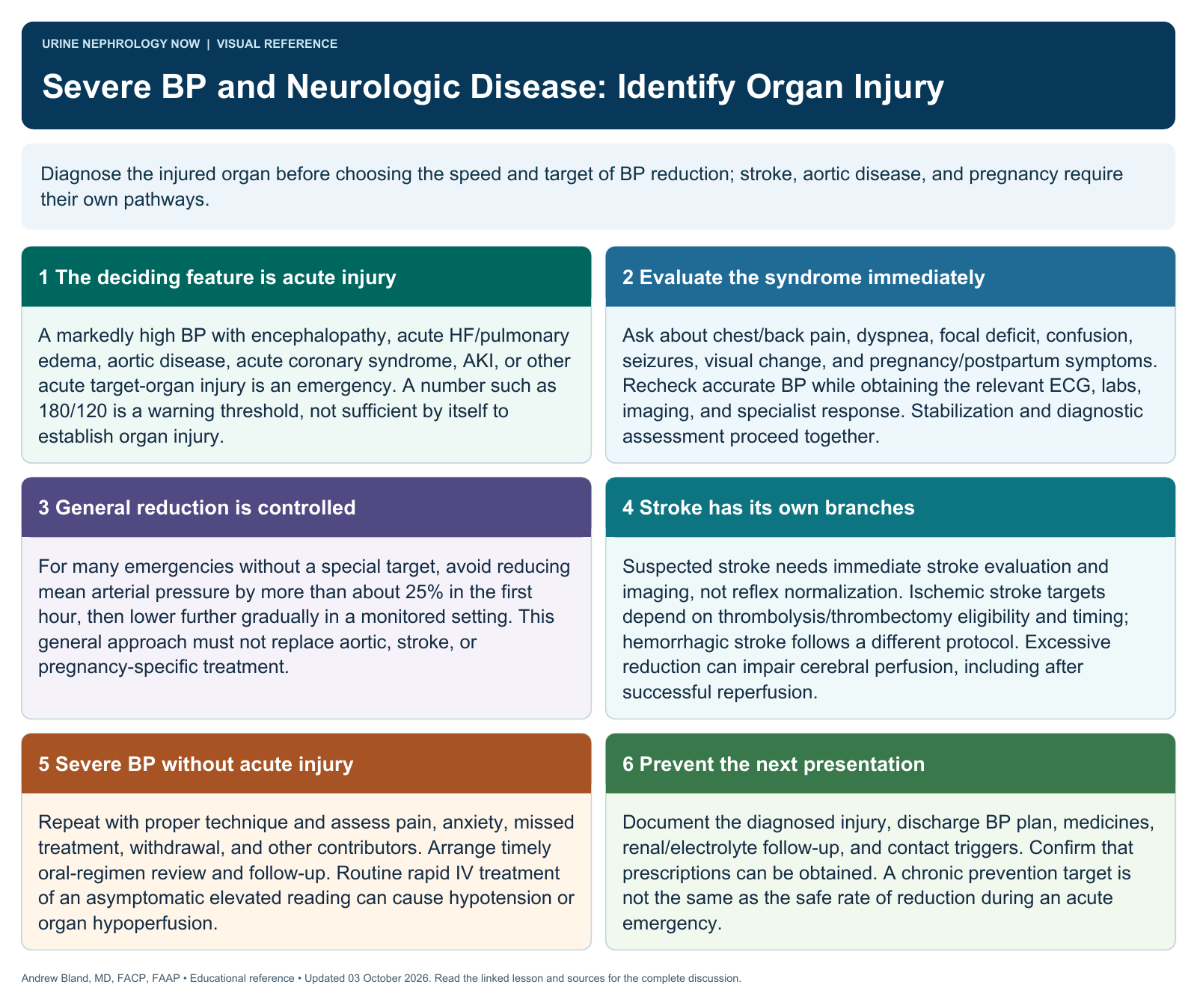
Browse the visual reference library · Download lesson Markdown
🎯 Precision Management Revolution
The 2025 guidelines provide refined, evidence-based protocols for acute cerebrovascular management, distinguishing between intracerebral hemorrhage subtypes and post-endovascular therapy scenarios. These nuanced approaches optimize outcomes while minimizing harm.
🩸 Acute Intracerebral Hemorrhage Management
⏰ Time-Critical Intervention Window
Initiate BP control within 2 hours of symptom onset when hematoma expansion risk peaks. This narrow window is crucial for preventing secondary injury.
Selected mild-to-moderate ICH with presenting SBP 150–220: target 140 mmHg, maintain 130–150 (AHA/ASA 2022 guideline)
Duration: 7 days post-hemorrhage
💎 Critical Evidence Integration
The refined Class 2a recommendation reflects nuanced interpretation of INTERACT-2 (showing benefit) and ATACH-2 (showing potential harm from overly aggressive reduction). The target avoids SBP <130 mmHg to prevent cerebral hypoperfusion in the setting of impaired autoregulation.
📋 Stepwise Management Protocol
Initial Assessment & Stabilization
Immediate neuroimaging (CT), coagulation studies, baseline neurological assessment. Establish IV access, initiate continuous BP monitoring.
Intensive BP Management
Target SBP 140 mmHg using continuous infusion agents. Nicardipine (preferred), labetalol, or esmolol for precise titration.
Maintenance & Monitoring
Continue SBP 130-139 mmHg range. Serial neurological assessments, repeat imaging if deterioration. Monitor for cerebral edema.
Sustained Control
Transition to oral agents using the stroke team’s individualized target. Begin rehabilitation planning, address secondary prevention.
🎯 Preferred IV Agents
- Nicardipine: 5-15 mg/hr infusion
- Labetalol: 10-20 mg boluses or 0.5-2 mg/min
- Esmolol: 25-300 mcg/kg/min (if no contraindications)
⚠️ Avoid These Agents
- Sublingual nifedipine: Unpredictable, excessive reduction
- IV hydralazine: Uncontrolled, precipitous drops
- IV metoprolol: Potential CNS depression
Post-Endovascular Therapy: Trial Evidence
ENCHANTED2/MT: very intensive lowering caused harm
After successful thrombectomy, ENCHANTED2/MT compared an SBP target <120 mmHg with 140–180 mmHg for 72 hours in patients with persistently elevated BP. The <120 strategy worsened functional outcomes. Yang et al., Lancet 2022.
The trial does not establish that every SBP below 140 is harmful.
Apply the result in context
Individualize post-thrombectomy BP management with the stroke team and current local stroke protocol, accounting for reperfusion, neurologic status, hemorrhage and comorbid illness. Do not use the trial comparator as a reason to raise every lower BP to 140 mmHg. Antithrombotic decisions require a separate stroke-specific indication and bleeding assessment.
🧊 Acute Ischemic Stroke (Non-Endovascular)
Permissive hypertension: Allow SBP <220 mmHg, DBP <120 mmHg
Avoid aggressive reduction in acute phase
🎯 Management by Clinical Scenario
💉 tPA Candidates
- Reduce SBP to <185 mmHg before tPA
- Maintain <180/105 mmHg for 24 hours post-tPA
- Use nicardipine or labetalol
- Monitor for hemorrhagic conversion
🚫 Non-tPA Patients
- Permissive hypertension: SBP <220 mmHg
- Avoid routine BP reduction
- Preserve penumbral perfusion
- Begin reduction after 24-48 hours
🫀 Cardiac Complications
- Acute MI: standard ACS protocols
- Heart failure: careful diuresis
- Arrhythmias: rate/rhythm control
- Aortic dissection: emergency surgery
🧠 Neurological Deterioration
- Cerebral edema: osmotic therapy
- Hemorrhagic conversion: BP control
- Malignant MCA syndrome: consider surgery
- Seizures: antiepileptic therapy
🧠 Cognitive Preservation & Dementia Prevention
📈 SPRINT-MIND Evidence Integration
🎯 Intensive BP Control
19% reduction in mild cognitive impairment with SBP <120 mmHg vs <140 mmHg
📊 Composite Cognitive Outcomes
15% reduction in combined MCI and probable dementia outcomes
🧪 White Matter Protection
Reduced small vessel disease progression and white matter hyperintensity burden
Target SBP <130 mmHg for cognitive preservation
Particularly important in midlife hypertension
🔬 Mechanistic Understanding
Midlife hypertension particularly predicts late-life cognitive decline through small vessel disease, blood-brain barrier disruption, and chronic cerebral hypoperfusion. The Class 1 upgrade supports aggressive treatment in younger patients for brain health preservation beyond cardiovascular protection.
📋 Cognitive Protection Protocol
👥 Target Populations
- Adults 50+ years with CV risk factors
- No history of diabetes or stroke
- Absence of orthostatic hypotension
- Life expectancy >3 years
🎯 Implementation Strategy
- Gradual SBP reduction to <130 mmHg
- Monitor cognitive function annually
- Screen for depression and anxiety
- Encourage cognitive stimulation
⚖️ Risk-Benefit Assessment
- Balance cognitive benefits vs fall risk
- Avoid excessive reduction (<110 mmHg)
- Consider frailty status
- Regular medication tolerance review
🧪 Adjunctive Measures
- Lipid management (statins)
- Diabetes prevention/control
- Physical exercise programs
- Social engagement promotion
💊 Cerebrovascular-Specific Medication Considerations
| Clinical Scenario | Preferred Agents | Target BP | Monitoring | Contraindications |
|---|---|---|---|---|
| Acute ICH | Nicardipine, labetalol, esmolol | Selected mild-to-moderate ICH: target 140; maintain 130–150 | Continuous BP, neuro checks q1h | Sublingual nifedipine, hydralazine |
| Post-Endovascular | Individualized stroke-team protocol | ENCHANTED2/MT comparator: 140–180; individual clinical target varies | Neuro status, vessel patency | Very intensive target <120 tested in ENCHANTED2/MT |
| tPA Eligible | Nicardipine, labetalol | SBP <185 pre-tPA, <180 post | BP q15min × 2hr, then q30min | Beta-blockers (relative) |
| Chronic Prevention | ACE inhibitors, thiazides, CCBs | SBP <130 mmHg | Cognitive assessment annually | Excessive reduction <110 mmHg |
| Cognitive Preservation | RAAS inhibitors preferred | SBP <130 mmHg | MoCA, orthostatic vitals | Rapid titration in elderly |
📚 Sources
- Anderson CS, Heeley E, Huang Y, et al; INTERACT2 Investigators. Rapid blood-pressure lowering in patients with acute intracerebral hemorrhage (INTERACT-2). N Engl J Med. 2013;368(25):2355-2365. PMID: 23713578. [Source for: target SBP <140 within 1 hour in acute ICH; primary outcome (death or major disability) numerically lower (52.0% vs 55.6%, OR 0.87, p=0.06) but did not meet significance; secondary functional outcomes favored intensive arm.]
- Qureshi AI, Palesch YY, Barsan WG, et al; ATACH-2 Investigators. Intensive Blood-Pressure Lowering in Patients with Acute Cerebral Hemorrhage (ATACH-2). N Engl J Med. 2016;375(11):1033-1043. PMID: 27276234. [Source for: target SBP 110-139 vs 140-179 in acute ICH — no significant difference in primary outcome (death or disability) but more renal adverse events in intensive arm. Tempers INTERACT-2 enthusiasm.]
- PROGRESS Collaborative Group. Randomised trial of a perindopril-based blood-pressure-lowering regimen among 6105 individuals with previous stroke or transient ischaemic attack. Lancet. 2001;358(9287):1033-1041. PMID: 11589932. [Source for: secondary stroke prevention — perindopril+indapamide reduced stroke 28% (HR 0.72) and major vascular events 26%; foundational secondary-prevention BP-lowering evidence after stroke or TIA.]
- Anderson CS, Huang Y, Lindley RI, et al; ENCHANTED Investigators. Intensive blood pressure reduction with intravenous thrombolysis therapy for acute ischaemic stroke (ENCHANTED): an international, randomised, open-label, blinded-endpoint, phase 3 trial. Lancet. 2019;393(10174):877-888. PMID: 30739745. [Source for: intensive BP lowering (target SBP 130-140) during/after IV thrombolysis did not improve functional outcome at 90 days but reduced symptomatic ICH (14.8% vs 18.7%, OR 0.75, p=0.0137).]
- Sandset EC, Anderson CS, Bath PM, et al; ESO Guidelines Committee. European Stroke Organisation (ESO) guidelines on blood pressure management in acute ischaemic stroke and intracerebral haemorrhage. Eur Stroke J. 2021;6(2):XLVIII-LXXXIX. PMID: 34780578. [Source for: ESO guideline on BP management in acute stroke — supports careful BP lowering in ICH, withholding aggressive lowering in acute ischemic stroke.]
- Whelton PK, Carey RM, Aronow WS, et al. 2017 ACC/AHA Guideline for High Blood Pressure in Adults. Hypertension. 2018;71(6):e13-e115. PMID: 29133356. [Source for: post-stroke target <130/80 mmHg secondary prevention.]
🎯 Cerebrovascular Disease: Key Learning Points
🩸 Acute ICH Management
- Selected mild-to-moderate ICH: target 140 mmHg and maintain 130–150
- Avoid SBP <130 mmHg to prevent hypoperfusion
- Use continuous infusion agents for precision
- INTERACT-2 vs ATACH-2 evidence integration
🔧 Post-Endovascular Care
- ENCHANTED2/MT found harm from a target <120 mmHg
- Individualize BP with the stroke team; the trial did not test every target below 140
- ENCHANTED-2/MT (Yang 2022) post-thrombectomy harm signal
- Gradual transition to standard targets
🧠 Cognitive Preservation
- Class 1 upgrade: SBP <130 mmHg for MCI prevention
- SPRINT-MIND: 19% reduction in cognitive impairment
- Midlife hypertension control crucial
- Balance benefits vs falls risk in elderly