Visual reference
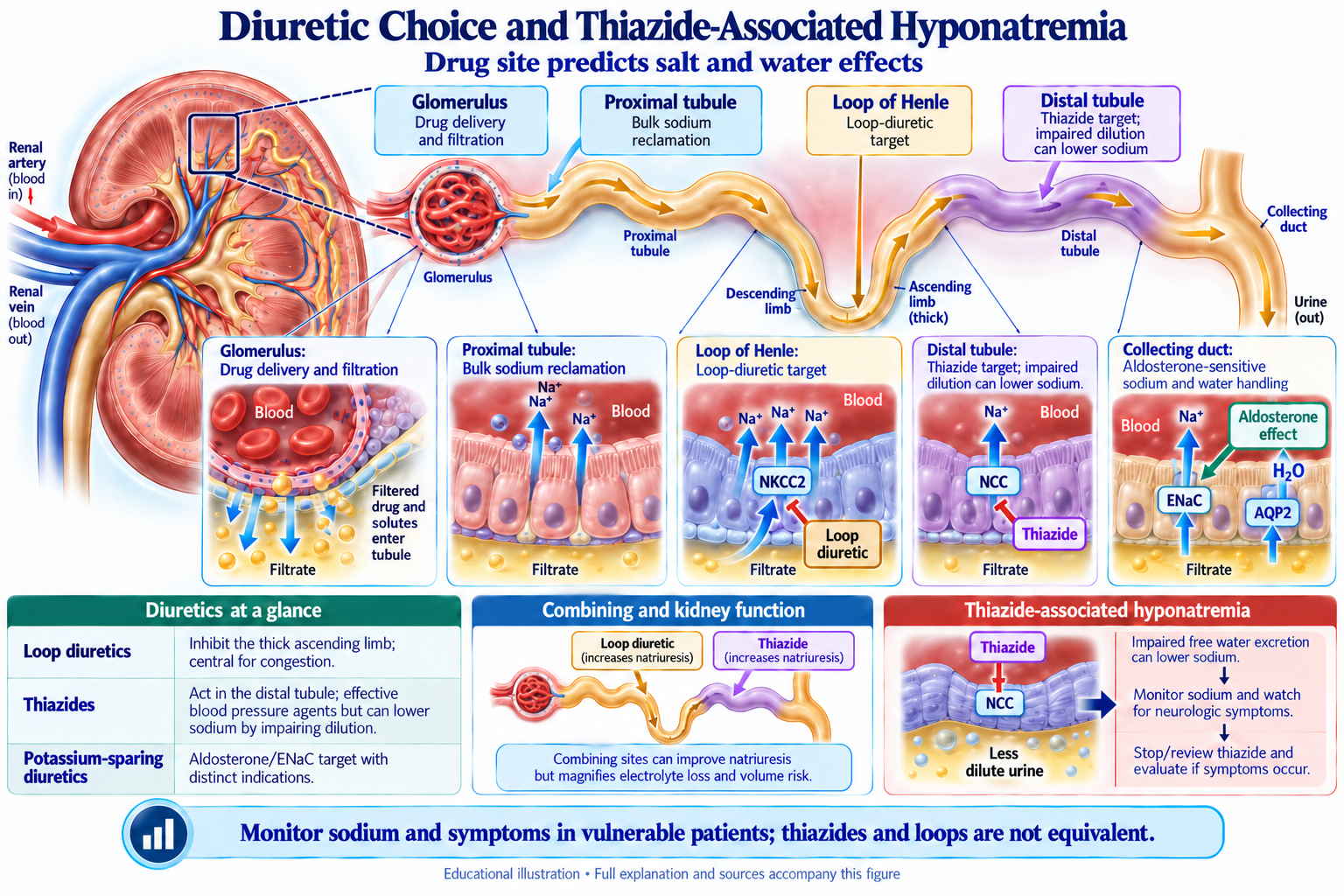
Browse the visual reference library · Download lesson Markdown
⚠️ Critical Safety Alert
💊 Thiazide vs Thiazide-Like Diuretics
🔍 Evidence-Based Selection Criteria
Current evidence strongly favors thiazide-like diuretics over traditional thiazides for cardiovascular outcome benefits and duration of action.
| Parameter | Hydrochlorothiazide (HCTZ) | Chlorthalidone | Indapamide | Clinical Significance |
|---|---|---|---|---|
| Half-Life | 6-15 hours | 40-60 hours | 14-18 hours | Longer = better 24-hour coverage |
| Duration of Action | 12-24 hours | 48-72 hours | 24-36 hours | Extended duration improves outcomes |
| 24-Hour BP Reduction | Baseline | 45% greater than HCTZ | 35% greater than HCTZ | Superior nighttime and early morning control |
| Cardiovascular Outcomes Evidence | Limited direct evidence | SHEP, ALLHAT trials | INDANA, ADVANCE trials | Thiazide-like agents have stronger evidence base |
| Stroke Prevention | 1.2% ARR over 5 years | 1.8% ARR over 5 years | 1.7% ARR over 5 years | Thiazide-like superior for stroke prevention |
| Heart Failure Prevention | 1.5% ARR over 5 years | 2.3% ARR over 5 years | 2.1% ARR over 5 years | Thiazide-like agents show greater benefit |
⚖️ Comprehensive Risk-Benefit Analysis
✅ Cardiovascular Benefits
Blood Pressure Lowering Treatment Trialists' Collaboration Results:
Major Clinical Benefits (5-year absolute risk reduction):
- All-cause mortality: 1.3% reduction (NNT = 77)
- Cardiovascular mortality: 1.0% reduction (NNT = 100)
- Major cardiovascular events: 2.8% reduction (NNT = 36)
- Stroke: 1.5% reduction (NNT = 67)
- Heart failure: 2.0% reduction (NNT = 50)
Mechanism of Cardiovascular Protection:
- Volume reduction: Decreased preload and cardiac workload
- Arterial effects: Direct vasodilation beyond volume effects
- Regression of LVH: Left ventricular mass reduction
- Improved arterial compliance: Reduced arterial stiffness
⚠️ Hyponatremia Risk Profile
Population-Based Risk Assessment:
High-Risk Demographics:
- Age >70 years: 14.8% absolute risk (OR 3.4)
- Female sex: 12.6% absolute risk (OR 2.7)
- Low body weight (<60 kg): 11.9% absolute risk (OR 2.3)
- Baseline Na+ <140 mmol/L: 10.4% absolute risk (OR 2.1)
- Concurrent SSRI use: 13.5% absolute risk (OR 2.8)
Risk Stratification by Severity:
4.2% absolute risk
Usually asymptomatic
1.8% absolute risk
Cognitive symptoms
0.4% absolute risk
Neurological complications
💧 The Fluid Intake Paradox
🚫 Critical Safety Information
Conventional advice to increase fluid intake during diuretic therapy is not only unsupported but actively harmful for patients taking thiazides.
Evidence Against Increased Fluid Intake:
Physiological Mechanism:
- Dilutional effect: Excessive water intake dilutes serum sodium
- Impaired water excretion: Thiazides impair free water clearance
- Enhanced ADH sensitivity: Increased antidiuretic hormone responsiveness
- Distal nephron effects: Reduced diluting capacity in collecting duct
Evidence-Based Fluid Recommendations:
Normal fluid intake (1.5-2.0 L/day)
No specific restrictions needed
Limit to 1.5 L/day
Careful monitoring required
Consider alternative agents
If thiazide essential: 1.2-1.5 L/day
🎯 Optimal Dosing Strategies
📊 Evidence-Based Dosing Guidelines
Current evidence supports lower starting doses with careful titration to minimize adverse effects while maintaining efficacy.
| Agent | Starting Dose | Target Dose | Maximum Dose | Monitoring Frequency |
|---|---|---|---|---|
| Hydrochlorothiazide | 12.5 mg daily | 12.5-25 mg daily | 50 mg daily | Weekly x 2, then monthly x 2 |
| Chlorthalidone | 12.5 mg daily | 12.5-25 mg daily | 25 mg daily | Weekly x 2, then monthly x 2 |
| Indapamide | 1.25 mg daily | 1.25-2.5 mg daily | 2.5 mg daily | Weekly x 2, then monthly x 2 |
Special Considerations for Dose Selection:
- Elderly patients (>75 years): Start with lowest dose and titrate cautiously
- Renal impairment (eGFR 30-60): Standard dosing, increased monitoring
- Severe renal impairment (eGFR <30): Consider alternative agents
- Heart failure: Higher doses may be required for volume management
Dose-Response Relationship:
Research demonstrates that the dose-response curve for thiazide diuretics is relatively flat beyond 12.5-25 mg daily equivalents. Higher doses increase adverse effects disproportionately to blood pressure benefits.
🔗 Combination Therapy and Potassium-Sparing Agents
⚡ Potassium-Sparing Diuretic Combinations
Addressing Electrolyte Complications
Available Fixed-Dose Combinations:
- HCTZ/Amiloride: 25/5 mg, good potassium preservation
- HCTZ/Triamterene: 25/37.5 mg, moderate potassium effect
- HCTZ/Spironolactone: 25/25 mg, aldosterone antagonism
- Chlorthalidone/Amiloride: Limited availability
Clinical Benefits:
- Reduced hypokalemia: 70-85% reduction in potassium loss
- Maintained natriuresis: Preserved blood pressure effects
- Reduced hyponatremia risk: 40-50% reduction in sodium depletion
- Improved tolerability: Fewer discontinuations
🎪 Triple Therapy Integration
Optimal Combination Strategies
Preferred Triple Combinations:
- ACE-I/ARB + CCB + Thiazide-like: Gold standard combination
- ACE-I/ARB + CCB + Potassium-sparing: For high hyponatremia risk
- Single-pill triple combinations: Improved adherence
- Component flexibility: Individual dose optimization
Sequential Addition Strategy:
📋 Structured Monitoring and Risk Mitigation
🎯 Evidence-Based Monitoring Protocol
Pre-Initiation Assessment:
- Baseline electrolytes: Sodium, potassium, chloride, CO2
- Renal function: Creatinine, eGFR, BUN
- Risk factor assessment: Age, sex, BMI, medications
- Comorbidity evaluation: Heart failure, liver disease, endocrine disorders
Monitoring Schedule:
| Timepoint | Standard Risk | High Risk | Parameters | Action Thresholds |
|---|---|---|---|---|
| 1-2 weeks | Required | Required | Na+, K+, Creatinine | Na+ <135: Reduce dose |
| 4-6 weeks | Recommended | Required | Complete metabolic panel | K+ <3.5: Add K+-sparing |
| 3 months | Required | Required | Electrolytes, eGFR | eGFR decline >25%: Evaluate |
| 6-12 months | Annually | Every 6 months | Complete assessment | Reassess risk factors |
Patient Education Components:
- Symptom recognition: Confusion, weakness, nausea, headache
- Fluid intake guidance: Avoid excessive water consumption
- Medication adherence: Consistent timing and dosing
- Emergency contact: When to seek immediate medical attention
🔄 Alternative Agent Selection for High-Risk Patients
🚦 Risk-Stratified Treatment Algorithm
For patients at high risk for thiazide-induced hyponatremia, alternative first-line agents should be strongly considered.
High-Risk Patient Identification:
- Elderly women (>70 years) with BMI <25 kg/m²
- Baseline sodium 135-140 mmol/L
- Concurrent SSRI, carbamazepine, or NSAID use
- History of hyponatremia from any cause
- Multiple hyponatremia risk factors present
Preferred Alternative Agents:
Calcium Channel Blockers
Advantages: No electrolyte effects, excellent cardiovascular outcomes
Preferred: Amlodipine 2.5-10 mg daily
ACE Inhibitors/ARBs
Advantages: Renoprotective, minimal electrolyte risk
Preferred: Lisinopril 5-40 mg or Losartan 50-100 mg daily
Potassium-Sparing Monotherapy
Advantages: Diuretic effect without hyponatremia risk
Preferred: Spironolactone 25-50 mg daily
🧮 Thiazide Hyponatremia Risk Calculator
📊 Risk Assessment Tool
Calculate individual patient risk for thiazide-induced hyponatremia:
📚 Sources
- ALLHAT Officers and Coordinators for the ALLHAT Collaborative Research Group. Major outcomes in high-risk hypertensive patients randomized to angiotensin-converting enzyme inhibitor or calcium channel blocker vs diuretic: ALLHAT. JAMA. 2002;288(23):2981-2997. PMID: 12479763. [Source for: chlorthalidone non-inferior or superior to lisinopril and amlodipine in primary CV outcome and HF; foundational thiazide-like outcome data; N=33,357.]
- SHEP Cooperative Research Group. Prevention of stroke by antihypertensive drug treatment in older persons with isolated systolic hypertension: Final results of the Systolic Hypertension in the Elderly Program. JAMA. 1991;265(24):3255-3264. PMID: 2046107. [Source for: chlorthalidone-based regimen reduced stroke 36% and major CV events 32% in isolated systolic HTN ≥60y; N=4,736.]
- Beckett NS, Peters R, Fletcher AE, et al; HYVET Study Group. Treatment of hypertension in patients 80 years of age or older. N Engl J Med. 2008;358(18):1887-1898. PMID: 18378519. [Source for: indapamide ± perindopril reduced stroke 30%, CV mortality 23%, all-cause mortality 21% in patients ≥80y; N=3,845.]
- Filippone EJ, Ruzieh M, Foy A. Thiazide-Associated Hyponatremia: Clinical Manifestations and Pathophysiology. Am J Kidney Dis. 2020;75(2):256-264. PMID: 31606239. [Source for: thiazide hyponatremia mechanism, risk factors, and management.]
- Chow KM, Szeto CC, Wong TY, Leung CB, Li PK. Risk factors for thiazide-induced hyponatraemia. QJM. 2003;96(12):911-917. PMID: 14631057. [Source for: thiazide-hyponatremia risk factors — age (HR 2.14/decade), low body weight (OR 0.77/5kg), low potassium (OR 0.37/SD); explicitly NOT female sex, NOT SSRIs, NOT NSAIDs.]
- Liamis G, Liberopoulos E, Barkas F, Elisaf M. Diabetes mellitus and electrolyte disorders. World J Clin Cases. 2014;2(10):488-496. PMID: 25325058. [Source for: thiazide-related electrolyte disturbances in diabetic patients including hyponatremia, hypokalemia, hypomagnesemia.]
- Roush GC, Holford TR, Guddati AK. Chlorthalidone compared with hydrochlorothiazide in reducing cardiovascular events: systematic review and network meta-analyses. Hypertension. 2012;59(6):1110-1117. PMID: 22526259. [Source for: chlorthalidone superiority over HCTZ in CV outcomes; longer half-life, more 24h coverage, 21% greater CHF/CHD reduction.]
- Whelton PK, Carey RM, Aronow WS, et al. 2017 ACC/AHA Guideline for High Blood Pressure in Adults. Hypertension. 2018;71(6):e13-e115. PMID: 29133356. [Source for: thiazide / thiazide-like first-line recommendation; chlorthalidone preferred where feasible.]