Visual reference
Browse the visual reference library · Download lesson Markdown
🚨 Critical HBPM Implementation Points
1
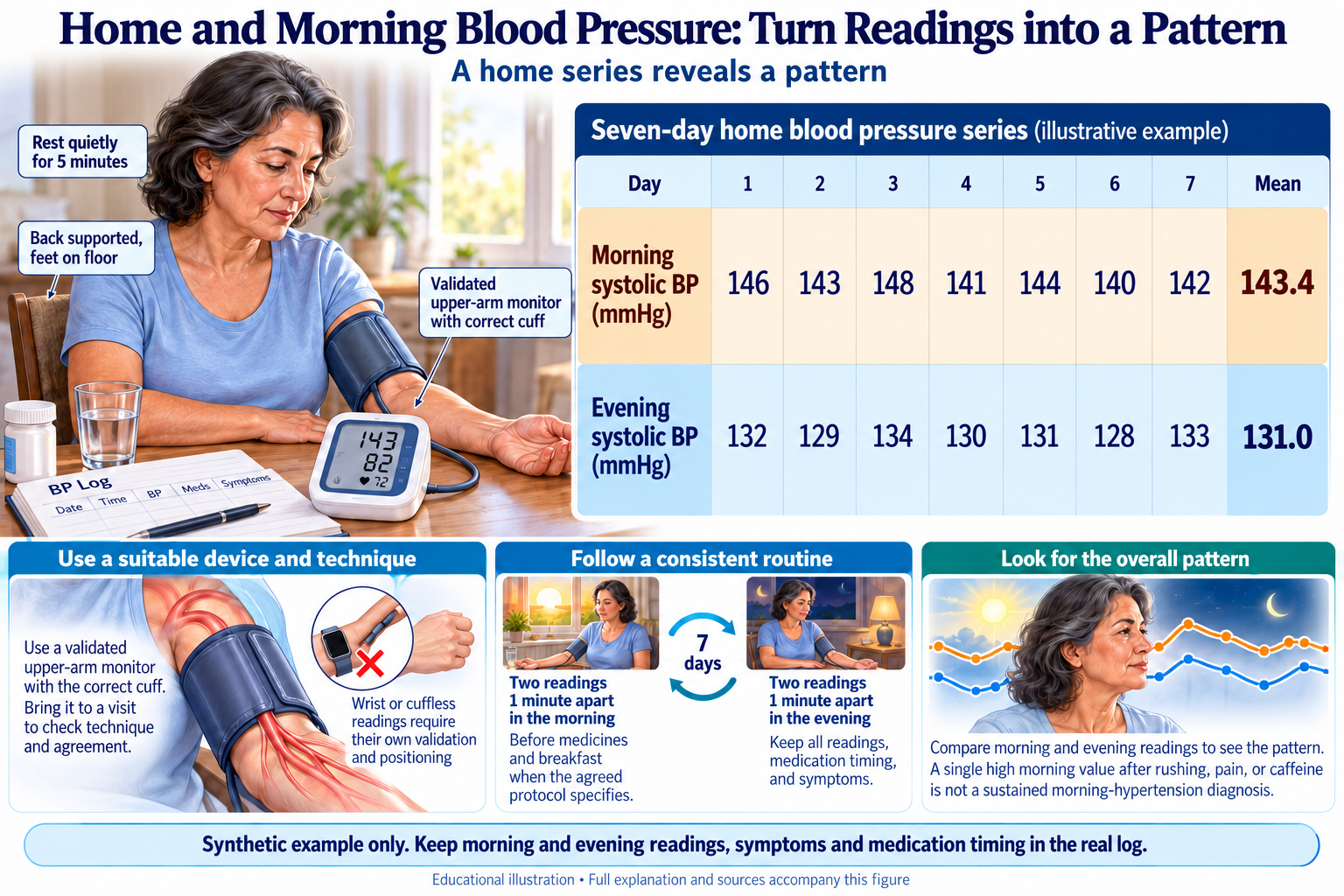
7-Day Rule: Morning and evening measurements for 7 consecutive days, discard Day 1 readings
2
Single Daily Priority: If only one measurement possible, choose morning pre-medication reading
3
Proper Technique: 5-minute rest, arm at heart level, appropriate cuff size, back supported
4
Device Validation: Use only clinically validated automated oscillometric devices
📋 Current Guideline Recommendations
🌍 2020 International Society of Hypertension
- Duration: Minimum 3 days, preferably 6-7 consecutive days
- Frequency: Before each clinic visit
- Status: "Invaluable adjunct to office measurements"
- Implementation: Essential component of diagnosis
🇪🇺 2021 European Society of Hypertension
- Protocol: 7 consecutive days, morning and evening
- Data Analysis: First day readings discarded
- Timing: Morning pre-dose preferred if single measurement
- Correlation: Strong association with cardiovascular outcomes
🇺🇸 2020 ACC/AHA Guidelines
- Minimum: 3 days of readings, optimally 7 days
- Schedule: Morning and evening measurements on separate days
- Integration: Useful adjunct to clinic BP measurements
- Threshold: ≥130/80 mmHg for diagnosis
🎯 Standardized Measurement Technique
⏰ Preparation and Timing
- Rest Period: 5-minute seated rest reduces systolic readings by 4.2 mmHg
- Pre-medication: Morning readings before antihypertensive medication
- Post-medication: 2-hour post-dose for efficacy assessment
- Consistency: Same time each day for reliable patterns
- Environmental: Quiet, comfortable temperature setting
🪑 Patient Positioning
- Seated Position: Back supported against chair back
- Feet Position: Flat on floor, legs uncrossed
- Arm Position: Supported on table at heart level
- Height Adjustment: Midpoint of upper arm at right atrium level
- Evidence: 0.7-0.8 mmHg increase per cm below heart level
🔧 Cuff Selection and Application
- Sizing Critical: Most common source of measurement error
- Bladder Coverage: Encircle 80-100% of arm circumference
- Undersized Impact: Falsely elevated readings (mean +5.7 mmHg)
- Application: Snug but not tight, 1-2 fingers under cuff
- Position: Lower edge 2-3 cm above antecubital fossa
📊 Multiple Reading Protocol
- Number: 2-3 readings per session, 1 minute apart
- First Reading: Typically discarded (often elevated)
- Averaging: Use mean of remaining readings
- Documentation: Record all readings for pattern assessment
- Variability: Note excessive differences (>10 mmHg)
🌅 Timing Considerations: Pre vs Post-Medication
🌄 Morning Pre-Medication Readings
Captures Trough Effect - Strongest Cardiovascular Predictor
- Timing: Before morning antihypertensive dose
- Clinical Significance: Represents weakest BP control period
- Prognostic Value: HR 1.18 per 10 mmHg increase (95% CI 1.12-1.24)
- Guideline Preference: ESH recommends as single daily measurement
- Medication Efficacy: Assesses 24-hour duration of therapy
⏰ Post-Medication Readings
Assesses Peak Drug Effect and Efficacy
- Optimal Timing: 2 hours post-dose for most antihypertensives
- ABPM Correlation: r=0.58 with daytime ambulatory readings
- Clinical Use: Medication titration and efficacy assessment
- Peak Effect: Captures maximum therapeutic response
- Safety Monitoring: Identifies excessive post-dose reduction
📈 Cardiovascular Outcome Correlations
🎯 Morning BP and Cardiovascular Risk
J-HOP Study (N=4,149) - Morning Hypertension Phenotypes
- Definition: Morning home SBP ≥135 mmHg and/or DBP ≥85 mmHg
- Prevalence: 10.8% general population, 19.6% in elderly (≥75 years)
- Independent Risk: Beyond evening BP measurements
- Clinical Implications: Requires targeted morning BP management
- Risk Stratification: Identifies high-risk patients for intervention
📊 Morning Surge Cardiovascular Impact
Top Decile of Sleep-Trough Surge (≥55 mmHg) vs Remaining 90% — per Kario et al., Circulation 2003;107(10):1401-1406, PMID 12642361
- Stroke incidence: 19% vs 7.3% (n=53 in top decile vs 466 in lower 90%)
- Adjusted relative risk: 2.7 (P=0.04), single composite stroke endpoint
- Independence: Significant after adjusting for age and 24-hour average BP
- Clinical Target: Morning surge ≥55 mmHg identifies patients at distinct stroke risk beyond mean BP
- Note: Separate HRs for coronary events / heart failure at this threshold are not from Kario 2003 — earlier teaching that cited per-outcome HRs at a 35 mmHg threshold has been corrected.
🔗 Correlation with 24-Hour ABPM
| ABPM Parameter | Correlation with Morning Home BP | 95% Confidence Interval | Clinical Interpretation |
|---|---|---|---|
| 24-hour Mean | r = 0.68 | 0.62-0.74 | Moderately strong correlation |
| Daytime Mean | r = 0.73 | 0.68-0.78 | Strong correlation |
| Nighttime Mean | r = 0.53 | 0.47-0.59 | Moderate correlation |
| Early Morning (6-9 AM) | r = 0.71 | 0.65-0.77 | Strong correlation |
📱 Device Selection and Validation
✅ Validated Device Requirements
- Validation Standard: ISO 81060-2:2018 protocol compliance
- Accuracy: Mean difference ≤5 mmHg, SD ≤8 mmHg
- Technology: Automated oscillometric devices preferred
- Database: Check dabl.ie or dableducational.org for validation
- Special Populations: Validation in pregnancy, arrhythmia, elderly
❌ Cuffless Device Limitations
- 2025 Guideline: Class 3 recommendation against clinical use
- Accuracy Issues: Unacceptable measurement variability
- Validation Gap: Absence of standardized protocols
- Consumer Devices: Not suitable for clinical decisions
- Future Potential: Awaiting technological improvements
🧮 HBPM Data Interpretation Calculator
Calculate average home BP from 7-day protocol (excluding Day 1)
Overall HBPM Average: 135 mmHg (Hypertension Present)
📊 Clinical Implementation Algorithm
🔄 2022 ESH Integrated Assessment Algorithm
1
Initial Screening: Multiple time measurements including morning pre-medication
2
Risk Stratification: Morning BP <135/85 mmHg = standard follow-up
3
High-Risk Pattern Assessment: Morning surge >35 mmHg, morning BP ≥145/90 mmHg
4
ABPM Consideration: Confirm patterns, assess nocturnal BP, quantify variability
5
Targeted Management: Chronotherapy, long-acting agents, combination therapy
📚 Sources
- Pickering TG, Miller NH, Ogedegbe G, Krakoff LR, Artinian NT, Goff D. Call to action on use and reimbursement for home blood pressure monitoring. Hypertension. 2008;52(1):10-29. PMID: 18497370. [Source for: 7-day HBPM protocol — two readings AM + PM, ≥12 readings for clinical decisions, discard day 1.]
- Muntner P, Shimbo D, Carey RM, et al. Measurement of Blood Pressure in Humans: AHA Scientific Statement. Hypertension. 2019;73(5):e35-e66. PMID: 30827125. [Source for: HBPM technique standards, validated devices, cuff sizing.]
- Whelton PK, Carey RM, Aronow WS, et al. 2017 ACC/AHA Guideline for High Blood Pressure in Adults. Hypertension. 2018;71(6):e13-e115. PMID: 29133356. [Source for: HBPM threshold ≥130/80 mmHg; Class 1 recommendation for HBPM use.]
- Stergiou GS, Bliziotis IA. Home blood pressure monitoring in the diagnosis and treatment of hypertension: a systematic review. Am J Hypertens. 2011;24(2):123-134. PMID: 20940712. [Source for: HBPM diagnostic accuracy and prognostic value; equivalent or superior to office BP for risk prediction.]
- Bobrie G, Chatellier G, Genes N, et al. Cardiovascular prognosis of "masked hypertension" detected by BP self-measurement. JAMA. 2004;291(11):1342-1349. PMID: 15026401. [Source for: HBPM detection of masked HTN — HR 2.06 vs sustained normotension; clinical utility of HBPM beyond office measurement.]
- Hoshide S, Kario K; JAMP Study Group. Morning home blood pressure surge and cardiovascular events. Hypertension. 2021;78(2):497-506. PMID: 34304583. [Source for: home-measured morning surge prognostic value.]
🎯 Key Learning Points
📱 7-Day Protocol: Morning and evening measurements for 7 days, discard Day 1 readings for accurate assessment
🌅 Morning Priority: Pre-medication morning readings provide strongest cardiovascular risk prediction
⏰ Technique Matters: 5-minute rest, proper positioning, validated devices essential for accuracy
📊 Independent Risk: Sleep-trough morning surge in the top decile (≥55 mmHg) carries adjusted stroke RR 2.7 independent of 24-h mean BP (Kario 2003, PMID 12642361). Surge >35 mmHg is a softer elevated-surge clinical indicator.