Visual reference
Browse the visual reference library · Download lesson Markdown
🎯 Precision Pharmacotherapy Approach
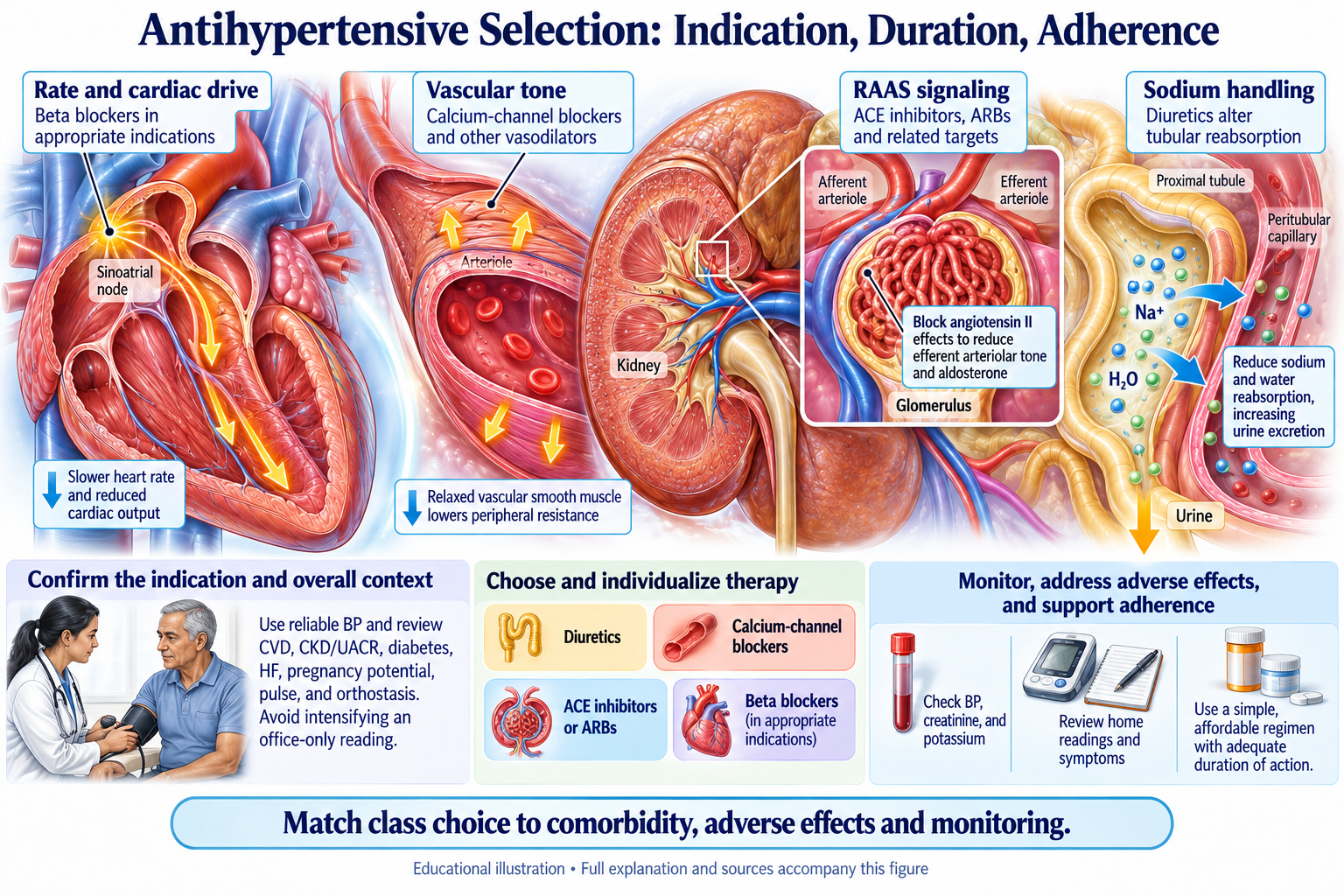
The 2025 hypertension guideline supports initial combination treatment for stage 2 hypertension. Select agents and follow-up according to blood pressure, comorbidities, tolerability, and patient preferences.
📋 Evidence-Based Treatment Algorithm
Risk Assessment & Treatment Threshold
PREVENT calculator ≥7.5%: Initiate medication for Stage 1 HTN (130-139/80-89 mmHg)
Stage 2 HTN (≥140/90 mmHg): Immediate medication regardless of cardiovascular risk
First-Line Agent Selection
Class 1 Options: Thiazide-type diuretics (chlorthalidone preferred), long-acting dihydropyridine CCBs, ACE inhibitors, ARBs
Stage 1 HTN: Monotherapy initiation acceptable
Stage 2 HTN: Initial Dual Therapy
Class 1 Recommendation: Start two agents simultaneously from different classes
Single-pill combinations preferred: 20-25% better adherence, equivalent efficacy
Target Achievement & Intensification
2025 AHA/ACC and ADA Standards of Care: <130/80 mmHg.
KDIGO 2021 (Blood Pressure in CKD): suggests a target systolic <120 mmHg when tolerated, using standardized office measurement (grade 2B, driven by the CKD subgroup of SPRINT). It explicitly excludes kidney transplant recipients and patients on dialysis.
Why the two numbers differ: much of the gap is measurement technique rather than disagreement about physiology. KDIGO's lower number presumes a standardized or unattended reading, which most routine clinic cuffs do not meet.
💊 First-Line Antihypertensive Agents
💧 Thiazide-Type Diuretics
Preferred Agent:
Chlorthalidone 12.5-25 mg daily
Superior potency and duration vs hydrochlorothiazide
Mechanism & Benefits:
- Volume depletion → vasodilation
- Stroke prevention superior
- Heart failure risk reduction
- Cost-effective
Monitoring:
Electrolytes, creatinine at 2-4 weeks. Watch for hypokalemia, hyponatremia, hyperuricemia.
🔴 Calcium Channel Blockers
Preferred Agents:
Amlodipine 2.5-10 mg daily
Nifedipine XL 30-90 mg daily
Long-acting dihydropyridines only
Clinical Advantages:
- Excellent stroke prevention
- No metabolic effects
- Safe in diabetes, CKD
- Complementary to RAAS inhibition
⚠️ Common Side Effects:
Peripheral edema (dose-dependent), gingival hyperplasia. Avoid immediate-release formulations.
🫀 RAAS Inhibitors
Agent Selection:
ACE inhibitors: Lisinopril, enalapril (dry cough 10-15%)
ARBs: Losartan, valsartan (better tolerance profile)
Compelling Indications:
- Diabetes with any albuminuria
- Chronic kidney disease
- Heart failure with reduced EF
- Post-myocardial infarction
❌ Class 3 (Harm): Dual RAAS Blockade
Never combine ACE inhibitor + ARB or + direct renin inhibitor. Increased hyperkalemia, hypotension, AKI without CV benefit.
🤝 Initial Combination Therapy Advantages
⏱️ Time to Target
Target BP achieved 6 months faster than sequential monotherapy titration. Earlier control reduces cardiovascular events.
📊 Efficacy
Additive BP reduction from complementary mechanisms. Lower doses of individual agents reduce side effects.
💊 Adherence
Single-pill combinations improve adherence by 20-25% compared to multiple separate tablets.
⚡ Tolerability
Fewer discontinuations due to adverse events. Complementary side effect profiles offset individual drug limitations.
🎯 Intensive Blood Pressure Targets
📈 SPRINT Trial Evidence
🫀 CV Events
25% relative risk reduction with intensive treatment (<120 vs <140 mmHg)
💀 Mortality
27% reduction in all-cause mortality with intensive targets
🧠 Cognitive
19% reduction in mild cognitive impairment (SPRINT-MIND)
⚠️ Patient Selection for Intensive Targets
✅ Appropriate Candidates
- Age 50+ years with CV risk factors
- No diabetes, stroke, or polycystic kidney disease
- Standing SBP ≥110 mmHg
- Life expectancy >3 years
- Motivated, adherent patients
❌ Avoid Intensive Targets
- Frail elderly patients
- Orthostatic hypotension
- Multiple falls history
- Limited life expectancy
- Advanced kidney disease
📊 Evidence Base for First-Line Agents
| Drug Class | Major Outcome Trials | Primary Benefits | Preferred Populations |
|---|---|---|---|
| Thiazide Diuretics | SHEP, ALLHAT, HYVET | Stroke prevention, heart failure reduction, cost-effective | Elderly, heart failure, stroke prevention |
| ACE Inhibitors | HOPE, EUROPA, ADVANCE | MI prevention, nephroprotection, mortality reduction | Diabetes, CKD, post-MI, heart failure |
| ARBs | LIFE, VALUE, ONTARGET | Stroke prevention, nephroprotection, better tolerance | ACE inhibitor intolerance, diabetes, CKD |
| Calcium Channel Blockers | ALLHAT, ASCOT, VALUE | Stroke prevention, elderly efficacy, no metabolic effects | Elderly, isolated systolic HTN, diabetes |
📚 Sources
- Whelton PK, Carey RM, Aronow WS, et al. 2017 ACC/AHA Guideline for High Blood Pressure in Adults. Hypertension. 2018;71(6):e13-e115. PMID: 29133356.
- Cameron NA, Jones DW, Khan SS, Lloyd-Jones DM. Case-Based Applications of the 2025 AHA/ACC/Multispecialty High Blood Pressure Guideline. Hypertension. 2025;82(12):2055-2063. PMID: 41204807.
- Brown C, Clark D, Jones DW. Updates in the 2025 AHA/ACC Hypertension Guideline. Curr Hypertens Rep. 2026;28(1). PMID: 41843050.
- Ettehad D, Emdin CA, Kiran A, et al. Blood pressure lowering for prevention of cardiovascular disease and death: a systematic review and meta-analysis. Lancet. 2016;387(10022):957-967. PMID: 26724178.
- SPRINT Research Group. A Randomized Trial of Intensive versus Standard Blood-Pressure Control. N Engl J Med. 2015;373(22):2103-2116. PMID: 26551272.
- ALLHAT Officers. Major outcomes in high-risk hypertensive patients randomized to ACE inhibitor or CCB vs diuretic. JAMA. 2002;288(23):2981-2997. PMID: 12479763.
🎯 Medical Management: Key Learning Points
💊 First-Line Selection
- Four drug classes with outcome evidence
- Chlorthalidone preferred over HCTZ
- Long-acting CCBs only (no immediate-release)
- Never combine ACE inhibitor + ARB
🤝 Combination Therapy
- Class 1 for Stage 2 HTN initial treatment
- Single-pill combinations improve adherence
- Target achieved 6 months faster
- Lower individual drug doses reduce side effects
🎯 Intensive Targets
- SPRINT: <120 mmHg reduces CV events 25%
- Careful patient selection essential
- Avoid in frail elderly or limited life expectancy
- Monitor for hypotension and falls