Visual reference
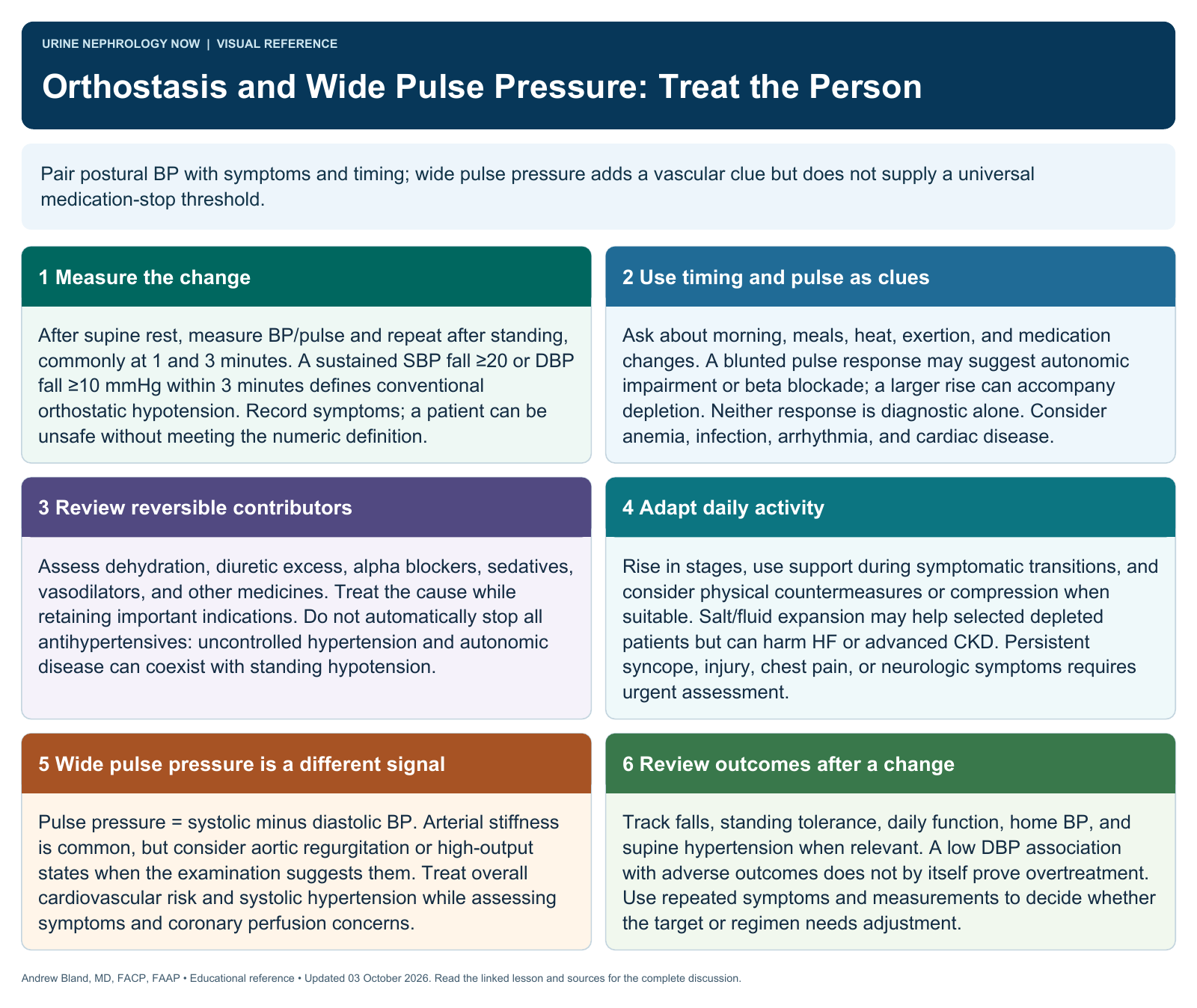
Browse the visual reference library · Download lesson Markdown
🔄 The Orthostatic Paradox
Class 1 Recommendation: Improved blood pressure control reduces orthostatic hypotension risk through better autonomic function and reduced arterial stiffness. The key is balancing intensive treatment benefits with individual tolerance.
📏 Definition and Diagnostic Criteria
🔢 Quantitative Definition
- Systolic: ≥20 mmHg decrease
- Diastolic: ≥10 mmHg decrease
- Timing: Within 3 minutes of standing
- HR Response: ≥30 bpm increase (POTS)
🔍 Clinical Assessment
- Symptoms: Dizziness, lightheadedness, falls
- Timing: Morning vs. postprandial
- Triggers: Heat, exercise, medications
- Duration: Immediate vs. delayed recovery
⚡ Special Considerations
- Masked OH: No symptoms despite BP drop
- Supine HTN: Concurrent condition
- Pseudohypertension: In elderly patients
- White-coat effect: Office vs. home readings
📐 Standardized Measurement Protocol
1️⃣ Supine Position
Patient lies flat for 5 minutes minimum. Record BP and HR at baseline.
2️⃣ Active Standing
Patient stands up actively (not assisted). Begin timing immediately.
3️⃣ 1-Minute Reading
Record BP and HR at 1 minute post-standing. Note any symptoms.
4️⃣ 3-Minute Reading
Final measurement at 3 minutes. Calculate changes from baseline.
5️⃣ Symptom Assessment
Document dizziness, weakness, falls risk throughout procedure.
6️⃣ Recovery Monitoring
Observe return to baseline and symptom resolution.
🧠 Neurogenic Causes
Autonomic Dysfunction
- Diabetes: Diabetic autonomic neuropathy
- Parkinson disease: α-synuclein deposition
- Multiple sclerosis: Demyelination effects
- Pure autonomic failure: Rare primary condition
Diagnostic Considerations
- Heart rate variability testing
- Tilt table testing if indicated
- Norepinephrine levels (supine vs. standing)
- Evaluation for underlying neurologic disease
🔬 2025 Guideline Evidence Base
✅ Class 1 Recommendation
Improved BP control reduces OH risk through better autonomic function and reduced arterial stiffness. This counterintuitive finding supports continued antihypertensive therapy in most patients.
⚠️ Class 2a Recommendation
Against withholding intensive treatment for asymptomatic orthostatic hypotension. Cardiovascular benefits outweigh theoretical risks in absence of symptoms or falls.
🎯 Clinical Application
Focus on symptomatic OH and falls risk rather than absolute BP numbers. Individual assessment of tolerance and quality of life impacts guides management decisions.
📊 SPRINT Trial OH Analysis
Trial Design
- Population: 9,361 high-risk patients
- Comparison: Intensive (<120) vs. standard (<140)
- Follow-up: 3.26 years median
- OH Assessment: Standing BP measured
OH Findings
- Prevalence: 23% baseline, similar both groups
- Incident OH: No difference intensive vs. standard
- Falls: No increased risk with intensive treatment
- Syncope: Rare in both groups (0.7% vs. 0.5%)
Clinical Implications
- Safety: Intensive treatment well-tolerated
- Benefits: 25% ↓ CV events, 27% ↓ mortality
- Quality of life: No significant impairment
- Patient selection: Exclude frail elderly
🧮 Orthostatic Hypotension Risk Calculator
Patient Characteristics
Risk Assessment
⚕️ Evidence-Based Management Strategy Matrix
| Patient Category | OH Status | BP Target | Treatment Approach | Monitoring Frequency | Special Considerations |
|---|---|---|---|---|---|
| Young (<65 years) | Asymptomatic OH | <130/80 mmHg | Continue intensive treatment | Standard (3-6 months) | Educate on position changes |
| Middle-aged (65-75) | Asymptomatic OH | <130/80 mmHg | Gradual BP reduction | Monthly until stable | Home BP monitoring |
| Elderly (75-85) | Mild symptoms | <140/90 → <130/80 | Stepwise approach | Bi-weekly initially | Falls risk assessment |
| Very elderly (>85) | Symptomatic OH | <140/90 mmHg | Conservative management | Weekly until stable | Quality of life focus |
| Frail/Limited mobility | Severe symptoms | <150/90 mmHg | Medication reduction | Weekly monitoring | Multidisciplinary care |
| High CV risk | Any OH | <130/80 mmHg | Benefits outweigh risks | Standard monitoring | Cardio-protective priority |
| Neurogenic OH | Severe OH | Individualized | Specialist management | Continuous monitoring | Fludrocortisone, midodrine |
🏃♂️ Behavioral Interventions
Position Change Techniques
- Gradual standing: 30-second stages, sit → stand
- Leg exercises: Calf pumps before standing
- Physical counter-maneuvers: Leg crossing, squatting
- Morning preparation: Head elevation, slow movements
Lifestyle Modifications
- Adequate hydration (2-3L daily unless contraindicated)
- Increased sodium intake (unless heart failure)
- Small, frequent meals to avoid postprandial OH
- Compression stockings (20-30 mmHg)
- Physical conditioning and resistance training
💊 Pharmacologic Strategies
Medication Optimization
- Dosing timing: Evening dosing for long-acting agents
- Formulation changes: Extended-release preferred
- Drug selection: Avoid alpha-blockers, high-dose diuretics
- Combination therapy: Lower doses, complementary mechanisms
Orthostatic Hypotension Treatments
- Fludrocortisone: 0.1-0.2mg daily, monitor K+ and edema
- Midodrine: 2.5-10mg TID, avoid evening dose
- Droxidopa: 100-600mg TID for neurogenic OH
- Pyridostigmine: 60mg TID for autonomic dysfunction
🔧 Device and Physical Therapies
Compression Devices
- Graduated stockings: 20-30 mmHg compression
- Abdominal binders: Reduce splanchnic pooling
- Pneumatic devices: Intermittent compression
- Whole-body suits: Severe refractory cases
Advanced Interventions
- Head-up tilt sleeping (4-6 inches)
- Targeted exercise training programs
- Biofeedback and autonomic training
- Electrical stimulation devices (experimental)
📋 Clinical Case: Balancing Intensive BP Control with OH Risk
Patient Presentation
Demographics: 72-year-old male
Medical History: Type 2 DM, CAD s/p CABG, CKD stage 3
Current BP: 165/95 mmHg (office), 155/90 mmHg (home)
PREVENT Risk: 22% (high risk)
Standing BP: 140/85 mmHg (25 mmHg drop)
Symptoms: Mild morning dizziness, no falls
Current Medications
- Lisinopril 20mg daily
- Amlodipine 5mg daily
- Hydrochlorothiazide 25mg daily
- Metoprolol XL 50mg daily
Management Strategy
Optimization Plan:
- Switch HCTZ to chlorthalidone 25mg daily
- Move amlodipine to evening dosing
- Add patient education on position changes
- Home BP monitoring with standing measurements
- Compression stockings trial
Monitoring Protocol:
- 2-week follow-up: symptom assessment, standing BP
- 4-week follow-up: home BP log review, medication adjustment
- 8-week follow-up: target BP achievement, falls assessment
- Goal: <130/80 mmHg (2025 AHA/ACC, ADA Standards of Care) without symptomatic OH
- Both guidelines, and why the lower one is not pursued here: KDIGO 2021 (Blood Pressure in CKD) suggests systolic <120 mmHg when tolerated, on standardized office measurement (grade 2B, driven by the CKD subgroup of SPRINT), and excludes transplant and dialysis patients. This patient has CKD stage 3, so KDIGO applies — but his 25 mmHg orthostatic drop with symptoms is precisely the "when tolerated" limit, so <130/80 without symptomatic OH is the operative goal. Note also that KDIGO's number presumes a standardized or unattended reading, which a routine clinic cuff does not meet.
📅 OH Monitoring and Management Timeline
Baseline Assessment (Week 0)
Comprehensive OH evaluation with standardized measurements, symptom assessment, falls risk screening, and medication review. Establish individual tolerance baseline.
Early Intervention (Weeks 1-2)
Implement behavioral modifications, adjust medication timing, begin compression therapy. Patient education on recognition and management of symptoms.
Close Monitoring Phase (Weeks 2-8)
Bi-weekly assessments with home BP monitoring including standing measurements. Medication titration based on tolerance and BP control. Falls diary implementation.
Stabilization Phase (Months 2-6)
Monthly monitoring with focus on sustained BP control and symptom stability. Quality of life assessment and functional capacity evaluation.
Long-term Management (6+ months)
Quarterly assessments with annual comprehensive OH evaluation. Medication optimization and lifestyle reinforcement. Specialist referral if refractory symptoms.
📚 Sources
- Freeman R, Wieling W, Axelrod FB, et al. Consensus statement on the definition of orthostatic hypotension, neurally mediated syncope and the postural tachycardia syndrome. Clin Auton Res. 2011;21(2):69-72. PMID: 21431947. [Source for: orthostatic hypotension definition — SBP drop ≥20 or DBP drop ≥10 within 3 min of standing.]
- SPRINT Research Group. A Randomized Trial of Intensive vs Standard BP Control. N Engl J Med. 2015;373(22):2103-2116. PMID: 26551272. [Source for: SPRINT orthostatic hypotension and falls data — falls HR 1.00 (no signal); orthostatic syncope SAE rate higher in intensive arm.]
- Whelton PK, et al. 2017 ACC/AHA HTN Guideline. Hypertension. 2018;71(6):e13-e115. PMID: 29133356. [Source for: target individualization in patients with orthostatic hypotension.]
- Juraschek SP, Daya N, Rawlings AM, et al. Association of History of Dizziness and Long-term Adverse Outcomes With Early vs Later Orthostatic Hypotension Assessments. JAMA Intern Med. 2017;177(9):1316-1323. PMID: 28738139. [Source for: orthostatic hypotension assessment timing — early (within 1 min) vs delayed measurement; ARIC cohort outcomes.]
🎯 Key Learning Points
🔄 Paradigm Shift
- Improved BP control reduces OH risk long-term
- Asymptomatic OH should not prevent intensive treatment
- Cardiovascular benefits outweigh theoretical risks
🎯 Risk Stratification
- Focus on symptoms and falls risk, not just numbers
- Age and frailty influence treatment approach
- Individual assessment guides management decisions
⚕️ Management Strategy
- Behavioral interventions as first-line therapy
- Medication optimization over discontinuation
- Gradual titration with close monitoring
📊 Evidence-Based Care
- SPRINT trial supports intensive treatment safety
- Standardized measurement protocols essential
- Quality of life metrics guide decision-making