Visual reference
Browse the visual reference library · Download lesson Markdown
🎯 From Genetic Signal to a Clinical Decision
🔬 CYP2C9 and losartan: a pharmacokinetic question
Losartan and its active metabolite E-3174 both contribute to AT1 blockade. CYP2C9 variation can alter formation and exposure of the metabolite. Small pharmacokinetic studies demonstrate a biological signal, but they do not by themselves establish a fixed percentage loss of BP efficacy, an increase in stroke risk, or a genotype-specific maintenance dose. Primary pharmacokinetic study.
Allele frequency differs across studied populations, and test panels have different variant coverage. Do not infer an individual genotype or drug response from a racial category. Interpret the laboratory phenotype with the actual variants tested and current drug interactions.
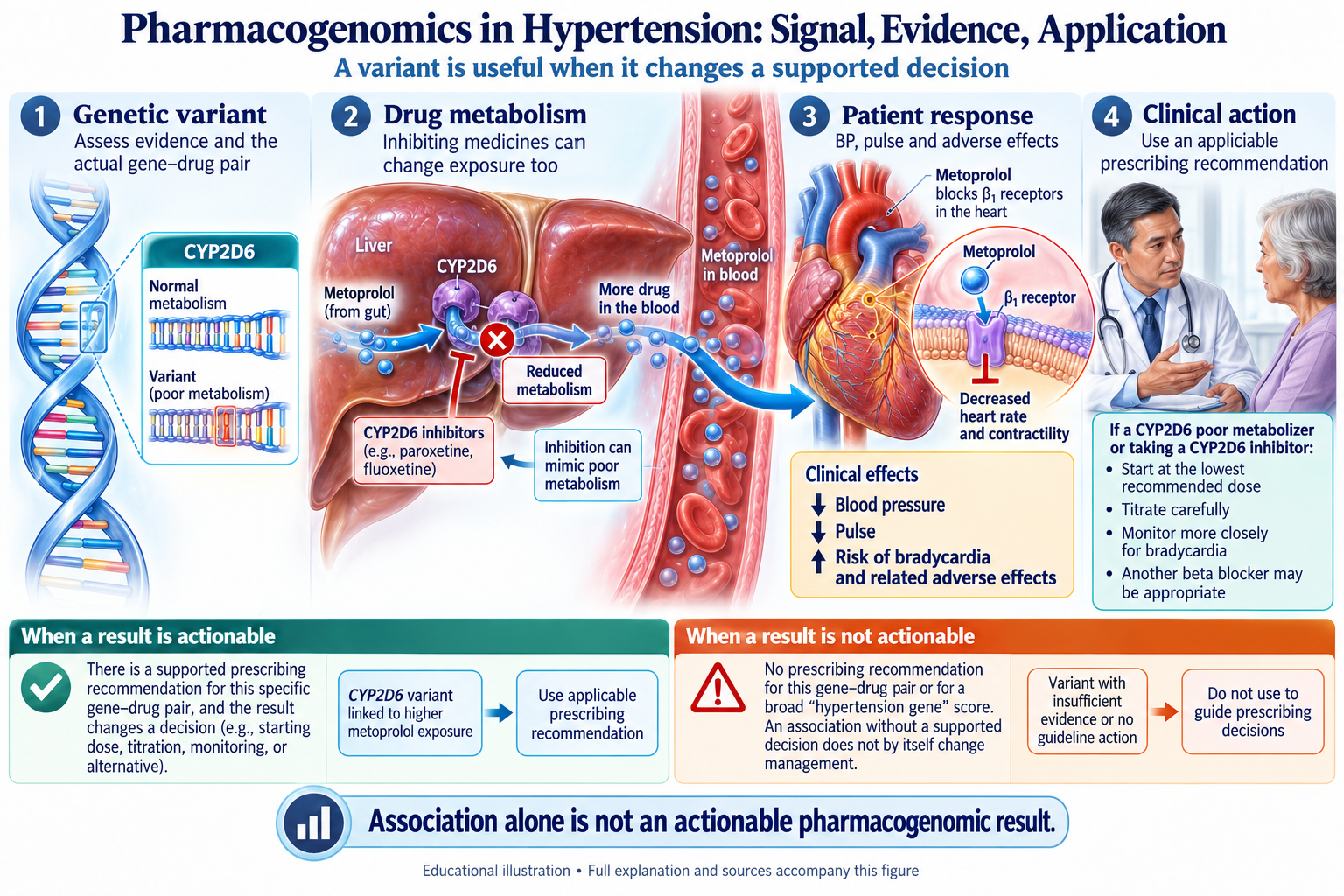
📊 A clinically actionable example: CYP2D6 and metoprolol
CPIC 2024 recommends the lowest recommended starting dose, careful upward titration, and closer bradycardia monitoring for CYP2D6 poor metabolizers starting or revising metoprolol; another beta blocker may be appropriate. Normal and intermediate metabolizers generally start standard dosing. Evidence is insufficient for a metoprolol recommendation in ultrarapid metabolizers or broad genotype dosing rules for the other beta blockers and signaling genes evaluated. CPIC guideline.
An already stable, tolerated regimen does not automatically require change when a result arrives. Check pulse, BP, symptoms, formulation, indication, and recent changes. Paroxetine or fluoxetine can inhibit CYP2D6 and create reduced functional metabolism despite a normal predicted genotype.
🏥 Put testing inside a clinical workflow
- State which drug decision could change: initial dose, titration, monitoring, or alternative.
- Check whether an applicable guideline explains use of an existing result or recommends ordering a test.
- Review variant coverage, laboratory quality, turnaround, cost, and who will interpret the result.
- Reconcile interacting medicines and the measured clinical response before changing treatment.
- Document the authorized plan and follow-up; an electronic alert is not an autonomous prescription.
💊 ARB selection still follows the clinical indication
For albuminuric CKD or hypertension, choose a suitable ACE inhibitor or ARB according to the disease evidence, tolerated dose, BP, potassium, kidney function, interactions, and access. Losartan has a uricosuric effect, but that feature does not make genotype-based selection a validated outcome strategy. Do not exceed labeled doses or substitute a new ARB solely because a variant predicts altered metabolite formation. Review creatinine and potassium after RAAS changes.
💰 Evaluate economic value rather than assuming it
Testing cost alone does not establish cost-effectiveness. An appropriate analysis needs the frequency of actionable results, the treatment change actually made, clinical benefits and harms, follow-up costs, and a relevant comparator. Local price, panel breadth, insurance, and turnaround vary. No verified evidence here establishes the former numerical break-even thresholds or universal same-day outcome benefit.
🔮 Emerging applications need validation
ADRB1 and other signaling variants, polygenic scores, and AI-assisted selection remain drug- and task-specific evidence questions. Mechanistic plausibility or prediction in a development dataset is insufficient for autonomous dosing. External validation, prospective clinical utility, population coverage, and human review must precede broad adoption. Keep a measured BP/pulse response and medication safety review at the center of care.
🧮 Pharmacogenomic Evidence Checklist
📊 Interpret a Genetic Result
Use the selections to frame a discussion, not to calculate a drug or dose. There is no validated CYP2C9-based ARB prescription generated here:
📚 Sources
Pharmacogenomic associations require validation and do not automatically establish a routine prescribing strategy. Direct teaching sources: CPIC 2024 beta-blocker guideline (PMID 38951961); CYP2C9-losartan primary pharmacokinetic study (PMID 11823761). The statin guideline below illustrates the general implementation framework, not an ARB dosing recommendation.
- Cooper-DeHoff RM, Niemi M, Ramsey LB, et al; CPIC. Clinical Pharmacogenetics Implementation Consortium guideline for SLCO1B1, ABCG2, and CYP2C9 and statin-associated musculoskeletal symptoms. Clin Pharmacol Ther. 2022;111(5):1007-1021. PMID: 35152405. [Source for: CPIC framework for cardiovascular pharmacogenomic recommendations.]
- Whelton PK, et al. 2017 ACC/AHA HTN Guideline. Hypertension. 2018;71(6):e13-e115. PMID: 29133356. [Source for: race-based and population-specific drug-class preferences.]
- Brown C, Clark D, Jones DW. Updates in the 2025 AHA/ACC Hypertension Guideline. Curr Hypertens Rep. 2026;28(1). PMID: 41843050. [Source for: 2025 update — PREVENT calculator includes social determinants; race-based recommendations being de-emphasized.]