Visual reference
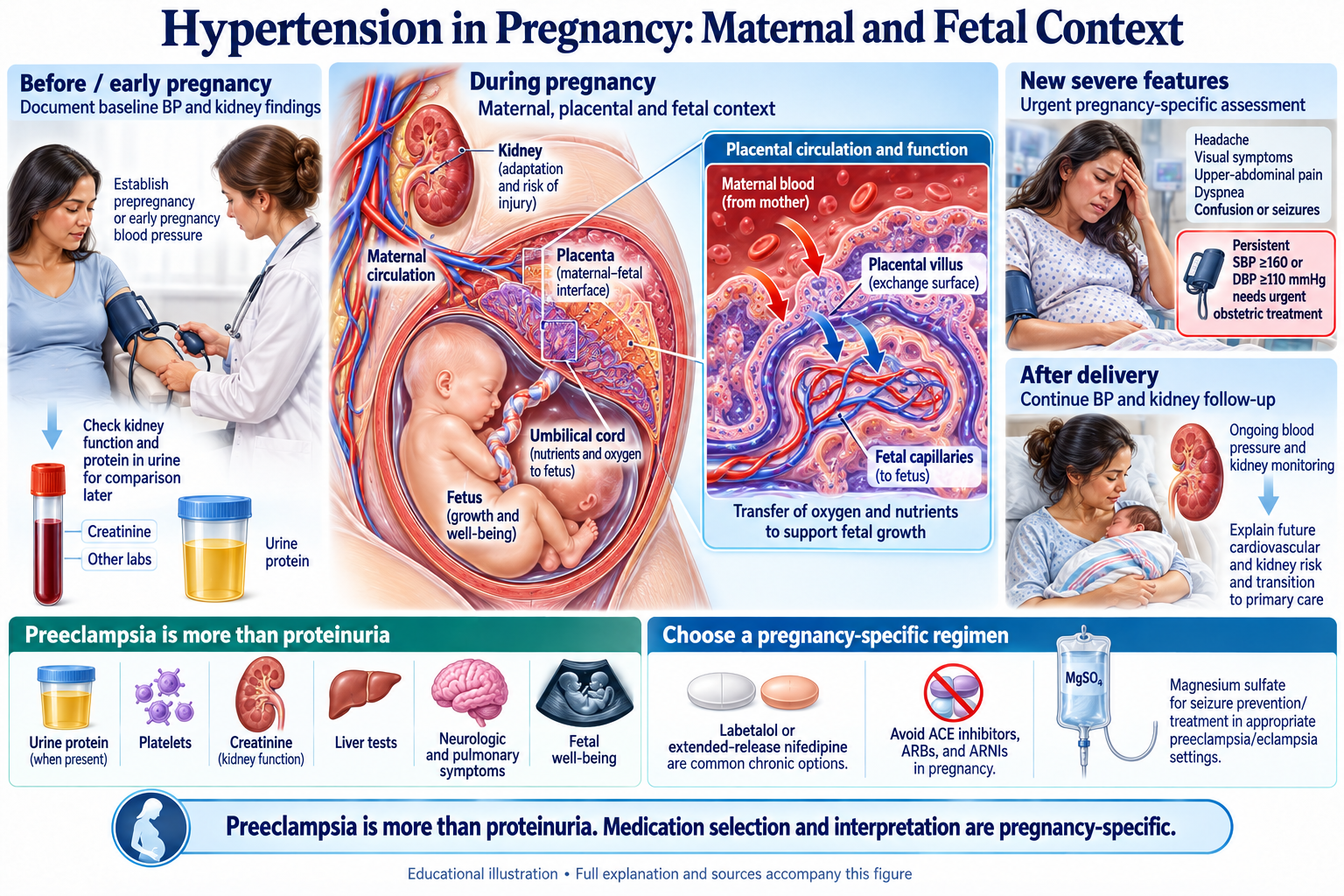
Browse the visual reference library · Download lesson Markdown
⚠️ Critical Safety Alert
30-60 minute window for treating severe hypertension (≥160/110 mmHg) represents a critical patient safety metric. Delayed treatment associated with maternal stroke.
🔬 CHAP Trial Revolutionary Evidence
🎯 Trial Design
- Population: 2,408 pregnant women with mild chronic HTN
- BP Range: 140-159/85-89 mmHg
- Intervention: Active treatment vs standard care
- Primary Outcome: Composite pregnancy complications
📊 Key Results
- approximately 18% relative reduction in composite adverse outcomes (rate 30.2% vs 37.0%, adjusted RR 0.82; ARR approximately 6.8%)
- No increase in fetal growth restriction
- Class 1 recommendation for treatment ≥140/90 mmHg
- Source: Tita AT et al. NEJM 2022;386(19):1781-1792, PMID 35363951
🎯 2025 Treatment Thresholds
✅ Chronic Hypertension
Treatment Threshold: ≥140/90 mmHg
Target: 120-160/80-105 mmHg
Evidence: CHAP trial Class 1 recommendation
Benefit: approximately 18% relative reduction in adverse outcomes (HR 0.82; ARR approximately 6.8%; rate 30.2% vs 37.0%)
🚨 Severe Hypertension
Definition: ≥160/110 mmHg
Action Timeline: 30-60 minutes
Target: 140-150/90-100 mmHg
Risk: Maternal stroke if delayed
💊 Pregnancy Medication Safety Profile
✅ SAFE - First Line
Labetalol
Dose: 100-400 mg BID
Avoid: Asthma, heart block
Benefits: Both α/β blockade
Extended-Release Nifedipine
Dose: 30-120 mg daily
Monitor: Tocolytic effects near term
Benefits: Effective, well-tolerated
⚠️ CAUTION - Second Line
Methyldopa
Dose: 250-1000 mg BID-TID
Issues: Less effective, sedation
Historical: Longest safety data
Hydralazine
Use: Acute severe HTN only
Route: IV/IM for emergencies
Risk: Unpredictable hypotension
❌ CONTRAINDICATED
ACE Inhibitors
Risk: Oligohydramnios, renal dysgenesis
Timing: Teratogenic 2nd/3rd trimester
ARBs & Atenolol
ARBs: Similar teratogenic risk as ACEIs
Atenolol: IUGR associations
MRA & Direct Renin Inhibitors
Risk: Teratogenic potential
Avoid: All pregnancy stages
🚨 Severe Hypertension Emergency Protocol
BP ≥160/110 mmHg → Action within 30-60 minutes
1️⃣ Assess
Confirm BP elevation, symptoms, target organ damage
2️⃣ Laboratory
CBC, CMP, LFTs, uric acid, 24h urine or protein/creatinine
3️⃣ First-Line
Labetalol 20mg IV → 40mg → 80mg Q20min (max 300mg)
4️⃣ Alternative
Hydralazine 5-10mg IV Q20-40min (max 30mg) or Nicardipine gtt
5️⃣ Target
140-150/90-100 mmHg (avoid <140 mmHg)
6️⃣ Monitor
Continuous fetal monitoring, maternal neurologic status
🧮 Pregnancy Hypertension Risk Calculator
🏥 Postpartum Management (Extended to 12 Weeks)
🤱 Breastfeeding Medication Compatibility
✅ Compatible
- Labetalol: Minimal milk transfer
- Nifedipine: Low milk concentration
- Enalapril: Preferred ACE inhibitor
- Captopril: Alternative ACE inhibitor
⚠️ Use with Caution
- Methyldopa: Monitor infant drowsiness
- Propranolol: Monitor infant HR, hypoglycemia
- Hydrochlorothiazide: May reduce milk supply
❌ Avoid if Possible
- Atenolol: High milk concentration
- Reserpine: Nasal congestion, lethargy
- High-dose diuretics: Milk supply reduction
👥 Special Population Considerations
🧓 Elderly (≥65 years)
- Target: <140/90 mmHg initially, then <130/80 if tolerated
- Avoid: Orthostatic hypotension, cognitive impairment
- Monitor: Falls risk, polypharmacy interactions
- Prefer: Low-dose combination therapy
🏃♀️ Athletes & Young Adults
- Rule out: Secondary causes, white-coat HTN
- Screening: Echo for LVH, exercise stress test
- Avoid: Beta-blockers in competitive athletes
- Target: <130/80 mmHg for long-term CV protection
🧬 Genetic Considerations
- African ancestry: Enhanced response to CCBs, diuretics
- Asian ancestry: Lower renin, increased salt-sensitivity
- Pharmacogenomics: CYP2D6 variants affect metoprolol
- Family history: Early screening, intensive targets
📚 Sources
- Tita AT, Szychowski JM, Boggess K, et al; CHAP Trial Consortium. Treatment for Mild Chronic Hypertension during Pregnancy. N Engl J Med. 2022;386(19):1781-1792. PMID: 35363951. [Source for: CHAP composite adverse outcome 30.2% vs 37.0% (adjusted RR 0.82, ARR approximately 6.8%); N=2,408. Established Class 1 treatment threshold ≥140/90 mmHg in chronic HTN of pregnancy.]
- Magee LA, von Dadelszen P, Rey E, et al. Less-tight versus tight control of hypertension in pregnancy: CHIPS. N Engl J Med. 2015;372(5):407-417. PMID: 25629739. [Source for: less-tight (DBP target 100) vs tight (DBP target 85) — primary composite no difference, but tight control reduced severe HTN; pre-CHAP foundational evidence.]
- Koopmans CM, Bijlenga D, Groen H, et al; HYPITAT study group. Induction of labour versus expectant monitoring for gestational hypertension or mild pre-eclampsia after 36 weeks: HYPITAT. Lancet. 2009;374(9694):979-988. PMID: 19656558. [Source for: induction at ≥36 weeks reduces severe maternal morbidity in gestational HTN / mild preeclampsia; informs delivery timing recommendations.]
- ACOG Committee on Practice Bulletins—Obstetrics. Gestational Hypertension and Preeclampsia: ACOG Practice Bulletin Number 222. Obstet Gynecol. 2020;135(6):e237-e260. PMID: 32443079. [Source for: ACOG severe HTN definition ≥160/110, 30-60 minute window for IV therapy, magnesium sulfate for preeclampsia with severe features.]
- Bramham K, Parnell B, Nelson-Piercy C, Seed PT, Poston L, Chappell LC. Chronic hypertension and pregnancy outcomes: systematic review and meta-analysis. BMJ. 2014;348:g2301. PMID: 24735917. [Source for: baseline maternal and fetal risks in chronic HTN of pregnancy — superimposed preeclampsia rate, IUGR rate, perinatal mortality.]
🎯 Key Learning Points
🔬 Evidence-Based Practice
- CHAP trial supports treating mild chronic HTN in pregnancy
- approximately 18% relative reduction in adverse outcomes (HR 0.82; ARR approximately 6.8%; rate 30.2% vs 37.0%) without fetal harm
- Class 1 recommendation for treatment ≥140/90 mmHg
⏰ Critical Timelines
- 30-60 minutes for severe HTN (≥160/110 mmHg)
- Extended postpartum monitoring through 12 weeks
- Delayed preeclampsia recognition and management
💊 Safe Medication Choices
- Labetalol and extended-release nifedipine preferred
- Absolute contraindication of ACE/ARB/MRA
- Breastfeeding compatibility considerations
👥 Population-Specific Care
- Individualized targets based on age and comorbidities
- Genetic ancestry influences drug response
- Special considerations for athletes and elderly