Visual reference
Browse the visual reference library · Download lesson Markdown
🆕 Formal Device Therapy Integration
The 2025 guidelines formally integrate renal denervation into the therapeutic algorithm with Class 2b recommendation, acknowledging modest efficacy (5-10 mmHg office SBP reduction) while recognizing procedural costs and uncertain long-term durability.
🎯 Resistant Hypertension Definition
📏 Precise Clinical Definition
Prevalence
10-15%
of treated hypertensive patients
CV Risk
2-3x higher
than controlled hypertension
Mortality Risk
50% increase
in cardiovascular events
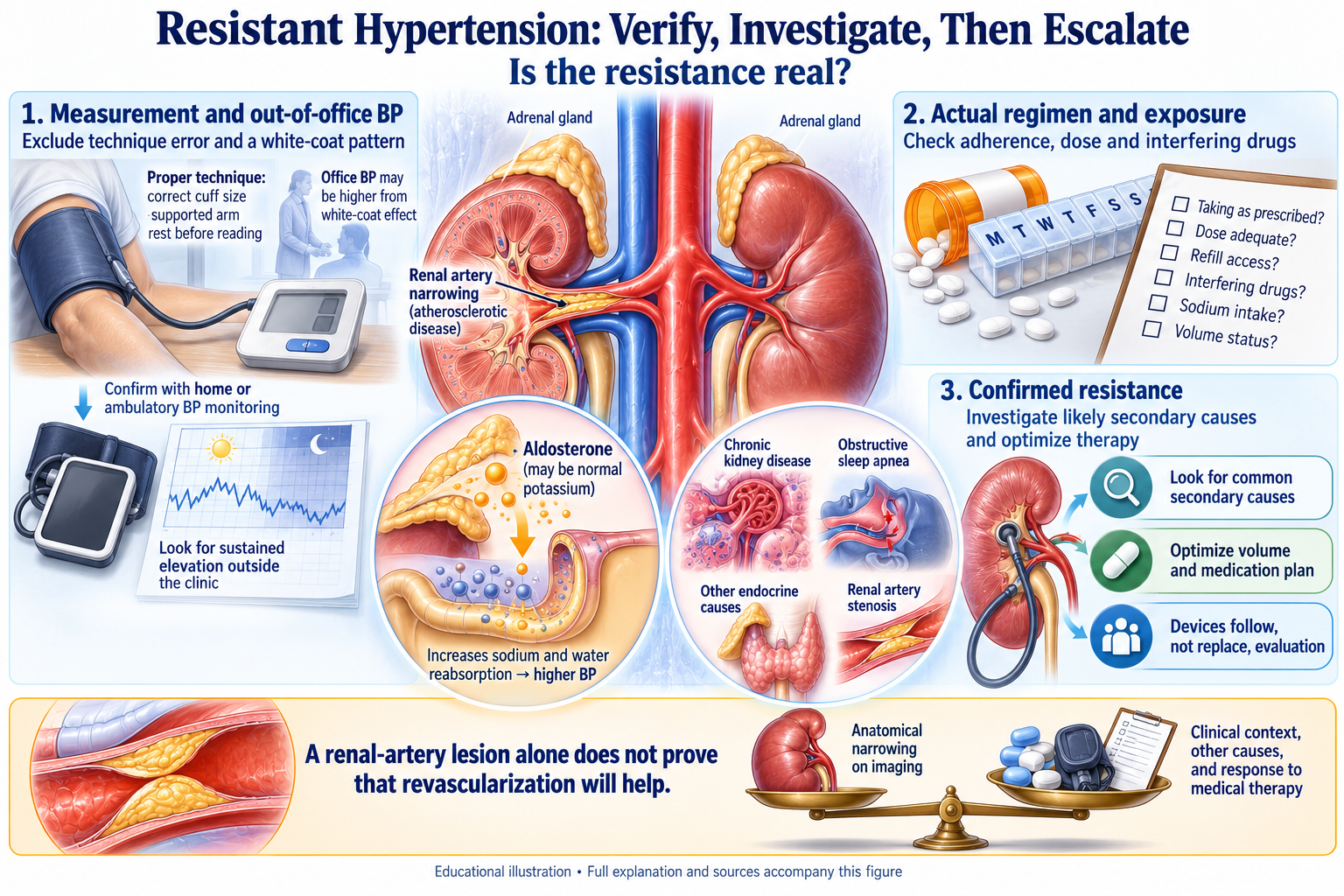
🔍 Systematic Evaluation Protocol
Step-by-Step Assessment
Confirm True Resistance with Out-of-Office Monitoring
- ABPM preferred: 24-hour monitoring with <10% reduction from office readings
- Home monitoring: 7-day protocol averaging ≥130/80 mmHg
- White-coat resistance: Exclude elevated office but normal out-of-office BP
- Masked uncontrolled HTN: Normal office but elevated out-of-office BP
Assess Medication Adherence
- Pharmacy records: Review prescription fill patterns and timing
- Pill counts: Direct assessment of remaining medications
- Drug levels: Serum levels when available and indicated
- Patient interview: Direct questioning about barriers to adherence
- Cost barriers: Assess financial constraints affecting compliance
Exclude Secondary Causes
- Primary aldosteronism: Universal screening with aldosterone-to-renin ratio
- Sleep apnea: STOP-BANG questionnaire, sleep study if indicated
- Renovascular disease: Age-appropriate screening (young: FMD, older: atherosclerotic)
- Pheochromocytoma: If episodic symptoms or family history
- Drug-induced HTN: NSAIDs, decongestants, stimulants, steroids
Optimize Current Regimen
- Medication doses: Ensure maximum tolerated doses of current agents
- Drug combinations: Verify synergistic combinations (ACE/ARB + diuretic + CCB)
- Diuretic adequacy: Ensure appropriate diuretic type and dose
- Timing optimization: Consider bedtime dosing for chronotherapy
Add Fourth-Line Agents
- Spironolactone (Class 1): 25-50 mg daily if eGFR ≥45 mL/min/1.73m²
- Alternative MRAs: Eplerenone if spironolactone intolerance
- Additional agents: Beta-blockers, alpha-blockers, central agents
- Monitor closely: Kidney function and electrolytes
💊 Spironolactone: The Fourth-Line Champion
Class 1 Recommendation: Mineralocorticoid Receptor Antagonism
📊 Efficacy Data (PATHWAY-2)
- BP reduction: −8.7 mmHg home systolic vs placebo (95% CI −9.7 to −7.7)
- Best-of-four ranking: Spironolactone was the most effective of 4 add-on drugs (vs doxazosin, bisoprolol, placebo) in approximately 58% of patients in crossover
- Onset: 4-6 weeks for full effect
- Source: Williams B et al. PATHWAY-2. Lancet 2015;386(10008):2059-2068. PMID 26414968
💊 Dosing Protocol
- Initial dose: 25 mg daily
- Titration: Increase to 50 mg daily if tolerated
- Maximum dose: 100 mg daily in selected patients
- Timing: Morning administration preferred
⚠️ Safety Requirements
- eGFR requirement: ≥45 mL/min/1.73m²
- Baseline K+: <5.0 mEq/L
- Monitoring: K+ and creatinine at 1, 3, 6 months
- Discontinue if: K+ >5.5 mEq/L or AKI
Alternative MRA: Eplerenone
Consider eplerenone 50-100 mg daily if spironolactone causes gynecomastia or breast tenderness. More selective for mineralocorticoid receptors but less potent and more expensive than spironolactone.
🔧 Renal Denervation: Class 2b Recommendation
Device-Based Therapy Integration
Patient selection requires documented adherence, office SBP 140-180 mmHg, eGFR ≥40 mL/min/1.73m², and absence of significant renal artery abnormalities. The Class 1 requirement for multidisciplinary team evaluation ensures appropriate patient selection and alternative treatment optimization.
SPYRAL HTN-OFF MED Pivotal
-3.9 mmHg
24-h ambulatory SBP vs sham (95% CrI -6.2 to -1.6); office SBP -6.5 mmHg
Bohm M et al. Lancet 2020;395:1444-51, PMID 32234534
SPYRAL HTN-ON MED
-7.4 mmHg
24-h ambulatory SBP vs sham (95% CI -12.5 to -2.3); office SBP -6.8 mmHg
Kandzari DE et al. Lancet 2018;391:2346-55, PMID 29803589
RADIANCE HTN-SOLO
-6.3 mmHg
Baseline-adjusted daytime SBP difference (95% CI -9.4 to -3.1)
Azizi M et al. Lancet 2018;391:2335-45, PMID 29803590
Response Rate
Modest, individualized
Set realistic expectations: pooled BP reductions are approximately 4-8 mmHg, not 60-70% "responder" rates as previously claimed
🎯 Patient Selection Criteria
✅ Inclusion Criteria
- Confirmed adherence: Pharmacy records, pill counts, or drug levels
- Office SBP: 140-180 mmHg on ≥3 medications
- eGFR: ≥40 mL/min/1.73m² with stable kidney function
- Renal anatomy: Suitable renal artery anatomy on imaging
- Age: 18-80 years (most studies)
- Life expectancy: >1 year
- Motivation: Willing to continue medications post-procedure
❌ Exclusion Criteria
- Renal artery stenosis: >30% stenosis
- Renal artery anatomy: <4 mm diameter or <20 mm length
- Previous renal intervention: Stenting or surgery
- Type 1 diabetes: With nephropathy
- Secondary hypertension: Untreated identifiable causes
- Pregnancy: Current or planned
- Severe kidney disease: eGFR <40 mL/min/1.73m²
🤔 Special Considerations
- Age >65: Enhanced sympathetic activity may predict better response
- Diabetes: Type 2 diabetes not an exclusion if no nephropathy
- Heart failure: May benefit from sympathetic denervation
- Chronic kidney disease: Careful risk-benefit assessment
- Cost considerations: Insurance coverage variable
- Center experience: Procedure volume and expertise matter
🏥 Multidisciplinary Team Approach
Class 1 Requirement: Team-Based Evaluation
👨⚕️ Core Team Members
- Interventional cardiologist: Procedure performance and technique
- Hypertension specialist: Medical optimization and patient selection
- Clinical pharmacist: Medication reconciliation and adherence
- Nurse coordinator: Patient education and follow-up coordination
📋 Team Responsibilities
- Pre-procedure: Confirm medical optimization and adherence
- Patient selection: Multidisciplinary consensus on candidacy
- Shared decision-making: Detailed risk-benefit discussion
- Post-procedure: Long-term follow-up and medication management
⚖️ Decision Factors
- Response prediction: 30-40% non-response rate
- Durability concerns: Long-term efficacy uncertain
- Cost-effectiveness: High upfront costs vs medication savings
- Patient preferences: Individual values and goals
🧮 Resistant HTN Risk Calculator
Treatment Strategy Optimizer
Treatment Recommendation
Next Steps:
Device Therapy Consideration:
🎯 Key Management Principles
🔍 Systematic Evaluation
Confirm true resistance with out-of-office monitoring, assess adherence, and exclude secondary causes before considering advanced interventions.
💊 Spironolactone First
Class 1 recommendation for spironolactone as fourth-line agent — PATHWAY-2 (Williams, Lancet 2015, PMID 26414968) showed −8.7 mmHg additional home systolic vs placebo, and spironolactone ranked best of 4 add-on drugs in approximately 58% of patients in crossover.
🔧 Device Therapy Selection
Renal denervation Class 2b recommendation requires careful patient selection, multidisciplinary evaluation, and realistic expectation setting for modest BP reductions.