Visual reference
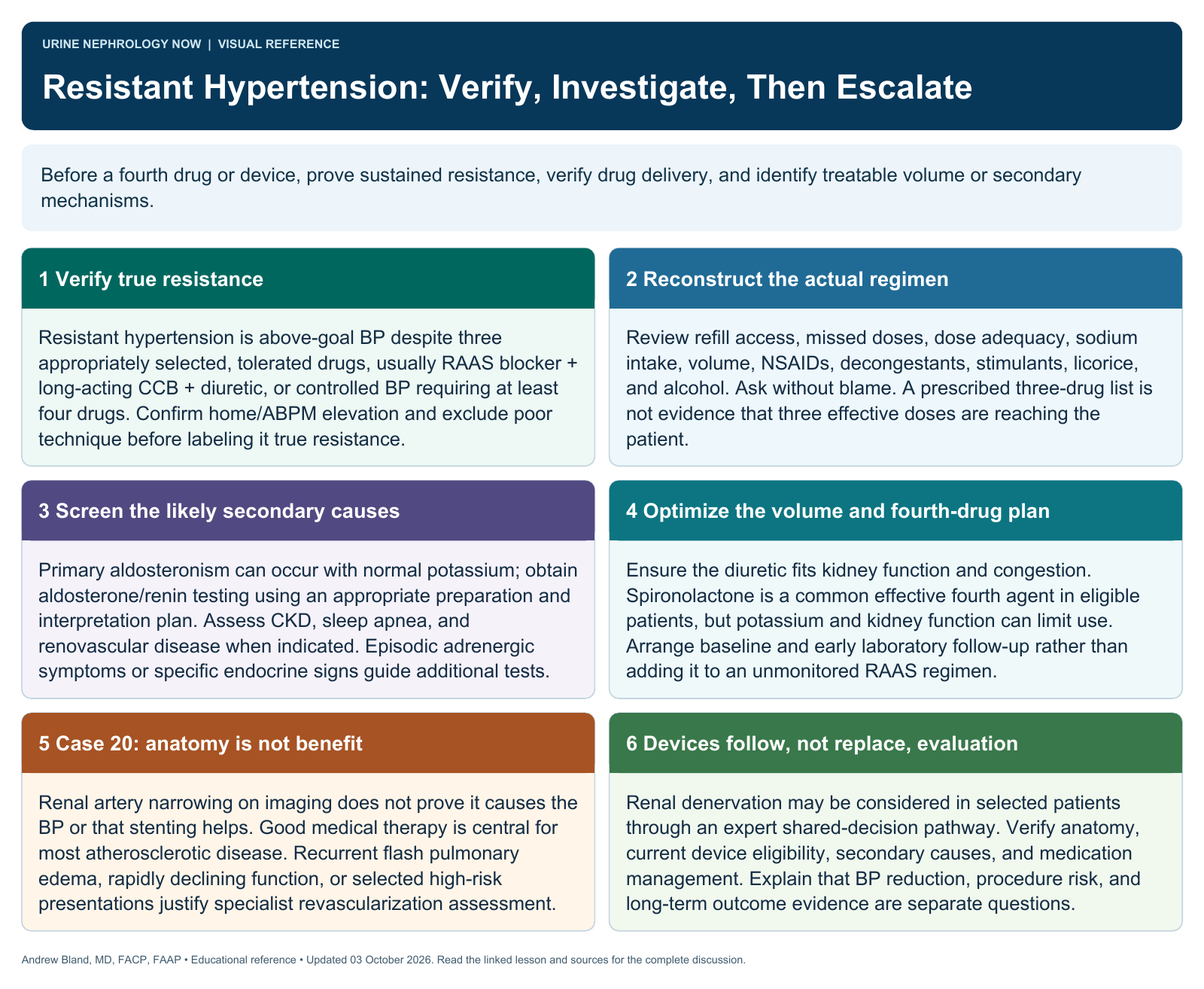
Browse the visual reference library · Download lesson Markdown
🚀 Breakthrough 2025 Integration
Renal denervation receives formal Class 2b recommendation marking the first device-based therapy integration in AHA/ACC hypertension guidelines. This represents a paradigm shift toward interventional management of resistant hypertension.
🔍 Resistant Hypertension: Systematic Evaluation
📋 Definition: Resistant Hypertension
Blood pressure remains above goal despite 3 optimally-dosed antihypertensives from different classes, including a diuretic, OR controlled on ≥4 medications
Confirm True Resistance
Out-of-office BP monitoring: ABPM or HBPM to exclude white-coat effect
Medication review: Verify optimal dosing, appropriate combinations, patient adherence
Assess Adherence
Pharmacy records: Prescription filling patterns, timing analysis
Drug levels: When available, direct measurement of medication concentrations
Screen for Secondary Causes
Primary aldosteronism: Universal screening with ARR (Class 1 recommendation)
Other causes: Sleep apnea, renal artery stenosis, pheochromocytoma evaluation
Optimize Medical Therapy
Fourth-line agent: Spironolactone 12.5-50 mg daily (Class 1 recommendation)
Alternative agents: Amiloride, eplerenone, or other evidence-based combinations
Consider Device Therapy
Renal denervation: Class 2b recommendation for selected patients
Multidisciplinary evaluation: Required before procedural intervention
💊 Advanced Treatment Strategies
🧪 Spironolactone: Fourth-Line Therapy Class 1
📊 Efficacy in Resistant HTN (PATHWAY-2)
- BP Reduction: −8.7 mmHg home systolic vs placebo (95% CI −9.7 to −7.7)
- Best-of-four ranking: Spironolactone most effective of 4 add-on drugs in approximately 58% of patients in crossover
- Optimal Dose: 12.5-50 mg daily (titrate based on response/tolerance)
- Source: Williams B et al. Lancet 2015;386(10008):2059-2068. PMID 26414968
✅ Ideal Candidates:
- eGFR ≥45 mL/min/1.73m²
- Potassium <4.5 mEq/L
- No significant kidney disease
- Volume-dependent resistant HTN
⚠️ Monitoring Protocol:
Check electrolytes and creatinine at 1 week, 1 month, then quarterly. Watch for hyperkalemia (>5.5 mEq/L) and acute kidney injury.
🔧 Renal Denervation Class 2b
📈 Contemporary Evidence
- Office BP: 5-10 mmHg systolic reduction
- 24-hour ABPM: 3-8 mmHg reduction
- Response Rate: 60-70% show clinically meaningful reduction
- Durability: Effects maintained at 3 years
🎯 Patient Selection Criteria:
- Office SBP 140-180 mmHg despite treatment
- Documented medication adherence
- eGFR ≥40 mL/min/1.73m²
- Suitable renal artery anatomy
- Life expectancy >1 year
❌ Contraindications:
- Significant renovascular abnormalities
- Previous renal artery intervention
- Type 1 diabetes with neuropathy
- eGFR <40 mL/min/1.73m²
⚗️ Alternative Combination Strategies
🔄 When Spironolactone Intolerant:
- Amiloride: 5-10 mg daily (K+-sparing, less hormonal effects)
- Eplerenone: 25-100 mg daily (selective MR antagonist)
- Beta-blockers: Carvedilol, bisoprolol if not contraindicated
- Alpha-blockers: Doxazosin XL for volume-independent resistance
🧬 Novel Agents (Research):
- Finerenone: Non-steroidal MR antagonist
- SGLT2 inhibitors: Modest BP effects + cardiorenal protection
- GLP-1 agonists: 3-5 mmHg reduction + weight loss
🔬 Renal Denervation: Comprehensive Overview
🔬 Mechanism of Action
- Sympathetic nerve ablation: Disrupts renal afferent/efferent pathways
- Central effects: Reduces overall sympathetic tone
- Local renal effects: Decreases renin release, sodium retention
- Vascular effects: Improved endothelial function
⚕️ Procedure Details
- Approach: Percutaneous, femoral artery access
- Technology: Radiofrequency or ultrasound ablation
- Duration: 45-90 minutes outpatient procedure
- Recovery: Same-day discharge, minimal downtime
📊 Key Clinical Trial Data
SPYRAL HTN-OFF MED Pivotal
24-h ABPM: -3.9 mmHg SBP vs sham (95% CrI -6.2 to -1.6)
Office SBP: -6.5 mmHg vs sham
Bohm 2020 Lancet, PMID 32234534
SPYRAL HTN-ON MED
24-h ABPM: -7.4 mmHg SBP vs sham (95% CI -12.5 to -2.3)
Office SBP: -6.8 mmHg vs sham
Kandzari 2018 Lancet, PMID 29803589
RADIANCE-HTN SOLO
Daytime ABPM: -6.3 mmHg baseline-adjusted SBP difference (95% CI -9.4 to -3.1)
Office SBP: approximately -6.5 mmHg between-group
Azizi 2018 Lancet, PMID 29803590
👥 Multidisciplinary Team Evaluation (Class 1 Requirement)
🩺 Hypertension Specialist
- Confirm true resistance
- Optimize medical therapy
- Exclude secondary causes
- Long-term BP management
🫀 Interventional Cardiologist
- Assess procedural feasibility
- Evaluate renal artery anatomy
- Perform procedure if appropriate
- Manage complications
🧠 Clinical Psychologist
- Assess adherence barriers
- Evaluate decision-making capacity
- Support lifestyle modifications
- Manage treatment expectations
💊 Clinical Pharmacist
- Medication reconciliation
- Drug interaction screening
- Adherence optimization
- Cost-effective alternatives
📊 Treatment Evidence Summary
| Treatment | Class/Level | BP Reduction | Response Rate | Key Considerations |
|---|---|---|---|---|
| Spironolactone | Class 1 | −8.7 mmHg home SBP vs placebo (PATHWAY-2) | Best-of-4 in approximately 58% (crossover) | Monitor K+, creatinine; eGFR ≥45 required |
| Amiloride | Class 2a | 10-15 mmHg | 50-60% | Alternative if spironolactone intolerant |
| Renal Denervation | Class 2b | 5-10 mmHg | 60-70% | Multidisciplinary evaluation required |
| Beta-blockers | Class 2b | 8-12 mmHg | 40-50% | Carvedilol preferred; avoid if contraindicated |
| Alpha-blockers | Class 2b | 6-10 mmHg | 40-50% | Doxazosin XL; monitor orthostatic hypotension |
📚 Sources
- Williams B, MacDonald TM, Morant S, et al; British Hypertension Society's PATHWAY Studies Group. Spironolactone versus placebo, bisoprolol, and doxazosin to determine the optimal treatment for drug-resistant hypertension (PATHWAY-2). Lancet. 2015;386(10008):2059-2068. PMID: 26414968.
- Bhatt DL, Kandzari DE, O'Neill WW, et al; SYMPLICITY HTN-3 Investigators. A controlled trial of renal denervation for resistant hypertension. N Engl J Med. 2014;370(15):1393-1401. PMID: 24678939.
- Böhm M, Kario K, Kandzari DE, et al; SPYRAL HTN-OFF MED Pivotal Investigators. Efficacy of catheter-based renal denervation in the absence of antihypertensive medications. Lancet. 2020;395(10234):1444-1451. PMID: 32234534.
- Kandzari DE, Böhm M, Mahfoud F, et al; SPYRAL HTN-ON MED. Effect of renal denervation on blood pressure in the presence of antihypertensive drugs. Lancet. 2018;391(10137):2346-2355. PMID: 29803589.
- Azizi M, Schmieder RE, Mahfoud F, et al; RADIANCE-HTN SOLO. Endovascular ultrasound renal denervation to treat hypertension. Lancet. 2018;391(10137):2335-2345. PMID: 29803590.
- Carey RM, Calhoun DA, Bakris GL, et al; American Heart Association. Resistant Hypertension: Detection, Evaluation, and Management. Hypertension. 2018;72(5):e53-e90. PMID: 30354828.
- Brown C, Clark D, Jones DW. Updates in the 2025 AHA/ACC Hypertension Guideline. Curr Hypertens Rep. 2026;28(1). PMID: 41843050. [Source for: 2025 update — RDN as adjunctive option in select resistant-HTN patients.]
🎯 Resistant HTN & Device Therapy: Key Learning Points
🔍 Systematic Evaluation
- Confirm resistance with out-of-office monitoring
- Assess adherence through pharmacy records
- Universal primary aldosteronism screening
- Optimize medical therapy before devices
💊 Medical Optimization
- Spironolactone is Class 1 fourth-line therapy
- −8.7 mmHg additional home SBP vs placebo (PATHWAY-2, PMID 26414968) — set patient expectations accordingly
- Monitor electrolytes and renal function
- Alternative agents for intolerance
🔧 Device Therapy
- Renal denervation: modest but durable effects
- Multidisciplinary evaluation mandatory
- 30-40% non-response rate expected
- Continued medications still required