Visual reference
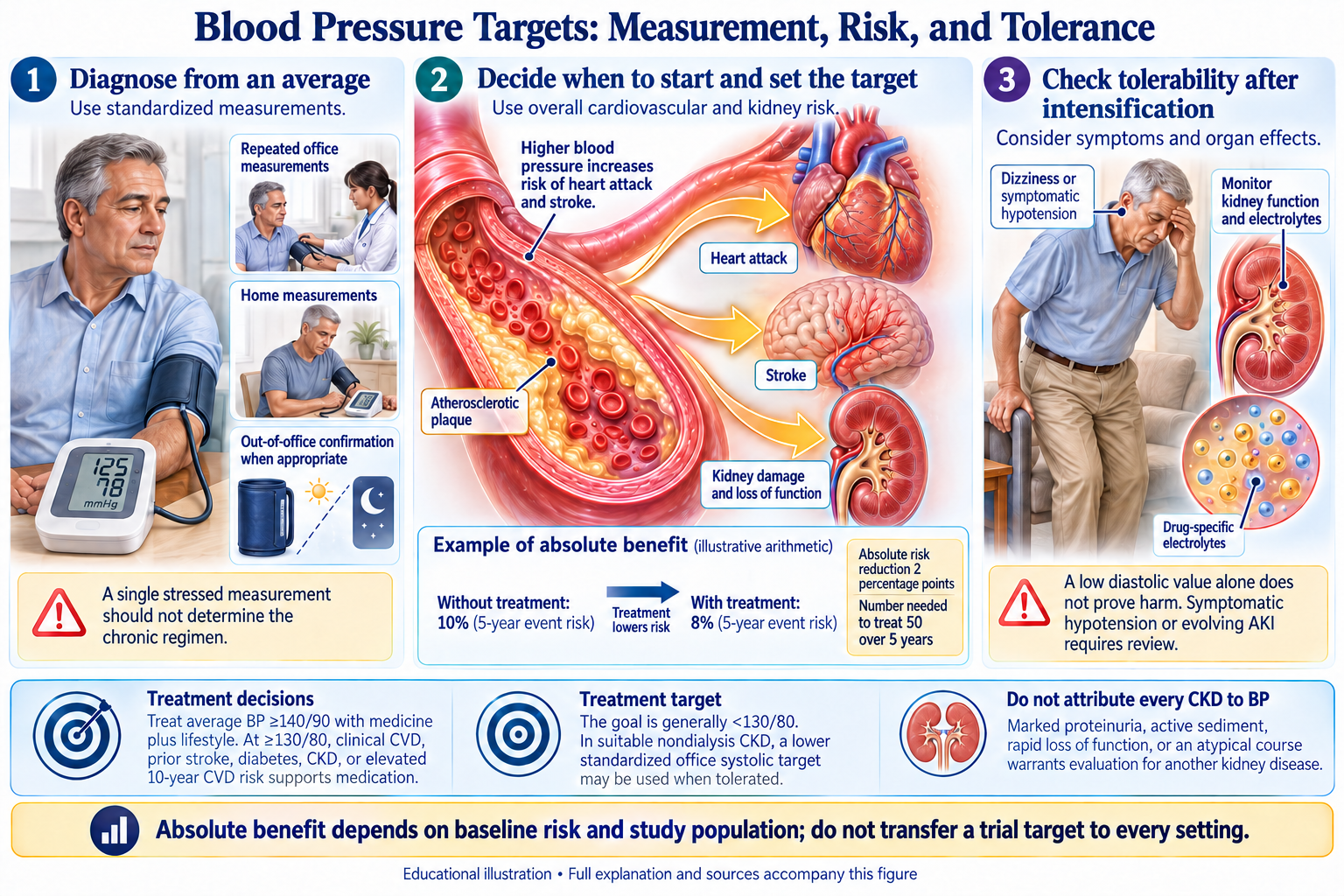
Browse the visual reference library · Download lesson Markdown
🎯 Evidence-Based Decision Framework
📐 ARR vs RRR vs NNT — Reading Any Hypertension Trial
🎓 Why this distinction is the most important number-skill in clinical decision-making
Almost every error in interpreting a hypertension trial — and almost every misleading marketing claim from a pharmaceutical company — comes down to confusing relative risk reduction (RRR) with absolute risk reduction (ARR). The original 1988 paper that formalized this for clinical medicine remains essential reading: Laupacis A, Sackett DL, Roberts RS. NEJM 1988;318(26):1728-1733 (PMID 3374545).
| Metric | What it is | Worked example: control event rate 10%, treatment event rate 7% |
|---|---|---|
| ARR (Absolute Risk Reduction) | Difference in event rates between groups, expressed in percentage points | 10% − 7% = 3 percentage points |
| RRR (Relative Risk Reduction) | The proportion of risk reduced, expressed as a percent of the control rate | (10 − 7) / 10 = 30% |
| NNT (Number Needed to Treat) | Patients you must treat for the trial duration to prevent ONE event | 1 / ARR = 1 / 0.03 = 33 patients |
| RR (Relative Risk / Risk Ratio) | Treatment event rate ÷ control event rate (HR is similar concept from time-to-event analysis) | 7 / 10 = 0.70 (so RRR = 1 − RR = 30%) |
🚨 The same RRR can mean wildly different clinical value
This is the single most important point. The RRR is roughly constant across baseline-risk strata in BP-lowering trials (BPLTTC 2021 PMID 33933205 — per-5-mmHg HR is similar across primary and secondary prevention). What varies is the ARR, because ARR depends on baseline risk:
| Patient population | Control event rate | Treatment event rate | RRR (looks the same) | ARR (drives the decision) | NNT |
|---|---|---|---|---|---|
| High-risk (CKD + CAD + DM) | 20% | 14% | 30% | 6% | 17 (compelling) |
| Moderate-risk (HTN, no other RF) | 10% | 7% | 30% | 3% | 33 (worthwhile) |
| Low-risk (young, BP 130-139) | 1% | 0.7% | 30% | 0.3% | 333 (much weaker case) |
Same RRR — same drug effect — wildly different ARR and NNT. Higher baseline risk → bigger ARR for the same RRR → smaller NNT → more compelling treatment. This is exactly why intensive BP control benefits high-risk patients far more than low-risk ones, even when the RRR is identical.
📊 Worked examples from the trials cited throughout this lecture series
- SPRINT (Wright NEJM 2015, PMID 26551272) primary composite — HR 0.75 → RRR 25% → ARR approximately 1.6% over 3.26 years → NNT 61
- SPRINT all-cause mortality — HR 0.73 → RRR 27% → ARR approximately 1.2% over 3.26 years → NNT 83
- STEP (Zhang NEJM 2021, PMID 34491661) primary outcome in elderly Chinese — HR 0.74 → RRR 26% → ARR approximately 1.1% over 3.34 years → NNT 91
- SHEP (1991) stroke prevention — RRR 36% → ARR 3.4% over 5 years → NNT 30 (much higher baseline stroke rate in untreated isolated systolic HTN drives the bigger ARR despite a similar RRR)
- HOPE ramipril CV prevention — RRR 22% → ARR approximately 3.8% over 4.5 years → NNT 26
Notice: SPRINT, STEP, and SHEP all have RRRs in the 25–36% range, but NNTs span 30 to 91. The difference is entirely about baseline risk in the control arms, not about the drugs being more or less "effective."
🔑 Three rules for reading any HTN trial
- Demand the ARR alongside any RRR. A "27% mortality reduction!" headline tells you nothing useful until you know the absolute event rates. If the control mortality was 4.5% and the treatment mortality was 3.3%, the RRR is 27% AND the ARR is 1.2% AND the NNT is 83 — three numbers you need together.
- Anchor on the patient in front of you. Trial enrollment criteria define the baseline risk that produced the trial's ARR. A 50-year-old with no comorbidities is not the SPRINT-Senior patient, even if she meets the BP threshold — her ARR will be smaller, her NNT larger, and the case for intensive treatment weaker.
- Pair NNT with NNH. Every BP-lowering trial also has adverse-event rates. A SPRINT-style intensive-target intervention with NNT 61 for CV prevention also has approximately NNH 16 for medication discontinuation, NNH 32 for electrolyte abnormalities, NNH 40 for AKI. The benefit-risk balance is patient-specific.
Foundational source: Laupacis A, Sackett DL, Roberts RS. An assessment of clinically useful measures of the consequences of treatment. NEJM 1988;318(26):1728-1733 (PMID 3374545). The "NNT framework" originates with this paper. ARR-primacy reframing in the urinenephrology mastery hypertension report was anchored to the same source on 2026-04-29. Teaching block added 2026-05-04 per Andy direction.
📉 Diminishing Returns: BP Target Analysis
📊 Cardiovascular Risk Reduction by Systolic BP Level
Evidence from the Blood Pressure Lowering Treatment Trialists' Collaboration demonstrates consistent relative risk reduction across BP levels, but absolute benefits decline substantially at lower targets.
| Starting SBP (mmHg) | Target SBP (mmHg) | Relative Risk Reduction | Absolute Risk Reduction (5-year) | NNT (5-year) | Clinical Significance |
|---|---|---|---|---|---|
| 250-230 | 230-210 | 36% (29-43%) | 12.4% | 8 | Compelling benefit |
| 210-190 | 190-170 | 30% (24-36%) | 6.2% | 16 | Strong benefit |
| 170-150 | 150-140 | 20% (17-23%) | 3.2% | 31 | Clear benefit |
| 150-140 | 140-130 | 15% (11-19%) | 2.0% | 50 | Moderate benefit |
| 140-130 | 130-120 | 13% (7-19%) | 1.4% | 71 | Marginal benefit |
| <130 | <120 | 7% (1-13%) | 0.6% | 167 | Minimal benefit |
Critical Insight: The Intensive Target Trade-off
While targeting systolic BP below 120 mmHg in SPRINT showed a 25% relative risk reduction, this translated to only 1.6% absolute risk reduction over 3.26 years (NNT = 61). This marginal benefit must be weighed against substantially increased adverse event rates.
👥 Population-Specific Risk-Benefit Profiles
🏃 Younger Patients (<65 years) Without Risk Factors
Benefits (Target <140 vs <120 mmHg):
- Cardiovascular events: 1.8% vs 2.2% ARR (incremental 0.4%)
- Low baseline risk: Limited absolute benefit potential
- Long-term exposure: Years of medication therapy required
Risks (Intensive Target):
- Serious adverse events: 1.6% absolute risk increase
- Medication burden: Multiple daily medications
- Cost considerations: Lifetime medication expenses
- Quality of life: Treatment-related symptoms
Recommendation: Standard targets (<140 mmHg) preferred. Intensive targets only if high additional risk factors or patient preference after informed discussion.
⚡ High-Risk Patients (10-year CV risk >15%) Without Frailty
Benefits (Target <140 vs <120 mmHg):
- Cardiovascular events: 3.5% vs 5.2% ARR (incremental 1.7%)
- High baseline risk: Substantial absolute benefit potential
- Shorter NNT: 59 patients for one prevented event
- Multiple risk factors: Synergistic benefit from BP control
Risks (Intensive Target):
- Serious adverse events: 2.4% absolute risk increase
- Acceptable trade-off: 1.4:1 benefit-to-risk ratio
- Enhanced monitoring: Required but manageable
Recommendation: Intensive targets (<130 mmHg) reasonable if well-tolerated. Benefits outweigh risks in most scenarios.
👴 Elderly Patients (>75 years) With Multiple Comorbidities
Benefits (Target <140 vs <120 mmHg):
- Cardiovascular events: 3.2% vs 4.1% ARR (incremental 0.9%)
- Moderate benefit: Some cardiovascular protection
- STEP trial data: Evidence in 60-80 year age group
Risks (Intensive Target):
- Serious adverse events: 5.8% absolute risk increase
- Falls and fractures: Substantially increased risk
- Cognitive impairment: Hypotension-related risks
- Polypharmacy: Drug interactions and complexity
- Unfavorable ratio: 1:6.4 benefit-to-risk ratio
Recommendation: Standard targets (140-150 mmHg) preferred. Individualize based on functional status and life expectancy. Avoid intensive targets in frail patients.
💊 Medication Class Risk-Benefit Profiles
⚖️ Comparative Benefit-Risk Assessment
Different antihypertensive classes offer varying profiles of cardiovascular benefits and treatment-related risks that must be considered for individual patient selection.
| Agent Class | CV Event Reduction (ARR 5-yr) | Mortality Reduction (ARR 5-yr) | Major Adverse Effects (ARI 5-yr) | Clinical Net Benefit |
|---|---|---|---|---|
| ACE Inhibitors | 2.2% | 1.0% | Cough 8.3%, Angioedema 0.3% | Positive, limited by cough |
| ARBs | 2.0% | 0.8% | Cough 0.4%, Angioedema 0.1% | Positive, excellent tolerance |
| Calcium Channel Blockers | 2.1% | 0.7% | Peripheral edema 3.2% | Positive, generally well-tolerated |
| Thiazide Diuretics | 2.8% | 1.3% | Hyponatremia 7.5% (elderly women) | Variable by population |
| Beta-Blockers | 1.5% | 0.5% | Fatigue 4.2%, Sexual dysfunction 2.8% | Positive in specific indications |
Thiazide Diuretic Risk-Benefit by Population:
✅ Favorable Population
Younger patients (<65 years) without risk factors:
- CV event prevention: NNT 36
- Hyponatremia risk: NNH 83
- Benefit-risk ratio: 2.3:1 favorable
❌ Unfavorable Population
Elderly women (>70 years) with multiple risk factors:
- CV event prevention: NNT 31
- Hyponatremia risk: NNH 8
- Benefit-risk ratio: 1:4 unfavorable
📈 Wide Pulse Pressure: Balancing Systolic and Diastolic Targets
⚖️ The Diastolic Dilemma
Critical Threshold: Diastolic BP <70 mmHg in CAD Patients
- INVEST Trial Evidence: 2.2-fold increased cardiovascular death risk
- Absolute risk increase: 4.3% over 5 years in wide pulse pressure patients
- J-curve phenomenon: Especially pronounced in coronary disease
- Mechanism: Reduced coronary perfusion during diastole
- High-risk groups: Diabetes, advanced age, established CAD
🎯 Risk-Stratified Management Approach
Benefits of Systolic BP Reduction in Wide Pulse Pressure:
- Stroke prevention: 17% relative reduction (ARR 1.4% over 5 years)
- All-cause mortality: 13% relative reduction (ARR 1.7% over 5 years)
- Arterial stiffness: RAAS inhibitors and CCBs provide additional benefits
Risks When Diastolic BP Falls Below 60 mmHg:
- Coronary events: 33% relative increase (ARI 3.2% over 5 years)
- Cardiovascular death: 26% relative increase (ARI 2.7% over 5 years)
- Highest risk: Pre-existing CAD, diabetes, age >75 years
Clinical Strategy: Prioritize systolic control while maintaining diastolic BP ≥70 mmHg in coronary disease patients. Use agents that reduce arterial stiffness preferentially.
🔄 ACE Inhibitor vs ARB Selection Framework
📊 Comparative Efficacy and Safety
ONTARGET Trial: Head-to-Head Comparison (N=25,620)
- Cardiovascular efficacy: No significant difference (RR 1.01, 95% CI 0.94-1.09)
- Absolute event rates: 16.5% vs 16.7% (difference 0.2% over 4.5 years)
- Renal protection: ARBs slight advantage (0.2% absolute difference)
- Heart failure: ACE-Is slight advantage (0.1% absolute difference)
⚠️ Safety Profile Differences
ACE Inhibitor Limitations:
- Persistent cough: 8.3% absolute risk increase (NNH 13)
- Angioedema: 0.3% vs 0.1% with ARBs (0.19% difference)
- Higher discontinuation: 3.2% additional treatment discontinuation
ARB Advantages:
- Superior tolerability: Lowest side effect profile
- Better adherence: Reduced treatment-limiting adverse effects
- Safety in high-risk groups: Lower angioedema risk in Black patients
🧮 Personalized Risk-Benefit Calculator
Calculate individualized benefit-risk assessment for hypertension management decisions:
🗂️ Clinical Decision Algorithm for Target Selection
📋 Evidence-Based Target Selection Framework
🚨 Special Population Considerations
👥 Population-Specific Modifications
- Chronic Kidney Disease: Target <130/80 mmHg (2025 AHA/ACC, ADA Standards of Care); KDIGO 2021 (Blood Pressure in CKD) suggests systolic <120 mmHg when tolerated, on standardized office measurement (grade 2B, driven by the CKD subgroup of SPRINT), explicitly excluding kidney transplant recipients and patients on dialysis. Much of the gap is measurement technique rather than disagreement about physiology — KDIGO's lower number presumes a standardized or unattended reading, which most routine clinic cuffs do not meet. Accept 30% creatinine rise, mandatory RAAS inhibition for albuminuria
- Diabetes: Target <130/80 mmHg, integrate with glycemic and lipid management
- Heart Failure: Evidence-based target <130 mmHg, optimize guideline-directed therapy
- Stroke Survivors: Gradual reduction, avoid acute drops, target <130/80 mmHg long-term
- Peripheral Artery Disease: Careful assessment of ankle-brachial index, avoid excessive reduction
- Cognitive Impairment: Consider impact on cerebral perfusion, individualize targets
⚠️ High-Risk Scenarios Requiring Caution
- Bilateral Renal Artery Stenosis: RAAS inhibitor contraindication, careful monitoring
- Severe Aortic Stenosis: Maintain adequate preload, avoid excessive BP reduction
- Hypertrophic Cardiomyopathy: Avoid vasodilators, beta-blockers or CCBs preferred
- Recent Stroke: Permissive hypertension in acute phase, gradual reduction thereafter
- Advanced Age with Frailty: Higher targets acceptable, focus on quality of life
- Multiple Falls History: Orthostatic assessment, careful titration to avoid hypotension
📚 Sources
- Ettehad D, Emdin CA, Kiran A, et al. Blood pressure lowering for prevention of CV disease and death: meta-analysis. Lancet. 2016;387(10022):957-967. PMID: 26724178. [Source for: per-10-mmHg constant RRR — major CV events HR 0.80, stroke HR 0.73, HF HR 0.72.]
- BPLTTC; Rahimi K, et al. BP lowering across baseline BP levels: IPD meta-analysis. Lancet. 2021;397(10285):1625-1636. PMID: 33933205. [Source for: constant RRR across baseline BP strata; primary vs secondary prevention HR 0.91 vs 0.89 per 5 mmHg; n=344,716.]
- Laupacis A, Sackett DL, Roberts RS. An assessment of clinically useful measures of the consequences of treatment. N Engl J Med. 1988;318(26):1728-1733. PMID: 3374545. [Source for: NNT methodology — foundational paper on absolute vs relative risk reduction in clinical decision-making.]
- SPRINT Research Group. A Randomized Trial of Intensive vs Standard BP Control. N Engl J Med. 2015;373(22):2103-2116. PMID: 26551272.
- Zhang W, Zhang S, Deng Y, et al; STEP Study. Trial of Intensive BP Control in Older Patients (STEP). N Engl J Med. 2021;385(14):1268-1279. PMID: 34491661.
- Whelton PK, et al. 2017 ACC/AHA HTN Guideline. Hypertension. 2018;71(6):e13-e115. PMID: 29133356.