Visual reference
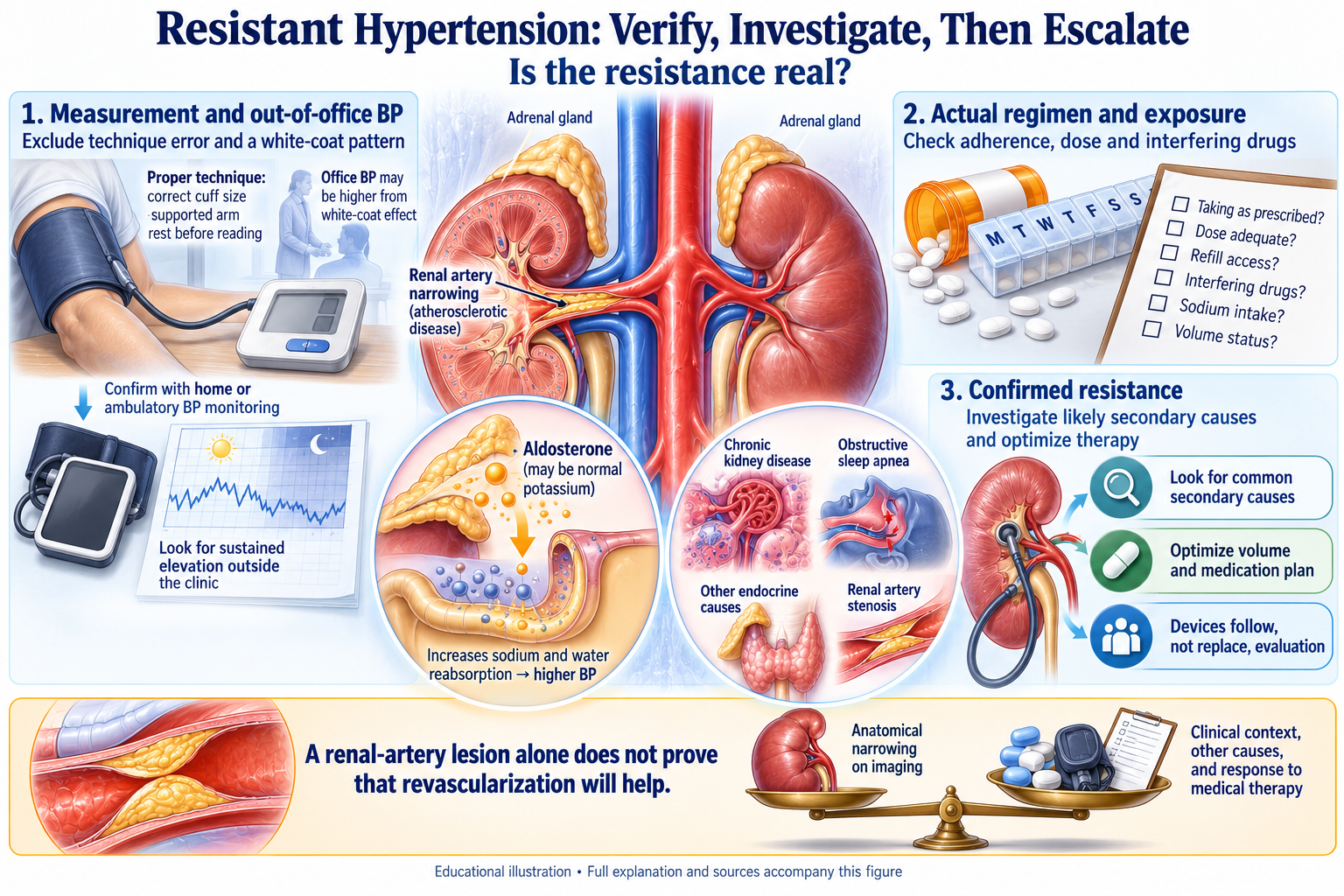
Browse the visual reference library · Download lesson Markdown
🚨 REVOLUTIONARY CHANGE: Universal PA Screening
Class 1 Recommendation: Screen ALL resistant hypertension patients for primary aldosteronism REGARDLESS OF POTASSIUM STATUS. Previous guidelines missed 70-80% of cases by requiring hypokalemia.
🧬 Primary Aldosteronism: The Great Masquerader
💡 High-Yield Clinical Pearls
- Normokalemic disease predominates: 70-80% of primary aldosteronism patients have normal potassium
- Cardiovascular risk exceeds BP alone: Independent predictor of cardiovascular events beyond hypertension
- Targeted therapy reduces excess risk: Mineralocorticoid receptor antagonism provides specific cardiovascular protection
- Prevalence in resistant HTN: 20% of patients with treatment-resistant hypertension have primary aldosteronism
🎯 Screening Indications (Class 1)
Resistant Hypertension
BP above goal despite 3 optimally-dosed antihypertensives including diuretic
Screen ALL patientsHypokalemia + HTN
Spontaneous: K+ <3.5 mEq/L
Diuretic-induced: K+ <3.0 mEq/L
Adrenal Incidentaloma
Any patient with incidentally discovered adrenal nodule and hypertension
Family History
First-degree relative with primary aldosteronism or early-onset HTN
Young-Onset HTN
Diagnosis before age 35, especially if severe
🧪 Screening Protocol: Aldosterone-to-Renin Ratio (ARR)
💎 2025 Guideline Innovation
No medication washout required for initial screening. Most antihypertensives can be continued except mineralocorticoid receptor antagonists, which must be discontinued for at least 4 weeks.
🧮 ARR Calculator
Calculate aldosterone-to-renin ratio and interpret results
📊 ARR Interpretation Guidelines:
- ARR <20: Primary aldosteronism unlikely
- ARR 20-30: Intermediate probability - consider repeat testing
- ARR >30: High probability - proceed to confirmatory testing
- ARR >50 + PAC >20: Very high probability - likely positive confirmatory test
💊 Medication Effects on ARR Testing
| Medication Class | Effect on ARR | Recommendation | Alternative if Necessary |
|---|---|---|---|
| MR Antagonists (spironolactone, eplerenone) |
False negative | MUST stop 4+ weeks | Amlodipine, hydralazine |
| Diuretics (thiazides, loops) |
False positive | Stop if possible 2+ weeks | Continue if essential for BP control |
| ACE Inhibitors/ARBs | Minimal effect | Continue | N/A |
| Calcium Channel Blockers | Minimal effect | Continue | N/A |
| Beta-blockers | False positive | Consider stopping if possible | Continue if cardiac indication |
🎯 Confirmatory Testing (When ARR Positive)
📋 Oral Sodium Loading
High-salt diet (6g/day) × 3 days → 24-hour urine aldosterone. Positive if >12 μg/24hr
💉 Saline Infusion Test
2L normal saline over 4 hours → plasma aldosterone. Positive if >10 ng/dL
💊 Captopril Challenge
25-50mg captopril → repeat ARR after 2 hours. Positive if no suppression
🫀 Renal Artery Stenosis: Medical vs Interventional
💡 Evidence-Based Management Shift
Medical therapy is Class 1 recommendation for atherosclerotic renal artery stenosis. CORAL and ASTRAL trials showed no benefit of revascularization over optimal medical therapy for most patients.
🎯 Screening Indications
- Resistant hypertension with preserved renal function
- Acute kidney injury with ACE inhibitor or ARB initiation
- Recurrent flash pulmonary edema with preserved EF
- Asymmetric kidney size (>1.5 cm difference)
- Abdominal bruit in young patient
- Early-onset severe hypertension (<30 years old)
🔬 Diagnostic Approach
CT Angiography
Preferred initial test. High sensitivity/specificity, evaluates anatomy. Contrast nephropathy risk in CKD.
MR Angiography
CKD-friendly option. No nephrotoxic contrast. May overestimate stenosis severity.
Renal Duplex
Operator-dependent. Peak systolic velocity >180 cm/s suggests stenosis. Non-invasive screening option.
⚕️ Management Strategy
📚 Medical Therapy (Class 1)
- ACE inhibitors or ARBs (monitor creatinine)
- Calcium channel blockers
- Statin therapy
- Antiplatelet therapy
- Smoking cessation
- Diabetes management
🔧 Revascularization (Class 2a)
- Resistant HTN despite optimal medical therapy
- Recurrent flash pulmonary edema
- Progressive renal insufficiency with RAAS inhibition
- Fibromuscular dysplasia (often curative)
🔍 Additional Secondary Causes: Recognition and Screening
Pheochromocytoma
24-hr urine catecholamines/metanephrines or plasma metanephrines
- Paroxysmal hypertension
- HTN crisis with anesthesia
- Family history of MEN syndromes
- Adrenal incidentaloma
Obstructive Sleep Apnea
Prevalence in resistant HTN
STOP-BANG questionnaire, overnight sleep study
- Morning hypertension pattern
- Witnessed apneas
- Excessive daytime sleepiness
- Obesity, large neck circumference
Coarctation of Aorta
Upper-lower extremity BP gradient >20 mmHg
4-extremity BP measurements, echocardiography
- Young-onset hypertension
- Weak/delayed femoral pulses
- Rib notching on chest X-ray
- Bicuspid aortic valve
Drug-Induced HTN
Medication history review is essential
- NSAIDs (including COX-2)
- Sympathomimetics
- Oral contraceptives
- Licorice, energy drinks
📚 Sources
- Funder JW, Carey RM, Mantero F, et al. The Management of Primary Aldosteronism: Case Detection, Diagnosis, and Treatment: An Endocrine Society Clinical Practice Guideline. J Clin Endocrinol Metab. 2016;101(5):1889-1916. PMID: 26934393. [Source for: PA screening with ARR; expanded screening criteria including resistant HTN, hypokalemia, adrenal incidentaloma.]
- Whelton PK, Carey RM, Aronow WS, et al. 2017 ACC/AHA Guideline for High Blood Pressure in Adults. Hypertension. 2018;71(6):e13-e115. PMID: 29133356. [Source for: secondary HTN screening triggers — resistant HTN, age <30, severe HTN, sudden onset, target organ damage out of proportion.]
- Brown C, Clark D, Jones DW. Updates in the 2025 AHA/ACC Hypertension Guideline. Curr Hypertens Rep. 2026;28(1). PMID: 41843050. [Source for: 2025 update — expanded primary aldosteronism screening to ALL stage 2 / resistant HTN patients.]
- Lenders JW, Duh QY, Eisenhofer G, et al. Pheochromocytoma and paraganglioma: an endocrine society clinical practice guideline. J Clin Endocrinol Metab. 2014;99(6):1915-1942. PMID: 24893135. [Source for: pheochromocytoma screening (plasma free or 24h urine fractionated metanephrines), test sensitivity 96-100%, specificity by test.]
- Bornstein SR, Allolio B, Arlt W, et al. Diagnosis and Treatment of Primary Adrenal Insufficiency: An Endocrine Society Clinical Practice Guideline. J Clin Endocrinol Metab. 2016;101(2):364-389. PMID: 26760044. [Source for: adrenal hormone disorders evaluation framework relevant to secondary HTN.]
- Gornik HL, Persu A, Adlam D, et al; First International Consensus on the diagnosis and management of fibromuscular dysplasia. J Hypertens. 2019;37(2):229-252. PMID: 30640867. [Source for: renovascular HTN — fibromuscular dysplasia evaluation and management.]
🎯 Secondary HTN Screening: Key Learning Points
🧬 Primary Aldosteronism
- Screen ALL resistant HTN regardless of K+
- Most patients are normokalemic (70-80%)
- ARR screening without medication washout
- MR antagonists reduce cardiovascular risk
🫀 Renal Artery Stenosis
- Medical therapy preferred (Class 1)
- Revascularization for specific indications
- FMD vs atherosclerotic different outcomes
- Monitor renal function with RAAS inhibitors
🔍 Clinical Approach
- High index of suspicion in resistant HTN
- Systematic evaluation prevents missed diagnoses
- Targeted therapy improves outcomes
- Cost-effective when appropriately applied