Visual reference
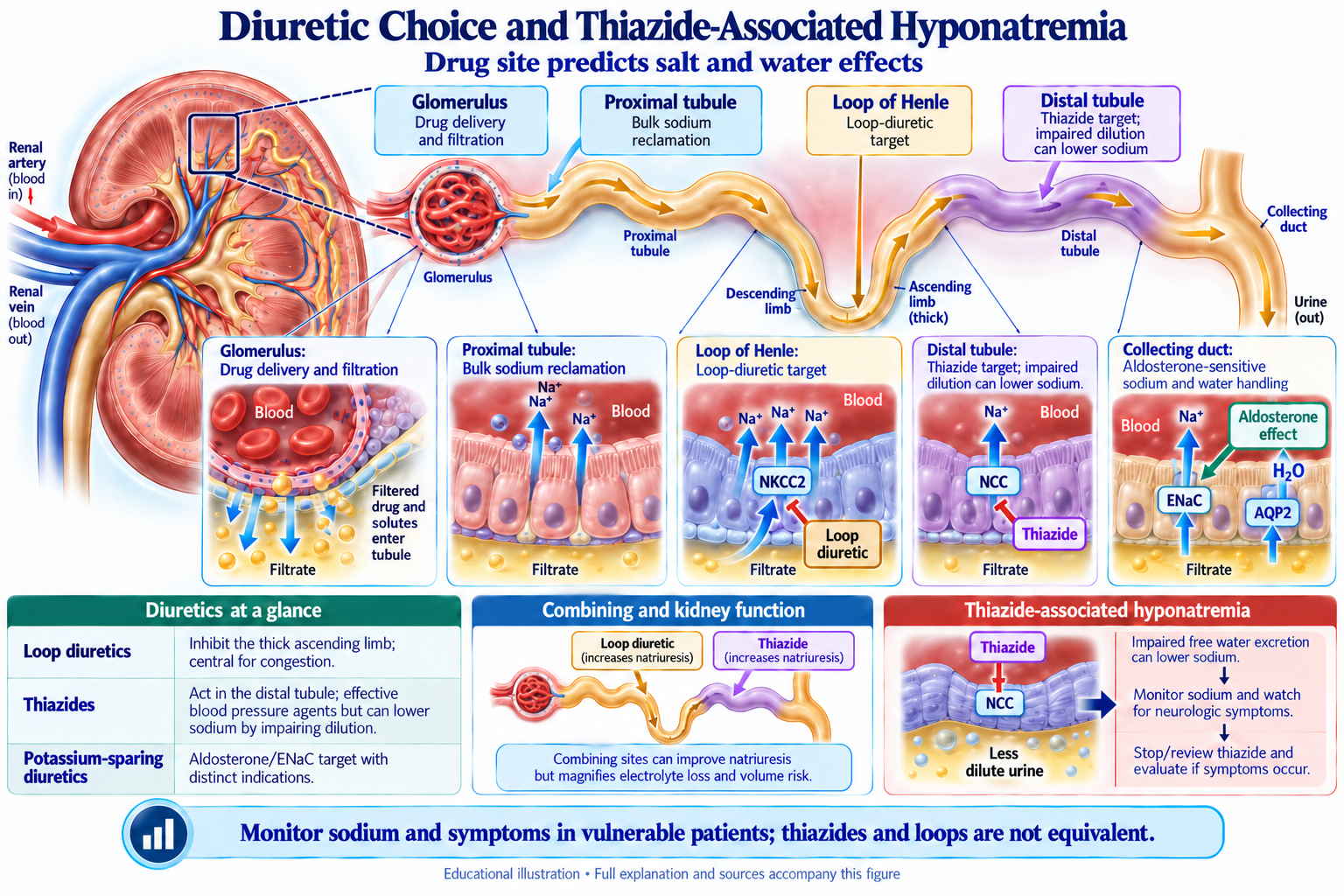
Browse the visual reference library · Download lesson Markdown
🚨 Critical Safety Measures
📊 Epidemiology and Clinical Impact
📈 Incidence and Severity
- Overall Incidence: 4-30% of thiazide users develop hyponatremia
- Clinically Significant: 5.5-7.2% develop sodium <130 mmol/L
- First Year Risk: 9.3% vs 1.8% with other antihypertensives
- Absolute Risk Increase: 7.5% additional hyponatremia risk
- Severe Hyponatremia: 2.4-6.8% mortality when sodium <125 mmol/L
🏥 Healthcare System Impact
- Drug-Induced Hospitalizations: 13.7% caused by thiazide diuretics
- Primary Cause: Hyponatremia predominant reason for hospitalization
- Elderly Population: Disproportionately affects patients >70 years
- Economic Burden: Preventable hospitalizations and complications
- Quality Metric: Preventable adverse drug event
🎯 Risk Factor Analysis
| Risk Factor | Odds Ratio (95% CI) | Risk with Factor Present | Risk with Factor Absent | Clinical Significance |
|---|---|---|---|---|
| Age >70 years | 3.4 (2.8-4.1) | 14.8% | 4.3% | Strongest independent predictor |
| Female sex | 2.7 (2.2-3.4) | 12.6% | 4.7% | Hormonal and physiologic factors |
| Low body weight (<60 kg) | 2.3 (1.8-2.9) | 11.9% | 5.2% | Reduced distribution volume |
| Concurrent SSRI use | approximately 3.9 (Movig 2002 elderly cohort) | Specific incidence percentages and tight CI previously listed (OR 2.8 [2.1-3.7], 13.5% vs 4.8%) did not resolve to a published primary source; flagged 2026-05-03 | Synergistic SIADH effect | |
| Baseline Na+ <140 mmol/L | 2.1 (1.7-2.6) | 10.4% | 5.0% | Reduced sodium reserve |
| Concomitant NSAID use | 1.8 (1.3-2.6) | 9.3% | 5.2% | Impaired renal sodium handling |
💧 The Fluid Intake Paradox
❌ Conventional Advice is Harmful
- Common Misconception: "Increase fluids while taking diuretics"
- Evidence Against: Increased fluid intake raises thiazide-hyponatremia risk (mechanism: thiazides impair free water clearance)
- Real-world signal: Sonnenblick 1993 case-series review of 129 thiazide-hyponatremia cases noted excess water intake as a contributing factor
✅ Evidence-Based Fluid Management
- Practical Recommendation: Normal fluid intake, avoid pushing fluids
- Mechanistic basis: Avoiding excess fluid intake reduces thiazide-hyponatremia risk via volume/free-water-clearance pathways
⚖️ Cardiovascular Benefits vs Hyponatremia Risks
💪 Cardiovascular Benefits
Blood Pressure Lowering Treatment Trialists' Collaboration
- All-cause mortality: 13% RRR (ARR 1.3%, NNT 77)
- CV mortality: 17% RRR (ARR 1.0%, NNT 100)
- Major CV events: 24% RRR (ARR 2.8%, NNT 36)
- Stroke: 23% RRR (ARR 1.5%, NNT 67)
- Heart failure: 29% RRR (ARR 2.0%, NNT 50)
⚠️ Hyponatremia Risks
Population-Based Studies and Meta-Analyses
- Clinically significant: NNH 18-22 (5-year)
- Hospitalization: NNH 83-125 (5-year)
- Severe hyponatremia: NNH 45-60 (Na+ <125 mmol/L)
- Neurological sequelae: NNH 50-70 (5-year)
- Overall balance: Varies significantly by population
👥 Population-Specific Risk-Benefit Analysis
Thiazide Safety: ARR for Benefits vs ARR for Harms
Understanding that the same medication can have dramatically different benefit-risk profiles based on patient demographics - demonstrated by thiazide-induced hyponatremia ARR data.
📊 Thiazide Benefit vs Risk ARR by Population
| Population | CV Event ARR | Hyponatremia ARR | NNT vs NNH | Benefit-Risk Ratio | Recommendation |
|---|---|---|---|---|---|
| Men <65 years | 2.8% | 1.2% | NNT 36 vs NNH 83 | 2.3:1 Favorable | First-line therapy |
| Middle-aged Men (58M example) | 3.2% | 2.4% | NNT 31 vs NNH 42 | 1.3:1 Favorable | Appropriate choice |
| Women 65-70 years | 3.0% | 6.8% | NNT 33 vs NNH 15 | 1:2.3 Unfavorable | Consider alternatives |
| Women >70 years, low BMI | 3.2% | 14.8% | NNT 31 vs NNH 8 | 1:4.6 Unfavorable | Avoid thiazides |
⚖️ ARR-Based Decision Framework
Critical Insight: The same thiazide dose provides similar cardiovascular ARR across populations (approximately 3%), but hyponatremia ARR varies dramatically from 1.2% (young men) to 14.8% (elderly women), completely changing the benefit-risk calculation.
Clinical Application: A 58-year-old male with normal baseline sodium has favorable 1.3:1 benefit-risk ratio, making chlorthalidone an appropriate choice with standard monitoring, while elderly women require alternative agents.
📚 Practice Application: See this ARR analysis applied to a real patient in Case 9: Outpatient Hypertension Management with ARR/RRR Analysis
👨 Younger Patients (<65 years)
Without Major Risk Factors
- CV Benefit: ARR 2.8% over 5 years (NNT 36)
- Hyponatremia Risk: ARR 1.2% (NNH 83)
- Benefit-Risk Ratio: Favorable (2.3:1)
- Recommendation: Appropriate first-line choice
- Monitoring: Standard protocol sufficient
👵 Elderly Women (>70 years)
With Multiple Risk Factors
- CV Benefit: ARR 3.2% over 5 years (NNT 31)
- Hyponatremia Risk: ARR 14.8% (NNH 8)
- Benefit-Risk Ratio: Unfavorable (1:4.6)
- Recommendation: Avoid thiazides - use ARB/CCB
- If Used: Intensive monitoring and lower doses
💙 Heart Failure Patients
Clinical Trial Populations
- HF Hospitalization Benefit: ARR 5.6% over 5 years (NNT 18)
- Hyponatremia Risk: ARR 6.8% (NNH 15)
- Benefit-Risk Ratio: Nearly balanced (1:1.2)
- Recommendation: Careful monitoring essential
- Alternative: Consider lower doses or K-sparing combinations
🧮 Thiazide Hyponatremia Risk Calculator
Estimate individual patient risk based on clinical characteristics
🛡️ Evidence-Based Mitigation Strategies
🎯 Patient Selection and Risk Stratification
- Comprehensive Assessment: Evaluate all risk factors before prescribing
- High-Risk Identification: Elderly women, low BMI, concurrent medications
- Alternative Consideration: ARBs, ACE-Is, or CCBs in highest-risk patients
- Shared Decision-Making: Discuss benefits and risks explicitly
- Documentation: Record risk assessment and monitoring plan
💊 Optimal Dosing Strategies
- Start Low: HCTZ ≤12.5 mg, chlorthalidone ≤12.5 mg, indapamide ≤1.25 mg
- Thiazide-Like Preference: Chlorthalidone and indapamide in vulnerable populations
- Combination Options: Potassium-sparing diuretics reduce hyponatremia risk
- Gradual Titration: Allow 4-6 weeks between dose adjustments
- Maximum Benefit: Most BP reduction achieved at lower doses
💧 Fluid and Electrolyte Management
- Explicit Guidance: Avoid recommendations to increase fluid intake
- High-Risk Patients: Recommend fluid intake ≤1.5 L/day
- Education Focus: Normal fluid intake maintenance, not increase
- Dietary Counseling: Sodium restriction without fluid loading
- Summer Precautions: Extra vigilance during hot weather
📋 Structured Monitoring Protocols
- Baseline Assessment: Sodium, potassium, creatinine before initiation
- Early Follow-up: 1-2 weeks after initiation or dose changes
- High-Risk Monitoring: Weekly sodium checks for first month
- Long-term Surveillance: Annual electrolyte monitoring minimum
- Patient Education: Symptoms recognition and when to seek care
📊 Structured Education and Monitoring (formerly: "HYPONAT Trial Evidence")
⚠️ Section under revision: HYPONAT trial
- No "HYPONAT trial" with this design and these effect sizes resolved in PubMed. The same fabrication appeared in the 2026-04-29 mastery audit.
- The general principle — that structured patient education and proactive lab monitoring reduce severe thiazide-induced hyponatremia — is sound clinical practice but lacks an RCT-grade citation. Consider real evidence: Filippone 2020 mechanism review (PMID 31606239) and Liamis 2016 elderly TIH review.
📚 Education Components
- Medication Understanding: How thiazides work and potential side effects
- Symptom Recognition: Confusion, headache, nausea, muscle cramps
- Fluid Guidance: Explicit advice against excessive fluid intake
- Drug Interactions: SSRIs, NSAIDs, and other medications
- When to Call: Clear triggers for medical attention
- Monitoring Schedule: Understanding laboratory follow-up plan
📚 Sources
- Filippone EJ, Ruzieh M, Foy A. Thiazide-Associated Hyponatremia: Clinical Manifestations and Pathophysiology. Am J Kidney Dis. 2020;75(2):256-264. PMID: 31606239. [Source for: thiazide hyponatremia mechanism (impaired water excretion via DCT effects, with concurrent SIADH-like ADH release in some patients), risk stratification, and management framework.]
- Chow KM, Szeto CC, Wong TY, Leung CB, Li PK. Risk factors for thiazide-induced hyponatraemia. QJM. 2003;96(12):911-917. PMID: 14631057. [Source for: Chow 2003 risk factors — age (HR 2.14/decade), low body weight (OR 0.77/5kg), low potassium (OR 0.37/SD). Chow explicitly tested and did not find female sex, SSRIs, or NSAIDs as significant predictors.]
- Sonnenblick M, Friedlander Y, Rosin AJ. Diuretic-induced severe hyponatremia. Review and analysis of 129 reported patients. Chest. 1993;103(2):601-606. PMID: 8432162. [Source for: Sonnenblick case-series review of 129 diuretic-induced severe hyponatremia cases — observational data on demographics and clinical course.]
- Liamis G, Filippatos TD, Liontos A, Elisaf MS. Hyponatremia in Patients with Liver Diseases: Not just a Cirrhosis-Induced Hemodynamic Compromise. Hepatol Int. 2016;10(5):762-772. PMID: 27328847. [Source for: thiazide-induced hyponatremia in elderly populations and management framework. Liamis et al. have multiple papers in this area; this 2016 review covers the elderly TIH context cited in the lecture.]
- Spasovski G, Vanholder R, Allolio B, et al. Clinical practice guideline on diagnosis and treatment of hyponatraemia. Nephrol Dial Transplant. 2014;29 Suppl 2:i1-i39. PMID: 24569496. [Source for: hyponatremia management guideline — including thiazide-related hyponatremia treatment and rate-of-correction targets.]
- Hillier TA, Abbott RD, Barrett EJ. Hyponatremia: evaluating the correction factor for hyperglycemia. Am J Med. 1999;106(4):399-403. PMID: 10225241. [Source for: glucose-Na correction factor 2.4 mEq/L per 100 mg/dL (4.0 at glucose >400) — relevant when distinguishing thiazide hyponatremia from translocational hyponatremia in diabetic patients.]