Visual reference
Browse the visual reference library · Download lesson Markdown
⚠️ Critical Clinical Alert
📊 Understanding Wide Pulse Pressure
🎯 Definition and Clinical Significance
Wide Pulse Pressure: Defined as the difference between systolic and diastolic blood pressure ≥60 mmHg, with particularly concerning patterns when ≥70 mmHg.
Epidemiology and Prevalence:
• Age 40-59: 15.3% prevalence
• Age 60-74: 28.7% prevalence
• Age ≥75: 41.2% prevalence
• Wide PP (≥60 mmHg): 42%
• Very wide PP (≥70 mmHg): 28%
• Extreme PP (≥80 mmHg): 12%
• Coronary artery disease: 51%
• Diabetes mellitus: 38%
• Chronic kidney disease: 45%
Pathophysiological Mechanisms:
- Arterial Stiffening: Increased collagen deposition and elastin degradation with aging
- Reduced Compliance: Loss of arterial elasticity leads to higher systolic and lower diastolic pressures
- Early Wave Reflection: Premature return of reflected pressure waves during systole
- Endothelial Dysfunction: Impaired nitric oxide-mediated vasodilation
- Accelerated Atherosclerosis: Enhanced plaque formation in stiffened arteries
🔄 The Evolution from Diastolic to Systolic Priority — Per-Decade Risk Picture
📈 How DBP, SBP, and Pulse Pressure Trade Places as the Dominant CV Risk Predictor With Age
The Framingham Heart Study analyses by Franklin and the global Prospective Studies Collaboration (Lewington 2002, n=1 million adults across 61 prospective cohorts) established that both SBP and DBP independently predict CV mortality across the adult lifespan, but the dominant component shifts with age. The clinical bottom line for nephrology and primary care: target SBP across all decades; in patients age 65+, DBP loses predictive power and a low DBP can become harmful (J-curve), so SBP control should not come at the cost of driving DBP below approximately 70 mmHg in patients with coronary disease.
| Age Decade | DBP as CV Predictor | SBP as CV Predictor | Pulse Pressure (PP) | Dominant Treatment Target |
|---|---|---|---|---|
| 30s–40s (<50) | Strong independent predictor; steepest per-10 mmHg risk slope vs older decades (Franklin 2001, Lewington 2002) | Also strong — 20 mmHg SBP increment roughly doubles CV mortality, similar magnitude to 10 mmHg DBP increment (PSC data). NOT secondary to DBP. | Less predictive (most patients still have normal arterial compliance) | SBP and DBP are co-dominant. Both independently predict CV events. Isolated diastolic HTN (DBP ≥80 with SBP <130) is most common at this age and does warrant treatment, but SBP is never unimportant. |
| 50s | Predictive value plateaus and begins declining | Predictive value continues rising | Becomes increasingly important as arteries stiffen | Transition decade. SBP and DBP roughly equal predictors; treat both. Mid-50s is when SBP overtakes DBP. |
| 60s | DBP loses predictive value; lowest-decile DBP begins to associate with HARM in CAD patients (J-curve emerges) | Strongest single predictor | Often the BEST single predictor at this decade (Franklin 1999 Framingham analysis) | SBP-focused treatment. Watch DBP — avoid driving below 70 mmHg in CAD patients with wide pulse pressure. |
| 70s+ | Largely non-predictive for CV events; low DBP (<60–70 mmHg) is associated with increased CV mortality and falls in CAD patients | Dominant predictor; confirmed actionable target by SHEP, HYVET, SPRINT-Senior, STEP | Best single predictor; reflects the underlying arterial stiffness driving the bulk of CV risk in the elderly | SBP exclusively. Achieve SBP target (<130 in most; individualize in frailty per HYVET/SPRINT-Senior) while accepting modest DBP drop, but stop intensification if DBP <65–70 in CAD patients. |
📐 ARR vs RRR vs NNT — why these three numbers must travel together
Almost every misread of a BP-lowering trial comes from confusing relative risk reduction (RRR) with absolute risk reduction (ARR). Quick framework (full teaching block: see risk-benefit-analysis.html):
- ARR = control event rate − treatment event rate (in percentage points)
- RRR = ARR / control event rate (as a percent)
- NNT = 1 / ARR (patients you must treat to prevent one event)
The same RRR can mean wildly different clinical value depending on the baseline risk in the patient in front of you. SPRINT (NNT 61), STEP (NNT 91), and SHEP (NNT 30) all have RRRs in the 25–36% range — the NNTs differ entirely because of baseline-risk differences in the trial populations. Anchored to Laupacis-Sackett-Roberts NEJM 1988 (PMID 3374545).
Practical rule for the per-decade table above: the dominant target shifts (DBP-emphasis in young adults → SBP-only in 70s+), but the ARR-vs-RRR discipline applies at every decade. A 25% RRR in a 35-year-old with isolated diastolic HTN and no other risk factors translates to a much larger NNT than the same 25% RRR in a 75-year-old with established CAD.
🎯 The "after age 65" clinical bottom line
- DBP loses independent predictive power for CV events after approximately age 65. Per Lewington 2002 PSC (n=1 million across 61 cohorts), the proportional risk slope for each 10 mmHg DBP increment flattens markedly above age 65, while the SBP slope stays robust. Per Franklin 1999/2001 Framingham analyses, pulse pressure becomes the best single predictor at age ≥60.
- Low DBP becomes harmful in patients with coronary disease (J-curve). Coronary perfusion is diastolic-dependent — when DBP drops below approximately 65–70 mmHg, particularly in patients with established CAD or wide pulse pressure, MI risk and mortality rise. The INVEST and ONTARGET sub-analyses are commonly cited for this signal.
- Action: In a 70-year-old with SBP 160 / DBP 65, treat the SBP — do not back off therapy because the DBP "looks low" in isolation, but DO stop intensifying if pushing SBP further would drive DBP below 65 in a CAD patient.
- Action: In a 75-year-old with SBP 150 / DBP 60 and known CAD, recognize that the wide pulse pressure (PP 90) carries more prognostic weight than the DBP alone; aggressive SBP lowering may worsen the J-curve. Use stiffness-friendly agents (CCBs, RAAS blockers, MRAs) rather than agents that disproportionately lower DBP.
Sources for the per-decade picture: Franklin SS, Jacobs MJ, Wong ND, et al. Predominance of isolated systolic hypertension among middle-aged and elderly US hypertensives: analysis based on National Health and Nutrition Examination Survey (NHANES) III. Hypertension. 2001. PubMed PMID 11244010. Franklin SS et al. Is pulse pressure useful in predicting risk for coronary heart disease? The Framingham Heart Study. Circulation 1999;100(4):354-360 (PMID 10421594). Lewington S et al. Prospective Studies Collaboration. Age-specific relevance of usual blood pressure to vascular mortality: a meta-analysis of individual data for one million adults in 61 prospective studies. Lancet 2002;360(9349):1903-1913 (PMID 12493255).
SHEP Trial: Isolated Systolic Hypertension Evidence
The Systolic Hypertension in the Elderly Program provided definitive evidence for treating isolated systolic hypertension:
SHEP Trial Results (Mean SBP reduction from 170 to 143 mmHg):
36% relative reduction
3.4% absolute reduction over 5 years
27% relative reduction
2.1% absolute reduction over 5 years
Minimal alteration
Benefits independent of DBP
⚖️ The Diastolic Dilemma: Balancing Benefits and Risks
💔 INVEST Trial: The J-Curve Phenomenon
The International Verapamil SR-Trandolapril Study provided critical insights into the risks of excessive diastolic blood pressure reduction in patients with coronary artery disease.
INVEST Trial Key Findings (22,576 patients with CAD):
High-Risk Combination (J-curve)
Wide PP (≥70 mmHg) + DBP <70 mmHg in CAD:
- Increased CV mortality vs DBP 70-85 mmHg range — directional signal from INVEST and ONTARGET sub-analyses (Messerli 2006 PMID 16785477; Sleight 2009 ONTARGET J-curve)
- Mechanism: impaired diastolic coronary perfusion in stiff arteries
DBP 70-85 mmHg in wide PP:
- Lowest cardiovascular mortality
- Balanced systolic control benefits
- Preserved coronary perfusion
Mechanism of Diastolic Hypotension Risk:
- Impaired Coronary Perfusion: Coronary flow occurs primarily during diastole
- Subendocardial Ischemia: Reduced perfusion pressure gradient
- Autoregulation Failure: Compromised coronary autoregulatory reserve
- Enhanced Demand-Supply Mismatch: Particularly during stress or exercise
👥 Population-Specific Risk Stratification
🔍 High-Risk Demographics
Increased Risk of Diastolic Hypotension Complications
Pre-existing Coronary Artery Disease:
- Hazard Ratio: 1.61 (95% CI: 1.32-1.97)
- Absolute Risk Increase: 4.6% over 5 years
- Clinical Impact: Enhanced ischemic risk with DBP <60 mmHg
Diabetes Mellitus:
- Hazard Ratio: 1.52 (95% CI: 1.24-1.87)
- Absolute Risk Increase: 4.1% over 5 years
- Mechanism: Microvascular disease acceleration
Advanced Age (>75 years):
- Hazard Ratio: 1.38 (95% CI: 1.15-1.65)
- Absolute Risk Increase: 3.6% over 5 years
- Considerations: Frailty and orthostatic intolerance
✅ Benefits of Systolic BP Reduction
Proven Cardiovascular Protection in Wide PP Populations
Stroke Prevention:
- Risk Reduction: 17% per 10 mmHg SBP reduction
- Absolute Benefit: 1.4% reduction over 5 years
- Number Needed to Treat: 71 patients
All-Cause Mortality:
- Risk Reduction: 13% per 10 mmHg SBP reduction
- Absolute Benefit: 1.7% reduction over 5 years
- Number Needed to Treat: 59 patients
Target Organ Protection:
- Left Ventricular Hypertrophy: Regression with SBP control
- Arterial Stiffness: Improved compliance with RAAS inhibition
- Cognitive Protection: Reduced dementia risk with SBP <140 mmHg
💊 Evidence-Based Management Strategies
🎯 Therapeutic Approach for Wide Pulse Pressure
Management of wide pulse pressure requires careful consideration of both systolic benefits and diastolic risks, with individualized target selection.
Preferred Antihypertensive Classes:
🛡️ RAAS Inhibitors (First Choice)
Mechanism: Reduce arterial stiffness beyond BP lowering
- ACE-I/ARB benefits: Improved arterial compliance
- Preferred agents: Long-acting formulations
- Evidence: HOPE, LIFE trials show PP reduction
- Avoid: Excessive doses causing DBP <70 mmHg
🔗 Calcium Channel Blockers
Mechanism: Direct arterial vasodilation and stiffness reduction
- Preferred: Dihydropyridines (amlodipine, nifedipine)
- Benefits: Excellent systolic BP reduction
- Evidence: ASCOT trial benefits in wide PP
- Caution: Monitor for excessive diastolic reduction
Agents to Use with Caution:
- Thiazide Diuretics: May preferentially reduce diastolic BP
- Beta-Blockers: Limited benefit on central pressure, may worsen PP
- Alpha-Blockers: Risk of orthostatic hypotension in elderly
- Immediate-Release Agents: Risk of excessive BP swings
🎯 Individualized Target Selection Algorithm
📋 Clinical Decision Framework
A systematic approach to target selection in wide pulse pressure patients balances cardiovascular protection with safety considerations.
Risk-Stratified Target Selection:
| Patient Profile | Systolic Target | Diastolic Threshold | Monitoring Frequency | Special Considerations |
|---|---|---|---|---|
| Low Risk (No CAD, DM, age <75) |
<130-140 mmHg | No specific limit | Every 3-6 months | Standard approach |
| Moderate Risk (One risk factor) |
<140 mmHg | ≥65 mmHg | Every 2-3 months | Cautious titration |
| High Risk (CAD + DM or age >75) |
130-150 mmHg | ≥70 mmHg | Monthly initially | Symptom-guided approach |
| Very High Risk (Multiple factors + frailty) |
140-160 mmHg | ≥75 mmHg | Every 2-4 weeks | Quality of life priority |
📊 Monitoring and Safety Protocols
🔍 Comprehensive Assessment Strategy
Systematic monitoring ensures optimization of benefits while minimizing risks in wide pulse pressure management.
Clinical Monitoring Parameters:
Hemodynamic Assessment
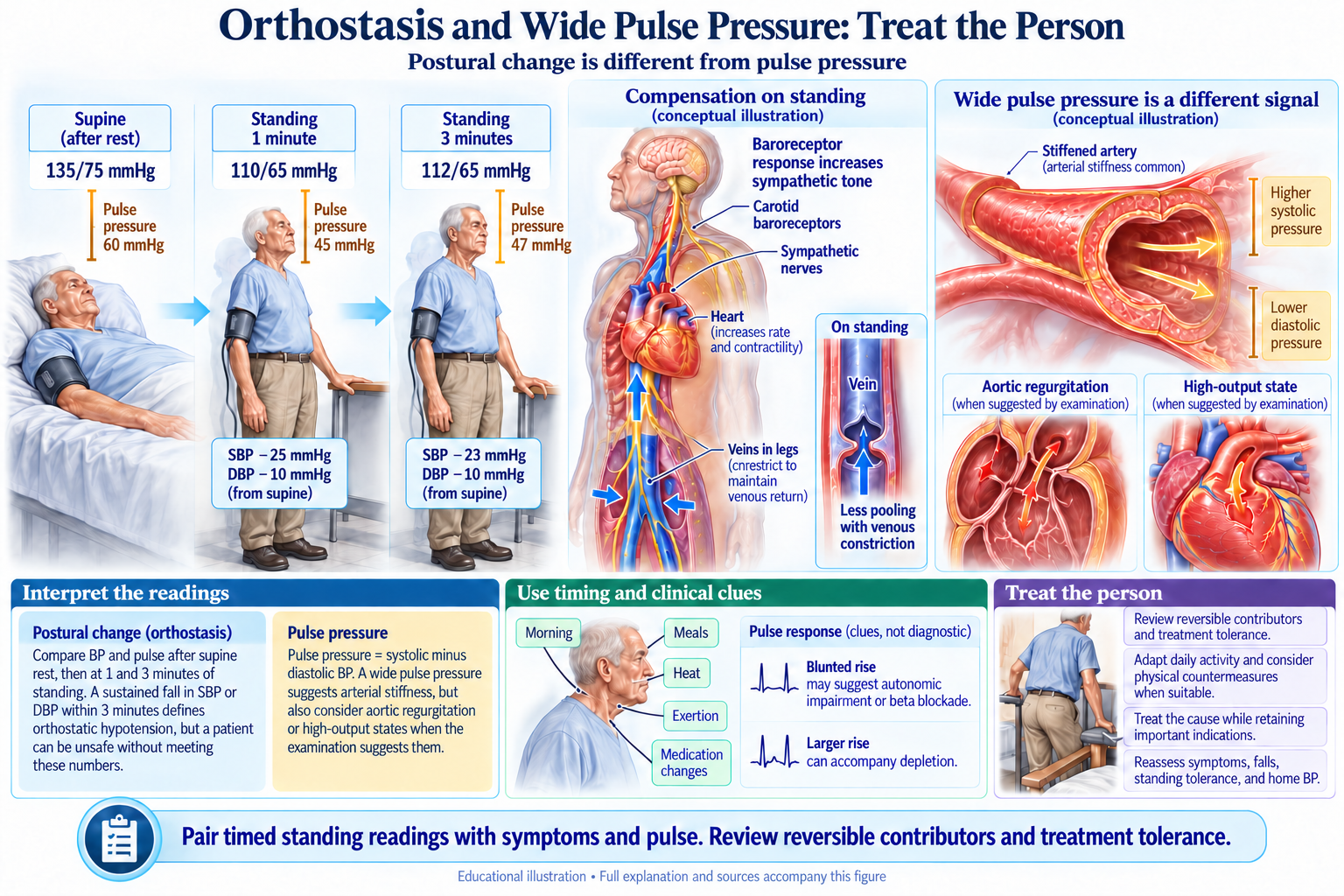
- Orthostatic vitals: Standing BP after 1 and 3 minutes
- Home BP monitoring: Morning and evening readings
- Pulse pressure tracking: Trend analysis over time
- Heart rate variability: Assessment of autonomic function
Symptom Surveillance
- Dizziness or lightheadedness: Especially with position changes
- Chest pain or discomfort: Particularly with exertion
- Cognitive changes: Memory or concentration issues
- Exercise tolerance: Reduction in functional capacity
Target Organ Assessment
- Echocardiography: LV mass and diastolic function
- Carotid ultrasound: Intima-media thickness
- Renal function: eGFR and proteinuria
- Cognitive testing: Mini-Mental State Exam if indicated
Safety Alert Criteria:
Immediate Intervention Required:
- Symptomatic hypotension: DBP consistently <60 mmHg with symptoms
- Orthostatic drop: >20/10 mmHg with symptoms
- New or worsening angina: Potential coronary hypoperfusion
- Cognitive deterioration: Possible cerebral hypoperfusion
- Syncope or near-syncope: Consider medication adjustment
🧮 Wide Pulse Pressure Risk Calculator
📊 Cardiovascular Risk Assessment Tool
Assess cardiovascular risk based on pulse pressure and comorbidities:
📚 Sources
- Franklin SS, Khan SA, Wong ND, Larson MG, Levy D. Is pulse pressure useful in predicting risk for coronary heart disease? The Framingham heart study. Circulation. 1999;100(4):354-360. PMID: 10421594. [Source for: pulse pressure as independent CHD predictor in age ≥60; foundational Framingham analysis.]
- Lewington S, Clarke R, Qizilbash N, Peto R, Collins R; Prospective Studies Collaboration. Age-specific relevance of usual blood pressure to vascular mortality. Lancet. 2002;360(9349):1903-1913. PMID: 12493255. [Source for: PSC age-specific BP-mortality relationships; SBP and DBP both predictive in middle age, SBP dominant in elderly.]
- Whelton PK, et al. 2017 ACC/AHA HTN Guideline. Hypertension. 2018;71(6):e13-e115. PMID: 29133356. [Source for: J-curve and CAD/wide-pulse-pressure considerations in target selection.]