Visual reference
Browse the visual reference library · Download lesson Markdown
🎯 Comprehensive Renal Mass & Cystic Disease Management
From simple cysts to advanced RCC - Evidence-based approaches for optimal patient care based on 2024 guidelines
434,840
Annual RCC cases worldwide
12 Million
People with ADPKD globally
70%
RCC diagnosed as stage I
67%
Angiomyolipomas avoid intervention
📋 Complete Clinical Management Guide
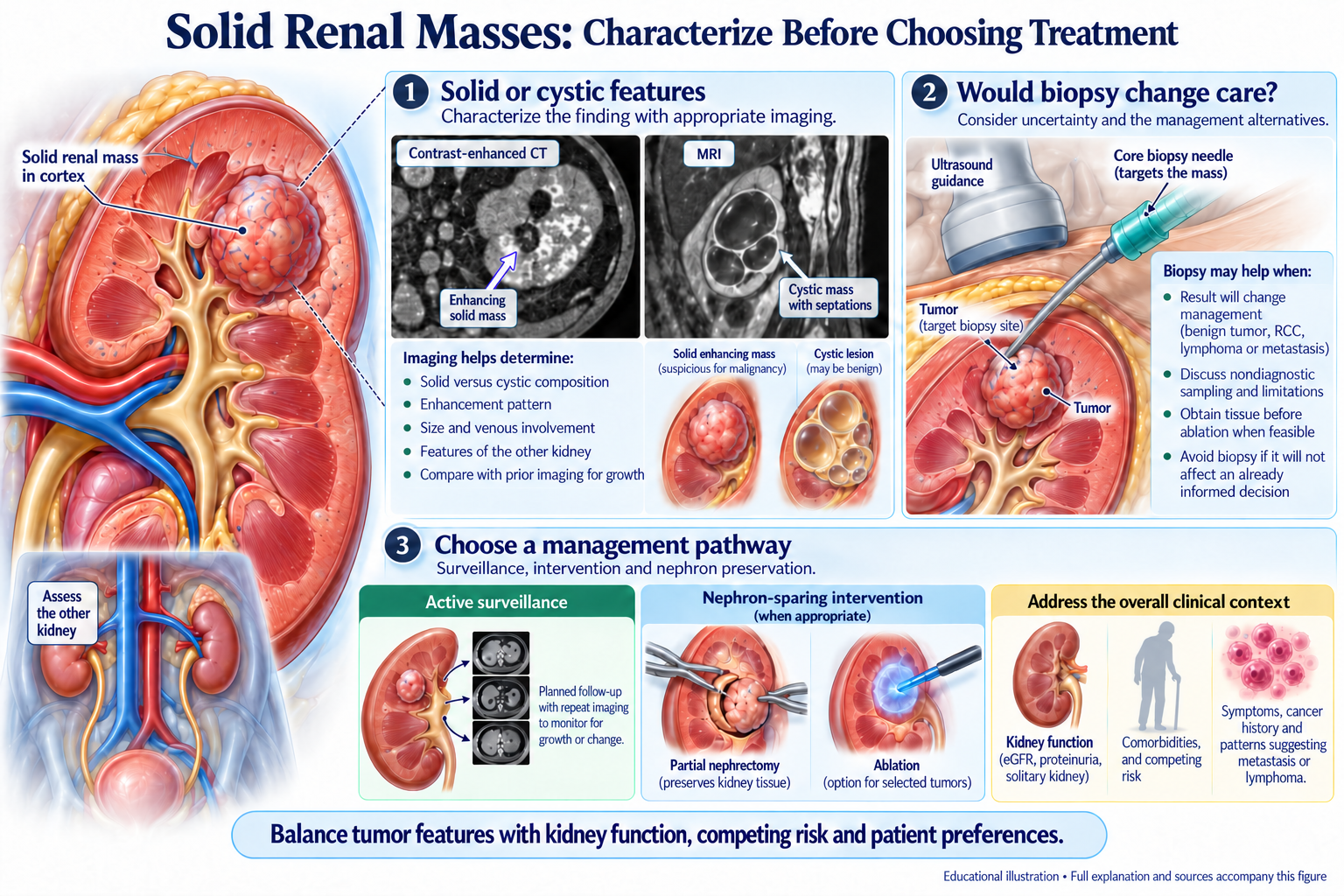
🎯 RENAL MASSES
🎯 Renal Cell Carcinoma
Complete RCC management from early stage to advanced disease
- Size-Based Risk: T1a (5.4%) → T2a (15-20%) metastatic rates
- Histologic Impact: Clear cell highest risk, chromophobe lowest
- Immunotherapy Revolution: Pembrolizumab + axitinib first-line
- Active Surveillance: Safe for selected T1a lesions
- Cryoablation Success: 95% success rate for ≤4cm tumors
- Long-term Outcomes: 10-year DSS 94% with cryoablation
🔴 Angiomyolipoma
Most common benign renal tumor - Conservative management
- Active Surveillance: First-line for most patients, including >4cm
- Conservative Success: 67% avoid intervention long-term
- Classification: Fat-rich, fat-poor, epithelioid variants
- Treatment Triggers: Pregnancy, growth >0.25cm/year
- TSC Association: mTOR inhibitors for multiple lesions
- Emergency Management: Retroperitoneal hemorrhage protocols
🩺 Renal Lymphoma & Metastases
Hematologic and metastatic disease to the kidney
- Renal Lymphoma: 5% CT detection, 30-60% autopsy studies
- Primary Origins: Lung, melanoma, breast, colon metastases
- B-cell NHL: Most common hematologic malignancy
- Diagnosis: Image-guided biopsy essential
- Treatment: Systemic therapy, not surgical
- Imaging Pattern: Bilateral enlargement, hypoenhancement
🧬 CYSTIC KIDNEY DISEASES
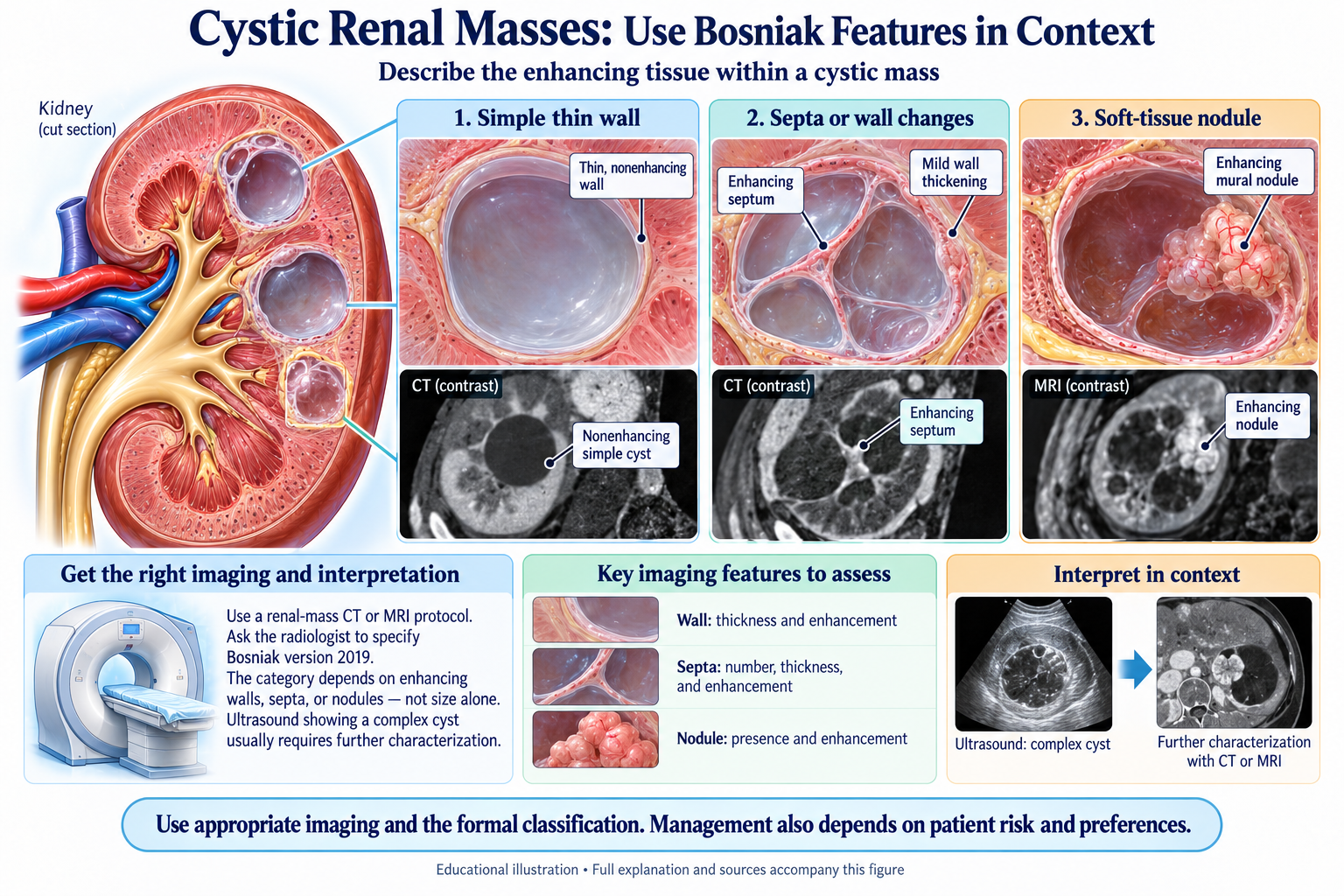
📊 Bosniak Classification 2019
Updated classification with enhanced precision
- Category I: Simple cysts - 0% malignancy risk
- Category II: Minimally complex - <1% risk
- Category IIF: Follow-up required - 0-38% risk
- Category III: Indeterminate - ~50% malignancy
- Category IV: Malignant-appearing - ~90% risk
- 2019 Updates: MRI integration, <30 HU benign rule
🧬 Autosomal Dominant PKD
Most common hereditary kidney disease worldwide
- Genetics: PKD1 (78%), PKD2 (15%) - progression correlation
- Risk Stratification: Mayo Classification 1A-1E
- Tolvaptan: First disease-modifying therapy approved
- Aneurysm Screening: 10-12% prevalence vs 2-3% general
- Liver Disease: 81.7% have hepatic cysts
- Height-Adjusted TKV: Best progression predictor
🔬 Other Cystic Diseases
Complete spectrum of cystic kidney diseases
- ARPKD: 1:20,000-50,000 births, PKHD1 mutations
- Nephronophthisis: AR inheritance, ESRD by age 13
- Medullary Cystic Disease: AD inheritance, hyperuricemia
- Medullary Sponge Kidney: 1:5,000 prevalence, stone risk
- Genetic Testing: Definitive diagnosis for complex cases
- Management: Symptomatic care, complication prevention
🧮 INTERACTIVE CLINICAL TOOLS
🎯 RCC Risk Calculator
- Size-based metastatic risk assessment
- Histologic subtype correlation
- Treatment recommendation generator
- Surveillance vs intervention guidance
📊 Bosniak Classifier
- Automated cyst classification tool
- 2019 updated criteria integration
- Management recommendation
- Surveillance protocol generator
🧬 ADPKD Risk Tools
- Height-adjusted TKV calculator
- Mayo Classification assessment
- Genetic testing decision aid
- Tolvaptan eligibility checker
🔴 AML Management
- Surveillance vs intervention
- Pregnancy risk assessment
- TSC association evaluation
- Growth rate analysis
👁️ RE-IMAGING PROTOCOLS
📅 Bosniak IIF Surveillance
- Initial Protocol: 6 months CT/MRI to establish stability
- Years 1-3: Annual imaging if stable
- Stable Rate: <1% malignancy in stable lesions
- Progression Criteria: New enhancement, thickness, nodules
- Patient Factors: Age, comorbidities, anxiety level
- Extended Follow-up: Consider longer intervals after 5 years
📈 ADPKD Monitoring
- High-Risk Patients: Annual height-adjusted TKV measurement
- Imaging Modality: MRI preferred (no radiation)
- Progression Assessment: TKV growth rate calculation
- Treatment Response: Monitor tolvaptan efficacy
- Aneurysm Screening: MRA every 5-10 years to age 60
- Liver Disease: Assess polycystic liver progression
🔍 Active Surveillance RCC
- T1a Protocol: CT/MRI at 3-6 months, then annually
- Growth Rate: Document size progression over time
- Intervention Triggers: Rapid growth, size >4cm, symptoms
- Patient Selection: Elderly, comorbid, patient preference
- Oncologic Safety: No adverse outcomes from delayed treatment
- Quality of Life: Preserve function, avoid treatment toxicity
🎯 Angiomyolipoma Follow-up
- Initial Assessment: CT/MRI at 6-12 months for growth rate
- Stable Lesions: Annual imaging for 2-3 years, then extend
- Growth Threshold: >0.25 cm/year suggests intervention
- Aneurysm Surveillance: Monitor for intralesional aneurysms
- TSC Patients: More frequent monitoring, consider mTOR inhibitors
- Pregnancy Planning: Pre-conception counseling and monitoring
🌟 2024 Evidence-Based Practice Highlights
🎯 Immunotherapy Revolution
Pembrolizumab + axitinib combination therapy has achieved first overall survival benefit in advanced RCC with 5-year follow-up confirming sustained benefit.
🔍 Bosniak 2019 Precision
Updated classification reduces unnecessary interventions for benign lesions while maintaining diagnostic accuracy through enhanced criteria and MRI integration.
💊 ADPKD Disease Modification
Tolvaptan represents the first approved therapy that significantly slows kidney function decline in high-risk ADPKD patients.
👁️ Active Surveillance Safety
Evidence supports observation for selected renal masses and complex cysts, reducing treatment-related morbidity while maintaining oncologic safety.
📋 Quick Reference Management Table
| Condition | Key Risk Factor | First-Line Management | Follow-up Protocol | Intervention Threshold |
|---|---|---|---|---|
| T1a RCC | Size + Histology | Active surveillance/Cryoablation | 3-6mo, then annual | Growth, symptoms, patient factors |
| Bosniak IIF | Complexity features | Active surveillance | 6mo, then annual 3-5yr | New enhancement, progression |
| ADPKD | PKD1 mutations, TKV | BP control, lifestyle | Annual TKV if high-risk | Mayo 1C-1E for tolvaptan |
| Angiomyolipoma | Size, pregnancy, TSC | Active surveillance | 6-12mo, then annual | >0.25cm/year growth, symptoms |
| Advanced RCC | IMDC risk factors | IO + TKI combination | Oncologic follow-up | Progressive disease |