⚡ Emergency Management Protocol
🎯 Angiomyolipoma: Key Clinical Facts
📊 Most Common Benign
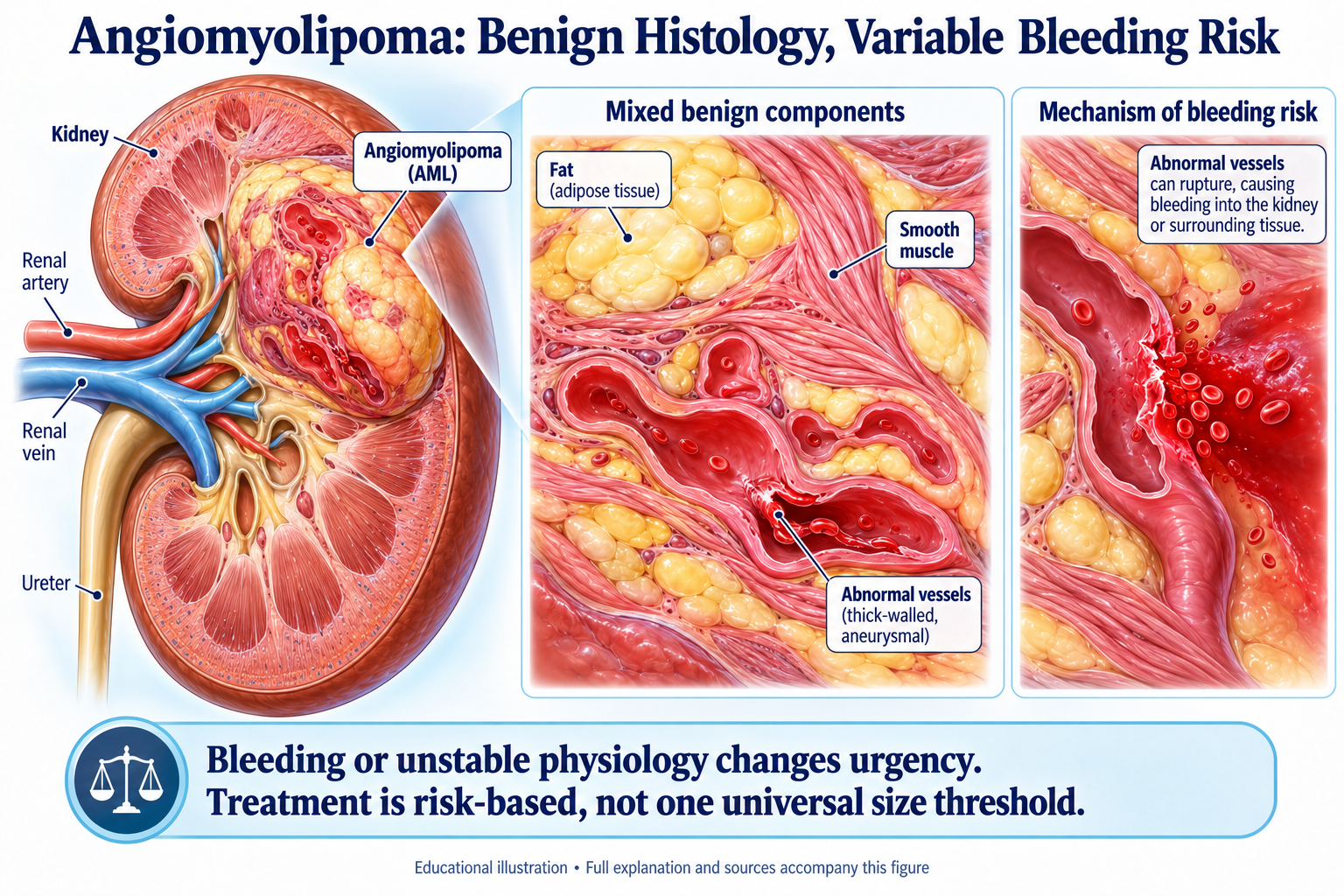
Most prevalent benign renal tumor, composed of vessels, smooth muscle, and fat
👁️ Conservative First-Line
Active surveillance appropriate for most patients, including lesions >4cm
✅ 67% Avoid Intervention
Recent studies show most patients managed conservatively don't require treatment
🧬 TSC Association
Multiple/bilateral lesions suggest tuberous sclerosis complex
🟢 Fat-Rich Angiomyolipoma
- Classic Appearance: Abundant adipose tissue on imaging
- Diagnosis: Characteristic fat signal on CT/MRI
- Behavior: Typically benign, slow growth
- Management: Active surveillance for most
- Hemorrhage Risk: Size-dependent, >4cm higher risk
- Imaging: Negative HU values on unenhanced CT
🟡 Fat-Poor Angiomyolipoma
- Imaging Challenge: Minimal fat content visible
- Differential: May mimic renal cell carcinoma
- Diagnosis: Biopsy often required for confirmation
- Behavior: Generally benign like fat-rich variant
- Management: More aggressive surveillance or intervention
- Pathology: Predominantly smooth muscle and vessels
🔴 Epithelioid Angiomyolipoma
- Malignant Potential: May undergo malignant transformation
- Rare Variant: <5% of all angiomyolipomas
- Histology: Epithelioid smooth muscle cells
- Behavior: More aggressive than classic types
- Management: Surgical resection often recommended
- Follow-up: Oncologic surveillance required
🧮 Angiomyolipoma Management Decision Aid
🧬 Tuberous Sclerosis Complex (TSC) Management
📊 Evidence for Conservative Management
Recent Study Results
- 67% Avoid Intervention: Long-term conservative management successful
- Size Not Absolute: >4cm threshold challenged by recent evidence
- Growth Rate Key: <0.25 cm/year supports observation
- Quality of Life: Conservative management preserves function
Intervention Triggers
- Women of Childbearing Age: Pregnancy increases bleeding risk
- Rapid Growth: >0.25 cm/year growth rate
- Large Aneurysms: Intralesional aneurysms ≥5mm
- Symptoms: Pain, hematuria, functional impairment
Treatment Modalities When Intervention Required
Selective Arterial Embolization • Nephron-Sparing Surgery • mTOR Inhibitors (TSC) • Cryoablation
👁️ Active Surveillance Protocol
- Initial: CT or MRI at 6-12 months to assess growth
- Stable Lesions: Annual imaging for 2-3 years, then extend
- Size Measurement: Maximum diameter in any plane
- Growth Rate: Calculate cm/year progression
- Aneurysm Surveillance: Look for intralesional aneurysms
- Patient Education: Signs/symptoms requiring urgent evaluation
⚠️ Red Flag Symptoms
- Sudden Severe Pain: Flank or abdominal pain suggesting rupture
- Gross Hematuria: Visible blood in urine, especially with pain
- Hypotension: Signs of hemodynamic instability
- Palpable Mass: Rapidly enlarging or tender mass
- Respiratory Issues: Large masses causing compression
- Nausea/Vomiting: Signs of retroperitoneal irritation
🎯 Selective Arterial Embolization
- First-Line Intervention: For symptomatic lesions
- Nephron-Sparing: Preserves kidney function
- Success Rate: 80-90% symptom resolution
- Complications: Post-embolization syndrome common
- Re-intervention: May require repeat procedures
- Best For: Large lesions with feeding vessels
🔪 Nephron-Sparing Surgery
- Enucleation: Tumor removal preserving normal kidney
- Definitive Treatment: Complete lesion removal
- Pathology: Provides tissue diagnosis
- Complications: Higher morbidity than embolization
- Function Loss: Some nephron loss inevitable
- Best For: Younger patients, uncertain diagnosis
💊 mTOR Inhibitor Therapy
- TSC-Associated: First-line for multiple lesions
- Everolimus: Most studied mTOR inhibitor
- Volume Reduction: 30-50% size reduction typical
- Side Effects: Stomatitis, hyperlipidemia, pneumonitis
- Duration: Requires long-term treatment
- Monitoring: Regular labs and pulmonary function
❄️ Thermal Ablation
- Cryoablation: Emerging treatment option
- Minimally Invasive: Percutaneous approach possible
- Size Limitations: Best for smaller lesions <4cm
- Function Preservation: Minimal kidney function loss
- Limited Data: Long-term outcomes being studied
- Patient Selection: Requires careful case evaluation
🎯 Key Learning Points
Conservative Management
Active surveillance is safe and effective for most angiomyolipomas, including those >4cm, with 67% avoiding intervention.
Growth Rate Matters
Growth rate <0.25 cm/year supports continued observation, while faster growth suggests need for intervention.
Pregnancy Considerations
Women of childbearing age require special consideration due to increased bleeding risk during pregnancy.
TSC Association
Multiple/bilateral angiomyolipomas suggest tuberous sclerosis complex requiring comprehensive evaluation and mTOR inhibitor therapy.