
Visual reference
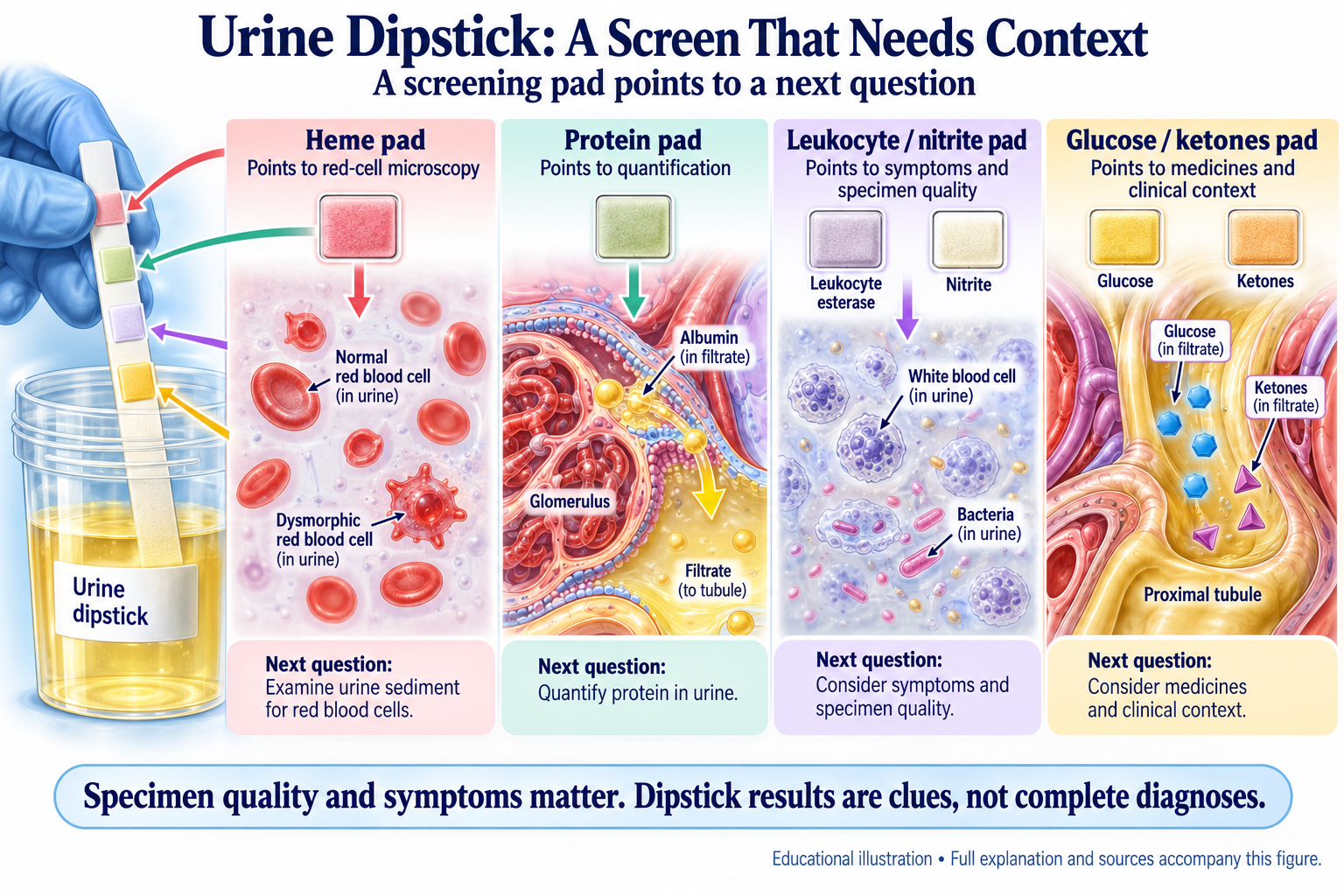
Browse the visual reference library · Download lesson Markdown
Urine sediment: clues to the AKI mechanism
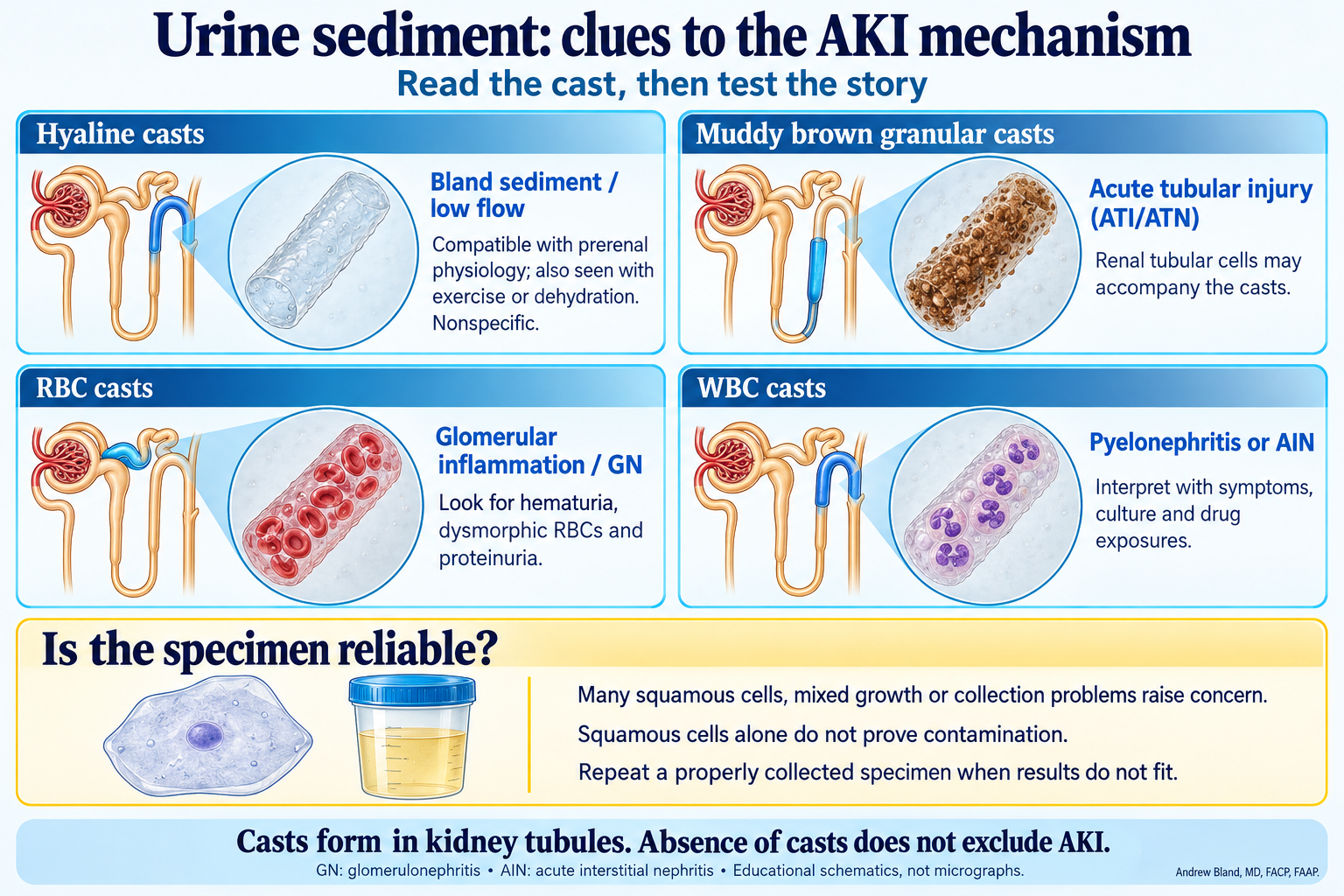
Read the cast, then test the clinical story and specimen quality.
Hyaline and muddy brown casts
A bland sediment with occasional hyaline casts is compatible with low-flow or prerenal physiology. Hyaline casts are nonspecific and also occur with dehydration or exercise without AKI. Muddy brown granular casts and renal tubular epithelial cells strongly support acute tubular injury, often termed ATN in teaching; they do not identify its cause by themselves.
Red-cell and white-cell casts
RBC casts strongly suggest glomerular inflammation, especially with dysmorphic red cells and proteinuria, and warrant prompt evaluation. WBC casts suggest inflammation within the kidney, including pyelonephritis or acute interstitial nephritis. Fever, flank symptoms and culture support infection; medication timing and other findings may suggest AIN. Neither cast is perfectly sensitive or exclusive to one diagnosis.
Check specimen quality before interpreting infection
Numerous squamous epithelial cells, mixed organisms on culture, vaginal secretions or menstrual blood, poor collection, or delayed processing raise concern for contamination. Squamous cells alone do not prove it, and bacteriuria or pyuria alone does not establish symptomatic UTI. When results conflict with the presentation, repeat a fresh properly collected midstream sample; use catheter sampling when clinically indicated.
Know what contamination does not explain
True cellular casts form within kidney tubules. Do not dismiss RBC or WBC casts as lower-tract contamination simply because squamous cells are also present. Absence of casts does not exclude intrinsic disease, and a bland urinalysis does not exclude obstruction.
Supporting evidence
Urinalysis Sub-Modules
🔬 Interpretation Fundamentals
Core principles and systematic approach to urinalysis interpretation
- Microscopy Priority: Why microscopy trumps dipstick
- UA Micro vs FeNa: Diagnostic priorities in AKI
- Contamination Challenge: The Olympic sport of clean catch
- Collection Mastery: Practical guidelines
- Key Learning Points: Evidence-based summary
🧪 Dipstick Analysis
Comprehensive dipstick parameters and limitations
- Dipstick Limitations: When chemistry lies
- Complete Analysis: All dipstick parameters
- Individual Parameters: Detailed interpretation
- Additional Tests: Bilirubin, urobilinogen
- Timing Requirements: Collection considerations
🔬 Ancillary Urine Testing
Advanced testing beyond routine dipstick and microscopy
- FeNa Analysis: Pitfalls and proper interpretation
- Urine Eosinophil Testing: Poor test for AIN
- Advanced Microscopy: Phase contrast and polarized light
- Clinical Context: When ancillary tests are useful
- FeNa Calculator: Interactive tool with clinical caveats
🦠 UTI Assessment and Treatment
Comprehensive UTI evaluation, prevention, and evidence-based management
- UTI Detection: Timing is everything (4-hour rule)
- Prevention Strategies: Vaginal estrogen, cranberry, D-mannose evidence
- Asymptomatic Bacteriuria: When NOT to treat
- Mental Status Myth: Debunking UTI-delirium association
- Treatment Guidelines: Evidence-based therapy selection
🧫 Dysmorphic RBCs (Glomerular Hematuria)
Recognize glomerular source of hematuria with thresholds, technique, and pitfalls
- Acanthocytes: Most specific for glomerular origin
- Thresholds: >5% dysmorphic RBCs suggests GN
- Technique: Phase-contrast tips for accuracy
- Referral Cues: When to escalate to GN workup
🩸 RBC Morphology Overview
Isomorphic vs dysmorphic RBCs, casts, and clinical integration
- Isomorphic vs Dysmorphic: Distinguish urologic vs glomerular
- Casts: RBC casts and their significance
- Clinical Context: Integrate microscopy with symptoms
- Pearls & Pitfalls: Avoid common interpretation errors
🎯 Nephrology-Focused Approach
From a nephrology perspective, the urinalysis is far more than a simple screening test. It's a window into kidney pathology that can reveal glomerulonephritis, acute tubular necrosis, interstitial nephritis, and other critical conditions. This modular approach ensures you master both the technical aspects and clinical interpretation needed for excellent patient care.
🔬 Evidence-Based Priority
- Microscopy First: Direct visualization of pathology
- Clinical Context: Symptoms + microscopy + dipstick
- Fresh Specimens: <2 hours for optimal results
- Contamination Awareness: Validity assessment
- Systematic Approach: Consistent interpretation
⚠️ Common Pitfalls
- Dipstick-Only Diagnosis: Missing critical findings
- FeNa Over-Reliance: Multiple confounding factors
- Contamination Ignorance: Treating normal flora
- Timing Issues: Old specimens, wrong collection
- Context Neglect: Not considering clinical picture
🎓 Learning Objectives
- Systematic Interpretation: Step-by-step approach
- Emergency Recognition: RBC casts, severe findings
- Quality Assessment: Valid vs contaminated specimens
- Clinical Integration: Lab + symptoms + examination
- Evidence Application: Current literature and guidelines