Visual reference
Browse the visual reference library · Download lesson Markdown
📚 Related Urinalysis Modules
🔬 Interpretation Fundamentals
Core principles and systematic approach
🧪 Dipstick Analysis
Comprehensive dipstick parameters and limitations
🦠 UTI Assessment
UTI detection, pitfalls, and evidence-based evaluation
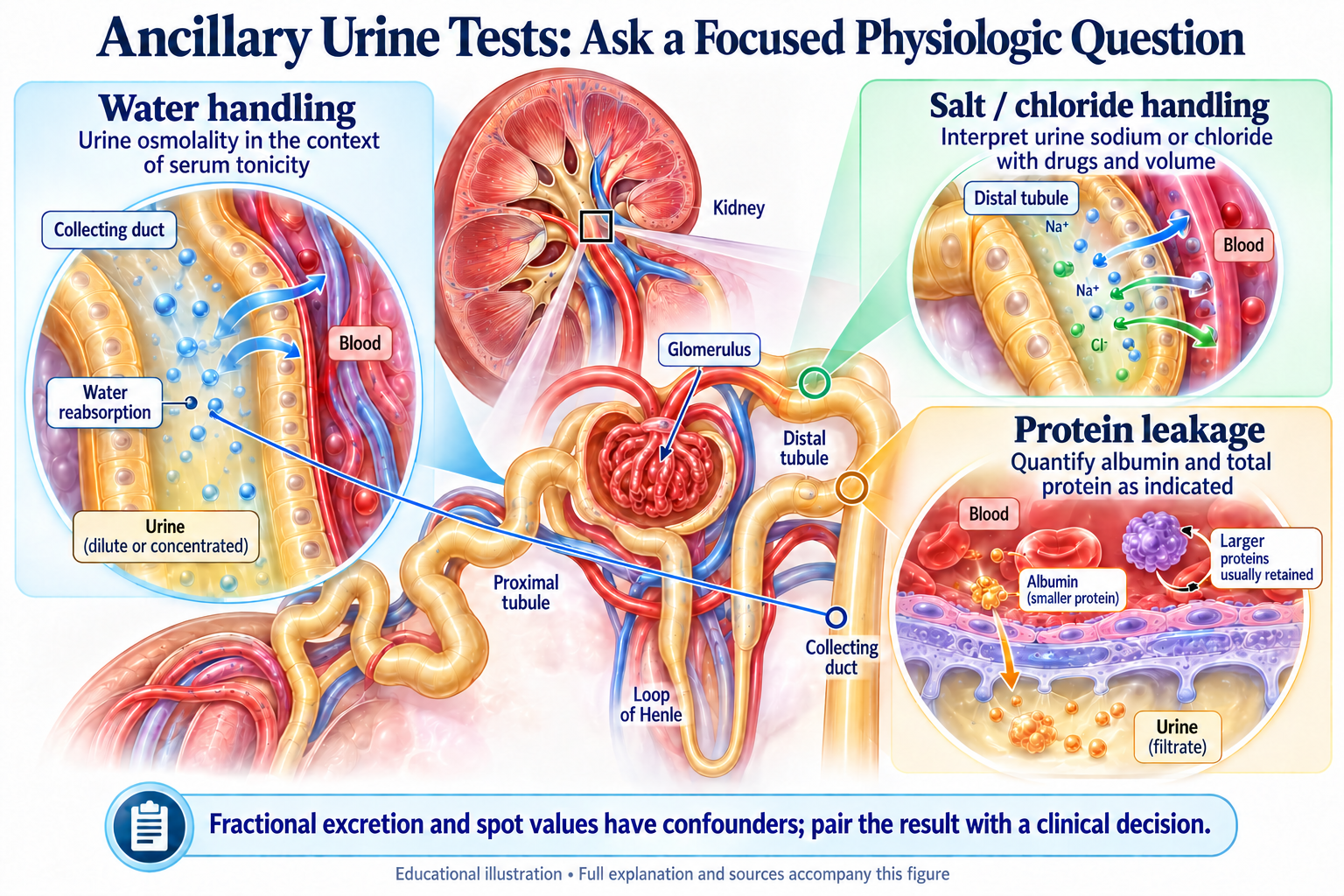
🧪 Ancillary Urine Testing: Beyond Basic Urinalysis
🎯 When Standard Testing Isn't Enough
When routine dipstick and microscopy don't provide clear answers, ancillary testing can offer additional diagnostic insights. However, these tests have specific limitations and should never replace good clinical judgment.
📊 Fractional Excretion of Sodium (FeNa)
- Purpose: Differentiate prerenal AKI from ATN
- Best Use: Oliguric AKI in hospitalized patients
- Major Limitation: Multiple scenarios invalidate interpretation
- Bottom Line: Microscopy findings should override FeNa
🦠 Urine Eosinophil Testing
- Intended Purpose: Diagnose acute interstitial nephritis
- Reality: Poor sensitivity (30%) and specificity (68%)
- PPV: Only 15.6% - most positive tests are wrong
- Recommendation: Avoid routine use
🔬 Advanced Microscopy
- Phase contrast: Enhanced RBC morphology assessment
- Polarized light: Crystal identification and characterization
- Special stains: Fat droplets, specific organisms
- Quantitative: Precise cell counting techniques
📊 FeNa ANALYSIS: The Misleading Metric
⚠️ The FeNa Trap
FeNa was developed in the 1970s for oliguric AKI in hospitalized patients. Its widespread misapplication to all AKI scenarios has led to countless diagnostic errors.
🚫 FeNa <1% Does NOT Mean Prerenal When:
- Patient on diuretics (use FEUrea instead)
- CKD with baseline low FeNa
- Contrast nephropathy
- Acute glomerulonephritis
- Rhabdomyolysis/hemolysis
- Early septic AKI
- Hepatorenal syndrome
🔄 FeNa >1% Does NOT Mean ATN When:
- Normal in elderly patients
- CKD patients (baseline higher)
- Post-obstructive diuresis
- Recovery phase of ATN
- Salt-wasting nephropathy
- Interstitial nephritis
- High sodium intake
🧠 Why Microscopy Trumps FeNa
FeNa tells you about sodium handling. Microscopy tells you about kidney pathology. In AKI, pathology matters more than physiology for immediate management decisions.
🧮 FeNa Calculator with Clinical Context
Fractional Excretion of Sodium (FeNa) with Interpretation Caveats
🦠 URINE EOSINOPHIL TESTING: A Persistent Clinical Myth
🎯 The Evidence Against Urine Eosinophils
Despite widespread use since the 1980s, urine eosinophil testing has poor sensitivity and specificity for acute interstitial nephritis (AIN). The largest biopsy-proven study (Muriithi et al. 2013) definitively showed this test lacks clinical utility.
📊 Actual Test Performance (Muriithi et al. 2013):
- Sensitivity: 30.8% (misses 70% of AIN cases)
- Specificity: 68.2% (32% false positive rate)
- Positive Predictive Value: 15.6% (most positive tests are wrong)
- Negative Predictive Value: 83.7% (only moderately helpful when negative)
- Study: 566 patients with kidney biopsy (gold standard)
🚫 Why This Test Fails:
- Eosinophils found in many conditions: UTI, prostatitis, pyelonephritis
- Absent in many AIN cases: No eosinophils in renal interstitial infiltrate
- Poor discrimination: Cannot distinguish AIN from ATN
- False reassurance: Negative test doesn't rule out AIN
- Wastes resources: $47-170 per test with poor utility
📚 Historical Context & Current Recommendations
1980s Myth Creation
Early small studies suggested correlation between urine eosinophils and AIN, leading to widespread adoption without rigorous validation.
2013 Reality Check
Largest biopsy-proven study definitively showed poor test characteristics when compared to kidney biopsy gold standard.
Current Consensus
Nephrology societies recommend AGAINST routine urine eosinophil testing for suspected AIN evaluation.
🎯 Clinical Bottom Line
"Urine eosinophils should be relegated to historical interest, not clinical practice." - Focus on clinical context, temporal relationship to drug exposure, and kidney biopsy when diagnosis is critical for management.
🧠 Alternative Approaches to AIN Diagnosis
📋 Clinical Assessment
- Temporal relationship to drug exposure
- Sterile pyuria with WBC casts
- Non-oliguric AKI pattern
- Absence of other AKI causes
🔬 Laboratory Findings
- Urinalysis: WBC casts, sterile pyuria
- Blood: Peripheral eosinophilia (inconsistent)
- Proteinuria: Usually <1-2 g/day
- Hematuria: May be present
🎯 Definitive Diagnosis
- Kidney biopsy when diagnosis critical
- Response to drug discontinuation
- Clinical course and recovery pattern
- Exclusion of other causes
🔬 Advanced Microscopy Techniques
🌟 Phase Contrast Microscopy
Enhanced RBC Morphology Assessment
- Purpose: Superior detection of RBC dysmorphism
- Advantage: Better visualization of cell membrane changes
- Clinical Use: Differentiating glomerular from non-glomerular hematuria
- Interpretation: >80% total dysmorphic RBCs = glomerular disease (Köhler 1991 threshold) OR >5% acanthocytes (more specific marker per Köhler 2002 — the modern preferred threshold for differentiating glomerular hematuria) [Reconciled 2026-05-03 — sister files dysmorphic-rbcs.html and rbc-morphology.html use the acanthocyte-specific threshold; both thresholds are valid in the published literature.]
- Limitation: Requires specialized equipment and training
💎 Polarized Light Microscopy
Crystal Characterization
- Purpose: Definitive crystal identification
- Birefringent: Calcium oxalate, uric acid (with first-order red compensator)
- Non-birefringent: Cystine, drug crystals (some)
- Clinical Value: Stone composition prediction and prevention
- Special Cases: Drug-induced crystalluria identification
🧪 Special Stains and Techniques
Specialized Diagnostic Applications
- Sudan III stain: Fat droplets in nephrotic syndrome
- Prussian blue: Hemosiderin detection
- Gram stain: Bacterial identification and morphology
- Congo red: Amyloid detection (rare in urine)
- Acetic acid: WBC identification and counting
🎯 Ancillary Testing Mastery Summary
📊 FeNa Reality Check
- Multiple scenarios invalidate FeNa interpretation
- Microscopy findings should override FeNa
- Developed for specific population (oliguric AKI)
- Pathology trumps physiology for management
🚫 Debunked Tests
- Urine eosinophils: Poor test for AIN
- 30% sensitivity, 68% specificity
- Biopsy-proven studies show poor utility
- Focus on clinical assessment instead
🔬 Advanced Techniques
- Phase contrast for RBC morphology
- Polarized light for crystal ID
- Special stains for specific diagnoses
- Use when standard methods insufficient
🎯 Clinical Wisdom
- No test replaces clinical judgment
- Understand test limitations before ordering
- Correlation with clinical context essential
- When in doubt, consult nephrology