Visual reference
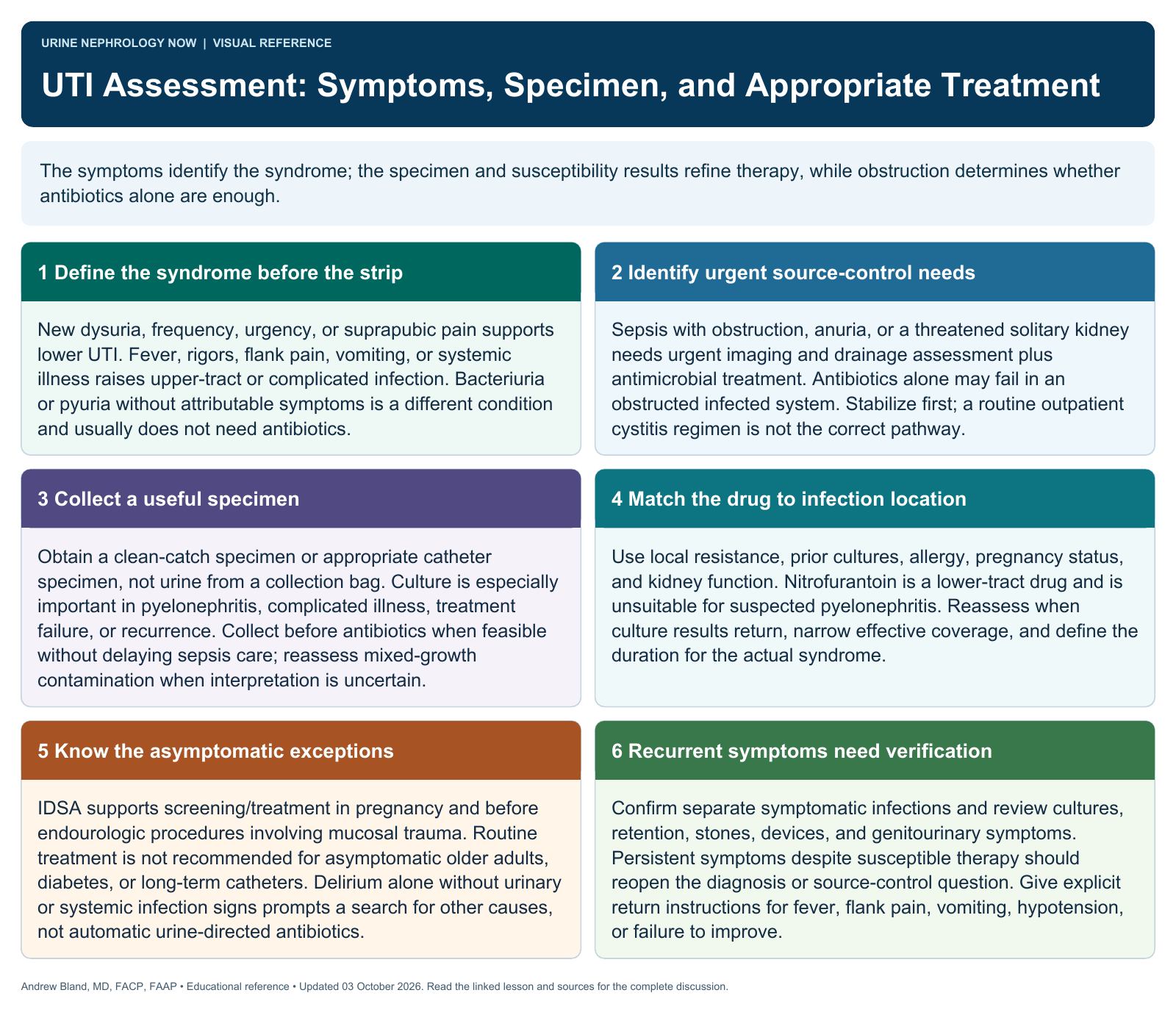
Browse the visual reference library · Download lesson Markdown
📚 Related Urinalysis Modules
🔬 Interpretation Fundamentals
Core principles and systematic approach
🧪 Dipstick Analysis
Comprehensive dipstick parameters and limitations
🔬 Ancillary Urine Testing
Microscopy, FeNa analysis, and urine eosinophil testing
🦠 UTI Detection: Timing is Everything
🟠 Leukocyte Esterase
What it detects: Enzyme from neutrophils (indirect measure of pyuria)
- Timing: No specific bladder dwell time required
- Sensitivity: 48-71% (varies by pathogen)
- Lower with: Enterococcus, Klebsiella infections
- False Positive: Trichomonas, vaginal contamination
- False Negative: Antibiotics, high glucose/protein
🟡 Nitrites - The 4-Hour Rule
Critical Timing: Bacteria need ≥4 hours in bladder to convert nitrates to nitrites
- High Specificity: 95% (positive = likely UTI)
- Poor Sensitivity: 23-38% (negative doesn't rule out UTI)
- False Negative: Frequent urination, non-nitrate reducers
- Organisms: E. coli, Klebsiella, Proteus (positive)
- Won't Detect: Enterococcus, Staph, Pseudomonas
⏰ Why Timing Matters for Nitrites
✅ Optimal Conditions
First morning void: Urine in bladder overnight (≥4 hours) allows bacterial enzyme activity to convert dietary nitrates to detectable nitrites.
❌ False Negative Scenarios
Frequent urination: Infants, elderly, overhydration, diuretics - insufficient dwell time for nitrate conversion.
🦠 Bacterial Specificity
Enterobacteriaceae only: Gram-negative organisms have nitrate reductase. Many Gram-positive bacteria lack this enzyme.
🎯 Clinical Integration
Best Approach: Combine LE + Nitrites + clinical symptoms. Sensitivity improves to 94% when both tests used together.
🚫 Asymptomatic Bacteriuria: The Great Overtreatment
📋 IDSA 2019 Definition
Asymptomatic Bacteriuria (ASB): ≥10⁵ CFU/mL bacteria in urine WITHOUT localizing genitourinary symptoms or systemic signs of infection
- Women: Two consecutive specimens with same organism
- Men: Single specimen ≥10⁵ CFU/mL
- Catheterized: ≥10³ CFU/mL (lower threshold)
- Key Point: Pyuria present in >90% of ASB cases
📊 Prevalence by Population
- Healthy premenopausal women: 3-7%
- Postmenopausal women: 10-20%
- Nursing home residents: 20-22%
- Spinal cord injury: 50%
- Diabetic women: 15-25%
- Elderly institutionalized: 30-70%
🚫 IDSA Strong Recommendations AGAINST Treatment
- Nursing home residents: Do NOT screen or treat
- Diabetic women: No benefit demonstrated
- Spinal cord injury: Treatment harmful
- Catheterized patients: No routine treatment
- Elderly with delirium: Assess other causes first
🧠 Mental Status Changes: Debunking the UTI Myth
❌ IDSA 2019 Strong Recommendation
"Assess other causes and observe" rather than treat ASB in elderly patients with delirium but no localizing GU symptoms or fever.
📊 Meta-Analysis Evidence
Significant association: Delirium + symptomatic UTI
No association: Delirium + ASB (statistically insignificant)
🔍 Alternative Causes of Delirium
More likely: Medications, dehydration, environment changes, infections at other sites, metabolic disturbances
💊 Harms of Inappropriate ASB Treatment
🛡️ UTI Prevention: Evidence-Based Strategies
🥇 Vaginal Estrogen (Grade B Evidence)
For postmenopausal women: STRONGEST evidence for UTI prevention
- Efficacy: 50-60% reduction in UTI risk
- Mechanism: Restores lactobacilli, normalizes pH (5.5→3.8)
- AUA Recommendation: Grade B (moderate strength)
- Formulations: Cream, ring, tablets
- Safety: Minimal systemic absorption
- Additional benefit: Treats genitourinary syndrome
🥈 Cranberry Products (Grade B Evidence)
Moderate evidence: 25-35% reduction in UTI risk
- 2023 Cochrane Review: 30% reduction (RR 0.70)
- Best form: Juice superior to supplements
- Mechanism: A-type PACs prevent E. coli adherence
- Dosing: 240-300mL juice daily or 36-72mg PACs
- Safety: Excellent, minimal side effects
- Population: Most effective in women with recurrent UTIs
🥉 D-Mannose: Recent Evidence Shows No Benefit
🚫 2024 Hayward Trial (JAMA Internal Medicine)
- Largest RCT to date: 598 women, 6 months follow-up
- Primary outcome: 51% (D-mannose) vs 55.7% (placebo) - NO difference
- Conclusion: "Should NOT be recommended for UTI prevention"
- Cost: $50-200/year with no proven benefit
- Contradicts: Earlier small studies with methodological flaws
🎯 Population-Specific Recommendations
👵 Postmenopausal Women
First-line: Vaginal estrogen
Second-line: Cranberry products
Not recommended: D-mannose
👩 Premenopausal Women
First-line: Cranberry products
Not recommended: D-mannose (Hayward 2024 showed no benefit)
Not applicable: Vaginal estrogen
🤰 Pregnant Women
Safe option: Cranberry juice (no-sugar-added)
Avoid: Supplements (insufficient safety data)
Contraindicated: Vaginal estrogen
🧮 UTI Prevention Strategy Calculator
🦠 URINE EOSINOPHIL TESTING: A Persistent Clinical Myth
🎯 The Evidence Against Urine Eosinophils
Despite widespread use since the 1980s, urine eosinophil testing has poor sensitivity and specificity for acute interstitial nephritis (AIN). The largest biopsy-proven study (Muriithi et al. 2013) definitively showed this test lacks clinical utility.
📊 Actual Test Performance (Muriithi et al. 2013):
- Sensitivity: 30.8% (misses 70% of AIN cases)
- Specificity: 68.2% (32% false positive rate)
- Positive Predictive Value: 15.6% (most positive tests are wrong)
- Negative Predictive Value: 83.7% (only moderately helpful when negative)
- Study: 566 patients with kidney biopsy (gold standard)
🚫 Why This Test Fails:
- Eosinophils found in many conditions: UTI, prostatitis, pyelonephritis
- Absent in many AIN cases: No eosinophils in renal interstitial infiltrate
- Poor discrimination: Cannot distinguish AIN from ATN
- False reassurance: Negative test doesn't rule out AIN
- Wastes resources: $47-170 per test with poor utility
💊 Evidence-Based UTI Treatment Guidelines
🎯 Treatment Decision Algorithm
STEP 1: Confirm Symptomatic UTI
✅ Localizing GU symptoms (dysuria, frequency, urgency, suprapubic pain)
✅ Systemic signs if present (fever, chills)
❌ Mental status changes alone in elderly
STEP 2: Assess Specimen Quality
✅ <10 squamous epithelial cells/hpf
✅ Appropriate bacterial morphology
❌ Mixed flora suggests contamination
STEP 3: Determine Complexity
Uncomplicated: Healthy women, no structural abnormalities
Complicated: Men, pregnancy, immunocompromise, urological abnormalities
STEP 4: Select Appropriate Therapy
Consider local resistance patterns, patient factors, and guideline recommendations
💊 Uncomplicated Cystitis (Women) — eGFR-Stratified
- First-line (eGFR ≥30 mL/min/1.73m²): Nitrofurantoin 100mg BID × 5 days
- First-line for CKD (eGFR <30) or where nitrofurantoin contraindicated: Fosfomycin 3g × 1 dose (effective at any eGFR — single-dose oral) OR Cephalexin 500mg q6h × 5-7 days
- Alternative: TMP-SMX DS BID × 3 days (if local E. coli resistance <20% AND eGFR sufficient — adjust for renal impairment)
- Avoid: Fluoroquinolones as first-line for uncomplicated cystitis (FDA 2016 black-box for tendinopathy/aortic dissection; reserve for failure or pyelonephritis)
- Avoid in CKD: Nitrofurantoin if eGFR <30 — sub-therapeutic urinary concentration AND elevated risk of pulmonary fibrosis, peripheral neuropathy, hepatotoxicity
🔥 Complicated UTI / Pyelonephritis
- Outpatient: Fluoroquinolone × 7-10 days
- Inpatient: Ceftriaxone or fluoroquinolone
- Severe sepsis: Broad-spectrum until culture
- Duration: 7-14 days based on severity
🚫 Do NOT Treat
- Asymptomatic bacteriuria (most populations)
- Elderly with delirium alone (no GU symptoms)
- Catheterized patients (unless symptomatic)
- Contaminated specimens (repeat collection)
🔍 Evidence-Based UTI Assessment Algorithm
📋 Step-by-Step UTI Evaluation
STEP 1: Clinical Assessment
Symptoms (dysuria, frequency, urgency, suprapubic pain), fever, flank pain, systemic signs
STEP 2: Specimen Quality Check
Microscopy first: <10 squamous epithelial cells/hpf, appropriate bacterial morphology
STEP 3: Microscopy Findings
WBC count, bacteria presence/type, WBC casts, RBCs, contamination indicators
STEP 4: Dipstick Correlation
Leukocyte esterase + nitrites (consider timing), blood, protein
STEP 5: Clinical Integration
Combine symptoms + microscopy + dipstick. Culture if complicated or treatment failure
🎯 High Probability UTI
- Classic symptoms
- Clean specimen
- Pyuria (≥10 WBC/hpf)
- Bacteriuria
- Positive nitrites
⚠️ Indeterminate
- Atypical symptoms
- Borderline contamination
- Mixed findings
- Negative nitrites
- Consider recollection
❌ Low Probability UTI
- Asymptomatic
- Contaminated specimen
- No pyuria
- Alternative diagnosis
- Consider other causes
🎯 UTI Assessment and Treatment Mastery Summary
🛡️ Prevention First
- Vaginal estrogen: Strongest evidence (postmenopausal)
- Cranberry products: Moderate evidence (all populations)
- D-mannose: No benefit shown (2024 high-quality trial)
- Population-specific recommendations essential
🚫 Avoid Overtreatment
- ASB ≠ UTI: Do not treat asymptomatic bacteriuria
- Mental status changes alone ≠ UTI indication
- Pyuria present in >90% of ASB cases
- IDSA 2019: Strong recommendations against
⏰ Timing Critical
- Nitrites require ≥4 hours bladder dwell time
- First morning void optimal for detection
- Frequent urination causes false negatives
- Fresh specimens prevent bacterial overgrowth
🎯 Evidence-Based Approach
- Symptoms + microscopy + dipstick integration
- Quality assessment before interpretation
- Systematic algorithm for decision-making
- Recognition of complicated UTI indicators