Visual reference
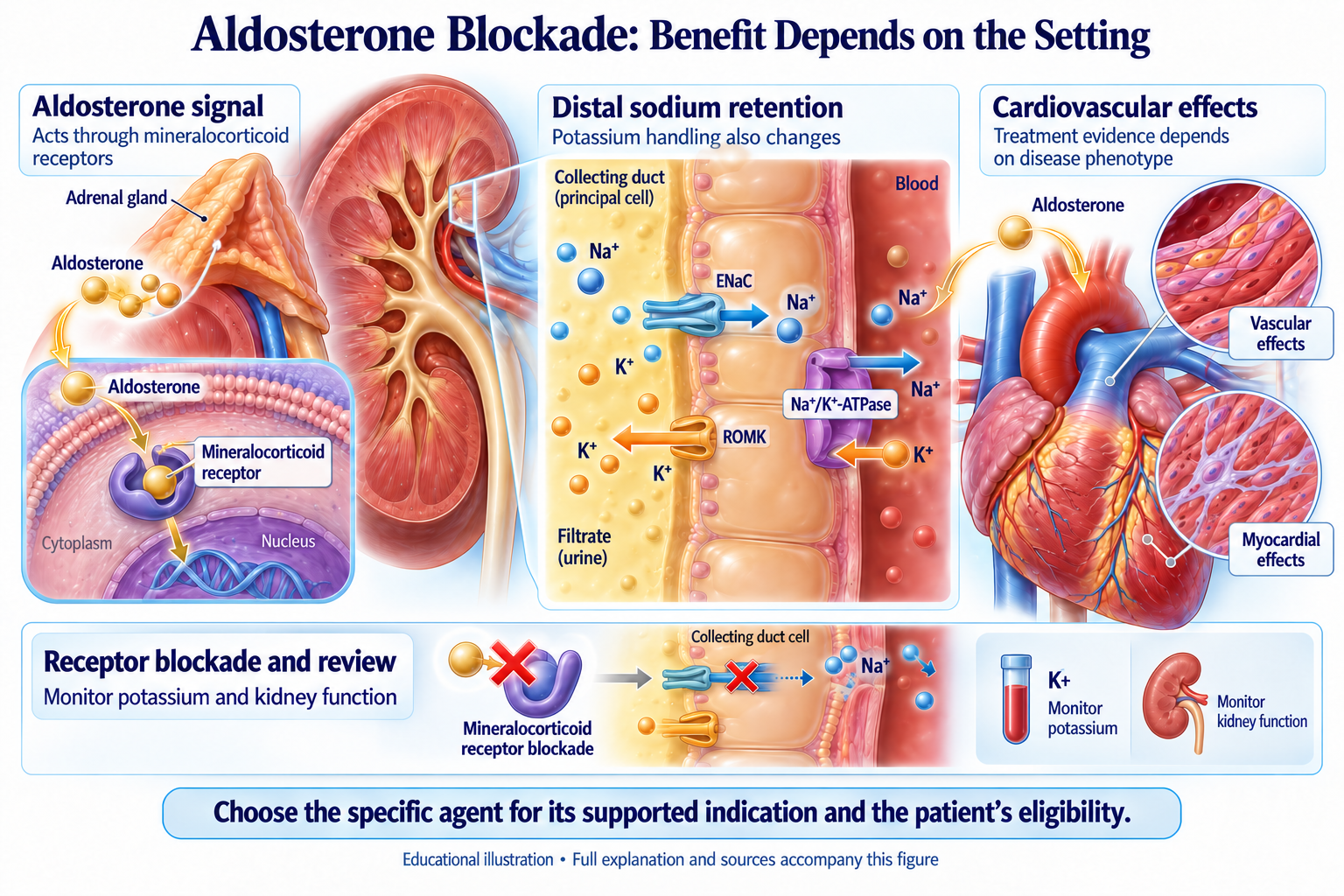
Browse the visual reference library · Download lesson Markdown
Executive Summary
This comprehensive evidence synthesis examines the mechanistic differences between non-steroidal mineralocorticoid receptor antagonists (nsMRAs), traditional steroidal MRAs, and aldosterone synthase inhibitors, with particular emphasis on their differential effects on heart failure outcomes and blood pressure control. The analysis distinguishes between aldosterone-dependent and aldosterone-independent mechanisms of MR activation, including the roles of salt, metabolic factors, cortisol, and inflammatory mediators in driving fibrosis and cardiovascular pathology.
Mechanistic Differences Between Therapeutic Approaches
Non-Steroidal MRAs: Finerenone
Finerenone represents the most extensively studied nsMRA, demonstrating distinct mechanistic advantages over traditional steroidal MRAs.
- Bulky Antagonist Binding: Inhibits transcriptional cofactor recruitment involved in hypertrophic, proinflammatory, and profibrotic gene expression
- Tissue Distribution: Preferential distribution to cardiovascular and renal tissues with reduced accumulation in reproductive organs, minimizing antiandrogenic and progestogenic effects
- Cofactor Modulation: Selectively modulates MR cofactor interactions, providing the molecular basis for superior antifibrotic activity
Traditional Steroidal MRAs: Spironolactone and Eplerenone
- Non-selective Binding: Spironolactone exhibits cross-reactivity with androgen and progesterone receptors → gynecomastia and erectile dysfunction
- Aldosterone Escape: Chronic MRA treatment can increase circulating aldosterone levels, potentially exacerbating non-genomic effects
- Tissue Accumulation: Long plasma half-lives contribute to hyperkalemia risk in moderate-to-advanced CKD
Aldosterone Synthase Inhibitors: Lorundrostat and Baxdrostat
Aldosterone synthase inhibitors target CYP11B2 to block aldosterone production at its source, eliminating both genomic and non-genomic aldosterone effects. This contrasts with MRAs, which may incompletely block aldosterone effects due to escape mechanisms. Selectivity ratios: lorundrostat 374:1, baxdrostat 100:1 for CYP11B2 over CYP11B1.
Heart Failure Outcomes and Blood Pressure Control
FINEARTS-HF: Breakthrough in HFpEF/HFmrEF
| Endpoint | Result | 95% CI | P-value |
|---|---|---|---|
| CV death + total worsening HF | 16% reduction (RR 0.84) | 0.74–0.95 | 0.007 |
| Worsening HF events | 18% reduction (RR 0.82) | 0.71–0.94 | 0.007 |
| Consistency across EF spectrum | Consistent benefits at EF 40–60% and >60% | ||
FIDELITY Pooled Analysis (FIDELIO-DKD + FIGARO-DKD)
- CV Death: 14% reduction (HR 0.86, 95% CI 0.78–0.95)
- Composite Renal Outcomes: 23% reduction
- UACR Reduction: 32% at 4 months
Aldosterone Synthase Inhibitors in HTN
| Agent | Trial | BP Reduction | Key Finding |
|---|---|---|---|
| Lorundrostat | TARGET-HTN / ADVANCE-HTN | 8.0 mmHg 24-hr ABPM SBP | Particularly robust effects in obesity |
| Baxdrostat | BrigHTN | Up to 11.0/6.8 mmHg | Dose-dependent (0.5–2.0 mg) |
Non-Aldosterone Activation of Mineralocorticoid Receptors
The MR binds aldosterone, cortisol, and corticosterone with similar high affinity. Circulating glucocorticoid levels exceed aldosterone by 100–1,000 fold. In tissues lacking 11β-HSD2 protection (cardiomyocytes, macrophages, podocytes), cortisol serves as the primary MR ligand. This is why nsMRAs provide benefit beyond what aldosterone synthase inhibitors can achieve.
Salt-Induced MR Activation
Salt loading activates MR independent of aldosterone through the Rac1 pathway, contributing to renal injury and hypertension in salt-sensitive models. Salt-induced MR activation increases NADPH oxidase activity and ROS production.
Metabolic Factors
- Glucose: AGEs directly activate MR signaling. MR overactivation contributes to insulin resistance and metabolic syndrome. MR activation in adipose tissue alters adipokine profiles (↑ TNF-α, ↓ adiponectin)
- Lipotoxicity: Adipocyte-derived leptin directly stimulates aldosterone synthesis, creating a feed-forward loop. Elevated FFAs enhance MR sensitivity
The 11β-HSD2 System
| Tissue Type | 11β-HSD2 Status | Primary MR Ligand | Clinical Implication |
|---|---|---|---|
| Renal epithelium, colon, salivary glands | Protected (11β-HSD2 converts cortisol → cortisone) | Aldosterone | Aldosterone-selective MR activation |
| Cardiomyocytes, macrophages, podocytes | Unprotected (no 11β-HSD2) | Cortisol | Cortisol-driven fibrosis and inflammation |
| Aging tissues | Declining with age | Cortisol (increasing) | Increased cortisol-mediated MR activation in elderly |
Inflammation and Fibrosis: Cellular and Molecular Mechanisms
MR in Immune Cell Function
- Macrophages: MR activation promotes pro-inflammatory M1 phenotype with increased TNF-α. MR-activated macrophages secrete profibrotic mediators including CTGF. Critically, macrophage MR drives fibrosis even when plasma aldosterone levels remain normal.
- T Cells: MR activation promotes pro-inflammatory Th17 cell development, impairs regulatory T cell function, and enhances autoimmune kidney disease progression.
Aldosterone Synthase Inhibitors: Superior Anti-Inflammatory Potential?
Aldosterone synthase inhibitors offer theoretical advantages for comprehensive inflammatory pathway suppression:
- Eliminates aldosterone production at source, blocking both genomic and non-genomic inflammatory cascades
- Prevents paradoxical aldosterone increases seen with chronic MRA therapy
- Eliminates aldosterone-mediated NADPH oxidase activation (NOX2/NOX4)
Current clinical trial evidence reveals a significant gap in direct comparative assessment of inflammatory biomarker responses between aldosterone synthase inhibitors and MRAs. Most outcome trials have focused on cardiovascular and renal endpoints rather than detailed inflammatory pathway analysis. Head-to-head inflammatory studies are a critical research priority.
Comprehensive Therapeutic Comparison
| Domain | Steroidal MRAs | Non-Steroidal MRAs (Finerenone) | Aldo Synthase Inhibitors |
|---|---|---|---|
| HFrEF | Established: RALES 30% mortality reduction; EPHESUS 15% reduction. Class I recommendation. | Emerging: ARTS-HF non-inferiority to eplerenone with lower hyperkalemia. FINALITY-HF ongoing. | Theoretical benefit only. No completed CV outcome trials in HFrEF. |
| HFpEF/HFmrEF | Limited: TOPCAT showed modest benefit only in Americas subgroup. | Definitive: FINEARTS-HF — 16% primary endpoint reduction, 18% HF event reduction. First MRA with proven HFpEF benefit. | No completed trials. Theoretical mechanistic advantages. |
| Hyperkalemia Risk | High: RALES 2% serious; real-world 5–10%. Dose-dependent, worse with declining GFR. | Reduced: FIDELIO-DKD 2.3% vs 0.9% discontinuation. FINEARTS-HF 1.2% vs 0.4% serious. | Variable: TARGET-HTN 0.8%. Limited long-term data. |
| Hormonal Side Effects | Significant: Gynecomastia 10–15% (spironolactone), erectile dysfunction, menstrual irregularities. | Minimal: No significant hormonal side effects vs. placebo. High MR selectivity. | Minimal: No direct receptor interaction. No hormonal side effects in trials. |
| Renal Safety | Moderate risk. Initial GFR decline stabilizes. Hyperkalemia risk increases with declining GFR. | Favorable: FIDELIO-DKD 23% reduction in composite renal outcomes. Better long-term GFR preservation. | Uncertain. Limited long-term data. Theoretical concern for volume depletion in CKD. |
| Volume Depletion Risk | Low: Preserved endogenous aldosterone synthesis provides safety margin. | Low: Preserved aldosterone synthesis capacity. | High: Complete aldosterone deficiency eliminates compensatory mechanisms during volume loss. |
| Anti-Inflammatory | Moderate: Partial inflammatory suppression. Compensatory aldosterone increase may limit effect. | Enhanced: Superior tissue selectivity, more potent NFκB suppression and antifibrotic effects. | Potentially superior: Complete elimination of all aldosterone-mediated inflammatory pathways. Requires clinical validation. |
Clinical Decision-Making Framework
| Clinical Scenario | Preferred Agent | Rationale |
|---|---|---|
| HFpEF/HFmrEF | Finerenone | First MRA with definitive outcome benefits (FINEARTS-HF). Superior tolerability. |
| HFrEF | Spironolactone/Eplerenone | Established mortality benefit (RALES, EPHESUS). Class I recommendation. |
| Treatment-Resistant HTN | Aldosterone Synthase Inhibitors | Novel mechanism for MRA-intolerant patients. Efficacy in obesity-associated HTN. |
| DKD with T2DM | Finerenone | Established cardiorenal protection. Lower hyperkalemia risk. Additive with SGLT2i. |
Ongoing Clinical Investigation: MOONRAKER Program
- REDEFINE-HF: Recently hospitalized patients with HFpEF/HFmrEF
- FINALITY-HF: HFrEF patients not receiving steroidal MRAs
- CONFIRMATION-HF: Combination therapy with SGLT2i across the EF spectrum
References
- Kintscher U, Bakris GL, Kolkhof P. Novel non-steroidal mineralocorticoid receptor antagonists in cardiorenal disease. Br J Pharmacol. 2022;179(13):3220-3234. [PubMed]
- Zhai S, Ma B, Chen W, Zhao Q. A comprehensive review of finerenone. Front Cardiovasc Med. 2024;11:1476029. [PubMed]
- Grune J, Beyhoff N, Smeir E, et al. Selective mineralocorticoid receptor cofactor modulation as molecular basis for finerenone's antifibrotic activity. Hypertension. 2018;71:599-608. [PubMed]
- Amazit L, Le Billan F, Kolkhof P, et al. Finerenone impedes aldosterone-dependent nuclear import of the MR. J Biol Chem. 2015;290:21876-21889. [PubMed]
- Agarwal R, Kolkhof P, Bakris G, et al. Steroidal and non-steroidal mineralocorticoid receptor antagonists in cardiorenal medicine. Eur Heart J. 2021;42:152-161. [PubMed]
- Pitt B, Zannad F, Remme WJ, et al. The effect of spironolactone on morbidity and mortality in patients with severe heart failure. N Engl J Med. 1999;341:709-717. [PubMed]
- Laffin LJ, Rodman D, Luther JM, et al. Aldosterone synthase inhibition with lorundrostat for uncontrolled hypertension: TARGET-HTN. JAMA. 2023;330:1140-1150. [PubMed]
- Freeman MW, Halvorsen YD, Marshall W, et al. Phase 2 trial of baxdrostat for treatment-resistant hypertension. N Engl J Med. 2023;388:395-405. [PubMed]
- Solomon SD, McMurray JJV, Vaduganathan M, et al. Finerenone in heart failure with mildly reduced or preserved ejection fraction. N Engl J Med. 2024;391:1475-1485. [PubMed]
- Bakris GL, Agarwal R, Anker SD, et al. Effect of finerenone on chronic kidney disease outcomes in type 2 diabetes. N Engl J Med. 2020;383:2219-2229. [PubMed]
- Pitt B, Filippatos G, Agarwal R, et al. Cardiovascular events with finerenone in kidney disease and type 2 diabetes. N Engl J Med. 2021;385:2252-2263. [PubMed]
- Agarwal R, Filippatos G, Pitt B, et al. Cardiovascular and kidney outcomes with finerenone: FIDELITY pooled analysis. Eur Heart J. 2022;43:474-484. [PubMed]
- Shibata S, Nagase M, Yoshida S, et al. Modification of mineralocorticoid receptor function by Rac1 GTPase. Nat Med. 2008;14:1370-1376. [PubMed]
- Usher MG, Duan SZ, Ivaschenko CY, et al. Myeloid mineralocorticoid receptor controls macrophage polarization and cardiovascular hypertrophy. J Clin Invest. 2010;120:3350-3364. [PubMed]
- Huby AC, Antonova G, Groenendyk J, et al. Adipocyte-derived leptin is a direct regulator of aldosterone secretion. Circulation. 2015;132:2134-2145. [PubMed]
- Chapman K, Holmes M, Seckl J. 11β-hydroxysteroid dehydrogenases: intracellular gate-keepers of tissue glucocorticoid action. Physiol Rev. 2013;93:1139-1206. [PubMed]
- Mazzieri A, Timio F, Patera F, et al. Aldosterone synthase inhibitors for cardiorenal protection. Kidney Blood Press Res. 2024;49:1041-1056. [PubMed]
- Kobayashi M, Girerd N, Zannad F. When to use spironolactone, eplerenone or finerenone in cardiorenal diseases. Nephrol Dial Transplant. 2024;39:1063-1072. [PubMed]
- Pitt B, Williams GH. Aldosterone Synthase Inhibitors and Mineralocorticoid Receptor Antagonists: Competitors or Collaborators? Circulation. 2024;149(6):414–416. PubMed. Commentary.