Visual reference
Browse the visual reference library · Download lesson Markdown
Abstract
Background: Flash pulmonary edema (FPE) represents a life-threatening form of acute decompensated heart failure characterized by rapid onset severe pulmonary congestion within minutes to hours. Despite advances in cardiovascular therapeutics, mortality rates remain substantial, necessitating comprehensive understanding of underlying pathophysiology and evidence-based management strategies.
Objective: To provide a systematic review of cardiac, valvular, and renal etiologies of flash pulmonary edema, with emphasis on contemporary diagnostic approaches and therapeutic interventions based on current literature through 2025.
Key Findings: FPE results from acute elevation of LVEDP above 18 mmHg through diverse pathophysiologic mechanisms. When respiratory failure complicates AKI in FPE, mortality rates exceed 80%. Contemporary management emphasizes rapid respiratory support with NIPPV and aggressive afterload reduction with high-dose vasodilators.
Pathophysiologic Framework
Fundamental Hemodynamic Principles
FPE occurs when left ventricular end-diastolic pressure rises acutely above the critical threshold of 18–20 mmHg, overwhelming the oncotic pressure gradient and forcing transudative fluid into the pulmonary interstitium and alveolar spaces. This threshold represents the point at which pulmonary capillary hydrostatic pressure exceeds the sum of plasma oncotic pressure and interstitial hydrostatic pressure.
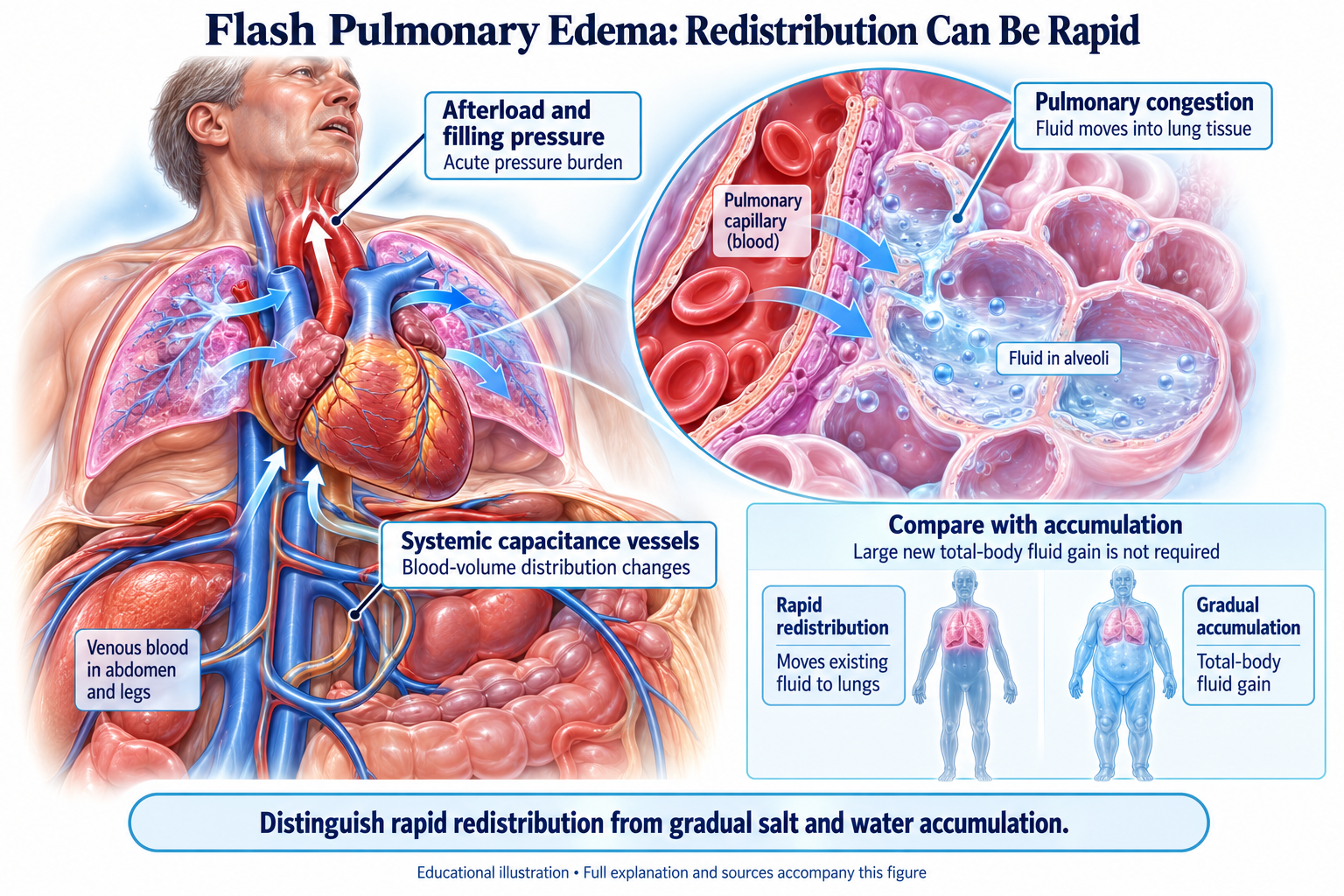
Contemporary literature increasingly recognizes FPE as synonymous with Sympathetic Crashing Acute Pulmonary Edema (SCAPE), reflecting the central role of excessive sympathetic activation in its pathogenesis. Many patients are euvolemic or hypovolemic despite pulmonary congestion, reflecting redistribution rather than total body volume overload.
Neurohormonal Activation and Sympathetic Response
Acute LVEDP elevations trigger intense activation of the sympathetic nervous system and RAAS. The sympathetic response, mediated by excessive catecholamine release, contributes to peripheral vasoconstriction, increased systemic vascular resistance, and further elevation of cardiac afterload. This creates a pathophysiologic cascade wherein initial hemodynamic stress precipitates progressive cardiac decompensation.
Pulmonary Capillary Stress Failure
In severe cases, extremely elevated pulmonary capillary pressures may cause structural disruption of the alveolar-capillary membrane when transmural pressures exceed 40–50 mmHg, leading to protein-rich fluid extravasation and hemorrhage. This mechanism represents a distinct pathophysiologic entity that may explain the rapid development and severity of FPE in certain clinical contexts.
Endothelial Dysfunction
Impaired nitric oxide synthesis and increased endothelin levels may contribute to excessive pulmonary capillary permeability. This partially explains why some patients develop fulminant pulmonary edema with relatively modest elevations in filling pressures.
Cardiac Etiologies
Hypertensive Heart Disease and Diastolic Dysfunction
Hypertensive heart disease represents the predominant cardiac etiology of FPE, particularly in patients with HFpEF. Hypertension precedes the development of heart failure in approximately 75% of cases. Chronic hypertension induces concentric LV hypertrophy and progressive diastolic dysfunction, creating exquisite sensitivity to changes in preload and afterload.
| Parameter | FPE Patients | Gradual Decompensation | P-value |
|---|---|---|---|
| E/e' Ratio | 15.3 ± 4.2 | 11.8 ± 3.6 | <0.001 |
| LA Volume (mL/m²) | 42.1 ± 12.8 | 35.7 ± 10.4 | <0.001 |
| Typical SBP at Presentation | >180 mmHg | Variable | — |
| Ejection Fraction | Typically >50% | Variable | — |
Acute Coronary Syndromes
ACS can precipitate FPE even in patients with previously normal cardiac function. A multicenter registry of 2,184 STEMI patients demonstrated FPE in 18.3% of cases.
| Independent Predictor | Odds Ratio (95% CI) |
|---|---|
| Anterior wall location | 2.47 (1.82–3.35) |
| Peak troponin >50 ng/mL | 3.14 (2.21–4.46) |
| Door-to-balloon >90 min | 1.67 (1.23–2.27) |
Patients with prior FPE episodes show significantly greater exercise-induced increases in mitral regurgitant volume (26 ± 14 mL vs. 5 ± 14 mL, P<0.001) and effective regurgitant orifice area (16 ± 10 mm² vs. 2 ± 9 mm², P<0.001) compared to controls.
Cardiomyopathies
- Takotsubo Syndrome: FPE occurs in approximately 15–20% of Takotsubo cases, with higher rates in elderly patients and those with concurrent psychiatric comorbidities.
- Hypertrophic Cardiomyopathy: Particular vulnerability to volume depletion, increased contractility, or decreased afterload, all of which can exacerbate LVOT gradients.
Valvular Etiologies
Acute Mitral Regurgitation
Unlike chronic MR where the LA gradually dilates, acute MR imposes sudden volume overload on a normal-sized, non-compliant left atrium, generating LA pressures exceeding 40–50 mmHg.
The posterior papillary muscle has singular blood supply from the posterior descending artery. Rupture occurs in approximately 0.7% of inferior STEMIs but carries mortality rates exceeding 80% without immediate surgical intervention.
Acute severe MR can cause unilateral pulmonary edema, most commonly affecting the right upper lobe. Posteriorly directed jets cause right-sided infiltrates; anteriorly directed jets affect left-sided distribution. This distinctive pattern can be diagnostically confusing on CXR.
Acute Aortic Regurgitation
The normal-sized LV cannot accommodate acute increases in diastolic volume, leading to dramatic elevations in LVEDP that may approach or equal aortic diastolic pressure.
- Stanford Type A Dissection: Involves the aortic root in approximately 60% of cases
- Infective Endocarditis: Operative mortality exceeds 25% even with contemporary surgical techniques
- Pathognomonic Finding: Premature mitral valve closure before onset of systole on echocardiography distinguishes acute from chronic aortic regurgitation
Critical Aortic Stenosis
Patients with critical AS (AVA <0.6 cm²) demonstrate exquisite sensitivity to changes in preload, afterload, and heart rate. Specific precipitants include atrial fibrillation with RVR, volume depletion, fever/sepsis, and anemia.
| Parameter | FPE Group | Stable Group |
|---|---|---|
| BNP (pg/mL) | 1,847 ± 1,203 | 891 ± 674 |
| Concurrent AFib | 47.3% | 28.1% |
Renal Etiologies
Renal Artery Stenosis and Pickering Syndrome
Originally described by Pickering and colleagues in 1988. FPE occurred in 31% of patients with bilateral RAS compared to 12% with unilateral disease in a registry of 1,824 patients.
| Independent Predictor | OR (95% CI) |
|---|---|
| Stenosis severity >80% | 3.42 (2.18–5.37) |
| Concurrent diabetes mellitus | 2.19 (1.45–3.31) |
| Baseline eGFR <45 mL/min/1.73m² | 1.87 (1.23–2.84) |
Consider RAS in patients presenting with FPE accompanied by: refractory hypertension, AKI following ACEi/ARB initiation, recurrent episodes without clear precipitant, atherosclerotic disease in other vascular beds, or abdominal bruits. Revascularization resolves recurrent FPE in 77% of patients.
Acute Kidney Injury
Pulmonary complications occurred in 23.7% of AKI patients in a prospective study of 2,847 patients, with FPE representing the most severe manifestation in 8.9%.
| Risk Factor for AKI-Associated FPE | OR (95% CI) |
|---|---|
| KDIGO Stage 3 vs. Stage 1 | 4.23 (2.91–6.15) |
| Oliguria >24 hours | 2.87 (1.94–4.25) |
| Concurrent sepsis | 1.93 (1.31–2.84) |
Volume-independent mechanisms of AKI-associated pulmonary edema include direct lung injury through organ crosstalk (IL-6, TNF-alpha), downregulation of epithelial sodium-water transporters in lung tissue, impaired alveolar fluid clearance, and increased pulmonary capillary permeability.
End-Stage Renal Disease Complications
Cardiovascular disease is the leading cause of mortality in ESRD, with acute HF episodes occurring at rates 10–20 times higher than the general population.
| FPE Precipitant in ESRD | OR (95% CI) |
|---|---|
| Missed dialysis sessions | 8.47 (5.23–13.71) |
| IDWG >4% of dry weight | 3.92 (2.18–7.05) |
| Vascular access dysfunction | 2.34 (1.45–3.78) |
Contemporary Management Strategies
Acute Respiratory Support
NIPPV initiated within 30 minutes of ED arrival demonstrated:
| Outcome | NIPPV | Standard O₂ | P-value |
|---|---|---|---|
| Intubation rate | 12.3% | 27.1% | <0.001 |
| Length of stay (days) | 3.8 ± 2.1 | 5.6 ± 3.4 | <0.001 |
| 30-day mortality | 8.7% | 15.2% | 0.003 |
Recommended Settings: CPAP 8–12 cmH₂O, or BiPAP with IPAP 12–18 cmH₂O and EPAP 6–10 cmH₂O. Higher CPAP levels (15–20 cmH₂O) may be beneficial in refractory cases.
Vasodilator Therapy
High-dose nitroglycerin is the cornerstone of pharmacologic therapy for SCAPE.
| Outcome | High-Dose NTG (≥100 mcg/min) | Conventional Dosing | P-value |
|---|---|---|---|
| Time to dyspnea resolution | 45 min | 120 min | <0.001 |
| Intubation rate | 8.7% | 18.3% | 0.002 |
| ED length of stay (hours) | 6.2 ± 3.1 | 9.8 ± 4.7 | <0.001 |
Protocol: SL NTG 0.4 mg q5min x3, then IV infusion starting 20–40 mcg/min, titrate by 20 mcg/min q3–5min targeting 10–20% SBP reduction. Doses up to 800 mcg/min may be used in refractory cases.
Diuretic Therapy: Evidence-Based Perspective
Many FPE patients are euvolemic or hypovolemic despite pulmonary congestion, reflecting redistribution rather than total body volume overload. A prospective RCT demonstrated that routine furosemide (40–80 mg IV) did not improve dyspnea scores, oxygenation, or LOS when added to standard NIPPV and vasodilator therapy. Limit diuretics to patients with clear evidence of volume overload.
Volume Management in Hypotensive Patients with Severe Valvular Disease
Severe Aortic Stenosis
Patients with severe AS require careful preload optimization. A multicenter registry of 623 patients demonstrated that careful volume administration (250–500 mL boluses) with invasive hemodynamic monitoring resulted in improved outcomes compared to standard HF protocols.
- Small-volume challenges (250 mL) with continuous hemodynamic assessment
- Concurrent inotropic support with dobutamine
- Avoidance of vasodilators that reduce preload
Acute Aortic Regurgitation
Intra-aortic balloon pump counterpulsation is absolutely contraindicated in acute aortic regurgitation due to potential exacerbation of regurgitant flow. Management focuses on afterload reduction (nitroprusside or nicardipine) and emergency surgical intervention.
Risk Stratification Framework for Volume Management
| Risk Level | Criteria | Approach |
|---|---|---|
| High Risk | Acute AR with EF <40%, MS with mean gradient >15 mmHg, RV failure, concurrent AKI with oliguria | Avoid volume; vasopressors/inotropes |
| Moderate Risk | AS with preserved EF, acute MR with mild-mod LV dysfunction, mixed valvular disease, concurrent CAD | Cautious 250 mL boluses with monitoring |
| Lower Risk | Severe AS with clear hypovolemia, MR with preserved LV function, distributive shock component | Careful volume trial appropriate |
References
- McDonagh TA, Metra M, Adamo M, et al. 2021 ESC Guidelines for the diagnosis and treatment of acute and chronic heart failure. Eur Heart J 2021. PubMed 34447992.
- Gheorghiade M, Zannad F, Sopko G, et al. Acute heart failure syndromes: current state and framework for future research. Circulation 2005. PubMed 16365214.
- Neskovic AN, Hagendorff A, Lancellotti P, et al. Emergency echocardiography: the European Association of Cardiovascular Imaging recommendations. Eur Heart J Cardiovasc Imaging 2013. PubMed 23239795.
- Liu KD, Glidden DV, Eisner MD, et al. Predictive and pathogenetic value of plasma biomarkers for acute kidney injury in patients with acute lung injury. Crit Care Med 2007. PubMed 18074478.
- Harjola VP, Mebazaa A, Čelutkienė J, et al. Contemporary management of acute right ventricular failure: a statement from the Heart Failure Association and the Working Group on Pulmonary Circulation and Right Ventricular Function of the European Society of Cardiology. Eur J Heart Fail 2016. PubMed 26995592.
- Pickering TG, Herman L, Devereux RB, et al. Recurrent pulmonary oedema in hypertension due to bilateral renal artery stenosis. Lancet. 1988;2(8610):551-552. [PubMed]
- Figueras J, Weil MH. Blood volume prior to and following treatment of acute cardiogenic pulmonary edema. Circulation 1978. PubMed 618625.
- Martindale JL, Wakai A, Collins SP, et al. Diagnosing acute heart failure in the emergency department: a systematic review and meta-analysis. Acad Emerg Med. 2016;23(3):223-242. [PubMed]
- Gray A, Goodacre S, Newby DE, et al. Noninvasive ventilation in acute cardiogenic pulmonary edema. N Engl J Med. 2008;359(2):142-151. [PubMed]
- Levy P, Compton S, Welch R, et al. Treatment of severe decompensated heart failure with high-dose intravenous nitroglycerin: a feasibility and outcome analysis. Ann Emerg Med. 2007;50(2):144-152. [PubMed]
- GUYTON AC, LINDSEY AW. Effect of elevated left atrial pressure and decreased plasma protein concentration on the development of pulmonary edema. Circ Res 1959. PubMed 13663218.
- West JB, Mathieu-Costello O. Stress failure of pulmonary capillaries: role in lung and heart disease. Lancet. 1992;340(8822):762-767. [PubMed]
- Cotter G, Metzkor E, Kaluski E, et al. Randomised trial of high-dose isosorbide dinitrate plus low-dose furosemide versus high-dose furosemide plus low-dose isosorbide dinitrate in severe pulmonary oedema. Lancet. 1998;351(9100):389-393. [PubMed]
- De Backer D, Biston P, Devriendt J, et al. Comparison of dopamine and norepinephrine in the treatment of shock. N Engl J Med. 2010;362(9):779-789. [PubMed]
- Rimoldi SF, Yuzefpolskaya M, Allemann Y, et al. Flash pulmonary edema. Prog Cardiovasc Dis 2009. PubMed 19917337.
- Paulus WJ, Tschope C. A novel paradigm for heart failure with preserved ejection fraction: comorbidities drive myocardial dysfunction and remodeling. J Am Coll Cardiol. 2013;62(4):263-271. [PubMed]
- Messerli FH, Rimoldi SF, Bangalore S. The transition from hypertension to heart failure: how SGLT2 inhibitors may be useful. JACC Heart Fail. 2017;5(7):543-551. [PubMed]
- Zile MR, Baicu CF, Gaasch WH. Diastolic heart failure: abnormalities in active relaxation and passive stiffness of the left ventricle. N Engl J Med. 2004;350(19):1953-1959. [PubMed]
- Gandhi SK, Powers JC, Nomeir AM, et al. The pathogenesis of acute pulmonary edema associated with hypertension. N Engl J Med. 2001;344(1):17-22. [PubMed]
- Nishimura RA, Otto CM, Bonow RO, et al. 2017 AHA/ACC focused update of the 2014 guideline for management of patients with valvular heart disease. J Am Coll Cardiol. 2017;70(2):252-289. [PubMed]