Visual reference
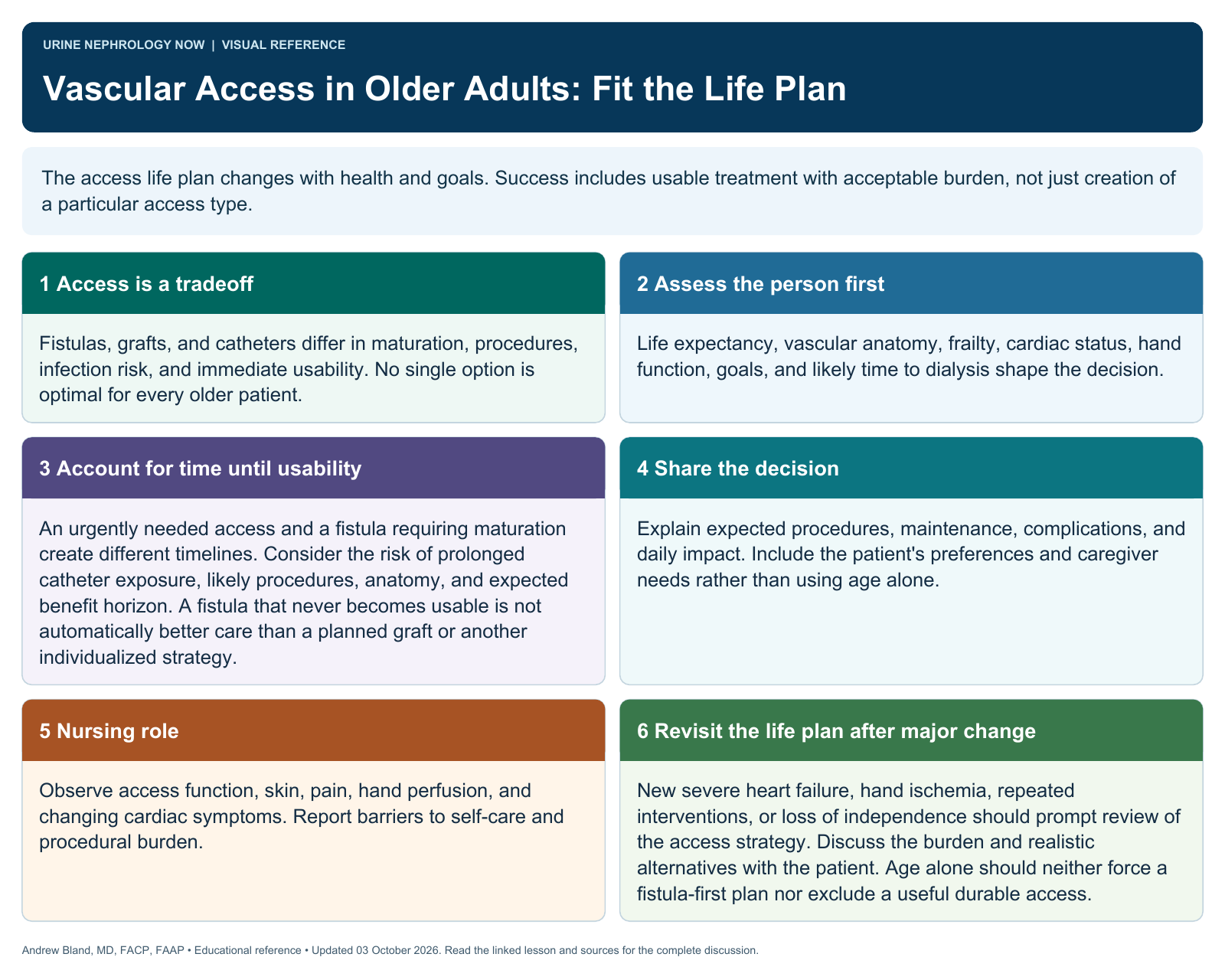
Browse the visual reference library · Download lesson Markdown
Bottom Line Up Front
For decades we told every hemodialysis patient the same thing: get a fistula. The evidence behind that instruction was entirely observational, and a large fraction of the apparent fistula survival benefit turns out to be the healthy patient, not the access. The ACCESS HD pilot trial — the first-ever randomized comparison of a catheter strategy against a fistula strategy in older starters — could not even recruit enough patients to run, because a plurality of older patients did not want a fistula. Its underpowered clinical secondaries mostly favored the catheter arm, with no mortality penalty.
The lesson is not “catheters are better.” The lesson is that reflexive Fistula-First for the older, catheter-dependent starter is not supported by randomized data, and the decision belongs inside the KDIGO/KDOQI ESKD Life-Plan and shared decision-making — not a one-size hierarchy.
1. Why Access Choice in the Older Starter Is a Different Problem
Vascular access is the lifeline of hemodialysis, and it is also one of the largest single drivers of morbidity, hospitalization, and cost in the dialysis population1,2. Three options exist: the autogenous arteriovenous fistula (AVF), the prosthetic arteriovenous graft (AVG), and the tunneled central venous catheter (CVC). For a fit 50-year-old with years of expected survival and good vessels, the fistula is close to unarguable. The calculus bends, sometimes sharply, once the patient is 75, frail, multimorbid, and already dialyzing through a catheter.
Four forces reshape the decision in the older patient:
- Competing mortality. Many older starters die of cardiovascular disease, infection, or withdrawal long before an access has time to pay back its up-front cost.
- Maturation failure. Fistulas in older patients fail to mature at high rates, and a fistula that never matures leaves the patient on the very catheter you were trying to avoid.
- A short time horizon. The infection and patency advantages of a fistula accrue on the back end. If survival is measured in months, the patient may never reach the payoff.
- Patient preference. Older patients, when actually asked, frequently prefer to keep the catheter they already have.
The question is never “fistula or catheter?” in the abstract. It is “does this patient live long enough, with vessels good enough, to convert the front-loaded cost of a fistula into a back-loaded benefit?” That reframing is the entire review.
2. How “Fistula First” Became Doctrine
The fistula’s reputation was earned honestly, at first. Early work established that catheters carry the heaviest burden of access-related morbidity — bacteremia, thrombosis, central stenosis, and repeated intervention1. Registry and cohort data then layered on a striking survival gap, and guidelines followed.
The most rigorous synthesis is Ravani and colleagues’ 2013 systematic review of 62 cohort studies comprising 586,337 participants3. According to the pooled random-effects meta-analysis, the risk gradient ran catheter > graft > fistula across the hard outcomes:
| Comparison | Outcome | Risk ratio (95% CI) |
|---|---|---|
| Catheter vs. fistula | All-cause mortality | 1.53 (1.41–1.67) |
| Catheter vs. fistula | Fatal infection | 2.12 (1.79–2.52) |
| Catheter vs. fistula | Cardiovascular events | 1.38 (1.24–1.54) |
| Catheter vs. graft | All-cause mortality | 1.38 (1.25–1.52) |
| Graft vs. fistula | All-cause mortality | 1.18 (1.09–1.27) |
These are large associations, and they drove a generation of practice. The 2019 KDOQI Clinical Practice Guideline for Vascular Access built on this body of work while — importantly — softening the old hierarchy into a patient-centered framework (Section 6)4.
Read the authors’ own caveat: Ravani et al. graded the risk of bias in the underlying studies as high, especially selection bias3. That single sentence is the hinge on which this entire topic turns. The association is real; the causal interpretation is where it breaks down.
3. The Confounding Problem: The Fistula Gets a Healthy Patient
Here is the uncomfortable engine underneath Fistula-First — the “fading certainties and growing doubts” that reframed this debate8. Sicker patients are less likely to receive, or successfully mature, a fistula. They crash onto dialysis, they have poor vessels, they have limited life expectancy — and they end up on catheters. So when we compare catheter patients to fistula patients, we are partly comparing sicker people to healthier people and attributing the difference to a piece of hardware.
Three studies dismantle the causal reading with unusual clarity.
Brown 2017 analyzed a USRDS-linked Medicare cohort of 115,425 incident hemodialysis patients aged 67 and older5. The fistula-first group had the expected mortality advantage over catheter-first patients: hazard ratio 0.50 (95% CI 0.48–0.52). But the decisive comparison is the group that attempted a fistula, had it fail, and started dialysis on a catheter anyway. Those patients — dialyzing through a catheter, exactly like the reference group — still had lower mortality: HR 0.66 (0.64–0.68). The absolute rates make the point plainly:
| Group | 6-mo mortality | 12-mo | 24-mo |
|---|---|---|---|
| Fistula-first | 9% | 17% | 31% |
| Catheter after failed fistula attempt | 15% | 25% | 42% |
| Catheter-first (reference) | 32% | 46% | 62% |
The patients who merely qualified for a fistula attempt did better even when they never got a working fistula. The authors concluded that patient factors account for about two-thirds of the apparent fistula survival benefit5. The access is not doing most of the work; the patient is.
Quinn 2017 attacked the same question from the cause-of-death angle in 2,300 Canadian incident patients6. Two investigators independently adjudicated every death. If catheters kill through access-related complications — line sepsis, endocarditis — then access-related deaths should be common in the catheter arm. They were not. Only 2.3% of all deaths (14 of 617) were access-related (10 catheter-related, 3 fistula-related, 1 PD-related). A predialysis fistula attempt was associated with lower mortality in patients under 65 (HR 0.49, 0.29–0.82) and in the first two years for those 65 and older (HR 0.60, 0.43–0.84) — but the effect reversed after two years in the older group (HR 1.83, 1.25–2.67). The authors’ conclusion is blunt: the excess mortality in catheter patients “does not appear to be due to direct, access-related complications” but rather residual confounding, unmeasured comorbidity, and selection bias6.
Lyu 2021 went further methodologically, using a target-trial-emulation framework on 19,867 elderly USRDS patients who all started hemodialysis with a catheter and then had either an AVF or an AVG created within six months, with instrumental-variable analysis (the operating surgeon’s proclivity to create a fistula as the instrument)7. Inverse-probability weighting still showed an early AVF advantage within six months (mortality HR 0.82, 0.75–0.91). But the instrumental-variable analysis — the design element that addresses unmeasured confounding — found no association between creating an AVF versus an AVG and mortality, sepsis, or all-cause, cardiovascular, or infection-related hospitalization7. Note what it does not compare: fistula versus staying on a catheter.
When a “failed fistula attempt” group that dialyzes through a catheter still beats the catheter-first group5, the benefit cannot be living in the fistula. It is living in whatever made those patients candidates in the first place. That is the single most useful mental model to carry into an access conversation.
4. ACCESS HD: The Trial That Tried to Answer It — and Couldn’t
Everything above is observational. The obvious fix is a randomized trial, and that is exactly what Quinn, Ravani, and colleagues attempted in ACCESS HD (Comparing Catheters to Fistulas in Older Patients Starting Hemodialysis), published ahead of print in the Journal of the American Society of Nephrology in 20269.
Design. A parallel-arm pilot randomized controlled trial across 12 centers (9 Canadian, 3 Australian), running 2014–2021. Adults aged 55 and older (Australian sites, 65 and older) who had started hemodialysis on a tunneled or non-tunneled catheter, on dialysis 365 days or less, and judged fistula-eligible by the local access team were randomized 1:1 to a fistula attempt (“fistula strategy”) or continued tunneled catheter (“catheter strategy”)9. The trial was open-label (blinding was impossible with a surgical intervention); deaths were adjudicated centrally, blinded to arm. The published protocol planned 100 patients aged 65 and older within 90 days of starting HD14; after 16 patients the criteria were broadened (March 2018) to age 55 and older and up to 365 days on HD to rescue recruitment9.
The primary endpoint was feasibility, not a clinical outcome. This is the interpretive key to the whole paper. Two co-primary feasibility targets were set:
| Feasibility endpoint | Target | Result |
|---|---|---|
| Proportion of eligible patients consenting to randomization | ≥ 25% | 25% (67/268; 95% CI 20–31%) — barely met |
| Proportion of fistula arm getting a fistula attempt ≤ 90 days | ≥ 80% | 71% (24/34; 95% CI 53–85%) — not met |
Of 1,287 patients screened, 975 did not meet criteria and 44 were deemed inappropriate by their nephrologist, leaving 268 eligible. Of those, 201 declined and only 67 were randomized (34 fistula / 33 catheter)9. The trial was stopped before its target sample size for slow recruitment9.
The most robust, least-biased finding is why patients said no. Among the 201 who declined: 37% preferred to keep their catheter, 23% preferred a fistula, and 17% did not want to join a study. Patient preference — not surgical capacity — was the dominant barrier to running the trial at all9.
4.1 Clinical secondary outcomes (hypothesis-generating)
The clinical signals are secondary, underpowered (n=67), and carry no adjustment for multiple testing. Read them as directional, not definitive.
| Outcome | Catheter arm | Fistula arm | Effect estimate |
|---|---|---|---|
| Mortality (median f/u 29 mo) | 6 (18%) | 8 (24%) | HR 1.19 (0.39–3.58), NS; Firth HR 0.99 (0.33–3.04) |
| Access-related death | 0 | 1 (MRSA line sepsis + probable endocarditis) | occurred in the fistula arm |
| Access-related procedures | 0.72 / patient-yr | 2.23 / patient-yr | IRR 3.10 (2.26–4.33) |
| Hospitalizations | 23 (70%) | 29 (85%) | IRR 2.12 (1.53–2.98) |
| Hospital days | — | — | IRR 2.94 (2.67–3.24) |
| Exit-site or tunnel infection | 8 (24%); 0.46 / patient-yr | 10 (29%); 0.49 / patient-yr | IRR 1.06 (0.65–1.73) — no difference |
| Bacteremia, all | 2 (6%); 0.03 / patient-yr | 13 (38%); 0.26 / patient-yr | IRR 8.69 (2.51–54.67) |
| Bacteremia, omitting catheter-related events | — | 3 (9%); 0.06 / patient-yr | IRR 1.93 (0.38–13.93) — NS |
| Fistula arm: fistula ever cannulated successfully | — | 18 / 34 (53%) | — |
| Fistula arm: another catheter inserted after randomization | — | 12 / 34 (35%) | catheter procedures were 49% of this arm’s procedures |
| Crossover: catheter arm with a fistula created | 7 / 33 (21%) | — | — |
| tPA (thrombolytic) use | 5.47 / patient-yr | 3.59 / patient-yr | IRR 0.66 (0.56–0.77) |
Almost every signal tilted toward the catheter arm — fewer procedures, fewer hospital days, less bacteremia, numerically fewer deaths, and the only adjudicated access-related death occurring in the fistula group. The one outcome favoring the fistula strategy was thrombolytic use, and the mechanism is transparent: catheters clot, so catheter patients needed more tPA9.
Why the fistula arm still had catheter-related bacteremia: patients randomized to a fistula strategy still had catheters during maturation. You do not escape the catheter by attempting a fistula — you often add a surgery on top of it and keep the line until the fistula works, if it ever does. That is why the fistula arm’s bacteremia was predominantly catheter-related.
4.2 Critical appraisal (Gyawali lens)
- Sponsor: Canadian Institutes for Health Research + Kidney Foundation of Canada — academic, non-industry. No commercial thumb on the scale.
- Endpoint honesty: the primary endpoint is feasibility and is labeled as such — no dressing up a surrogate as a clinical win.
- Hard endpoints, blinded adjudication: deaths were centrally adjudicated blinded to arm; endpoints are death, hospitalization, procedures, bacteremia — not surrogates.
- Real-world eligibility & ITT: broad inclusion (≥55, catheter start), intention-to-treat, high follow-up completeness.
- The soft spot: n=67 cannot balance baseline covariates. The fistula arm ran more female, higher BMI, more vascular disease and COPD; the catheter arm carried more heart failure and GI bleeding. With no multiplicity adjustment, the clinical secondaries can be exaggerated or masked by chance. This trial cannot establish that catheters are superior — and does not claim to.
The catheter arm’s bacteremia rate was extraordinarily low: 2 events in 33 patients over a median 29 months, 0.03 per patient-year. US national surveillance puts the catheter bloodstream-infection rate at 2.16 per 100 patient-months — about 0.26 per patient-year, roughly nine times higher13. The fistula arm’s 0.26 per patient-year matched the US national catheter rate, because most of its bacteremia came from the catheters it kept during maturation (35% needed a new catheter; only 53% ever used the fistula)9.
So the “catheter strategy had less bacteremia” result is a result about excellent catheter care in 12 Canadian and Australian units. It transfers to a unit only if that unit’s own catheter infection rate is similarly low. Know your unit’s NHSN catheter BSI rate before quoting it.
It does not show catheter and fistula infection rates are the same. Exit-site/tunnel infections were equal (IRR 1.06); bacteremia not attributable to a catheter was 3 events vs 0 with a confidence interval from 0.38 to 13.9. A working fistula still carries about one-eighth the national bloodstream-infection rate of a catheter13.
The rate ratios are fragile. They are unadjusted Poisson estimates on small event counts that treat repeat events in the same patient as independent (3 fistula-arm patients had 189–361 hospital days), so the confidence intervals are narrower than the data justify. The authors themselves call them “nominal.”
Two things, both solid: (1) a definitive fistula-vs-catheter RCT is not feasible in the current climate, blocked by structural fistula incentives and strong patient preference; and (2) there is no signal of harm from a catheter strategy in older starters — in units whose catheter infection rate was about one-ninth the US national rate. Everything else, including the bacteremia difference, is hypothesis-generating and setting-dependent.
5. The Three Options, Head to Head
A patient-centered decision still requires knowing the honest trade-offs of each access.
| Feature | Fistula (AVF) | Graft (AVG) | Tunneled catheter (CVC) |
|---|---|---|---|
| Time to usability | Months (median approximately 115 days)10 | approximately 2–4 weeks (early-cannulation grafts sooner) | Immediate |
| Primary/maturation failure | High, esp. older patients | Lower — grafts “mature” reliably | N/A |
| Infection risk | Lowest once working | Intermediate | Highest |
| Patency / reintervention | Good once mature, but frequent maintenance | Frequent thrombosis/reintervention | Dysfunction, tPA, exchange |
| Cardiac effect | High-output flow can burden a failing heart | Similar high-flow concern | None |
| Best-fit patient | Long expected survival, good vessels | Needs permanent access but poor veins / faster timeline | Short horizon, bridging, strong preference, exhausted sites |
The maturation reality deserves its own numbers. The NIH Hemodialysis Fistula Maturation (HFM) Study (Huber 2021, n=535 with maturation ascertained) is the cleanest prospective look10. Among patients with kidney failure, unassisted AVF maturation was 29% at 3 months, 67% at 6 months, and 76% at 12 months; median time to maturation was 115 days; over one-third needed an intervention before the fistula matured; and 47.5% of matured fistulas required further intervention to maintain patency10. A fistula is not a “place it and forget it” access — it is a program of procedures.
| HFM Study — unassisted AVF maturation | 3 months | 6 months | 12 months |
|---|---|---|---|
| Cumulative maturation rate | 29% | 67% | 76% |
| Median time to maturation | 115 days | ||
| Intervention before maturation | Over one-third of fistulas | ||
| Matured fistulas needing further intervention | 47.5% | ||
The only prior randomized signal on the permanent-vs-catheter question comes from Aitken 2017, a single-center RCT of 121 patients needing urgent access, randomizing early-cannulation graft (± fistula) against tunneled catheter (± fistula)11. It was powered for bacteremia, not mortality.
| Outcome (6 mo) | Catheter | Early-cannulation graft | RRR | ARR | NNT |
|---|---|---|---|---|---|
| Culture-proven bacteremia | 16.4% | 3.3% | approximately 80% | 13.1% | 8 |
| Mortality (secondary) | 16% | 5% | approximately 69% | 11% | 9 |
Appraise Aitken before you quote it. The mortality result is a secondary endpoint in a single-center trial powered for bacteremia, and one co-author is a W.L. Gore employee (Gore manufactures the graft)11. The catheter-arm bacteremia rate also ran higher than typical real-world experience. Cite it as suggestive — a graft can beat a catheter on infection when access is urgent — not as a mortality mandate. A relative risk reduction from a small industry-co-authored trial is exactly the kind of headline the critical-appraisal lens tells you to discount.
6. A Patient-Centered Framework: The ESKD Life-Plan
The 2019 KDOQI guideline replaced the rigid Fistula-First slogan with the End-Stage Kidney Disease Life-Plan and the principle of “the right access, in the right patient, at the right time, for the right reasons”4. That is the framework to actually use.
The decision rests on three questions:
- What is the expected survival and trajectory? A robust patient with years ahead earns the fistula’s back-loaded benefit. A frail patient with a short horizon may never reach it.
- What are the vessels and the surgical timeline? Poor veins push toward a graft; an urgent need with no mature options may mean a bridging catheter regardless.
- What does the patient actually want? ACCESS HD showed this is not a footnote — it is often the deciding factor, and more than a third of eligible older patients preferred their catheter9.
high competing mortality
robust
Do not forget the cardiac cost of a fistula. In an older patient with reduced ejection fraction or pulmonary hypertension, a high-flow upper-arm fistula can worsen high-output physiology. In that patient the “gold standard” access can be the wrong one on hemodynamic grounds alone — another reason the hierarchy has to yield to the individual.
The unresolved frontier is graft-versus-fistula in exactly this population, which the ongoing AV Access Trial (Murea et al.) is designed to test, with catheter-free days and access-related infection as primary outcomes12. Until it reports, the honest position is that access type matters less than access fit.
7. Clinical Bottom Line
- Abandon reflexive Fistula-First for the older, catheter-dependent starter. The randomized data do not support it, and the observational advantage is largely selection bias5,6,7,9.
- The fistula survival benefit is roughly two-thirds patient, one-third access — and access-related complications cause only about 2% of deaths5,6.
- ACCESS HD shows a definitive trial is not feasible and finds no harm from a catheter strategy, with most underpowered signals favoring the catheter — but it cannot prove catheter superiority, and its catheter arm’s bacteremia rate was about one-ninth the US national catheter rate, so the infection result depends on catheter-care quality9,13.
- Still favor a fistula in the robust older patient with good vessels and a long horizon; the back-loaded infection and patency benefits are real if the patient lives to collect them.
- A graft is a legitimate middle path when veins are poor or the timeline is short — reliable maturation, at the cost of more thrombosis and reintervention10,11.
- Anchor the decision in the ESKD Life-Plan and shared decision-making4. When an older patient tells you he would rather keep his catheter, ACCESS HD says you are on solid ground honoring that.
“Right access, right patient, right time, right reason.” For the frail older starter who prefers his line, that can mean the catheter — and the evidence finally backs you up.
References
- Feldman HI, Kobrin S, Wasserstein A. Hemodialysis vascular access morbidity. J Am Soc Nephrol. 1996;7(4):523–535. PMID: 8724885
- Bello AK, Okpechi IG, Osman MA, et al. Epidemiology of haemodialysis outcomes. Nat Rev Nephrol. 2022;18(6):378–395. PMID: 35194215
- Ravani P, Palmer SC, Oliver MJ, et al. Associations between hemodialysis access type and clinical outcomes: a systematic review. J Am Soc Nephrol. 2013;24(3):465–473. PMID: 23431075
- Lok CE, Huber TS, Lee T, et al. KDOQI Clinical Practice Guideline for Vascular Access: 2019 Update. Am J Kidney Dis. 2020;75(4 Suppl 2):S1–S164. PMID: 32778223
- Brown RS, Patibandla BK, Goldfarb-Rumyantzev AS. The Survival Benefit of “Fistula First, Catheter Last” in Hemodialysis Is Primarily Due to Patient Factors. J Am Soc Nephrol. 2017;28(2):645–652. PMID: 27605542
- Quinn RR, Oliver MJ, Devoe D, et al. The Effect of Predialysis Fistula Attempt on Risk of All-Cause and Access-Related Death. J Am Soc Nephrol. 2017;28(2):613–620. PMID: 28143967
- Lyu B, Chan MR, Yevzlin AS, Gardezi A, Astor BC. Arteriovenous Access Type and Risk of Mortality, Hospitalization, and Sepsis Among Elderly Hemodialysis Patients: A Target Trial Emulation Approach. Am J Kidney Dis. 2022;79(1):69–78. PMID: 34118301
- Quinn RR, Ravani P. Fistula-first and catheter-last: fading certainties and growing doubts. Nephrol Dial Transplant. 2014;29(4):727–730. PMID: 24327565
- Quinn RR, Oliver MJ, Wald R, et al. Comparing Catheters with Fistulas in Older Patients Starting Hemodialysis: A Pilot Randomized Controlled Trial. J Am Soc Nephrol 2026. PubMed 42319856.
- Huber TS, Berceli SA, Scali ST, et al. Arteriovenous Fistula Maturation, Functional Patency, and Intervention Rates. JAMA Surg. 2021;156(12):1111–1118. PMID: 34550312
- Aitken E, Thomson P, Bainbridge L, et al. A randomized controlled trial and cost-effectiveness analysis of early cannulation arteriovenous grafts versus tunneled central venous catheters in patients requiring urgent vascular access for hemodialysis. J Vasc Surg. 2017;65(3):766–774. PMID: 28236919
- Murea M, Gardezi AI, Goldman MP, et al. Study protocol of a randomized controlled trial of fistula vs. graft arteriovenous vascular access in older adults with end-stage kidney disease on hemodialysis: the AV access trial. BMC Nephrol. 2023;24(1). PMID: 36829135
- Nguyen DB, Shugart A, Lines C, et al. National Healthcare Safety Network (NHSN) Dialysis Event Surveillance Report for 2014. Clin J Am Soc Nephrol. 2017;12(7):1139–1146. PMID: 28663227
- Quinn R, Ravani P; ACCESS HD Investigators. ACCESS HD pilot: a randomised feasibility trial Comparing Catheters with fistulas in Elderly patientS Starting haemodialysis. BMJ Open. 2016;6(11):e013081. PMID: 27884849
Reference 9 (ACCESS HD) is published ahead of print and not yet PubMed-indexed as of July 2026.
Also on this topic
The same subject at other levels of depth.