Visual reference
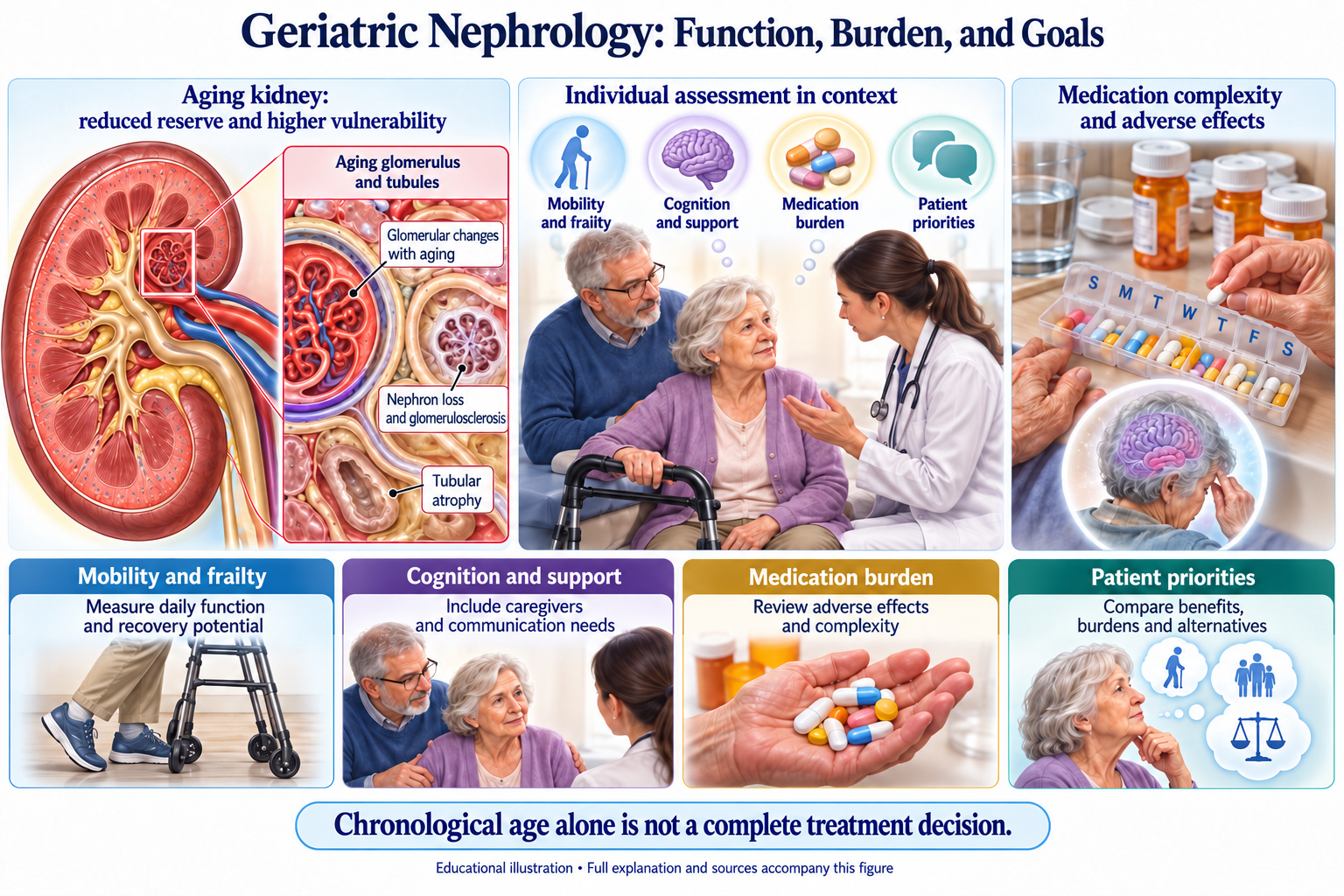
Browse the visual reference library · Download lesson Markdown
Aging & Renal Physiology
Age-Related GFR Decline
- GFR declines ~1 mL/min/1.73m²/year after age 40 (average)
- NOT linear: Variable among individuals (some stable, others steeper decline)
- By age 80: Mean GFR ~60 mL/min/1.73m² in absence of kidney disease
Clinical Pearl: Serum Creatinine Paradox
Serum creatinine may remain “normal” (<1.0 mg/dL) despite significant GFR decline. Mechanism: Decreased muscle mass + decreased creatinine production in elderly → lower baseline creatinine. Always calculate eGFR (CKD-EPI) in all elderly patients; never rely on creatinine alone.
Structural Changes
- Progressive renal atrophy with age (1–2% per decade after age 40)
- Glomerular sclerosis progresses (10–15% sclerotic glomeruli by age 80 in absence of disease)
- Glomerular basement membrane thickening; vascular sclerosis limiting renal perfusion
Functional Impairments
| Function | Change | Clinical Implication |
|---|---|---|
| Concentrating ability | Max urine osm 800 vs 1200+ in young | Risk of dehydration-induced AKI |
| Acid-base regulation | Reduced urine acidification; decreased NH3 excretion | RTA risk; higher serum K+ at given GFR |
| Thirst mechanism | Impaired thirst response | Dehydration risk |
| ADH sensitivity | Increased sensitivity | Hyponatremia risk with diuretics |
| Drug clearance | Many drugs renally cleared; accumulation with CKD | Polypharmacy risk (median 5–10 medications) |
Epidemiology of CKD in Elderly
- Prevalence: 30–50% of adults >70 years have eGFR <60
- ESRD: Fastest-growing segment is elderly (age >75 on dialysis growing)
- Comorbidities: Hypertension (80%), diabetes (40%), cardiovascular disease (50%+)
- CKD progression: Slower than younger populations; variable trajectory
Causes of CKD in Elderly
Most Common
- Diabetic nephropathy: Most common cause of ESRD in elderly (25–30%); often decades of type 2 diabetes
- Hypertensive nephrosclerosis: Second most common (20–25%); often multifactorial
- Recurrent AKI: Baseline CKD + acute insult → CKD progression. Common precipitants: NSAIDs, ACE-I/ARB initiation, dehydration, sepsis, contrast
Less Common but Important
- Renovascular disease (atherosclerotic RAS): 5–10% of elderly CKD; progressive ischemic nephropathy
- Urinary obstruction: BPH/prostate cancer in men; malignancy, stricture in either gender
- Glomerulonephritis: ANCA vasculitis and anti-GBM disease can present >60 years
- Contrast-induced nephropathy: Risk factors include CKD, diabetes, dehydration
Conservative Management (Non-Dialytic CKD Care)
Comprehensive management of CKD without dialysis or transplant. Appropriate for eGFR 10–20 in many elderly patients. Achieves quality of life, slows progression, addresses comorbidities.
1. Blood Pressure Control
- Target: <130/80 mmHg per the 2025 AHA/ACC guideline and the ADA Standards of Care. KDIGO 2021 (Blood Pressure in CKD) suggests a systolic target <120 mmHg when tolerated, using standardized office measurement (grade 2B, driven by the CKD subgroup of SPRINT); it explicitly excludes kidney transplant recipients and patients on dialysis. Much of the gap is measurement technique rather than disagreement about physiology — KDIGO's lower number presumes a standardized or unattended reading, which most routine clinic cuffs do not meet.
- Agents: ACE-I/ARB first-line (renal protection) if tolerated
- Monitor K+, Cr closely (acute rise may indicate critical stenosis/advanced CKD)
- Caution: Aggressive BP lowering may reduce renal perfusion in elderly
2. RAAS Inhibition
- Slows CKD progression; reduces albuminuria/proteinuria
- Monitoring: K+, Cr 1–2 weeks after initiation, then every 3–6 months
- Relative contraindication: Creatinine rise >30%, hyperkalemia K+ >6
3. Mineral-Bone Metabolism
- Phosphate binders: Calcium-based vs non-calcium (sevelamer, lanthanum)
- Calcium-based binders: Risk of vascular calcification in elderly; consider non-calcium alternatives
- Monitor: Calcium, phosphate, PTH, alkaline phosphatase
4. Anemia Management
- Ferritin <100 or TSAT <20%: Iron supplementation
- ESA: If Hgb <10 in symptomatic elderly; target Hgb 10–11 (conservative)
- Avoid transfusion unless Hgb <7 (CV risk)
5. Nutrition & Protein
- Protein: 0.6–0.8 g/kg/day; monitor nutrient intake
- Phosphate: <1000 mg/day
- Potassium: <2000–3000 mg/day if hyperkalemia
- Sodium: <2000 mg/day
6. Medication Management
- Avoid nephrotoxins: NSAIDs, excess ACE-I/ARB, certain antibiotics
- De-prescribe: Regular review for unnecessary medications (polypharmacy risk)
Avoid NSAID + ACE-I/ARB + diuretic simultaneously in elderly patients. This combination carries high AKI risk. Always assess concurrent medications before adding any of these three drug classes.
Dialysis: Indications, Timing, and Modalities
Absolute Indications for Dialysis
- Severe uremia (symptoms despite conservative care)
- Refractory hyperkalemia (K+ >6.5 despite management)
- Refractory fluid overload (pulmonary edema despite diuretics)
- Uremic pericarditis
Timing in Elderly
- “Planned” start: eGFR 5–10 mL/min/1.73m² allows vascular access placement
- “Urgent” start: Acute deterioration; less optimal outcomes
- Avoid: Unnecessarily early start (premature frailty) and avoidable late start (acute complications)
Modalities in Elderly
| Modality | Advantages | Disadvantages | Best For |
|---|---|---|---|
| In-Center HD (3×/wk) | Predictable, established, frequent monitoring | 3 visits/week; vascular access complications; hypotension | Most elderly patients (most common) |
| Peritoneal Dialysis | Home-based, gentler BP stability, preserves residual renal function | Requires dexterity, peritonitis risk, difficult with dementia | Functional, cognitively intact elderly |
| Twice-Weekly HD | Fewer sessions; less aggressive; may reduce hospitalization | Emerging evidence; less solute clearance | Frail elderly with residual renal function |
Patient Outcomes by Choice
| Outcome | Dialysis (Age >75) | Conservative Management |
|---|---|---|
| Median survival | 3–4 years | 1–3 years from eGFR <10 |
| Hospitalization | 20–30% annual rate | Lower rates |
| Quality of life | Variable; many report good satisfaction | Better symptom control in many |
| Cause of death | Cardiovascular; infection | Comorbidities (not uremia, if managed well) |
Shared Decision-Making & Palliative Nephrology
Key Questions for Elderly Patient/Family
- What is most important? (Quality of life, length of life, time at home, minimizing burden)
- What are realistic expectations? (Dialysis improves survival but doesn’t “cure” CKD; life expectancy <5 years common)
- Can patient handle regimen? (Physical, cognitive, transportation, social support)
- What would be “unbearable”? (Frequent hospitalizations, major lifestyle change, loss of independence)
Appropriate Scenarios for Non-Dialytic Management
- Advanced dementia with ESRD (unable to consent, understand, cooperate)
- Severe functional decline (bedridden, multiple comorbidities)
- Short life expectancy from non-renal disease (metastatic cancer, end-stage heart/lung disease)
- Explicit patient refusal
Goals shift to: symptom relief (uremia, dyspnea, pain), comfort care, advance care planning, palliative care/hospice involvement.
Specific Geriatric Considerations
AKI in Elderly
- Increased incidence and slower recovery
- Risk factors: Medications, dehydration, contrast, sepsis
- Management: Volume assessment critical; often hypovolemic (avoid aggressive diuresis)
- Stop NSAIDs, ACE-I/ARB temporarily; monitor closely
Cognitive Impairment & CKD
- Uremia may worsen cognition (reversible with dialysis if early)
- Distinguish: uremia vs medication effects vs primary dementia
- Avoid/minimize: NSAIDs (mental status), benzodiazepines (cognition)
Frailty Assessment
- Fried Frailty Phenotype: Unintended weight loss, weakness, exhaustion, slow gait, low activity
- High frailty: Consider non-dialytic pathway
- Moderate frailty: Shared decision-making
- Low frailty: Dialysis reasonable
Medication Dosing
- eGFR-based dosing essential (not just creatinine)
- Polypharmacy review: Look for duplicates, interactions, unnecessary drugs
- Key nephrotoxins to minimize: NSAIDs (even topical + systemic = risk), contrast (limit volume, prehydrate), aminoglycosides
Clinical Pearls
- Never rely on serum creatinine alone in elderly—calculate eGFR; low creatinine does not equal preserved renal function
- GFR decline variable in elderly—some stable, others progressive; baseline + trajectory matter
- Avoid the “triple whammy” (NSAID + ACE-I + diuretic)—high AKI risk in elderly
- Creatinine rise after ACE-I/ARB initiation: Consider critical RAS vs advancing CKD; do not reflexively stop
- Dialysis survival in elderly <5 years median—realistic expectations essential
- Conservative management appropriate for many eGFR 10–20 elderly—reduces burden, maintains quality of life
- Dehydration is a major risk in elderly CKD—encourage fluid intake; monitor for hypernatremia
- Cognitive impairment may reverse with dialysis if uremia-related but is permanent if dementia
- Frailty assessment helps guide dialysis vs conservative pathway
- Palliative nephrology for advanced dementia, severe comorbidity, patient choice—good outcomes possible
References
- O’Hare AM, Choi AI, Bertenthal D, et al. Age affects outcomes in chronic kidney disease. J Am Soc Nephrol. 2007;18(10):2758-2765. PubMed
- Kidney Disease: Improving Global Outcomes (KDIGO) Blood Pressure Work Group. KDIGO 2021 Clinical Practice Guideline for the Management of Blood Pressure in Chronic Kidney Disease. Kidney Int 2021. PubMed 33637192.
- Kurella Tamura M, Covinsky KE, Chertow GM, et al. Functional status of elderly adults before and after initiation of dialysis. N Engl J Med. 2009;361(16):1539-1547. PubMed
- Wong SP, Kreuter W, O'Hare AM. Healthcare intensity at initiation of chronic dialysis among older adults. J Am Soc Nephrol 2014. PubMed 24262795.
- Fried LP, Tangen CM, Walston J, et al. Frailty in older adults: evidence for a phenotype. J Gerontol A Biol Sci Med Sci. 2001;56(3):M146-M156. PubMed
- Davison SN. Advance care planning in patients with chronic kidney disease. Semin Dial. 2012;25(6):657-663. DOI | PubMed
- Murtagh FEM, Burns A, Moranne O, et al. Supportive Care: Comprehensive Conservative Care in End-Stage Kidney Disease. Clin J Am Soc Nephrol 2016. PubMed 27510453.
- Rosansky SJ. Renal function trajectory is more important than CKD stage for managing patients with CKD. Am J Nephrol. 2012;35(6):557-561. PubMed