Visual reference
Browse the visual reference library · Download lesson Markdown
Physiologic Renal Changes in Normal Pregnancy
Hemodynamic Changes
| Parameter | Change | Clinical Implication |
|---|---|---|
| GFR | Increases 40–50%; peaks 2nd trimester | SCr <0.8 mg/dL normal; 1.0+ may indicate compromise |
| Renal plasma flow | Increases 50–80% | Decreased filtration fraction |
| Blood pressure | Decreases 10–15 mmHg (2nd/3rd trimester) | Returns to baseline postpartum |
| Kidney size | Increases 1–1.5 cm length | Reversible postpartum |
| Collecting system | Physiologic hydronephrosis (R > L); 80–90% by 3rd trimester | Do NOT interpret as obstruction; resolves 4–6 wks postpartum |
Metabolic Changes
- Acid-base: Chronic respiratory alkalosis (hyperventilation); serum HCO3 decreases 4–5 mEq/L (to 19–21)
- Osmolality: Decreases ~10 mOsm/kg (set point reset); sodium decreases 3–5 mEq/L (physiologic hyponatremia)
- Glucose: Glucosuria common (decreased reabsorptive threshold + increased filtered load)
- Protein: Proteinuria increases to ~250 mg/day (normal <150); UPCR often <0.2
Clinical Pearl
Serum creatinine >0.8 mg/dL in pregnancy may indicate renal compromise (vs non-pregnant baseline). Physiologic hydronephrosis is common and resolves postpartum—do not pursue imaging unless there are clinical signs of obstruction.
Preeclampsia & Eclampsia
Pathophysiology
- Definition: New-onset hypertension (≥140/90 mmHg) + proteinuria (≥0.3 g/24h) after 20 weeks gestation
- Incidence: 3–5% of pregnancies
- Mechanism: Shallow placental trophoblast invasion → placental ischemia → release of sEng, sFlt-1 → systemic endothelial dysfunction
Renal Pathology
- Glomerular endotheliosis: Swollen endothelial cells narrowing capillary lumens
- No immune complex deposits (light microscopy normal)
- Foot process effacement (may resemble MCD)
- Tubular necrosis in severe cases; cortical necrosis (rare; most severe)
Clinical Features
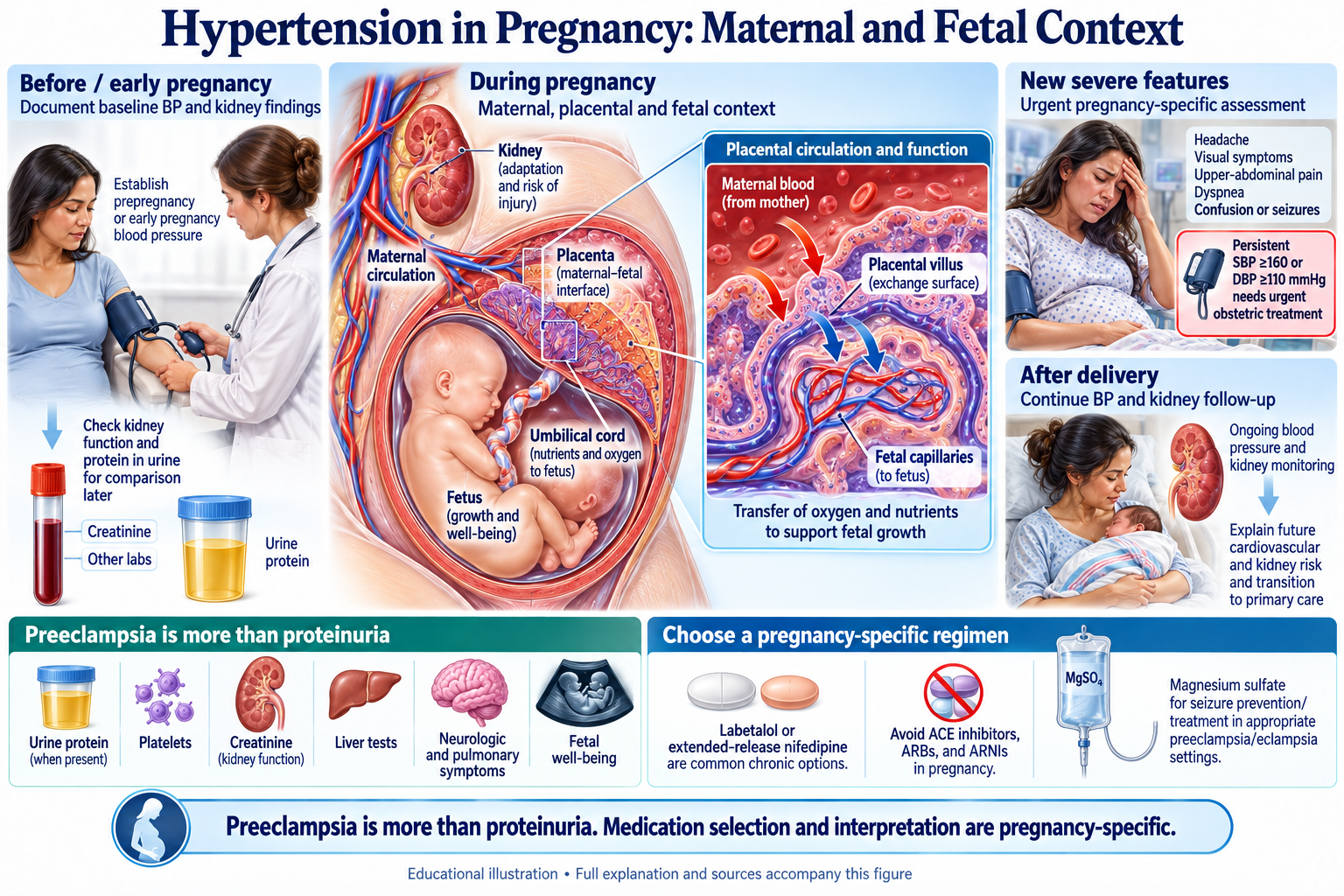
- Maternal: New-onset HTN (often ≥160/110 in severe form), proteinuria (often nephrotic-range), headache, vision changes, epigastric/RUQ pain, edema
- Severe features: BP ≥160/110, creatinine elevation, pulmonary edema, seizure (eclampsia)
- Fetal: IUGR, preterm delivery, neonatal complications
HELLP Syndrome
- Definition: Hemolysis, Elevated Liver enzymes, Low Platelets (variant of severe preeclampsia)
- Usually 3rd trimester or early postpartum
- Microangiopathic hemolytic anemia (schistocytes), elevated LDH/bilirubin, platelets <100,000
- Often lacks significant proteinuria/HTN—can be misdiagnosed as TTP
- AKI common (50% of HELLP); TMA pattern; cortical necrosis possible
Management
| Condition | Treatment | BP Target | Key Points |
|---|---|---|---|
| Preeclampsia | Delivery (only curative); labetalol/nifedipine; MgSO4 for seizure prophylaxis | 140–150/90–100 (not <130/80) | After 37 wks: deliver. Before 37 wks: individualize. Avoid ACE-I/ARB (teratogenic) |
| HELLP | Urgent delivery (<24h if >34 wks); platelet transfusion if <50K + bleeding; ICU | Same as preeclampsia | <34 wks: individualize timing |
| Eclampsia | MgSO4 (4–6 g IV load, 1–2 g/hr maintenance); emergent delivery | Stabilize before delivery | Continue MgSO4 12–24h postpartum |
Prognosis
- 80–90% resolve completely postpartum; renal function usually recovers within days to weeks
- Persistent HTN in 10–15% at 1 year postpartum; 15–25% recurrence risk in future pregnancies
- Long-term: Increased cardiovascular disease risk (HTN, stroke, MI) and increased CKD risk
Thrombotic Microangiopathy (TMA) in Pregnancy
Critical Distinction: Three Overlapping TMAs
HELLP can masquerade as TTP. Always check ADAMTS13 activity. Normal in HELLP, <10% in TTP. This distinction is lifesaving—TTP requires emergent plasma exchange.
| Condition | Peak Timing | Mechanism | ADAMTS13 | Plasma Exchange |
|---|---|---|---|---|
| Preeclampsia/HELLP | 3rd trimester/postpartum | Endothelial dysfunction, ischemic | Normal (often >60%) | Limited role |
| TTP | Any trimester; postpartum | ADAMTS13 deficiency | <10% (diagnostic) | ESSENTIAL; lifesaving |
| aHUS | Any trimester; postpartum | Complement dysregulation | Normal (>10%) | Variable; eculizumab emerging |
TTP Management in Pregnancy
- Plasma exchange (ESSENTIAL): Daily until ADAMTS13 normalizes, platelet count rises, schistocytes clear
- Caplacizumab: Anti-VWF nanobody; emerging benefit
- Avoid platelet transfusion (except life-threatening bleeding)
- Delivery: TTP usually requires immediate treatment regardless of trimester
aHUS Management
- Plasma exchange: May help; less clearly essential than TTP
- Eculizumab (C5 inhibitor): Can induce remission; emerging standard of care
- Delivery may improve outcome (removes pregnancy stimulus to TMA)
Acute Kidney Injury in Pregnancy
Pregnancy-Specific Causes
| Timing | Cause | Mechanism |
|---|---|---|
| 1st trimester | Hyperemesis gravidarum | Volume depletion |
| Any | Preeclampsia/HELLP | Endothelial dysfunction |
| Any | Placental abruption | DIC → AKI |
| Postpartum | Amniotic fluid embolism | Intravascular coagulation |
| Postpartum | Massive hemorrhage | Volume depletion, DIC |
| Postpartum | Infection/sepsis | Septic shock |
Management Principles
- Volume status assessment critical: Many pregnancy-related AKI are volume-responsive
- Careful fluid balance; avoid excessive diuretics
- Dialysis if: fluid overload, hyperkalemia, severe acidosis, uremia
- Maintain renal perfusion (avoid aggressive diuresis); close fetal monitoring
CKD in Pregnancy
Outcomes by GFR Category
| GFR Category | Pregnancy Outcome | Fetal Outcome | Maternal Risk |
|---|---|---|---|
| >60 (CKD 1–2) | Good; mild GFR decline common | Excellent | Low |
| 30–60 (CKD 3) | Careful monitoring; variable | Good if well-managed | Moderate |
| <30 (CKD 4) | Reduced fertility; high complication risk | Acceptable with intensive management | High |
| On dialysis (CKD 5) | Very rare successful pregnancies; high miscarriage | Poor unless intensified dialysis | Very high |
Management Strategies
Pre-Conception
- Baseline renal function, proteinuria assessment
- BP control (target <130/80)
- Stop ACE-I/ARB if conception planned (teratogenic)
- Assess for complications (anemia, bone disease)
During Pregnancy
- Monthly monitoring (vs routine 2–4 weeks)
- Target BP: 120–140/80–90 mmHg; labetalol, nifedipine preferred
- Monitor proteinuria; nephrotic-level may develop/worsen
- Dialysis adjustments: If dialysis-dependent, may need intensification (more frequent/longer sessions)
Medication Safety in Pregnancy
Critical: ACE-I/ARB Contraindicated in Pregnancy
ACE-I and ARBs cause fetal AKI, oligohydramnios, and fetal loss. Must be stopped if conception is planned or confirmed. Safe alternatives: labetalol, nifedipine, hydralazine, methyldopa.
Drugs to Avoid
| Drug Class | Why Avoid | Safe Alternatives |
|---|---|---|
| ACE-I/ARB | Fetal AKI, oligohydramnios, fetal loss | Labetalol, nifedipine |
| Thiazide diuretics | Electrolyte derangement, reduced placental perfusion | Hydralazine (IV), labetalol |
| NSAIDs | Especially 3rd trimester; ductus arteriosus closure, AKI | Acetaminophen |
| Spironolactone | Potential fetal side effects | Other agents |
Safe Agents
- Labetalol: Combined alpha-beta blocker; safe throughout pregnancy
- Nifedipine (extended-release): Safe; used extensively
- Hydralazine: Safe; typically used IV for severe HTN
- Methyldopa: Safe; older agent, less commonly used now
Lactation
- Most antihypertensives safe in breastfeeding
- ACE-I/ARB: Safe postpartum (can resume)
- Diuretics: Can reduce milk supply; use cautiously
Clinical Pearls
- Serum creatinine >0.8 mg/dL in pregnancy may indicate renal compromise (vs non-pregnant baseline)
- Physiologic hydronephrosis common; resolves postpartum—do not pursue imaging unless signs of obstruction
- Preeclampsia does not equal eclampsia: Eclampsia requires seizure; treat preeclampsia before it progresses
- HELLP can masquerade as TTP: Check ADAMTS13 (normal in HELLP, low in TTP)
- TTP in pregnancy is an OBSTETRIC EMERGENCY—plasma exchange is lifesaving
- aHUS can be triggered by pregnancy/postpartum: Consider complement mutation testing
- Proteinuria <0.3 g/day normal in pregnancy; 0.3–1 g/day needs investigation; >1 g/day pathologic
- ACE-I/ARB must be stopped if conception planned—risk of fetal AKI, oligohydramnios, neonatal death
- Dialysis-dependent pregnancy possible but rare; requires intensified dialysis schedule
- Postpartum follow-up essential: Monitor BP, renal function; assess long-term CVD/CKD risk
References
- Wiles KS, Chappell LC, Clark DJ, et al. Reproductive health and pregnancy in women with chronic kidney disease. Nat Rev Nephrol. 2018;14(3):165-184. PubMed
- Dines V, Suvakov S, Kattah A, et al. Preeclampsia and the Kidney: Pathophysiology and Clinical Implications. Compr Physiol. 2023;13(1):4231-4267. DOI | PubMed
- Fakhouri F, Roumenina L, Provot F, et al. Pregnancy-associated hemolytic uremic syndrome revisited in the era of complement gene mutations. J Am Soc Nephrol 2010. PubMed 20203157.
- Zheng XL, Vesely SK, Cataland SR, et al. ISTH guidelines for the diagnosis of thrombotic thrombocytopenic purpura. J Thromb Haemost 2020. PubMed 32914582.
- Piccoli GB, Conijn A, Consiglio V, et al. Pregnancy in dialysis patients: is the evidence strong enough to lead us to change our counseling policy? Clin J Am Soc Nephrol 2010. PubMed 19965547.
- Jim B, Garovic VD. Acute Kidney Injury in Pregnancy. Semin Nephrol 2017. PubMed 28711077.
- Kuklina EV, Ayala C, Callaghan WM. Hypertensive disorders and severe obstetric morbidity in the United States. Obstet Gynecol. 2009;113(6):1299-1306. PubMed
- Wiles KS, Furniss G, Amos A, et al. Clinical practice guideline on pregnancy and renal disease. BMC Nephrol. 2019;20:401. PubMed