Visual reference
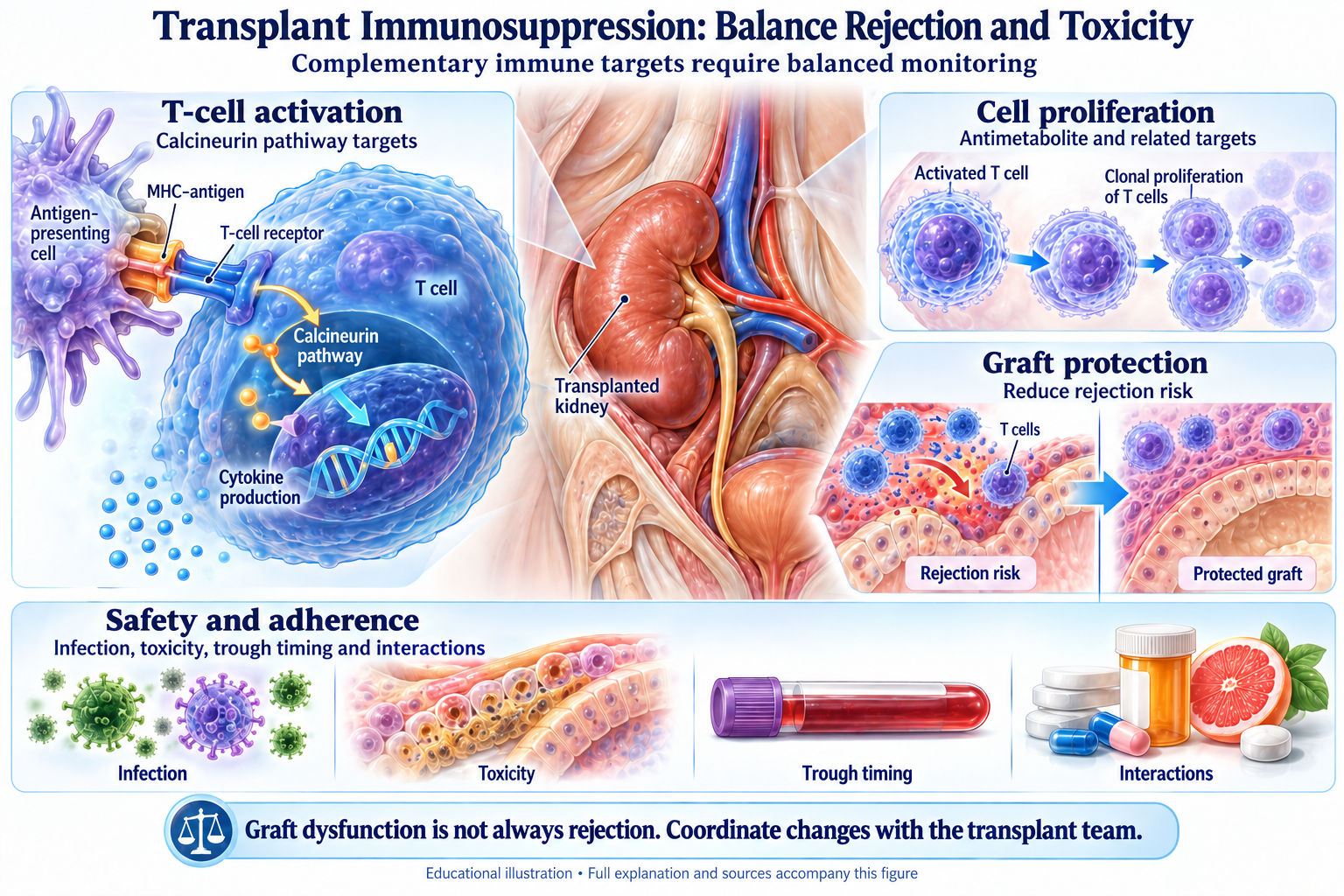
Browse the visual reference library · Download lesson Markdown
Overview
Post-transplant immunosuppression represents a delicate balance between preventing allograft rejection and minimizing drug toxicity and infection risk. Modern immunosuppressive regimens achieve excellent short-term outcomes (>95% one-year graft survival in living-donor kidneys) but long-term challenges—chronic kidney disease in the graft, late acute rejection, CNI toxicity, and malignancy—persist. Understanding the mechanism of action, drug interactions, therapeutic drug monitoring (TDM), and non-adherence as the #1 cause of late graft loss is essential for nephrologists managing transplant patients.
Induction therapy: Basiliximab (IL-2 antagonist) or ATG (antithymocyte globulin) ± alemtuzumab. Maintenance triple therapy (standard): Calcineurin inhibitor (tacrolimus preferred over cyclosporine; target trough 8–12 ng/mL year 1, 6–10 ng/mL year 2+) + mycophenolate mofetil (1–3 g/day) + prednisone (taper to 5–10 mg/day). Key challenges: CNI nephrotoxicity (dose-dependent), non-adherence (leading cause of late graft loss), BK virus (polyomavirus), PTLD (post-transplant lymphoproliferative disorder), malignancy. TDM critical: Tacrolimus has narrow therapeutic window; target levels individualized.
Historical Evolution
| Era | Regimen | 1-Year Graft Survival | 5-Year Graft Survival |
|---|---|---|---|
| Pre-1980s | Azathioprine + prednisone | ~70% | ~40% |
| Cyclosporine Era (1980s–2000s) | Cyclosporine + azathioprine + prednisone | ~85% | ~65% |
| Modern Era (2000s–present) | Tacrolimus + MMF + prednisone + induction | ~96% (living-donor) | ~70–75% |
Immunologic Principles
Allograft Rejection Mechanisms
Acute Cellular Rejection (ACR)
- T-cell mediated; CD8+ cytotoxic T cells and CD4+ helper T cells infiltrate graft
- Results from insufficient CNI/antimetabolite therapy
- Incidence: 10–20% in modern series (down from 40–60% in 1990s)
- Often reversible with pulse steroids or antibody therapy
Acute Antibody-Mediated Rejection (AMR)
- Humoral immune response; donor-specific antibodies (DSA) bind HLA/non-HLA antigens
- Complement activation (C4d deposition in peritubular capillaries); endothelial injury
- More refractory to treatment than ACR
- De novo DSA formation: 5–10% per year post-transplant
Chronic Rejection
- Combination of cellular and humoral alloimmunity
- Pathology: Chronic allograft nephropathy (CAN) — intimal fibrosis, glomerular sclerosis
- Progressive graft dysfunction (proteinuria, GFR decline)
- Often irreversible; leads to late graft loss
Mechanisms of Key Agents
Calcineurin Inhibitors (CNI)
- Tacrolimus and cyclosporine inhibit calcineurin phosphatase
- Calcineurin normally dephosphorylates NFAT (nuclear factor of activated T cells)
- CNI blockade → NFAT remains phosphorylated → stays in cytoplasm → cannot enter nucleus
- Result: Reduced IL-2 transcription → T cell proliferation inhibited
Mycophenolate Mofetil (MMF)
- Prodrug of mycophenolic acid (MPA)
- Selectively inhibits inosine monophosphate dehydrogenase (IMPDH) type II
- IMPDH type II preferentially expressed in lymphocytes
- Inhibition → reduced guanosine synthesis → reduced lymphocyte proliferation
- Selective for T and B cells (other cell types use salvage pathway)
Induction Therapy
IL-2 Receptor Antagonists
| Agent | Mechanism | Dosing | Advantages | Disadvantages |
|---|---|---|---|---|
| Basiliximab | Chimeric monoclonal Ab to IL-2R alpha chain | 20 mg day 0, day 4 | Well-tolerated; minimal systemic effects | Less effective in high-risk; fewer infections |
T-Cell Depleting Agents
Antithymocyte Globulin (ATG, rabbit)
- Polyclonal antibody; depletes T cells
- Dosing: 1.5 mg/kg/day × 3–5 days
- More potent than basiliximab; greater T-cell depletion
- Side effects: Cytokine release syndrome (fever, chills, myalgia; mitigated by slow infusion)
- Risk: Increased infection (CMV), PTLD from over-immunosuppression
Alemtuzumab
- Anti-CD52 monoclonal antibody; profound T and B cell depletion
- Dosing: 30 mg on day 0 and day 1 (typical)
- Most potent depletion; excellent for high-risk patients
- Risk: Very high infection/PTLD risk (requires close monitoring, CMV prophylaxis)
- Reduced maintenance immunosuppression often possible
Clinical Pearl
Induction agent selection depends on immunologic risk: High-risk (retransplant, prior sensitization, PRA >50%) → T-cell depleting agent (ATG or alemtuzumab). Low-risk, older age, CMV+ → basiliximab. Standard induction: basiliximab (low-risk) vs. ATG (high-risk).
Maintenance Immunosuppression: Triple Therapy
Component 1: Calcineurin Inhibitor
Tacrolimus (Preferred)
- Mechanism: CNI; more selective for T cells than cyclosporine
- Dosing: Initial 0.1–0.3 mg/kg/day divided BID; titrate to trough levels
- Target trough levels:
- Year 1 post-transplant: 8–12 ng/mL (peak efficacy window)
- Year 2+: 6–10 ng/mL (reduce toxicity while maintaining efficacy)
- Some centers use lower targets (5–7 ng/mL) in stable patients
- Monitoring: Trough levels twice weekly initially, then weekly × 1 month, then every 1–3 months
- Metabolism: Hepatic (CYP3A4); highly protein-bound
- Nephrotoxicity: Dose-dependent; afferent arteriolar vasoconstriction and CAN
- Advantages over cyclosporine: Better graft survival (SYMPHONY trial), less HTN, easier TDM
Cyclosporine (Less Common)
- Older CNI; more nephrotoxic, more HTN induction, less T-cell selective
- Target trough 100–200 ng/mL (or C2 600–800 ng/mL)
Component 2: Antimetabolite
Mycophenolate Mofetil (MMF)
- Mechanism: Selective IMPDH type II inhibitor; reduces lymphocyte proliferation
- Dosing: 1–3 g/day (divided BID or TID)
- Efficacy: Reduces acute rejection rate by ~50% compared to azathioprine
- GI side effects: Diarrhea (30–40%), nausea; manage with enteric-coated form
- No TDM needed (variable absorption); some use MPA AUC if severe GI issues
MMF is teratogenic (category D). Avoid in women of childbearing age or ensure reliable contraception. Switch to azathioprine prior to planned pregnancy.
Component 3: Corticosteroids
- Mechanism: Nuclear transcription factor; suppresses IL-2, TNF-alpha, other cytokines
- Initial dose: 20–30 mg/day (day 0, post-transplant)
- Taper schedule:
- Week 1: 20–30 mg/day
- Month 1: 15 mg/day
- Month 3: 10 mg/day
- Month 6–12: 5 mg/day (maintenance)
- Complications: HTN, hyperglycemia, weight gain, osteoporosis, infection susceptibility
Clinical Pearl
Steroid minimization/withdrawal: Modern regimens attempt to taper prednisone to the lowest possible dose (5–10 mg/day) due to long-term toxicity, but complete withdrawal increases rejection risk. Risk-benefit individualized based on rejection history, DSA status, and patient factors.
Newer/Alternative Immunosuppressive Agents
mTOR Pathway Inhibitors
| Agent | Target Trough | Advantages | Disadvantages |
|---|---|---|---|
| Sirolimus | 5–10 ng/mL | No CNI nephrotoxicity; less HTN; anti-angiogenic (may reduce malignancy risk) | GI side effects, hyperlipidemia, interstitial pneumonitis (rare), impaired wound healing |
| Everolimus | 3–8 ng/mL | Better GI tolerability than sirolimus | Similar profile to sirolimus |
Belatacept (Costimulation Blockade)
- Mechanism: CTLA-4-Ig fusion protein; blocks CD80/CD86 costimulatory molecules (prevents T-cell second signal)
- Dosing: IV 5 mg/kg on days 0, 4, 14, 28, 56, 84 (loading), then every 4 weeks maintenance
- Advantages: No CNI nephrotoxicity; potential reduced malignancy; good long-term graft survival
- Disadvantages: IV only (requires infusion center); PTLD risk if EBV-seronegative; higher early cellular rejection
Therapeutic Drug Monitoring & Drug Interactions
TDM Targets
| Drug | Target Level | Timing | Method | Year 1 Frequency |
|---|---|---|---|---|
| Tacrolimus | 8–12 ng/mL (Y1); 6–10 ng/mL (Y2+) | Pre-dose (trough) | LC-MS/MS (gold standard) | 2×/wk → weekly → biweekly → monthly |
| Cyclosporine | 100–200 ng/mL | Pre-dose | HPLC or LC-MS/MS | Similar |
| Sirolimus | 5–10 ng/mL | Pre-dose | LC-MS/MS | Similar to tacrolimus |
| Everolimus | 3–8 ng/mL | Pre-dose | LC-MS/MS | Similar to tacrolimus |
Major CYP3A4 Interactions (Tacrolimus)
Inhibitors (Increase Tacrolimus Levels — Toxicity Risk)
- Antibiotics: Macrolides (erythromycin, azithromycin); fluoroquinolones
- Antifungals: Fluconazole, itraconazole, voriconazole (avoid if possible; reduce tacrolimus dose)
- Antiretrovirals: Ritonavir (boosting agent)
- Other: Cimetidine, diltiazem, verapamil, grapefruit juice
Inducers (Decrease Tacrolimus Levels — Subtherapeutic Risk)
- Anticonvulsants: Phenytoin, phenobarbital, carbamazepine
- Antibiotics: Rifampicin/rifampin (potent inducer; avoid)
- Other: St. John’s wort (herbal; avoid)
Different generic formulations have different bioavailability. Switching brands can cause subtherapeutic or toxic levels. Maintain consistent formulation if possible. If switch unavoidable: close TDM (check trough 5–7 days post-switch); adjust dose as needed.
Non-Adherence: The #1 Cause of Late Graft Loss
Epidemiology
- ~20–25% of renal transplant patients are non-adherent to immunosuppression
- Adherence worsens over time (years 3–5: 30–40% non-adherent)
- Non-adherence associated with 2–3× higher risk of graft loss
Causes of Non-Adherence
| Category | Examples |
|---|---|
| Intentional | Belief that reduced dose is safe; desire to “test” kidney; intentional missed doses |
| Unintentional | Forgetfulness; complex regimen; cost/insurance barriers; side effects |
| Psychosocial | Depression, anxiety, substance abuse, denial of transplant |
| Side effects | GI issues (MMF), HTN (CNI), tremor (CNI), acne (steroids) |
| Access/cost | Pharmacy access, medication cost, out-of-pocket expenses |
Interventions to Improve Adherence
- Education: Emphasize graft dependence on immunosuppression; explain consequences
- Simplification: Once-daily formulations if possible; reduce number of agents
- Reminder systems: Phone alerts, pill organizers, pharmacy calls
- Psychosocial support: Mental health screening; intervention if depression/substance abuse
- Cost assistance: Pharmaceutical patient assistance programs; navigate insurance barriers
- Frequent monitoring: Close contact with transplant team; early identification
Clinical Pearl
Late acute rejection (years 1–5) is increasingly recognized as primarily due to non-adherence rather than immunologic failure. Always suspect non-adherence (check tacrolimus level) when acute rejection develops in a stable transplant patient. Non-adherence is preventable; intervention is critical.
CNI Nephrotoxicity, Viral Complications, and Malignancy
CNI Nephrotoxicity
Acute CNI Nephrotoxicity
- Dose-dependent; reversible
- Mechanism: Afferent arteriolar vasoconstriction; reduced GFR
- Manifests as rising creatinine with elevated trough levels
- May mimic acute rejection (distinguished by biopsy or CNI level reduction + Cr improvement)
Chronic CNI Nephrotoxicity (CAN)
- Cumulative, irreversible arteriolopathy/tubulointerstitial fibrosis
- Pathology: Tubular atrophy, interstitial fibrosis, arteriolar hyalinosis
- Develops despite “normal” trough levels (time-dependent)
- Contributes to long-term graft dysfunction
Management
- Reduce CNI dose: Decrease tacrolimus; check trough in 3–5 days; reassess Cr after 1–2 weeks
- Switch CNI: Cyclosporine to tacrolimus (or vice versa)
- CNI-sparing regimen: Add sirolimus or everolimus; reduce CNI dose while maintaining IS
Clinical Pearl
ACE-I/ARB are generally protective and should be used in renal transplant patients for HTN management and graft protection (reduce proteinuria, slow graft decline). Do NOT avoid ACE-I/ARB in transplant; monitor Cr/K+ but they are beneficial.
BK Polyomavirus Nephropathy (BKVN)
- Mechanism: BK virus reactivation in immunocompromised patients; direct viral cytolysis of tubular epithelium
- Incidence: 1–5% of renal transplants (higher with tacrolimus than cyclosporine)
- Presentation: Asymptomatic rise in creatinine (months 3–12 post-transplant typical)
- Diagnosis:
- Plasma BK viral load: >100 copies/mL suggests viremia; >1000 copies/mL concerning
- Urine BK viral load: >107 copies/mL suggests active replication
- Kidney biopsy: Nuclear inclusions, inflammation, fibrosis (confirms diagnosis)
- Management: Reduce immunosuppression (decrease CNI and/or antimetabolite); quarterly monitoring
- Prognosis: If caught early (low viral load), ~70% respond to reduced IS; if delayed, progressive graft loss likely
Cytomegalovirus (CMV)
- Risk: ~20% of CMV-seronegative recipients of seropositive donor (D+/R-) without prophylaxis
- Prophylaxis: Valganciclovir 900 mg PO daily × 3–6 months (for D+/R- or high-risk)
- Clinical disease: Fever, leukopenia, viral syndrome, colitis, esophagitis (rare now with prophylaxis)
Malignancy and PTLD Risk
Post-Transplant Lymphoproliferative Disorder (PTLD)
- Spectrum from benign lymphoid hyperplasia to frank lymphoma
- EBV-associated (90% of cases): Risk highest in EBV-seronegative recipients
- Risk increased with T-cell depleting induction (ATG, alemtuzumab >> basiliximab)
- Incidence: 1–2% in modern series; higher (5–10%) with alemtuzumab
Solid Malignancy
- Skin cancer: 20–40× higher (monitor skin regularly)
- Cervical cancer: HPV screening/vaccination recommended
- Lymphomas: EBV-related and non-EBV
- Lung, kidney, liver, colon cancers: 2–3× general population
Minimize immunosuppression over time (reasonable goal). Screen for cancer (skin exams, cervical cytology, colonoscopy per guidelines). Vaccinate pre-transplant (HPV vaccine) when possible. If EBV-seronegative, use less aggressive induction (basiliximab > ATG); monitor EBV viral load in year 1.
References
- Kidney Disease: Improving Global Outcomes (KDIGO) Transplant Work Group. KDIGO clinical practice guideline for the care of kidney transplant recipients. Am J Transplant. 2009;9 Suppl 3:S1-S155. PubMed
- Ekberg H, Tedesco-Silva H, Demirbas A, et al. Reduced exposure to calcineurin inhibitors in renal transplantation (SYMPHONY trial). N Engl J Med. 2007;357(25):2562-2575. PubMed