ACE Inhibitors and ARBs: Kidney-Protecting Blood Pressure Medicines
If your kidney doctor has you on lisinopril, losartan, or a medicine like them, you may wonder why — especially if you've heard they can "raise your creatinine." This page answers the common questions in plain language. It is written for patients, not for medical staff.
ACE inhibitors (like lisinopril) and ARBs (like losartan) are among the most useful medicines your kidney doctor has. They lower blood pressure, cut the amount of protein leaking into your urine, and slow kidney disease down — and they protect your heart at the same time. A few things surprise people. Your creatinine, a kidney blood test, may tick up a little when you start, and that small change is usually a good sign, not damage. ACE inhibitors can cause a dry cough that a simple switch fixes. Both can nudge your potassium up, so you'll get blood tests. And there are days you should hold them — when you're sick and dehydrated, or if you become pregnant. Each point is explained below.
Visual reference
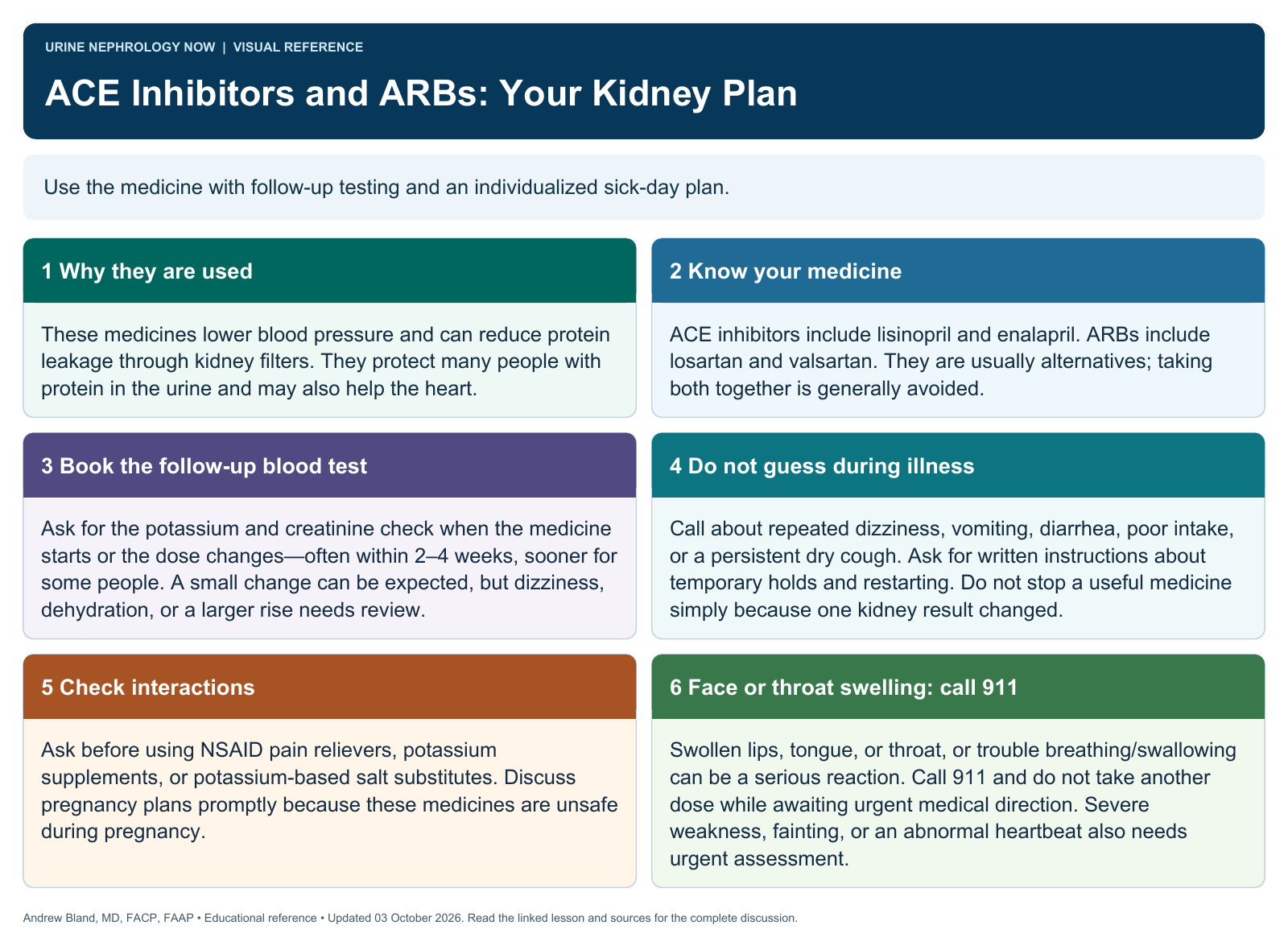
Browse the visual reference library · Download lesson Markdown
What are ACE inhibitors and ARBs?
These are two closely related families of blood pressure medicine. Both act on the same body system — a chain of hormones, called the renin-angiotensin system, that controls your blood pressure and how your kidneys handle salt and water. ACE inhibitors and ARBs each turn that system down a notch, which relaxes your blood vessels and takes strain off your kidneys.
You can often recognize your own medicine by the way its generic name ends. ACE inhibitors usually end in "-pril," and ARBs usually end in "-sartan."
| Family | How to spot it | Common examples |
|---|---|---|
| ACE inhibitors | Names usually end in "-pril" | lisinopril, enalapril, ramipril, perindopril, fosinopril, captopril |
| ARBs | Names usually end in "-sartan" | losartan, valsartan, irbesartan, olmesartan, telmisartan, candesartan |
The two families do nearly the same job. Your doctor's choice between them usually comes down to side effects, cost, and what has worked for you before.
Why your kidney doctor prescribes them
Blood pressure is only part of the reason. These medicines do something for the kidneys that ordinary blood pressure pills do not, and they work in three separate ways.
1. They lower your blood pressure
High blood pressure damages kidneys over time, and kidney disease raises blood pressure — a loop that feeds itself. ACE inhibitors and ARBs bring the pressure down and help break that loop. On their own the drop is modest, so they are often paired with other blood pressure medicines.
2. They lower the protein in your urine
Healthy kidneys keep protein in your blood, not your urine. When kidneys are under stress, protein starts leaking out — and that leak both signals damage and speeds it up. These medicines cut the amount of protein in the urine by roughly a third to a half. Most other blood pressure pills don't do this, and it is a big part of why nephrologists reach for them.
3. They ease the pressure inside your kidney's filters
Your kidneys clean your blood through millions of tiny filters. In kidney disease those filters often run under too much pressure, which wears them out over the years. ACE inhibitors and ARBs relax the small vessel that carries blood away from each filter, letting the pressure inside settle — a little like easing your foot off the gas. Lower filter pressure is gentler on the kidney over the long run. It is also the reason for the creatinine change described in the next section.
In a landmark 1993 trial, people with diabetic kidney disease who took an ACE inhibitor were far less likely to progress to kidney failure than those who did not. Later studies found the same protection with ARBs. These medicines also lower the risk of dying after a heart attack and help people with certain kinds of heart failure — which is why a single medicine can protect your kidneys and your heart together.
A normal early change: a small rise in creatinine
When you first start one of these medicines — or your dose goes up — your kidney blood test, creatinine, may rise a little, which can make your kidney number (eGFR) look slightly lower. If no one warns you, that reads as bad news. In most people it is expected and not harmful.
A rise of up to about 30 percent is the filter pressure settling — the same helpful effect described above — not the medicine harming your kidneys. Your doctor will usually recheck the number in a week or two to confirm it has leveled off. Do not stop the medicine on your own because of this test; call the clinician who prescribed it. A larger or steadily climbing rise is a different situation and does need attention, which is exactly why that follow-up blood test matters.
The dry cough — and the easy fix
About one in ten people who take an ACE inhibitor develop a dry, tickly cough — some studies find more, some fewer. It tends to be worse at night or when lying down. It can start within a day of your first dose, but it can also show up months later, after the medicine has given you no trouble at all. The cough is irritating but not dangerous, and it is not a sign that your kidneys or lungs are being harmed. It simply comes from the way ACE inhibitors work in the body.
The fix is straightforward. ARBs — the "-sartan" medicines — act on the same system and protect your kidneys just as well, but they do not cause this cough. Switching from an ACE inhibitor to an ARB clears the cough for most people who make the change. Give it time: the cough usually settles within a few weeks of stopping, though for some people it takes up to three months to go away completely. If you have a nagging dry cough while you are on an ACE inhibitor, tell your doctor and ask whether a switch makes sense — rather than quitting on your own.
Keeping an eye on your potassium
These medicines can raise the potassium level in your blood. A small rise is common and usually harmless. But potassium that climbs too high can affect your heartbeat, so your doctor checks it with a blood test before you start and again after — often at one to two weeks, then every few months.
A few things raise the chances of high potassium: more advanced kidney disease, diabetes, and anti-inflammatory painkillers such as ibuprofen or naproxen. High potassium rarely causes anything you can feel, which is precisely why the blood tests matter. If your level runs high, your doctor may lower the dose, adjust your diet, add a medicine that helps your body clear potassium, or pause the drug. That is their call to make with you — not something to change on your own.
When your doctor may hold them
These are long-term medicines, but there are situations where pausing them for a while is the safe move:
- When you're sick and dehydrated. A stomach bug with vomiting or diarrhea, or any illness where you can't keep fluids down, can leave you dry. Combined with a medicine that is easing your filter pressure, that can strain the kidneys. Ask your care team for a "sick-day plan" — which medicines to pause when you are ill and not eating or drinking normally.
- Around surgery or other procedures. Practices differ here — your team may or may not ask you to hold a dose. Follow the instructions they give you.
- With regular anti-inflammatory painkillers. Ibuprofen and naproxen, taken alongside one of these medicines and a water pill, are hard on the kidneys — a combination doctors call the "triple whammy." Check with your team before using them regularly.
- If you become pregnant or are planning to. ACE inhibitors and ARBs can harm a developing baby and are not used in pregnancy. If you are pregnant, might be, or are trying to conceive, tell your doctor promptly so you can move to a safer medicine.
One medicine, not two
You might wonder whether taking an ACE inhibitor and an ARB together would protect your kidneys twice as well. It doesn't. Large studies found that combining the two raised potassium and the risk of kidney injury without adding any benefit. That is why your doctor picks one, not both, and builds around it with other kidney-protecting medicines when they are needed.
Warning signs — when to call
Swelling of your lips, tongue, face, or throat, or any trouble breathing or swallowing. This is a rare but serious reaction. It happens most often in the first few months, but it can start after years on the medicine — so do not rule it out because you have taken the pill a long time. Call 911 or go to the emergency room, stop the medicine, and do not take it again.
• Vomiting or diarrhea you can't stay ahead of, or signs of dehydration — dry mouth, little or very dark urine, weakness, or dizziness
• Muscle weakness, numbness or tingling, or a slow or irregular heartbeat (possible high potassium)
• Fainting, or lightheadedness when you stand up
• A kidney or potassium blood-test result your doctor asked you to watch for
• A pregnancy, or a plan to become pregnant
• A new dry cough that will not go away
Questions worth asking your kidney team
- Is this medicine mainly for my blood pressure, my kidneys, my heart — or more than one of these?
- My creatinine may rise a little at the start — when will you recheck it, and how much of a change would worry you?
- What potassium level is too high for me, and how often will you check it?
- What is my "sick-day plan" — should I pause this if I can't eat or drink normally?
- Is it safe for me to take ibuprofen or naproxen while I'm on this?
- I have a bothersome dry cough — could the medicine be the cause, and can I switch?
- I'm pregnant or thinking about it — do I need a different medicine?
References
These are the main peer-reviewed sources behind this page. They are written for clinicians; your own doctor can help you interpret them.
- Kidney Disease: Improving Global Outcomes (KDIGO) CKD Work Group. KDIGO 2024 Clinical Practice Guideline for the Evaluation and Management of Chronic Kidney Disease. Kidney Int. 2024;105(4S):S117. PubMed
- Lewis EJ, Hunsicker LG, Bain RP, et al. The effect of angiotensin-converting-enzyme inhibition on diabetic nephropathy. The Collaborative Study Group. N Engl J Med. 1993;329(20):1456-1462. PubMed
- Pfeffer MA, Braunwald E, Moyé LA, et al. Effect of captopril on mortality and morbidity in patients with left ventricular dysfunction after myocardial infarction. Results of the survival and ventricular enlargement trial. The SAVE Investigators. N Engl J Med. 1992;327(10):669-677. PubMed
- Fried LF, Emanuele N, Zhang JH, et al. Combined angiotensin inhibition for the treatment of diabetic nephropathy. N Engl J Med. 2013;369(20):1892-1903. PubMed
- Mann JF, Schmieder RE, McQueen M, et al. Renal outcomes with telmisartan, ramipril, or both, in people at high vascular risk (the ONTARGET study): a multicentre, randomised, double-blind, controlled trial. Lancet. 2008;372(9638):547-553. PubMed