Understanding Dialysis: Your Options
If your kidneys are failing, or getting close, you and your kidney team will start talking about dialysis. That is a big conversation, and it helps to walk in knowing the basics. This page explains the main choices in plain language — what each one is, what a normal week looks like, and the questions that decide which one fits you. It is written for patients, not for medical staff.
Dialysis does part of the job your kidneys can no longer do — it clears waste and extra fluid from your blood. There are two main kinds: hemodialysis, where a machine filters your blood, and peritoneal dialysis, which uses the lining of your own belly and is done at home. Some people, after talking it through, choose not to do dialysis at all and focus on comfort instead. There is no single right answer. The best choice depends on your health, your home life, and what matters most to you.
Visual reference
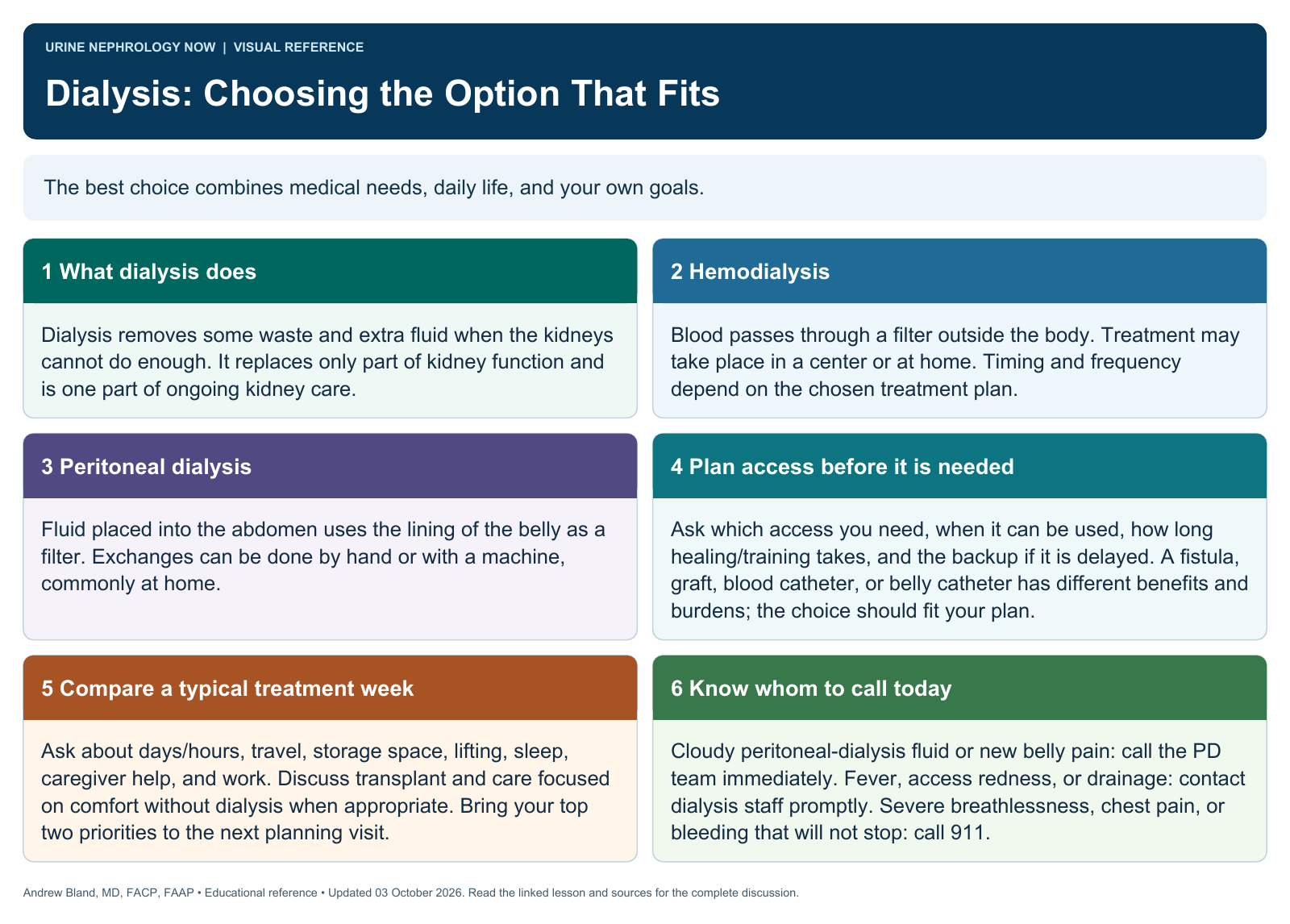
Browse the visual reference library · Download lesson Markdown
What dialysis does
Healthy kidneys clean your blood around the clock. They pull out waste, get rid of extra fluid, and keep the salts in your body in balance. When your kidneys fail, that work stops getting done, and the waste and fluid build up.
Dialysis takes over part of that job. It is not a cure and it does not do everything your kidneys did, but it removes enough waste and fluid to keep you well. Because your kidneys are not working full time, dialysis has to be repeated — every week, and for most types, several times a week.
The two main types of dialysis
Almost everyone who starts dialysis chooses between two approaches. They clean your blood in different ways and fit into your life very differently.
Hemodialysis (HD)
In hemodialysis, some of your blood is gently pumped out of your body, through a filter that acts like an artificial kidney, and then returned to you clean. It runs through soft tubing the whole time, so you stay connected to the machine during treatment.
Most people do hemodialysis at a dialysis center about three times a week, and each session lasts roughly three to four hours. Some people are trained to do it at home, often more often and on their own schedule. A partner usually trains alongside them.
Peritoneal dialysis (PD)
Peritoneal dialysis uses the thin lining inside your own belly — called the peritoneum — as a natural filter. A cleaning fluid is run into your belly through a soft tube, left there for a few hours, and then drained out, carrying the waste and extra fluid with it. Filling and draining is called an "exchange."
This is a home treatment. You can do the exchanges by hand during the day, usually about four times, or let a small machine do them at night while you sleep. Either way, you and your care team learn the routine together before you do it on your own.
Here is how the two compare side by side:
| Hemodialysis (HD) | Peritoneal dialysis (PD) | |
|---|---|---|
| How your blood gets cleaned | A machine filters your blood outside your body | Cleaning fluid inside your belly does the filtering |
| Where | A dialysis center, or at home | At home |
| How often | Usually 3 times a week | Every day |
| How long each time | About 3 to 4 hours per session | Exchanges through the day, or overnight by machine while you sleep |
| Who runs it | Center staff, or you and a trained partner at home | You, at home |
| Access you need | A fistula, graft, or catheter (arm, neck, or chest) | A soft tube in your belly |
Home or in-center?
Where dialysis happens is often as important to daily life as which type you pick.
In-center hemodialysis means you go to a dialysis unit, and trained staff handle everything. You show up, they connect you, and they watch you closely for the whole session. Many people like not having to run the treatment themselves.
Home hemodialysis puts a machine in your home. You and a partner are trained to run it, which takes some weeks of teaching, and in return you get more flexibility and can dialyze more often. Many people say more frequent treatments feel easier on them. The trade-off is that using your access more often tends to mean more procedures to keep it working.
Peritoneal dialysis is usually a home treatment, although it can also be provided in hospital or with assistance in other settings. There is no center to travel to, and the daytime hand exchanges or the overnight machine fit around work, family, and sleep. It asks you to keep supplies at home and to follow a careful clean routine every time.
What a typical week looks like
The rhythm of each option is different, and picturing a real week helps.
On in-center hemodialysis, you spend three half-days a week at the unit — for example Monday, Wednesday, and Friday — plus the time it takes to get there and back. The days in between are yours. Some people read, nap, or use the time to rest while they are connected.
On peritoneal dialysis, there is something to do every day, but it is spread out and done at home. If you use the daytime method, you stop to do an exchange a few times a day, and each one takes about half an hour. If you use the overnight machine, you connect at bedtime and disconnect in the morning, leaving your days free.
Access: how dialysis reaches your body
Before hemodialysis can start, you need a reliable way for the machine to draw blood out and return it quickly. This is called your "access," and it is set up ahead of time by a surgeon. There are three kinds.
| Type of access | Where it is | When it can be used | Good to know |
|---|---|---|---|
| Fistula | Your arm — the surgeon joins one of your own arteries and veins | Checked at about 6 weeks, but often 2 to 4 months before it is ready to use | Usually lasts the longest and has the lowest infection risk. Sometimes a fistula does not develop and a second operation is needed. Whether it is right for you depends on your veins, your other health problems, and your longer-term plan. |
| Graft | Your arm — a soft tube joins an artery and vein | About 2 to 4 weeks | A good option when your own veins are too small. Clots and infections happen a little more often than with a fistula. |
| Catheter | A large vein in your neck or chest | Right away | Used when you need dialysis quickly, or while a fistula heals. It carries important infection and other risks. Some people use a tunneled catheter longer term after an individualized discussion of health, access options, and goals. |
A working fistula has a soft buzzing vibration you can feel with your fingers, and a whooshing sound if you listen. Your team will show you how to check for it. If that buzz ever disappears, call your dialysis unit right away — it can mean the fistula has clotted, and acting fast can save it.
Peritoneal dialysis needs its own access: a soft tube placed into your belly during a minor procedure. It usually needs a couple of weeks to heal before you begin using it, so this too is arranged in advance. If you need to start sooner than that, your team can begin with smaller amounts of fluid.
Common problems to know about
Both types of dialysis are safe and done every day by many thousands of people. Still, it helps to know the bumps that can come up so they do not catch you off guard.
With hemodialysis, the most common issue is a drop in blood pressure during treatment, because fluid is being pulled off. It can make you feel dizzy, crampy, or sick to your stomach. Your nurses watch for this and can slow things down or give fluid to settle it. Muscle cramps can happen for the same reason, and the very first few treatments sometimes cause a headache or nausea, which is why teams start slow and gentle.
With the access itself, watch for infection and clotting, and rarely a fistula can pull too much blood away from your hand, leaving it cold, numb, or achy — call your team right away if that happens.
With peritoneal dialysis, the main worry is an infection inside the belly, called peritonitis, which can come from the catheter. This is why the clean routine matters so much. The warning signs are cloudy drain fluid, belly pain, or fever, and they need a call to your team the same day.
Staying well between treatments
Dialysis is only part of the picture. What you do between sessions matters just as much.
Fluid and salt. Because your kidneys are not clearing fluid on their own, what you drink between treatments adds up. Your team will talk with you about limits, and about the salt that makes you thirsty in the first place.
Diet. Certain minerals, especially potassium and phosphorus, can build up when the kidneys are not filtering them. A kidney dietitian will help you find foods you enjoy that keep those in a safe range.
Your team. You do not do this alone. A dialysis team usually includes your kidney doctor, dialysis nurses, a dietitian, a social worker who helps with the practical and emotional side, and technicians who run the machines. Lean on them.
Choosing not to do dialysis: conservative care
Dialysis is a choice, not something that has to happen. Some people — often older adults who are also living with other serious illnesses — decide that the burden of treatment is not right for them. Instead they choose what is called conservative or supportive care: managing symptoms with medicines and diet, and focusing on quality of life and comfort rather than starting dialysis.
This is a real and respected path, not giving up. If you are weighing it, ask your kidney team to walk you through what it would mean for you, so you can decide with clear eyes and your family alongside you.
How the choice gets made
There is no one-size answer, and your team will not hand you a single option and walk away. The right fit depends on several things: your other health conditions, how much kidney function you still have, your home and whether you have space and support for a home treatment, how much independence you want, and what you value in your days.
Many people also change course over time — starting one way and switching later as their life or health changes. Nothing you choose now locks you in forever.
Warning signs — when to call
• Your fistula or graft stops buzzing, or the skin over it is red, swollen, warm, or painful
• Bleeding from your access that does not stop with steady pressure
• Cloudy fluid, belly pain, or a fever if you are on peritoneal dialysis (possible peritonitis)
• Feeling very dizzy, faint, or short of breath
• A large, fast weight gain or new swelling and trouble breathing between treatments
• A hand that becomes cold, pale, numb, or painful on the side of your fistula
Questions to ask your kidney team
- Given my health and my home life, which option fits best — in-center hemodialysis, home hemodialysis, or peritoneal dialysis?
- Is conservative care something I should consider, and what would it look like for me?
- What kind of access is right for me, and how far ahead do we need to plan it?
- What would a normal week look like once I start?
- What limits will I have on fluids, salt, and diet?
- Who is on my care team, and who do I call when something does not seem right?
- If I start one way, can I switch later if it is not working for me?
About this guide
This guide follows the dialysis and access guidelines from KDOQI (the National Kidney Foundation), the peritoneal dialysis guidelines from the International Society for Peritoneal Dialysis, and KDIGO's chronic kidney disease guideline, along with the medical literature.