CKD Complications: Anemia, Bones, and More
If you have chronic kidney disease (CKD), your kidneys do more than make urine — and that is why kidney disease can quietly change your blood counts, your bones, and the balance of minerals and acid in your body. This page explains what happens, why it happens, and what your kidney team watches for at each visit. It is written for patients, not for medical staff.
Healthy kidneys make a hormone that keeps your blood counts up, help keep your bones strong, and clear extra potassium and acid from your body. As CKD advances, each of those jobs slips — so you can develop anemia (low blood counts), bone and mineral problems, high potassium, and a buildup of acid. Most of these start silently, before you feel anything, which is why your team checks specific blood tests at every visit. The good news: each one can be treated, and treating it helps you feel better and protects your heart and bones.
Visual reference
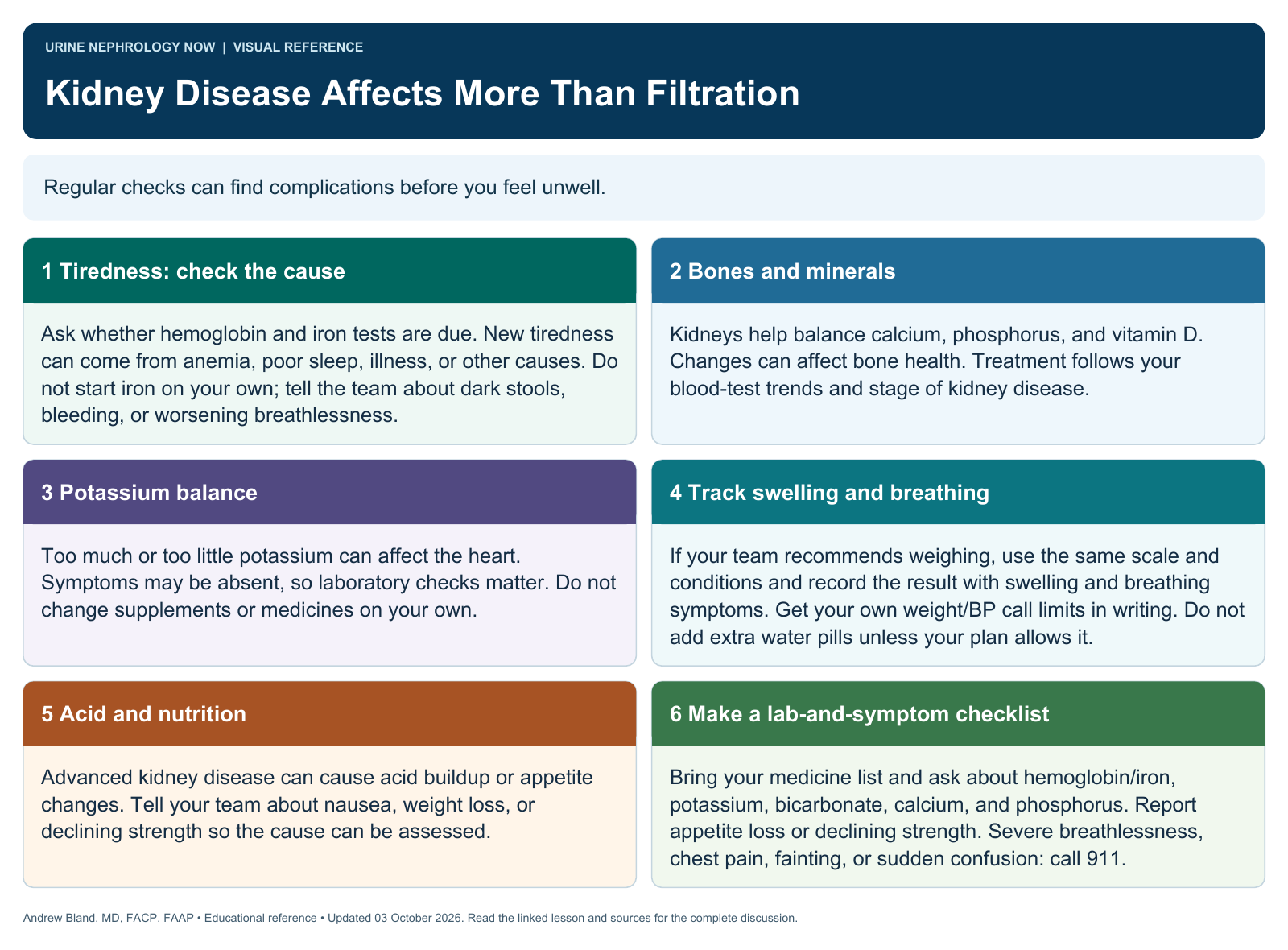
Browse the visual reference library · Download lesson Markdown
Why kidney disease touches so much of your body
Your kidneys are not just a filter. Along with removing waste and extra fluid, they do four jobs that matter here:
- They make erythropoietin (EPO), a hormone that tells your bone marrow to build red blood cells.
- They help control phosphorus, calcium, and vitamin D — the minerals that keep your bones strong.
- They remove extra potassium, a mineral that affects your heartbeat.
- They clear the acid your body makes from the food you eat.
When kidney tissue is damaged, all four of those jobs weaken — though not all at the same time or the same pace. That is why one disease shows up in so many different blood tests — and why your team looks at more than just your kidney number.
Anemia: low blood counts
Anemia means you do not have enough red blood cells. Those cells carry oxygen, so when they run low you may feel tired, weak, cold, or short of breath. Anemia becomes more common as kidney function drops, and it is one of the main reasons people with CKD feel worn out.
A few things drive it:
- Less EPO. This is the biggest reason. Damaged kidneys make less of the hormone that signals your marrow to produce red cells.
- Iron that your body cannot use. CKD makes it hard to put iron to work, even when your stored iron looks normal on paper. The iron gets locked away and cannot reach the marrow.
- Shorter-lived cells. In kidney disease, red cells tend to wear out and break down sooner than they should.
What your team checks: your hemoglobin — the red-cell number — and your iron studies, which show both how much iron you have stored and how much your body can actually use.
What your team treats it with: iron. It can be a pill, but it is often given into a vein instead — especially once you are on dialysis — because pills are absorbed poorly in CKD. If iron alone is not enough, your team may add an ESA — a lab-made version of the EPO hormone your kidneys have stopped making. The goal is a healthy middle range, often a hemoglobin around 10 to 11.5, and your team will set the target that fits you. Pushing it higher than that does not help and can raise the risk of clots and stroke, so more is not better here.
Your bones and minerals
CKD throws off the balance of three things that keep your bones strong: phosphorus, calcium, and vitamin D. Doctors call the whole problem CKD mineral and bone disorder. It starts early — often by the middle stages of CKD — and usually before you notice a thing.
Here is the chain of events. As the kidneys weaken, they first make less active vitamin D, so your gut absorbs less calcium. Four small glands in your neck — the parathyroid glands — respond by pumping out more parathyroid hormone (PTH), which pulls calcium out of your bones to keep your blood level up. This usually starts years before phosphorus (a mineral in many foods) begins to build up on your blood tests — which is why your team checks PTH early, while your calcium and phosphorus still look normal. Over time the extra PTH steadily weakens bones and raises your risk of fractures, and some of the extra calcium and phosphorus can settle into blood vessels and make them stiff.
One thing worth knowing: guidance on bone-density scans in CKD has changed. Older advice was to skip the scan because it could look falsely reassuring. Current kidney guidance instead suggests the scan is worth doing if the result would change your treatment, because a low bone-density score does predict fracture risk in people with kidney disease. Your team will read it alongside your blood tests and your overall picture rather than on its own.
What your team checks: phosphorus, calcium, PTH, and vitamin D, often starting in the middle stages of CKD.
What your team treats it with: eating less phosphorus, plus phosphate binder pills taken with meals that soak up phosphorus from food before it reaches your blood. Your team may also replace vitamin D and, if PTH climbs too high, add a medicine that calms the parathyroid glands.
Phosphate binders only work when they are in your stomach at the same time as your food — that is how they trap phosphorus before it gets into your blood. Taken between meals, they do much less. If you forget a dose, take it with your next meal rather than on an empty stomach.
Potassium and your heartbeat
Potassium is a mineral that helps your heart and muscles work. Healthy kidneys remove whatever you do not need. In CKD, potassium can build up in the blood — a problem called hyperkalemia. When it climbs too high, it can trigger dangerous, even life-threatening changes in your heart's rhythm.
What makes potassium tricky is that a high level usually causes no symptoms, so a routine blood test is often the only warning — feeling fine does not mean your potassium is fine. That is one reason your team checks it so often. When symptoms do appear — a racing, pounding or irregular heartbeat, or new muscle weakness — treat it as urgent and seek care the same day, as in the warning box below. Potassium is managed with diet — cutting back on the highest-potassium foods — and sometimes with a medicine that helps your body clear the extra. Some kidney-protecting blood pressure medicines can nudge potassium up, so your team may recheck your level after starting or increasing one of them.
Acid buildup
Every day your body makes acid, mostly from the protein in your food, and healthy kidneys clear it. In CKD that acid can build up — a condition called metabolic acidosis. Left alone, extra acid slowly wears on your bones, breaks down muscle, and may speed up the loss of kidney function itself.
Your team checks this with a blood test, usually the bicarbonate (sometimes labeled "CO2") level, which reflects how much acid your body is holding onto. When it runs low, the treatment is simple and gentle: a base such as sodium bicarbonate (related to baking soda) or citrate, taken as a tablet or liquid to neutralize the extra acid. Correcting it protects your bones and muscles. It may also help slow kidney disease down, but that part is still being studied.
The rest of the body
Because your kidneys reach so many systems, more advanced CKD can show up in other ways:
- Your heart. Kidney disease is hard on the heart. Anemia, high blood pressure, extra fluid, and stiff blood vessels all add strain, which is why heart disease is the single biggest health risk for people with CKD.
- Itchy skin. A buildup of phosphorus and waste products can cause stubborn itching. Getting phosphorus under control helps, and there are medicines for the itch itself — the best-studied one is for people on dialysis.
- Feeling generally unwell. When wastes build up in very advanced CKD, they can cause nausea, a poor appetite, trouble concentrating, restless legs, and easy bruising. Bring these to your team promptly.
- Infections. Kidney disease can weaken the immune system, so infections deserve early attention.
Treatments that slow kidney disease down
Alongside treating each complication, your team uses a few medicines that slow the kidney disease itself. Blood pressure medicines called ACE inhibitors and ARBs lower the pressure inside the kidney's tiny filters and cut the amount of protein leaking into your urine — and less protein in the urine means slower decline, so they help most when you are leaking protein. A newer group called SGLT2 inhibitors protects the kidneys as well, whether or not you have diabetes. Treating acid buildup may add some protection too, though the evidence for that is not as strong. Each of these works best when your blood pressure, potassium, and labs are watched along the way.
What your kidney team checks at each visit
Most CKD complications are silent early on, so your team leans on regular blood and urine tests to catch them before they cause trouble. Here is what those common tests are looking for:
| Test | What it measures | Why it matters |
|---|---|---|
| Hemoglobin | Your red blood cell level | Screens for anemia |
| Iron studies | Iron you have stored, and iron your body can use | Guides iron treatment |
| Phosphorus | A mineral that builds up in CKD | High levels harm bones and blood vessels |
| Calcium | Your blood calcium level | Part of the bone and mineral picture |
| PTH (parathyroid hormone) | How hard your parathyroid glands are working | Rises early in bone and mineral disease |
| Vitamin D | Your vitamin D stores | Low levels push PTH up |
| Bicarbonate (CO2) | How much acid your body is holding | Flags metabolic acidosis |
| Potassium | A mineral that affects heart rhythm | High levels can be dangerous and silent |
| Creatinine / eGFR | Your kidney function number | Tracks how your kidneys are doing over time |
| Urine protein | Protein leaking into your urine | More protein means faster kidney decline |
Warning signs — when to call
• Severe or worsening tiredness, or shortness of breath when you are resting — this can signal significant anemia
• A racing, pounding, or irregular heartbeat, or new muscle weakness — possible high potassium
• Chest pain or trouble breathing that is new or getting worse
• A new, very painful skin sore or dark patch of skin, especially if you are on dialysis
• Nausea or vomiting that keeps you from eating or drinking normally
• Fever or other signs of infection
• New confusion or unusual drowsiness
Questions worth asking your kidney team
- Which of my blood tests point to a complication right now, and which are in a good range?
- Do I have anemia — and if so, do I need iron, an ESA, or both?
- Are my phosphorus, calcium, and PTH where you want them, and should I be taking a phosphate binder?
- Is my potassium safe, and are any of my medicines affecting it?
- Do I have acid buildup, and would a bicarbonate supplement help?
- Which of my treatments are meant to slow my kidney disease down, and how will we track them?
About this guide
This guide is based on current international kidney-care guidelines (KDIGO) and the medical literature.