Diabetes and Your Kidneys
If you have diabetes, your kidneys are one of the organs worth watching most closely. Diabetes is the single most common reason people end up needing dialysis — but that outcome is far from guaranteed. Caught early and treated well, the damage can usually be slowed, and sometimes nearly stopped. This page explains what happens inside your kidneys, the one test that spots trouble early, and why today there is more your care team can do than at any time before.
High blood sugar quietly wears on your kidneys over years, usually with no symptoms until a lot of damage is done. A simple urine test can catch it early — long before you would feel anything. Two things drive the damage: high blood sugar and high blood pressure, so both need to be controlled. A newer group of medicines now protects the kidneys directly, beyond just lowering sugar, and can meaningfully lower your risk of kidney failure.
Visual reference
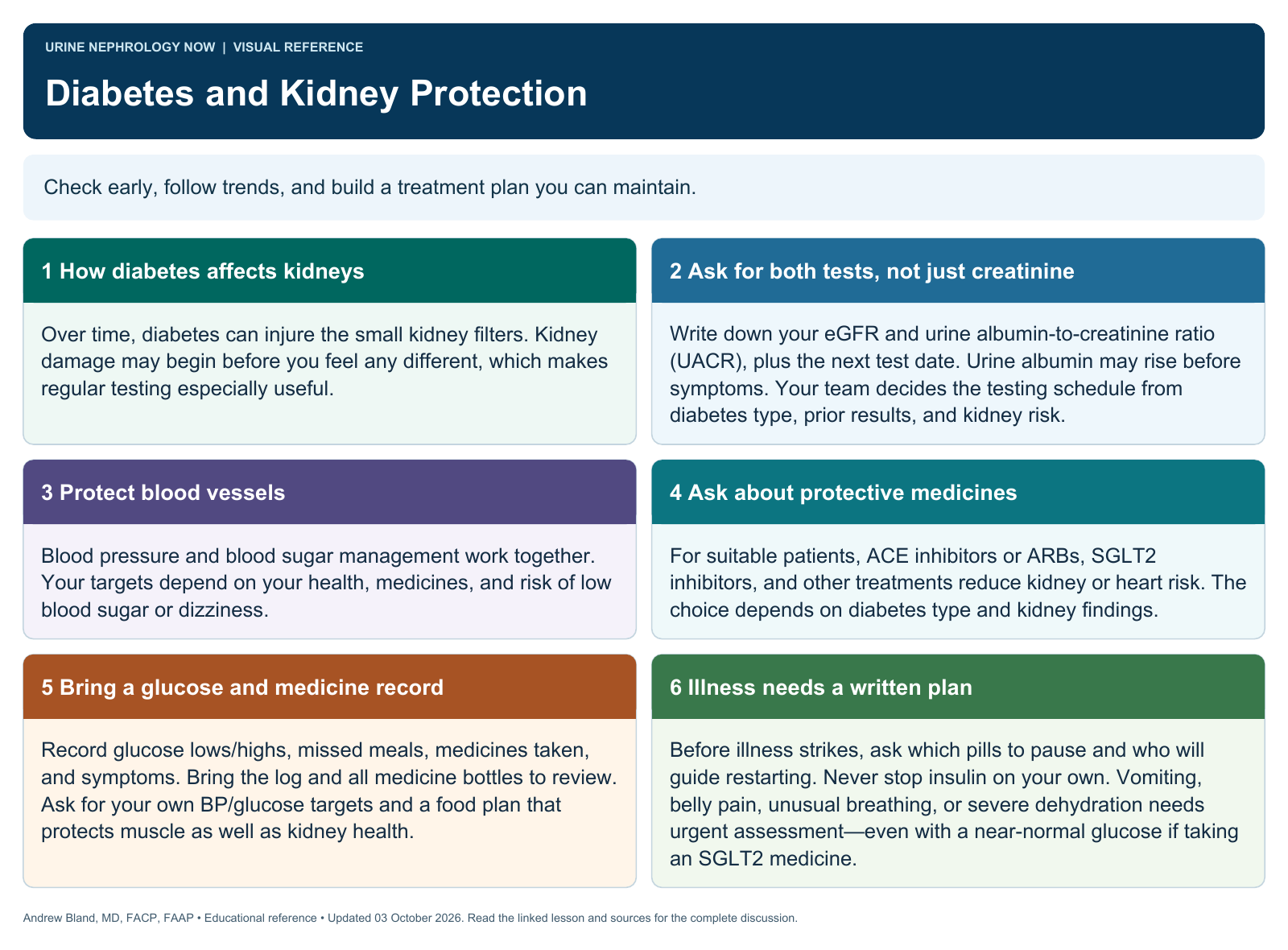
Browse the visual reference library · Download lesson Markdown
How diabetes harms your kidneys
Each kidney holds about a million tiny filters. Their job is to clean your blood — keeping the things your body needs and sending waste and extra water out as urine. In diabetes, high blood sugar slowly changes how these filters work.
Two problems build up together. First, the sugar itself is hard on the delicate filter walls, damaging them a little at a time. Second, the filters start running under too much pressure, the way a hose wears out faster when the water is always turned up high. Over the years, that steady strain leads to inflammation and then scarring, and scarred filters do not come back.
The hardest part is that this happens silently. Most people feel completely normal while the early damage is taking hold, which is exactly why testing matters. About 4 in 10 people with diabetes develop some degree of kidney disease, so this is common — not a sign you did something wrong.
The urine albumin test — your early warning
Albumin is a protein that normally stays in your blood. Healthy kidney filters hold it back. When the filters are damaged, small amounts of albumin start to slip through into your urine — and this leak shows up years before you would notice any symptom. That makes the urine albumin test the earliest and most useful warning sign you have.
The test is easy: a small urine sample, no needle, often done right in the clinic. The result is reported as a ratio (albumin compared to another substance called creatinine). Two blood-and-urine numbers together tell your team how your kidneys are doing:
| Test | What it measures | What the number tells you |
|---|---|---|
| Urine albumin (a urine sample) | How much protein is leaking through the filters | Under 30 mg/g is normal. Higher means more leak — an early sign of damage, and something treatment can lower. |
| eGFR (a blood test) | How well the kidneys are filtering overall | A higher number is better. It tends to change later than the urine test does. |
Here is the encouraging part: the urine albumin number is not just a warning light. It also responds to treatment. When the right medicines bring that leak down, your risk of kidney failure drops with it. That is why your team watches this number and works to lower it, not just to record it.
Why blood sugar and blood pressure both matter
People often focus only on blood sugar, but your kidneys are caught between two forces, and controlling just one is not enough.
Blood sugar does the chemical damage described above. Keeping it closer to your target takes a steady strain off the filters. Your A1c goal is set with your doctor — for many adults it lands near 7 percent, but the right number depends on your age, other health issues, and which medicines you take.
Blood pressure does the mechanical damage — the too-much-pressure problem inside the filters. Lowering it eases that strain directly. Certain blood pressure medicines, described next, do double duty by protecting the kidneys as well.
Guidelines differ on the number to aim for. Diabetes and heart groups say under 130/80. The kidney guideline (KDIGO) aims lower — a top number under 120 — but only when the reading is taken the careful way: sitting quietly, unrushed, with your arm supported. Most office checks are quicker than that, and that difference in how it is measured explains much of the gap. The lower target was not written for people on dialysis or with a kidney transplant. Ask your doctor which number is yours.
Think of it as taking your foot off two pedals at once. Do both and the filters get a real rest; do only one and the other keeps the damage going.
The medicines that protect your kidneys
This is where kidney care has changed the most. Until recently there was essentially one type of medicine for diabetic kidney disease. Now there are several, and some of them protect the kidneys directly — beyond whatever they do for blood sugar or blood pressure. Here are the main families in plain terms:
| Medicine family | Some brand names | What it does for your kidneys |
|---|---|---|
| ACE inhibitors and ARBs | lisinopril, losartan, valsartan | Lower blood pressure and ease the pressure inside the filters. The long-standing foundation of kidney protection. |
| SGLT2 inhibitors | Jardiance, Farxiga, Invokana | Protect the filters and slow the disease — and they help even in people who do not have diabetes at all. |
| GLP-1 medicines | Ozempic (semaglutide), and similar | Lower blood sugar and help with weight. Semaglutide is the one tested in a large kidney trial, where it lowered the risk of serious kidney and heart problems. |
| Finerenone | Kerendia | Calms inflammation and scarring in the kidney and lowers the albumin leak. |
These are not either-or choices. They work in different ways, so your doctor may build up a combination over time — often starting with an ACE inhibitor or ARB and an SGLT2 inhibitor, then adding others depending on your urine albumin, your blood sugar, and how you tolerate each one. Used together, they protect the kidneys far more than any single one alone.
These medicines have been tested in large, careful studies. In one trial of more than 3,500 people with type 2 diabetes and kidney disease, those taking semaglutide (a GLP-1 medicine) had about 24 percent fewer serious kidney problems, such as kidney failure or a large drop in kidney function. SGLT2 inhibitors have shown a similar benefit across many studies, slowing kidney disease whether or not a person has diabetes. The gains are real and they add up over the years you stay on treatment.
A normal early change: a small dip in your kidney number
When you first start an ACE inhibitor, an ARB, or an SGLT2 inhibitor, your kidney blood number (eGFR) may drop a little in the first few weeks, and the related blood test, creatinine, may tick up. Seeing this without warning can be alarming.
In most people this small early change is expected and not harmful. It reflects the very effect you want — the filter pressure easing off. Your doctor will usually recheck the numbers after a few weeks to confirm they have settled. Do not stop the medicine on your own because of this test. Talk with the clinician who prescribed it first.
Staying safe on these medicines
Each family has a few things to know. None of these should scare you off — they are manageable, and your team watches for them.
- SGLT2 inhibitors can make genital yeast infections a little more likely. Good daily hygiene helps. These medicines also need a "sick-day plan" — a short pause while you are seriously ill, vomiting, or not eating and drinking normally.
- GLP-1 medicines commonly cause nausea or an upset stomach at first, especially as the dose is raised. Starting low and going up slowly makes this much easier, and it usually settles.
- Finerenone, ACE inhibitors, and ARBs can raise the potassium level in your blood, so your team will check it with a simple blood test after starting or changing the dose.
Ask your kidney team to spell out your sick-day plan — which medicines to hold when you are ill and cannot keep fluids down — before you ever need it.
What you can do
The medicines do a lot of the work, but your everyday habits still matter:
- Take your kidney and blood pressure medicines every day, even when you feel completely fine. These medicines work quietly, and the benefit comes from staying on them.
- Keep your blood sugar and blood pressure in the range you and your doctor agreed on.
- Get your urine albumin and blood tests checked on the schedule your team sets — usually at least once a year, and more often when something changes.
- Do not stop a medicine over a small lab change. Call first.
- Ask about diet, including how much protein is right for you. The answer depends on your kidney function, so get a number that fits you rather than guessing.
When to call your doctor
• A stomach bug with vomiting or diarrhea where you cannot keep fluids down — this is when your sick-day plan matters
• Muscle weakness, numbness, or a slow or irregular heartbeat, especially if you take finerenone, an ACE inhibitor, or an ARB (possible high potassium)
• New or worsening swelling in your legs, or sudden weight gain over a day or two
• Much less urine than usual, or urine that looks very dark
• Any kidney lab result that worries you, before you change or stop a medicine on your own
Questions worth asking your kidney team
- What is my urine albumin number and my eGFR, and how have they changed over the past year?
- Am I on all the medicines that could protect my kidneys, or is there one we should add?
- What are my personal targets for blood sugar and blood pressure?
- Would an SGLT2 inhibitor, a GLP-1 medicine, or finerenone help in my case?
- What is my sick-day plan — which medicines should I pause if I am ill and not eating or drinking?
- How much protein should I be eating, given my kidney function?
About this guide
This guide is based on current international kidney-care guidelines (KDIGO), the American Diabetes Association Standards of Care, and the medical literature.