GLP-1 Medicines and Your Kidneys
If your doctor has started you on a GLP-1 medicine — or is thinking about it — you may have questions about what it does to your kidneys. This page answers the common ones in plain language. It is written for patients, not for medical staff.
GLP-1 medicines were first used for type 2 diabetes and weight. Large, high-quality studies now show they also protect the kidneys and the heart. If you have kidney disease, that is good news, not a reason to worry. There are a few things to watch for — a normal early change in one blood test, some stomach side effects at the start, protecting your muscle during weight loss, and planning ahead for surgery. Each one is explained below.
Visual reference
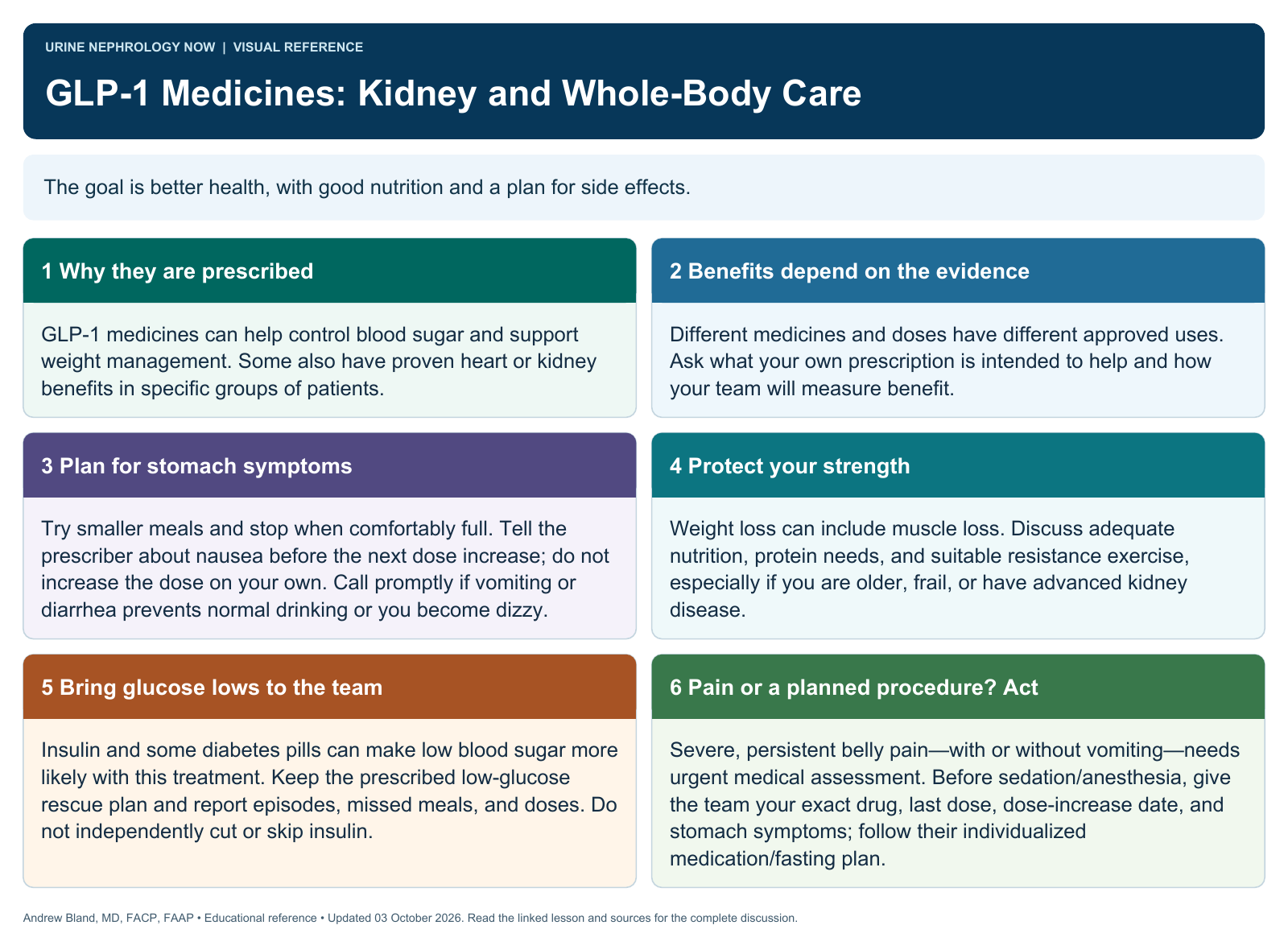
Browse the visual reference library · Download lesson Markdown
What are GLP-1 medicines?
GLP-1 stands for a natural gut hormone your body makes after you eat. These medicines are a longer-lasting copy of that hormone. They help your body release insulin when your blood sugar is high, slow down how fast your stomach empties, and reduce appetite. That is why they lower blood sugar and help with weight.
You may know them by their brand names. The most common ones are:
| Brand name | Generic name | How it is taken |
|---|---|---|
| Ozempic, Wegovy, Rybelsus | semaglutide | Weekly shot (Rybelsus is a daily pill) |
| Mounjaro, Zepbound | tirzepatide | Weekly shot |
| Trulicity | dulaglutide | Weekly shot |
| Victoza, Saxenda | liraglutide | Daily shot |
Doctors prescribe them for type 2 diabetes, for weight management, to lower the risk of heart attack and stroke, and — more recently — to protect the kidneys in people with kidney disease. Mounjaro and Zepbound (tirzepatide) work on two gut hormones instead of one, which is why they often cause the most weight loss.
How GLP-1 medicines help your kidneys
Researchers describe several pathways that may contribute to kidney benefit: better glucose control, changes in weight and circulation, and effects on inflammation. The benefit demonstrated in a trial belongs to the specific medicine and patient group studied; these are not three independently proven effects of every GLP-1 medicine.
1. Better blood sugar
High blood sugar over many years is one of the most common causes of kidney damage. By keeping blood sugar closer to normal, GLP-1 medicines take a steady strain off your kidneys. This is the most familiar benefit — but it is also the smallest of the three.
2. Taking the pressure off your kidney's filters
Your kidneys clean your blood through millions of tiny filters. In kidney disease, those filters often run under too much pressure, which wears them out over time. GLP-1 medicines help your kidneys let go of extra salt and water and gently lower that filter pressure — a little like easing your foot off the gas. They also lower blood pressure slightly, which helps too.
3. Calming inflammation in the kidney itself
Laboratory and clinical research suggests that effects on inflammation may contribute to kidney protection. The contribution separate from glucose, weight, and blood-pressure changes is still being studied. Ask which outcome evidence applies to your particular medicine and health conditions.
In a large 2024 study called FLOW, more than 3,500 people with type 2 diabetes and kidney disease took semaglutide (Ozempic) or a placebo. The people on semaglutide had about 24% fewer serious kidney problems — such as kidney failure or a large drop in kidney function — and they were also less likely to die from heart disease. Other studies have shown these medicines lower the risk of heart attack and stroke, and improve symptoms in a common type of heart failure.
A normal early change: a small bump in one blood test
When you first start one of these medicines (or increase the dose), your kidney blood test — creatinine — may tick up a little, which can make your kidney number (eGFR) look slightly lower. This can be alarming if no one warns you about it.
In most people this small early change is expected and not harmful. It reflects the filter pressure easing off — the same helpful effect described above — and it is also seen with other kidney-protecting medicines such as SGLT2 inhibitors (Jardiance, Farxiga) and blood-pressure medicines called ACE inhibitors and ARBs. Your doctor will usually recheck the number after a few weeks to confirm it has settled. Do not stop the medicine on your own because of this test — talk with the clinician who prescribed it.
What to expect — the common side effects
The most common side effects are in the stomach and gut: nausea, vomiting, diarrhea, constipation, or feeling full quickly. These come from the medicine slowing how fast your stomach empties. They are usually worst in the first one to two months, while the dose is being raised, and they ease for most people after that.
A few points that help:
- Starting at a low dose and going up slowly makes the stomach side effects much easier to handle. This is why the dose is increased gradually.
- Smaller, more frequent meals and avoiding very greasy or heavy foods can help while your body adjusts.
- Stomach side effects are the number one reason people stop these medicines. If they are severe, tell your prescriber — there are ways to manage them rather than quitting.
- Serious inflammation of the pancreas (pancreatitis) is rare but real. Severe stomach pain that spreads to your back, especially with vomiting, needs urgent medical care.
Protecting your muscle during weight loss
When you lose weight quickly, some of what you lose is fat — but some of it is muscle. On GLP-1 medicines, a meaningful share of the weight lost can come from muscle unless you take steps to protect it. Losing muscle matters, especially for older adults, because it can lead to weakness, falls, and losing the ability to do things on your own.
Two things protect your muscle while the weight comes off:
- Eat enough protein. During active weight loss, most adults need more protein than usual, spread across meals rather than saved for dinner. If your appetite is low, eating the protein part of your meal first helps.
- Do strength training. Lifting weights or resistance exercise two to three times a week tells your body to keep muscle instead of losing it. Walking and other activity are good for you, but they do not protect muscle as well as strength training does.
The right amount of protein is different when you have kidney disease — more is not automatically better, and the target depends on your kidney function and whether you are on dialysis. Do not change your protein on your own. Ask your kidney doctor or a kidney dietitian for a number that is right for you.
Before surgery or a procedure
Because these medicines slow how fast your stomach empties, food can stay in your stomach longer than expected. During anesthesia, that can raise the risk of stomach contents getting into the lungs. For that reason, you may be told to hold your dose before a planned surgery or procedure that uses sedation or general anesthesia.
Many people can continue their GLP-1 medicine before a procedure. Your surgical team and prescriber will consider your symptoms, recent dose changes, and the planned anesthesia. Some people need a liquid diet or other precautions, and some need a change in medication timing. Do not change the dose on your own.
If you have surgery or a procedure with sedation coming up and no one has talked with you about your GLP-1 medicine and anesthesia, ask about it at your pre-op visit. Tell every team involved — your surgeon, your anesthesia team, and the clinician who prescribes the medicine — that you take it.
Low blood sugar — only with certain other medicines
On their own, GLP-1 medicines rarely cause low blood sugar, because they only nudge insulin when your sugar is already high. But if you also take insulin or a sulfonylurea pill (such as glipizide or glyburide), the combination can drop your blood sugar too low — especially if you are eating less because of nausea.
Signs of low blood sugar include shakiness, sweating, a fast heartbeat, or feeling lightheaded or confused. If this happens and you can check your sugar, do so, then eat or drink about 15 grams of fast sugar — half a cup of juice, a few glucose tablets, or a few hard candies — and check again in 15 minutes. Tell your prescriber, because your other diabetes medicine may need to be adjusted. Do not skip meals.
If you already have kidney disease
GLP-1 medicines can be used — and are often helpful — in people with reduced kidney function. A few extra points apply:
- They work even when kidney function is low, and they are frequently used alongside an SGLT2 inhibitor (such as Jardiance or Farxiga). Used together, the two protect the kidneys more than either one alone.
- Watch fluids during illness. If you have a stomach bug with vomiting or diarrhea and cannot keep fluids down, you can become dehydrated, which is harder on the kidneys. Ask your care team about a "sick-day plan" — which of your medicines to pause when you are ill and not eating or drinking normally.
- Protein targets are individual. As noted above, do not raise your protein on your own — check with your kidney team.
When to call your doctor
• Severe stomach pain, especially pain that spreads to your back
• Vomiting for more than a day, or not being able to keep fluids down
• Signs of dehydration — dry mouth, little or very dark urine, weakness or dizziness
• New lightheadedness when you stand up, or a fall
• Symptoms of low blood sugar, if you also take insulin or a sulfonylurea
• Weight coming off faster than about 2 pounds a week for more than two weeks
• A surgery or procedure scheduled, with no medication plan discussed
Questions worth asking your care team
- Is this medicine meant to help my kidneys, my heart, my blood sugar, my weight — or several of these?
- My kidney blood test may change a little at the start — when will you recheck it?
- How much protein should I eat, given my kidney function?
- What is my "sick-day plan" — which medicines should I pause if I cannot eat or drink normally?
- Do I need to hold this medicine before any planned surgery or procedure?
- I also take insulin or a sulfonylurea — does that dose need to change?
References
These are the main peer-reviewed studies behind this page. They are written for clinicians; your own doctor can help you interpret them.
- Perkovic V, Tuttle KR, Rossing P, et al. Effects of Semaglutide on Chronic Kidney Disease in Patients with Type 2 Diabetes (FLOW). N Engl J Med. 2024;391(2):109–121. doi:10.1056/NEJMoa2403347. PMID: 38785209
- Lincoff AM, Brown-Frandsen K, Colhoun HM, et al. Semaglutide and Cardiovascular Outcomes in Obesity without Diabetes (SELECT). N Engl J Med. 2023;389(24):2221–2232. doi:10.1056/NEJMoa2307563. PMID: 37952131
- Kosiborod MN, Abildstrøm SZ, Borlaug BA, et al. Semaglutide in Patients with Heart Failure with Preserved Ejection Fraction and Obesity (STEP-HFpEF). N Engl J Med. 2023;389(12):1069–1084. doi:10.1056/NEJMoa2306963. PMID: 37622681
- Marso SP, Daniels GH, Brown-Frandsen K, et al. Liraglutide and Cardiovascular Outcomes in Type 2 Diabetes (LEADER). N Engl J Med. 2016;375(4):311–322. doi:10.1056/NEJMoa1603827. PMID: 27295427
- Kindel TL, Wang AY, Wadhwa A, et al. Multisociety clinical practice guidance for the safe use of glucagon-like peptide-1 receptor agonists in the perioperative period. Surg Obes Relat Dis. 2024;20(12):1183. PubMed