Checking Your Blood Pressure at Home
If you have kidney disease, your blood pressure is one of the most important numbers you can track at home. High blood pressure slowly wears kidneys down, and keeping it in a good range is one of the strongest ways to protect the kidney function you still have. But a reading only helps if it was taken the right way. This page shows you how — plus when to check, what to aim for, and what to bring to your visits.
A blood pressure reading is only as good as the way it was taken. Small things — a full bladder, crossed legs, an arm below your heart, talking while the cuff runs — can each push the number up by 5 to 15 points and lead to the wrong choice about your medicine. The fix is a short, steady routine: rest first, sit the right way, use a validated upper-arm monitor, and take two readings each morning before your pills. Most people with kidney disease aim for a home average under 130/80, but your own target is set by your kidney team. Keep a log, and bring it — along with your monitor — to every appointment.
Visual reference
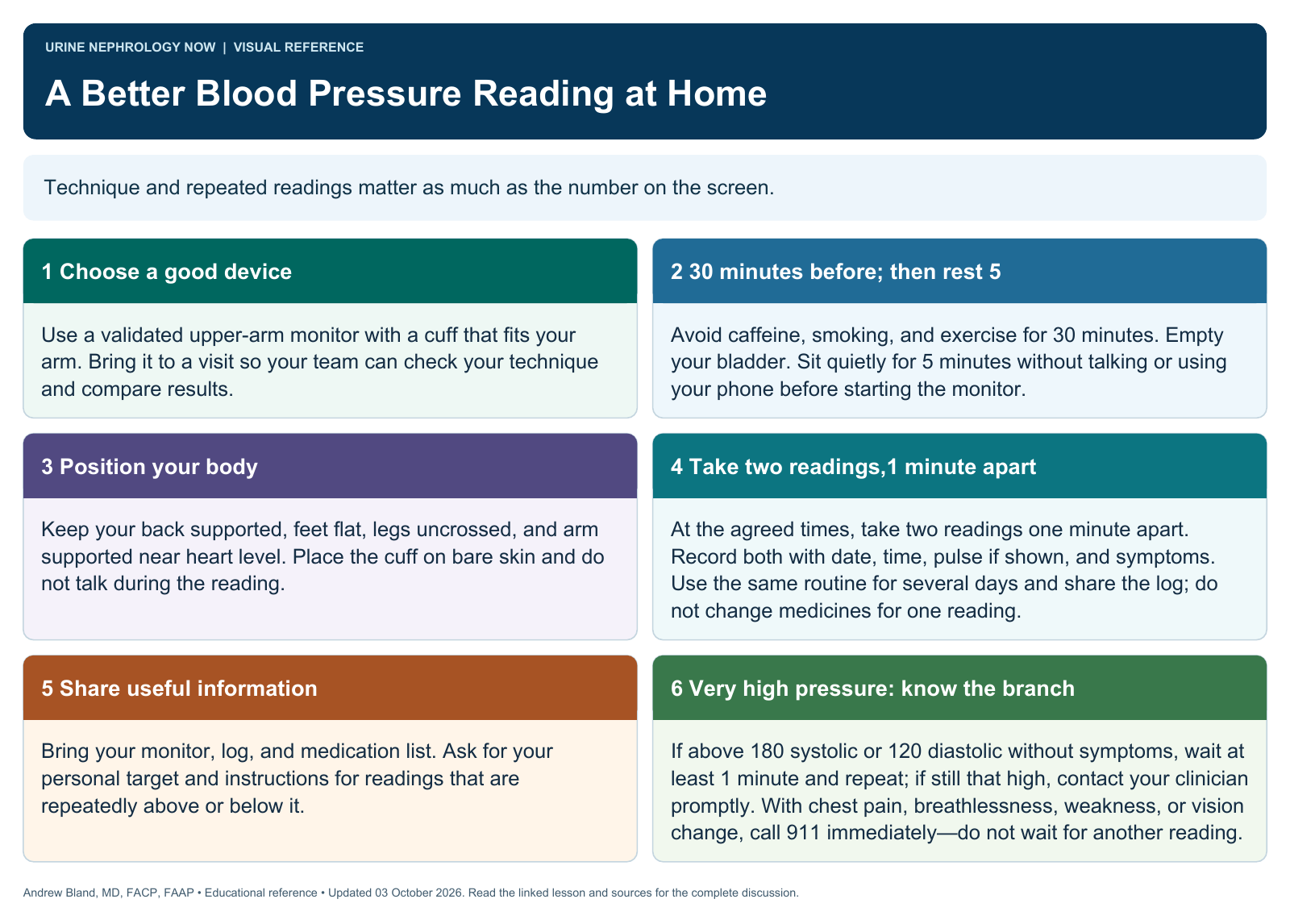
Browse the visual reference library · Download lesson Markdown
Why measuring at home is worth it
Your blood pressure at home often looks different from your blood pressure in the clinic. Some people run high in the office only because they are a little nervous there — the so-called "white coat" effect. Others look fine in the office but run high the rest of the time, which is called masked high blood pressure. That second pattern is the more dangerous of the two, because it hides in plain sight.
A week of home readings gives your kidney team a truer picture than a single office cuff ever could. For kidney disease, home and 24-hour readings also line up better with what actually happens to your kidneys and heart over the years, which is why we lean on them so heavily.
Choosing a monitor
Buy a monitor that has been tested for accuracy — this is called a "validated" device. You can check whether a specific model passed at validatebp.org, a list kept by blood pressure experts. An upper-arm cuff is the best choice for most people.
| Type of device | What to know |
|---|---|
| Upper-arm cuff | The best choice — the most models are validated, and it is the easiest to use correctly. |
| Wrist monitor | Fine only if it is validated and you keep the wrist at heart level. It is easy to use wrong (see below). |
| Smartwatch, fitness tracker, or finger device | Not accurate enough for medical decisions. Do not rely on these for your kidney care. |
When you shop, look for a clear digital display, a memory that stores your past readings, and — most of all — a cuff sized to your arm.
Before you measure: get ready
What you do in the few minutes beforehand changes the number as much as the cuff itself. Three simple steps:
- Empty your bladder. A full bladder can add about 10 to 15 points on its own.
- Skip caffeine, smoking, and exercise for 30 minutes. Caffeine alone adds about 8 points, and it can last a few hours — so measure before your coffee, not after.
- Sit and rest quietly for 5 minutes. No phone, no TV, no talking. Let your body settle.
How to take the reading, step by step
- Sit in a chair with your back supported. Put both feet flat on the floor — do not cross your legs or let your feet dangle.
- Rest your bare arm on a table so the cuff sits level with your heart, at about mid-chest height. Let the table hold your arm up; do not hold it up yourself.
- Wrap the cuff on bare skin, not over a sleeve. The bottom edge should sit about one inch above the crease of your elbow, snug enough that you can just slip a fingertip underneath.
- Stay still and quiet. Do not talk or reach for your phone while the cuff inflates.
- Take two readings about one minute apart, and write both down.
A cuff that is too small reads falsely high; one that is too big reads falsely low. Before you buy a monitor, wrap a tape measure around your upper arm and match that to the cuff size on the box. If you are between sizes or your arm is on the larger side, ask your pharmacist or kidney team which cuff to get.
If you use a wrist monitor
The most common mistake with wrist monitors is holding the wrist too low, which throws the number off. Rest your elbow on a table and bring your wrist to the center of your chest, over your breastbone, with the screen facing you. If your team cannot get your wrist readings to match theirs, switch to an upper-arm cuff.
When and how often to measure
For your kidney team to trust the numbers, take them the same way at the same times:
- Start with the morning reading. Measure within an hour of waking, before your blood pressure pills and before breakfast. By then the last dose has worn off the most, so a gap in coverage shows up. Morning readings taken this way predict heart and stroke risk even in people whose office readings look fine.
- Evening is a useful second check if your team asks for it.
- Two readings each time, about one minute apart.
- Do this for seven days in a row before an appointment. If seven feels like too many, four days is the least that still counts.
- Throw out the whole first day. First-day readings tend to run high while you get used to the routine. Average the rest.
Sometimes your team will want to see how a particular medicine is working and will ask you to check at a set time after you take it. Different pills peak at different times, so use the timing they give you rather than a rule of thumb. This is for fine-tuning your treatment, not for diagnosing — so only do it if your team asks.
What your numbers should be
Home readings usually run a little lower than office readings, so the cutoffs are not the same. As a general guide, a home average of 130/80 or higher counts as high blood pressure — that cutoff comes from the 2025 American Heart Association and American College of Cardiology guideline, and the diabetes guidelines use the same one. Many people with kidney disease aim to keep their home average below 130/80, and some — if they feel well on their medicines — aim a bit lower.
You may hear a lower number too. The kidney guideline (KDIGO 2021) aims for a top number under 120, but only when it is measured in the clinic with a careful, unhurried routine. Most of the gap between the two numbers is about how the reading is taken, not a disagreement about your kidneys. That under-120 goal was not written for people on dialysis or with a kidney transplant.
But these are starting points, not your prescription. Your target depends on your kidney function, your age, whether you have diabetes, and how your body handles the medicines. Older adults and anyone prone to dizziness are sometimes given a slightly higher target on purpose, to avoid lightheadedness and falls. Ask your team for your number and write it at the top of your log.
One more thing worth remembering: a single reading is never the whole story. Blood pressure drifts up and down all day long. What matters is the average across several days — so do not stop or change a medicine because of one high or low number. Call your team instead.
Things that push the number up
If your readings look higher than you expected, one of these is usually the reason:
| What went wrong | What it does to your reading |
|---|---|
| Cuff too small for your arm | 5 or more points higher |
| Legs crossed at the knee | 5 to 8 points higher |
| Feet dangling or unsupported | Pushes the number up |
| Arm resting below heart level | Higher the lower it sits |
| Back not supported | 5 to 10 points higher |
| Talking during the reading | About 10 points higher |
| Full bladder | About 10 to 15 points higher |
| Caffeine in the last 30 minutes | About 8 points higher, and it can last a few hours |
| A cigarette in the last 30 minutes | Pushes the number up and keeps it up |
| Exercise in the last 30 minutes | Can move the number either way — wait 30 minutes |
These add up. Fixing two or three of them can be the difference between "your medicine is working" and "we need to add another pill."
What to bring to your appointment
- Your log — every reading, with the date, the time, and whether it was before or after your pills.
- Your average, if your monitor shows one, or a simple average you worked out yourself.
- Your monitor itself. Your team can check it against theirs to confirm it is accurate and watch how you use it.
- A list of your blood pressure medicines and the times of day you take them.
Warning signs — when to call
• A home average at or above the number your team told you to call about
• Dizziness or lightheadedness when you stand up, or a fall
• Readings running much lower than usual, along with feeling weak or faint
A top number over 180 or a bottom number over 120 together with a severe headache, chest pain, trouble breathing, vision changes, or weakness on one side of your body. Do not wait — this can be an emergency.
Questions worth asking your kidney team
- What home blood pressure number should I be aiming for?
- What reading should make me call the office?
- Should I measure once a day or twice, and for how many days before my visit?
- Is my cuff the right size for my arm?
- Should I take or hold my blood pressure pills before I measure?
- Based on my morning numbers, does the timing of my medicines need to change?
This guide is based on the 2025 AHA/ACC high blood pressure guideline, the KDIGO 2021 blood pressure guideline for kidney disease, and the American Heart Association's recommendations on how to measure blood pressure.
Also on this topic
The same subject at other levels of depth.