IgA Nephropathy: A Patient's Guide
IgA nephropathy is the most common kidney-filtering disease in the world. If you or someone in your family has just been diagnosed, this page explains — in plain language — what it is, how doctors check for it, and the treatments that can protect your kidneys. It is written for patients and families, not for medical staff.
IgA nephropathy happens when an antibody called IgA builds up in your kidneys' tiny filters and slowly causes inflammation and scarring. The single most important thing to track is the amount of protein leaking into your urine — lowering it is the main goal of treatment. Care starts with blood-pressure medicines that protect the kidneys, and in the last few years several new medicines have been approved that target the disease itself. Most people can slow the damage, and some can nearly stop it.
Visual reference
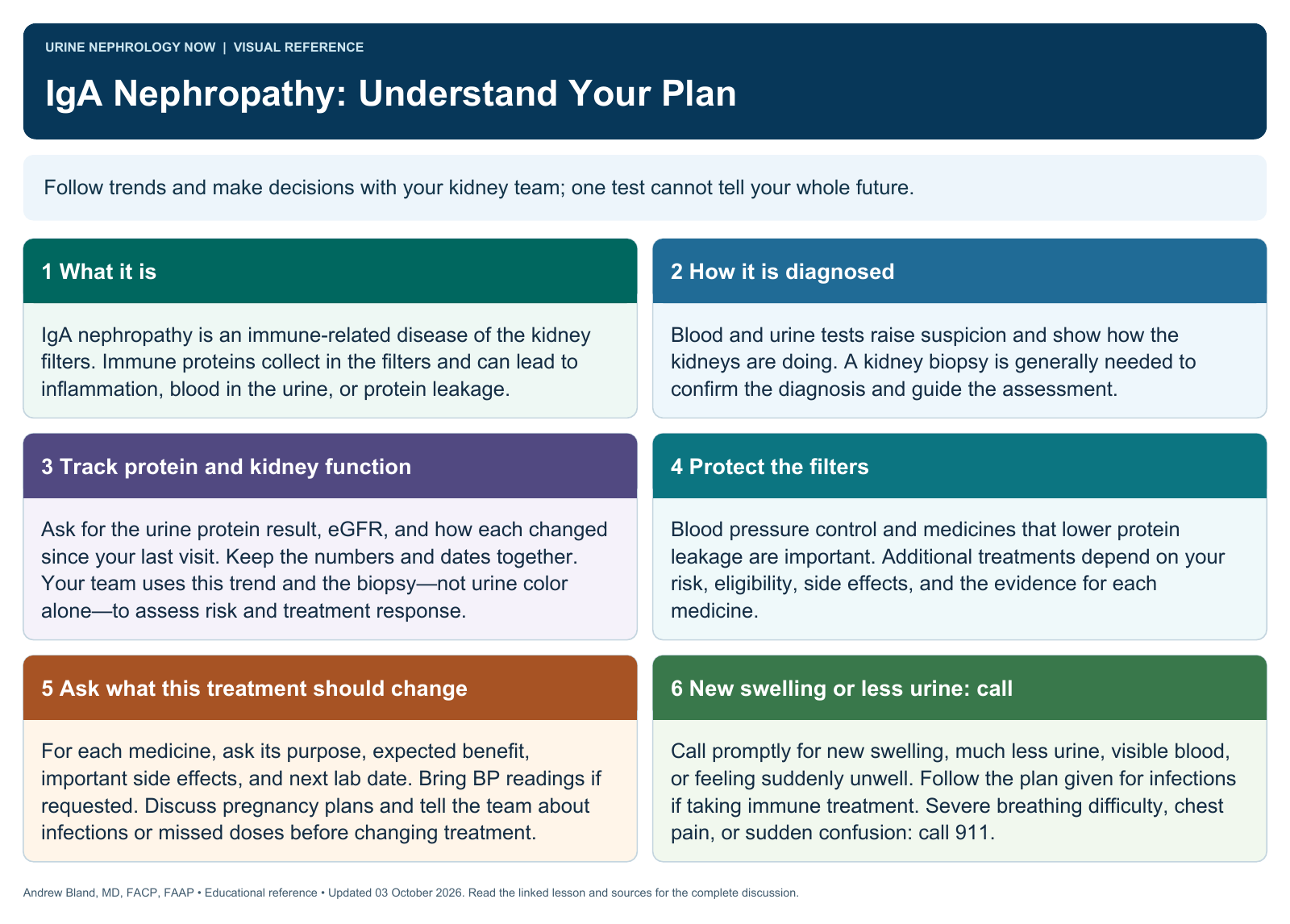
Browse the visual reference library · Download lesson Markdown
What is IgA nephropathy?
Your body makes an antibody called IgA to fight infections, especially in your gut and airways. In IgA nephropathy — sometimes called "Berger's disease" — some of this IgA builds up in the tiny filtering units of your kidneys, called glomeruli. Each kidney holds about a million of them.
Those deposits cause inflammation, and over months and years they can scar the filters. The good part is that scarring is not a foregone conclusion: with today's treatments, many people can slow it down, and some can stop it.
Treatment has changed dramatically in the last few years. For the first time, there are medicines that target the specific steps causing this disease — not just broad medicines that dial down the whole immune system. You and your nephrologist have more tools than ever before.
How the disease develops: the "four hits"
It helps to picture IgA nephropathy as a chain of four events. Each "hit" builds on the one before it. This matters because different treatments are aimed at different links in the chain.
Hit 1: abnormal antibodies are made
Deep in your gut, immune tissue makes IgA antibodies to fight infections. In this disease, some of that IgA is made incorrectly — it is missing a sugar coating that normally helps your body clear it away. Think of a shipping label with a smudged barcode: the package is made, but the sorting system cannot process it properly.
Hit 2: the immune system attacks its own antibodies
Your immune system spots the faulty IgA and treats it as a foreign invader. It makes more antibodies that attack the faulty IgA — an immune reaction against your own body.
Hit 3: sticky clumps form in the blood
The faulty IgA and the antibodies attacking it clump together into sticky clusters that float through your bloodstream. Their size and stickiness make them likely to get caught in your kidney filters — like debris drifting downstream toward a screen it is too big to pass through.
Hit 4: kidney damage and scarring
When those clumps land in the filters, they trigger inflammation. Over time that inflammation can leave permanent scars — the way debris that keeps collecting in a water filter first slows it down and eventually ruins it.
How is it diagnosed?
Doctors usually start to suspect IgA nephropathy when you have:
- Blood in the urine — sometimes visible as tea- or cola-colored urine, often during a cold or sore throat
- Protein in the urine, picked up on a lab test
- Changes in kidney function on your blood work
The diagnosis is confirmed with a kidney biopsy — a small sample of kidney tissue looked at under a microscope. The biopsy shows the IgA deposits and tells your nephrologist how much inflammation and scarring is present. That information guides which treatments make sense for you.
What does this mean for my kidneys?
IgA nephropathy looks different from one person to the next. Many people have a slow, manageable course. Some have a very mild form that may never need more than blood-pressure medicine. A smaller group has a more aggressive form that calls for closer monitoring and extra medicines.
Your nephrologist gauges your risk mainly from three things: how much protein is leaking into your urine, your kidney function (a blood test called eGFR), and what your biopsy showed — how much is active inflammation versus old scarring.
The most important number in IgA nephropathy is the protein in your urine (proteinuria). Higher protein means higher risk. The main goal of treatment is to bring that number down as much as possible — and every reduction counts.
How is it treated?
Everyone starts on foundation therapy — blood-pressure medicines that protect the kidneys. From there, your nephrologist may add targeted medicines based on your risk. Each medicine works on one of the links in the four-hit chain, which is why no single drug is right for every person.
Here are the main medicines that are already approved and in use:
| Medicine | Generic name | What it does |
|---|---|---|
| Lisinopril, Losartan (and similar) | ACE inhibitors / ARBs | The foundation. They lower the pressure inside your kidney filters and cut protein leakage. Every other medicine builds on this one. |
| Farxiga, Jardiance | dapagliflozin, empagliflozin | First made for diabetes; they also ease filter pressure, calm inflammation, and slow kidney decline. |
| Tarpeyo | budesonide (delayed-release) | A steroid pill built to release in the gut, where the faulty IgA is made — so it works at the source with far fewer whole-body steroid side effects. |
| Filspari | sparsentan | Blocks two pathways at once — one that raises filter pressure and one that drives scarring. |
| Vanrafia | atrasentan | Blocks a pathway in the kidney that leads to scarring. |
| Fabhalta | iptacopan | Calms "complement," an inflammatory chain reaction that damages the filters when the clumps land there. |
There is also a wave of newer medicines being tested in trials. Some — called APRIL and BAFF/APRIL inhibitors — aim to stop the faulty IgA from ever being made, going after the very start of the chain. If they work as hoped, they could change the disease at its root rather than only limiting the damage. Ask your nephrologist whether a clinical trial is an option for you.
Older, whole-body steroids such as prednisone are still used, but cautiously — usually only for rapidly worsening disease — because they carry significant side effects. That is exactly why the newer, targeted medicines are preferred when they fit your situation.
What you can do
- Take your medicines as prescribed. Even when you feel fine, they are working to protect your kidneys. Do not stop or skip doses without talking to your doctor.
- Keep every lab appointment. Your blood and urine tests are how your team tracks your progress — the urine protein most of all.
- Control your blood pressure. High blood pressure speeds up kidney damage. The usual target is below 130/80. A home blood-pressure cuff helps.
- Go easy on salt. Aim for less than 2,000 mg of sodium a day. Less salt helps your blood-pressure medicines work and lowers protein leakage.
- Avoid NSAID pain relievers — ibuprofen, naproxen, Advil, Aleve. They can worsen kidney function and work against your treatment. Acetaminophen (Tylenol) is usually the safer choice, and check with your doctor before starting any new medicine or supplement.
If you are pregnant or planning a pregnancy
Several of these medicines — including sparsentan (Filspari), atrasentan (Vanrafia), and the ACE inhibitors and ARBs — cannot be used during pregnancy, because they can seriously harm a developing baby. Most of the newest medicines are off-limits in pregnancy too.
If you are planning a pregnancy or think you may be pregnant, contact your nephrologist right away. There are pregnancy-safe treatment plans, but they need careful coordination — do not wait until a routine visit to bring it up.
When to call your kidney team
• A lot more visible blood in your urine than usual, or urine that stays tea- or cola-colored
• Any symptom your nephrologist specifically told you to watch for
• Dizziness or lightheadedness, which can happen if your blood pressure drops too low on your medicines
• A stomach bug with vomiting or diarrhea that keeps you from drinking normally — especially if you take one of the diabetes-family kidney medicines
• Fever or other signs of infection, particularly if you take a medicine that lowers your immune defenses
• A new or worsening side effect from any of your medicines
• A pregnancy, or plans to become pregnant
Questions worth asking your kidney team
- What did my kidney biopsy show — how much scarring versus active inflammation?
- What is my current urine protein level, and what number are we aiming for?
- What is my eGFR, and has it been holding steady?
- Am I on the highest dose of blood-pressure medicine I can tolerate?
- Which of the approved targeted medicines might be right for me?
- Should I be on a diabetes-family kidney medicine (such as dapagliflozin) for extra protection?
- Is a clinical trial of a newer medicine an option for me?
- How often should I have lab work, and which over-the-counter medicines should I avoid?
About this guide
Not every person needs every medicine. Your plan is built around your biopsy, your urine protein, your kidney function, and your other health conditions — a medicine that is right for one person may not be right for you. This guide is based on current international kidney-care guidelines (KDIGO) and the medical literature.
Also on this topic
The same subject at other levels of depth.
- Clinical Mastery deep dive: IgA Nephropathy