Kidney Biopsy: What to Expect
Your doctor has recommended a kidney biopsy — or you are thinking one over — and you want to know what actually happens. This page walks through the whole process in plain language: why the test is done, how to prepare, what the procedure itself is like, and how to take care of yourself while you heal.
A kidney biopsy uses a thin needle to take a tiny piece of your kidney so it can be examined under a microscope. It answers questions that blood tests and scans cannot, and it helps your doctor choose the right treatment for you. The test takes about 30 to 60 minutes. Your two biggest jobs are before the biopsy — stopping certain medicines that make bleeding more likely — and after it: taking it easy for two weeks so the small puncture can heal. Serious problems are uncommon.
Visual reference
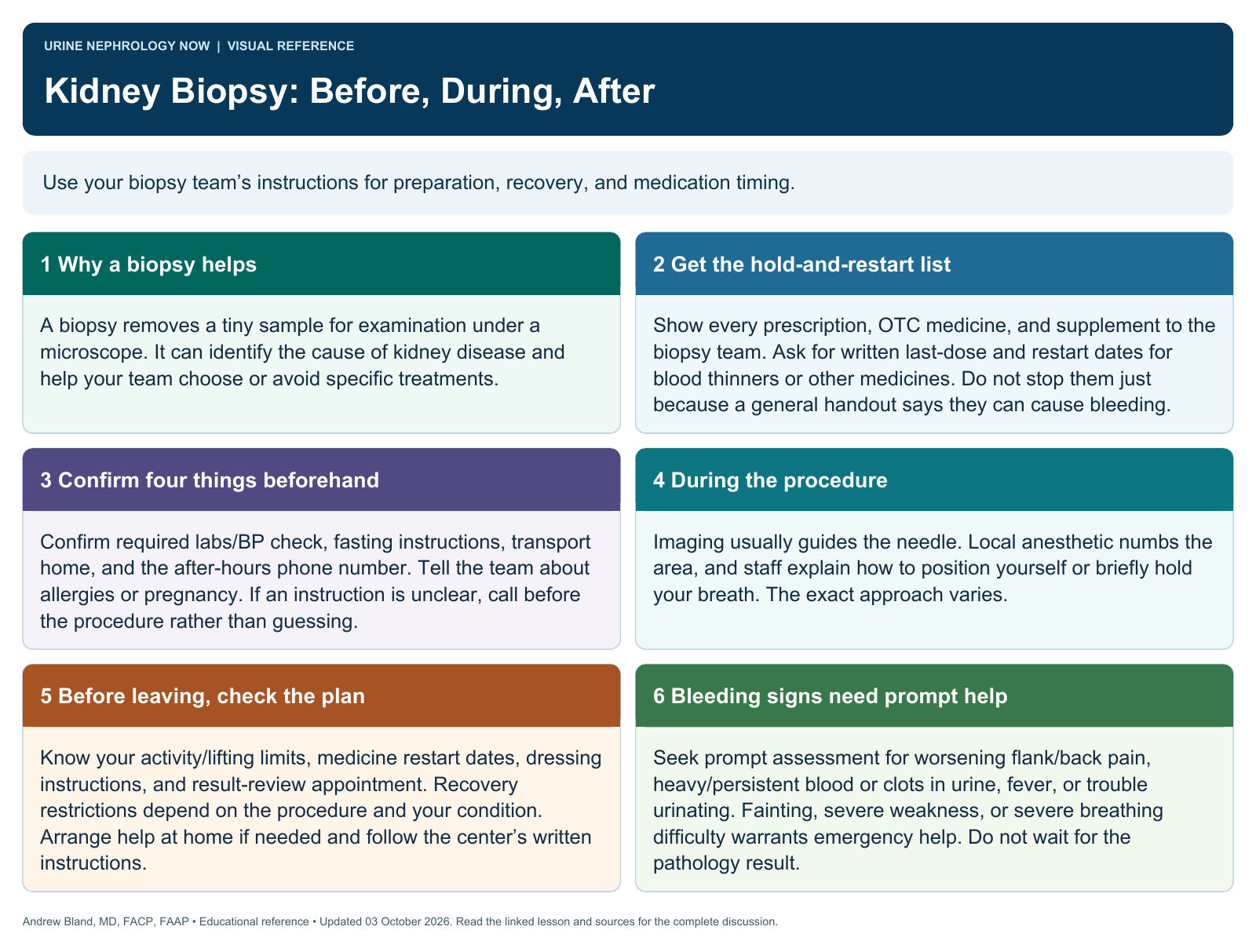
Browse the visual reference library · Download lesson Markdown
What is a kidney biopsy, and why do I need one?
A kidney biopsy is a test in which a doctor takes a very small sample of kidney tissue to look at under a microscope. Think of it like taking a soil sample to see what is happening underground — except here, we are checking what is happening inside your kidney.
Your doctor wants to find out why your kidneys are not working as well as they should. Blood tests and scans can tell us that something is wrong; the biopsy shows what is wrong and often why. That information is what lets your doctor make the right diagnosis and build the best treatment plan for you. Without it, choosing how to help your kidneys would be mostly guesswork.
Before your biopsy: medicines to stop
Some medicines make you bleed more easily. Think of them as making your blood "slippery" — harder for a small cut to stop bleeding. Because the biopsy makes a tiny puncture in the kidney, these medicines need to be out of your system first.
| Medicine | Common brand names | Stop taking it |
|---|---|---|
| Aspirin | Bayer, Bufferin | 7 days before |
| Ibuprofen | Advil, Motrin | 7 days before |
| Naproxen | Aleve | 7 days before |
| Vitamin E supplements | — | 7 days before |
| Fish oil supplements | — | 7 days before |
| Clopidogrel | Plavix | 3 days before |
| Cilostazol | Pletal | 3 days before |
If you take warfarin (Coumadin), Eliquis, Xarelto, or Pradaxa, your doctor will give you specific instructions about when to stop. These medicines protect you from clots and strokes, so the timing has to be planned for you personally. Only stop them when your doctor tells you to.
Need something for pain or a headache in the week before your biopsy? Acetaminophen (Tylenol) is safe to take. For anything else, check with your doctor first.
The morning of your biopsy
Do not eat or drink anything for 8 hours before the procedure — that includes water, gum, and candy. You may take your regular morning medicines with just a tiny sip of water, unless your doctor told you to hold them.
Bring these with you:
- Picture ID and your insurance card
- A list of all your medicines
- A book or something to keep you busy — you will be lying down for several hours afterward
- Comfortable, loose-fitting clothes
- Someone to drive you home
What happens during the biopsy
You will lie on your stomach on a table. The doctor cleans your back and injects numbing medicine so you will not feel pain. Using a CT scanner — a special X-ray machine — the doctor takes pictures to find the safest spot on your kidney. Then a thin needle is used to remove a very small piece of tissue. Most people feel pressure but not pain.
From start to finish, the test takes about 30 to 60 minutes.
What are the risks?
Like every medical test, a kidney biopsy carries some risk — but serious problems are not common, and your team knows how to watch for them and treat them. Here is an honest look at what can happen and how often:
| What can happen | How often |
|---|---|
| A little blood in the urine for a day or two | Almost everyone — it usually clears on its own |
| Blood in the urine you can clearly see | About 5 to 10 out of every 100 people |
| Bleeding that needs a blood transfusion | About 1 to 2 out of every 100 people |
| A procedure to seal a bleeding blood vessel with tiny coils or plugs | About 1 out of every 500 people |
| Surgery to remove the kidney because bleeding cannot be stopped any other way | Fewer than 1 out of every 1,000 people |
Other possible problems include infection where the needle went in and soreness in your back or side for a few days. Most people who have a kidney biopsy do well and go home without any of the serious problems on this list.
Right after the biopsy
You will lie flat on your back for 4 to 6 hours while a nurse checks your blood pressure and pulse often. This resting time is not optional — it is how we make sure the puncture site has sealed before you go home. You may see some blood in your urine during this time. That is expected, and it usually goes away within a day or two.
Once you are home:
- Rest quietly for the rest of the day
- Drink plenty of water to help flush your system
- Walking around the house and light activities are fine — nothing more strenuous yet
Your doctor will have the biopsy results in a few days and will talk with you about what was found and what comes next.
Getting back to normal: the two-week recovery
Think of the biopsy site as a small cut deep inside your body that needs time to seal completely. Different activities put different amounts of stress on that healing spot, so activity comes back in stages:
| Time after biopsy | Usually fine | Hold off on |
|---|---|---|
| Days 1–2 | Slow walking around the house, regular meals, TV, reading, light desk work while sitting | Lifting over 5 pounds, bending at the waist to pick things up, vacuuming or sweeping, taking out trash, sleeping on the biopsy side |
| Days 2–3 | Folding laundry, preparing simple meals, short car rides as a passenger, gentle short walks | Lifting over 10 pounds, driving, scrubbing floors, moving furniture |
| Days 3–5 | Driving if you feel steady and are off pain medicine, light grocery shopping with a cart, walking the dog on a leash, watering plants | Lifting over 15 pounds, pushing a heavy cart, twisting sports like golf, heavy cleaning, changing bed sheets alone |
| Around 1 week | Most daily activities, office work, slow stationary biking, gentle yoga or stretching, carrying groceries under 10 pounds per bag | Lifting over 20 pounds, running, jumping, quick twisting movements, contact sports, vibrating equipment |
| At 2 weeks | Everything — regular exercise and sports, all lifting, mowing the lawn, swimming and hot tubs, all work activities | — |
A rough guide to those weights: 5 pounds is a bag of flour, 10 pounds is a gallon of milk or a bag of sugar, 15 pounds is a toddler or a medium bag of dog food, and 20 pounds is two gallons of milk or a large bag of cat litter.
Your kidneys sit in your body a little like eggs in an egg carton — protected, but able to shift. Pushing a mower or a leaf blower sends vibration and pressure straight to the healing site, and a riding mower adds up-and-down jolts. Give it the full two weeks before any lawn work.
One rule covers every stage: if an activity causes pain, dizziness, or new blood in your urine, stop and rest. Your body will tell you if you are doing too much too soon.
Warning signs — when to call your doctor
• Severe pain that does not get better with Tylenol
• Dizziness or feeling faint
• Urine with a lot of blood in it — the color of cranberry juice
• Fever over 100.4°F
• Swelling where the needle went in
• Little or no urine
• Chest pain or trouble breathing
A trace of pink in the urine in the first day or two is expected. Urine that looks like cranberry juice is not — that needs a call, right away.
Questions to ask your kidney team
- Which of my medicines do I stop before the biopsy, and exactly when?
- I take a blood thinner — what is my specific plan for stopping it and restarting it?
- How long will I stay in the hospital after the biopsy?
- When can I go back to work?
- What signs should I watch for at home?
- When and how will I get my results?
Your healthcare team is there to help you. If anything on this page raises a question, ask — the better prepared you are, the smoother the whole experience will go.
This guide is based on current international kidney-care guidelines (KDIGO) and the medical literature.
Also on this topic
The same subject at other levels of depth.
- Lecture: Kidney Biopsy Interpretation
- Student handout: Kidney Biopsy: A Comprehensive Student Guide