Kidney Stones: Treating Them and Preventing the Next One
If you have just passed a kidney stone — or ended up in the emergency room with one — you already know they cause some of the worst pain a person can feel. The reassuring part: most stones pass on their own, and once you have had one, there is a lot you can do to keep the next one from forming. This page covers what to expect while a stone passes, when to get help, and the changes that lower your odds of doing this again. It is written for patients, not for medical staff.
Most kidney stones smaller than about a quarter-inch pass on their own with fluids, pain medicine, and time. Get help right away if you have a fever, cannot keep fluids down, or have pain that will not settle — those can signal a blocked, infected kidney, which is an emergency. To stop the next stone, three things do most of the work: drink enough to keep your urine pale all day, go easy on salt (but not on calcium), and let your kidney team run a 24-hour urine test so your prevention plan fits your body.
Visual reference
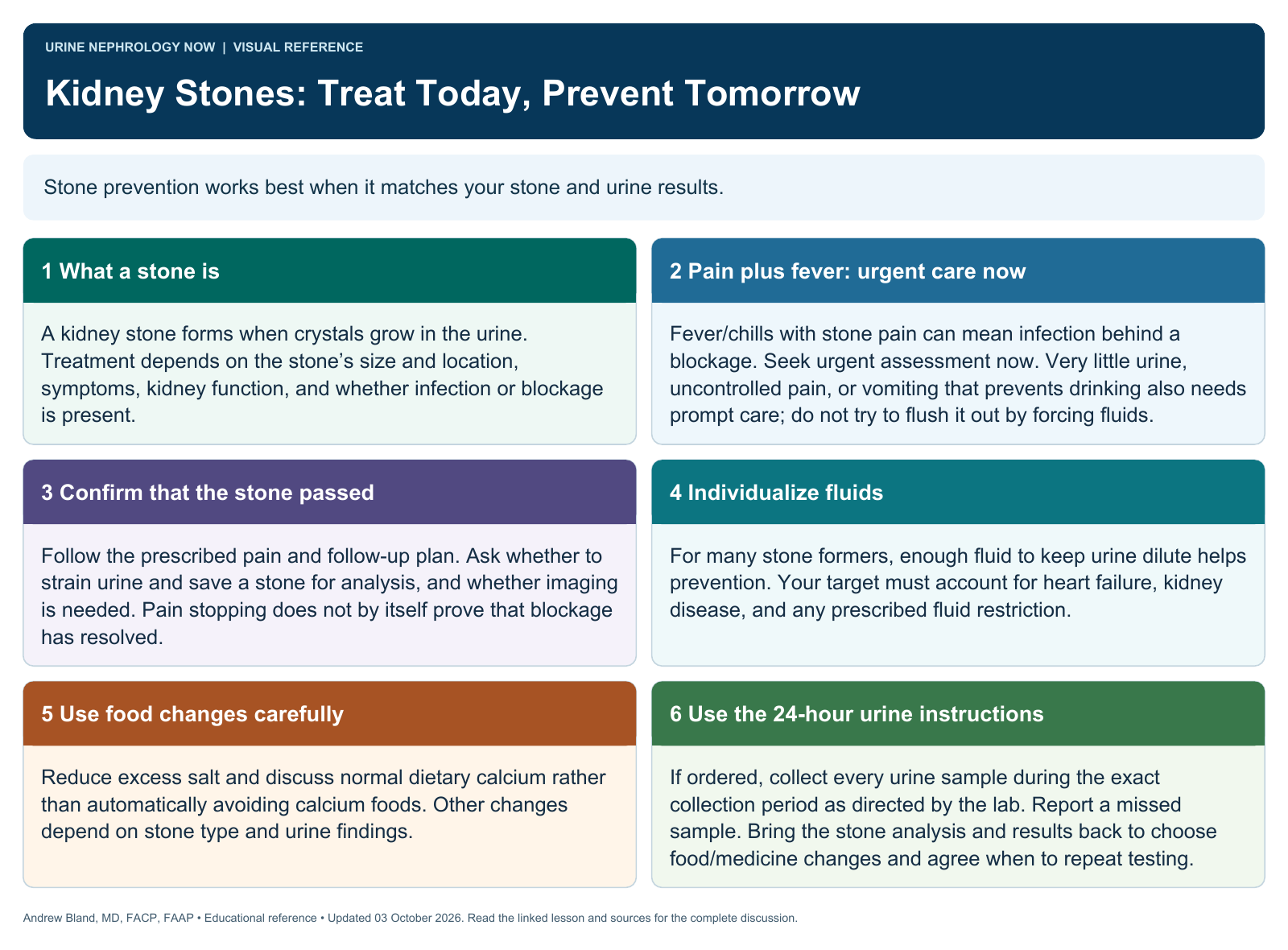
Browse the visual reference library · Download lesson Markdown
What a kidney stone is
A kidney stone is a hard lump that forms when certain minerals in your urine get too concentrated and start to crystallize, the way sugar left in a glass of water eventually forms crystals. About 1 in 8 men and 1 in 20 women get one at some point. Once you have had a stone, roughly half of people form another within 5 to 10 years if nothing changes — but that drops to about 1 in 10 when you take the right steps.
Stones are not all the same, and your type changes which prevention steps help most. If you catch the stone, the lab can tell you exactly what it is made of.
| Stone type | How common | What tends to drive it |
|---|---|---|
| Calcium (oxalate or phosphate) | Most stones — roughly 8 in 10 | Not enough fluid, too much salt, low protective citrate |
| Uric acid | Approximately 1 in 10 | Acidic urine, gout, lots of red meat, shellfish, or sugary drinks — sometimes can be dissolved with medicine |
| Struvite (infection) | Approximately 1 in 10 | Certain urine infections; grows fast and large; usually needs a procedure |
| Cystine | Rare | An inherited condition; starts young and runs in families; needs a lot of fluid |
What passing a stone feels like
The classic sign is sudden, severe pain in your back or side, below the ribs. As the stone travels down the tube toward your bladder, the pain often moves around to the lower belly and groin. It tends to come in waves, with calmer stretches in between, and it can bring on nausea or vomiting. Many people cannot sit still and keep shifting position trying to get comfortable.
Other things you might notice: pink, red, or brown urine from a little bleeding as the stone scrapes along, and — once the stone is close to the bladder — a burning feeling or a sudden urge to go. Small stones under about an eighth of an inch pass on their own roughly nine times out of ten, so the goal early on is to control the pain and let nature do the work.
Getting through it at home
If your doctor has confirmed the stone is small and there is no infection, most of the work happens at home:
- Keep drinking. Steady fluids help flush the stone along. You do not need to force gallons — comfortable, regular sips through the day.
- Stay ahead of the pain. An anti-inflammatory such as ibuprofen works well for stone pain if your kidneys allow it. Do not use these if you have kidney disease or your doctor has told you to avoid them — ask first.
- Ask about a stone-passing pill. Your doctor may prescribe tamsulosin, which relaxes the tube so the stone slides out more easily. It helps most when the stone is low and close to the bladder.
- Catch the stone. Strain your urine or pee into a clear container and save anything solid. Sending it to the lab tells you the stone type, which shapes everything you do to prevent the next one.
Your doctor will usually recheck with a scan a few weeks later to confirm the stone passed. If it has not, or the pain flares, that is when you talk about removing it.
If the stone will not pass
When a stone is too big to pass — bigger than about a quarter-inch — or gets stuck and keeps causing pain or blockage, a urologist can remove it. There are three common ways, and most are same-day or a short stay:
- Shock wave treatment. Focused sound waves aimed from outside your body break the stone into sand-sized pieces you then pee out. No cuts are involved.
- Ureteroscopy. A thin scope passes up through the bladder to the stone, and a small laser breaks it apart. This works very well, especially for stones lower in the tube.
- Keyhole kidney surgery. For large stones, a surgeon makes a small opening in your back to reach the kidney directly and remove them.
Your urologist chooses the method based on the stone's size, where it is sitting, and what it is made of.
Fluid: the single most powerful prevention step
If you change one thing, change this. Water dilutes your urine so minerals stay dissolved instead of clumping into a stone. Low urine volume is the most common reason stones form, and it is the easiest thing to fix.
The goal is to drink enough to make about 2 to 3 liters of urine a day — roughly 2 to 3 quarts. Your urine color is a good daily gauge: aim for pale straw, not dark yellow. Spread your drinking across the day, and have a glass before bed, since urine gets most concentrated overnight. Water is best. If you form uric acid or cystine stones, your team may ask you to drink even more.
You do not have to track ounces. If your urine is pale for most of the day, you are probably drinking enough. Dark yellow means catch up on fluids.
The food changes that matter
Beyond fluid, a few specific food changes move the needle. Which ones matter most depends on your stone type and 24-hour urine results, so treat this as a starting point and let your team fine-tune it.
| What to adjust | What to do | Why it helps |
|---|---|---|
| Salt | Keep sodium under about 2,300 mg a day — roughly one teaspoon | High salt makes your kidneys spill more calcium into the urine, feeding calcium stones |
| Calcium | Do not cut it — get about 800 to 1,000 mg a day from food | Cutting calcium backfires and lets more oxalate reach your urine; calcium in food ties up oxalate in the gut |
| Oxalate | Go easy on very high-oxalate foods: spinach, rhubarb, nuts, chocolate, black tea, colas | Oxalate joins with calcium to form the most common stones; pairing these foods with a calcium food softens the effect |
| Citrate | Add citrus — lemon or lime in your water, oranges | Citrate is a natural stone blocker, and low urine citrate is a common, fixable risk |
| Animal protein | Keep meat, poultry, and seafood moderate rather than heavy | Large amounts raise acid, uric acid, and oxalate in the urine |
| Sugary drinks | Limit non-diet sodas and high-fructose drinks | They push uric acid and oxalate up |
Many people assume that cutting calcium prevents calcium stones. It is the opposite. Get your calcium from food, and keep it at a normal amount. Do talk with your doctor before starting a calcium supplement in pill form, because supplements can behave differently from calcium in meals.
Why a 24-hour urine test prevents the next stone
General advice only goes so far, because two people who form stones can have completely different reasons. A 24-hour urine test is how your kidney team finds your reason. You collect all of your urine for one full day into a jug, and the lab measures how much fluid you are making along with the levels of the minerals that build stones — calcium, oxalate, citrate, and uric acid — plus how much salt you are eating.
That turns prevention from guesswork into a plan built for your body. If your citrate is low, you get citrate. If your urine calcium is high, salt comes down, and sometimes a water pill is added. If your urine volume is low, the target becomes more fluid.
A 24-hour urine is especially worth it if you have had more than one stone, a first stone before age 50, a stone at a young age, a family history, or an unusual stone type. Collect it a few weeks after the episode settles, while you are eating and drinking normally, so it reflects your real life. Your team may repeat it after a few weeks to confirm the plan is working.
Medicines that can prevent stones
Sometimes fluid and diet are not enough on their own, and your doctor adds a medicine matched to your stone type and your urine results. The common ones are simple:
- A water pill (thiazide) lowers the amount of calcium your kidneys spill into the urine.
- Potassium citrate raises protective citrate and is used for calcium, uric acid, and cystine stones.
- Allopurinol lowers uric acid, for people who form uric acid stones or run high uric acid.
None of these are for everyone. The 24-hour urine is what tells your team which, if any, actually fits you.
Warning signs — when to call
• Fever or chills along with the pain — a blocked, infected kidney is an emergency
• Pain that your medicine will not control
• Vomiting that will not stop, or not being able to keep fluids down
• Little or no urine
• Only one working kidney, a kidney transplant, or known kidney disease, plus stone symptoms
• Pink, red, or brown urine that keeps up or comes with feeling generally unwell
Questions worth asking your kidney team
- What type of stone did I have, and do we know why it formed?
- Should I collect a 24-hour urine, and when is the right time?
- How much should I be drinking, and how can I tell if it is enough?
- Does my diet need to change — salt, oxalate, protein — and by how much?
- Do I need a medicine to help prevent the next stone?
- When should I have my next scan or urine test to check the plan is working?
References
This is a peer-reviewed source behind the diet advice on this page. It is written for clinicians; your own doctor can help you interpret it. The rest of this guide is based on current urology and kidney-care guidelines and the medical literature.
- D’Alessandro C, Ferraro PM, Cianchi C, Barsotti M, Gambaro G, Cupisti A. Which Diet for Calcium Stone Patients: A Real-World Approach to Preventive Care. Nutrients. 2019;11(5):1182. doi:10.3390/nu11051182. PMID: 31137803