NSAIDs and Your Kidneys
If you have kidney disease — or you are trying to protect kidneys that are already under strain — the pain-reliever aisle can be confusing. Some of the most common products are hard on the kidneys, and they hide in medicines you might not expect. This page explains which pain relievers to be careful with, why they matter for your kidneys, and what you can reach for instead. It is written for patients, not for medical staff.
NSAIDs are a group of common pain and fever medicines — ibuprofen (Advil, Motrin) and naproxen (Aleve) are the ones most people know. They work well, but they can lower the blood flow your kidneys depend on. In people with kidney disease, heart failure, or dehydration — and especially when combined with certain blood-pressure medicines and water pills — they can cause sudden kidney injury. Taken at high doses for years, they can scar the kidneys for good. The reassuring part: for most everyday aches and fevers, acetaminophen (Tylenol) is a safer choice for your kidneys. Read the label, and ask your kidney team before you start any regular pain medicine.
Visual reference
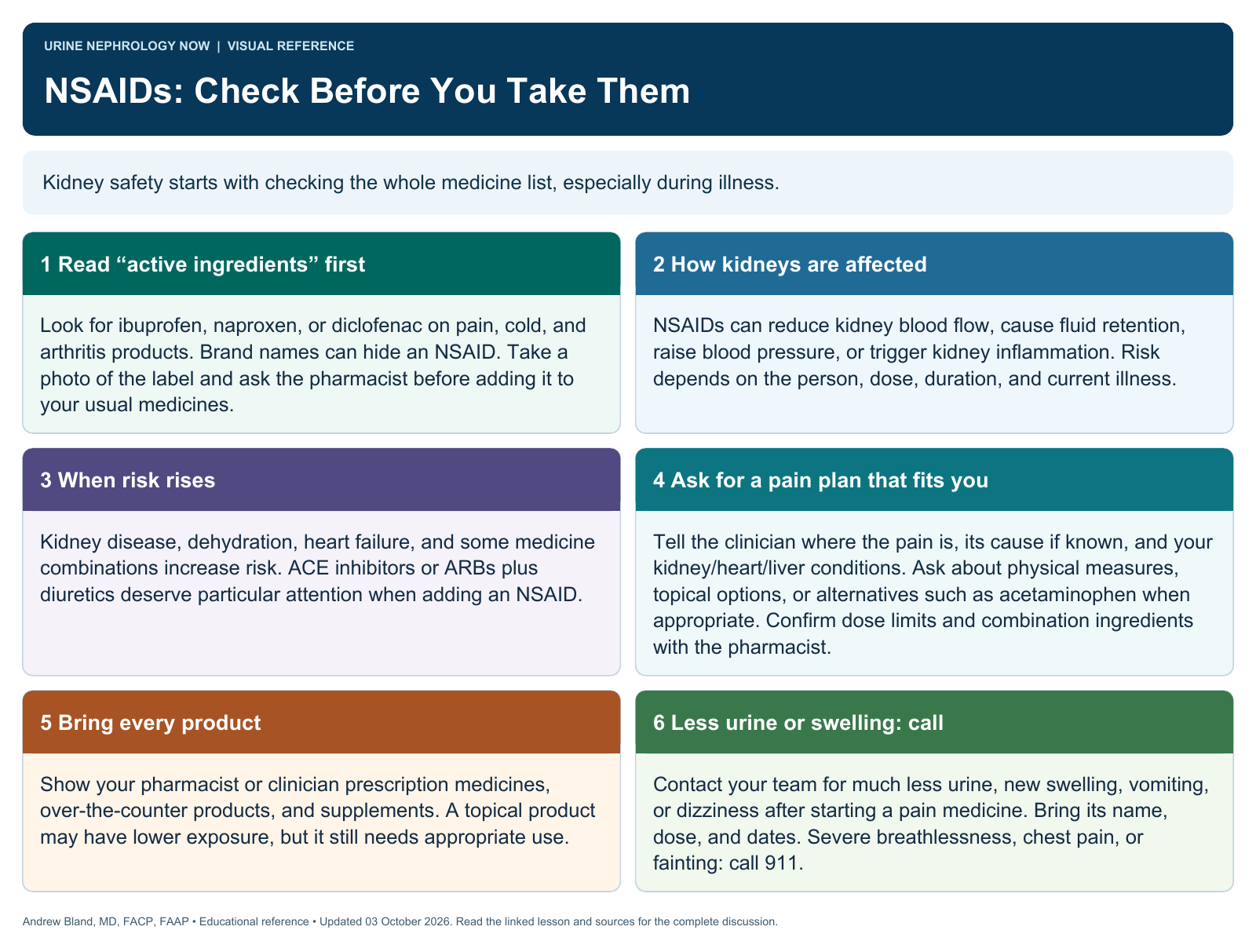
Browse the visual reference library · Download lesson Markdown
What counts as an NSAID?
NSAID stands for nonsteroidal anti-inflammatory drug. It is a family of medicines that bring down pain, swelling, and fever. Many are sold over the counter, so it is easy to take them without thinking of them as "real" medicine — but they act on your kidneys just as a prescription would.
Here are the ones you are most likely to run into:
| Generic name | Common brand names | Where you will see it |
|---|---|---|
| ibuprofen | Advil, Motrin | Over the counter; also in many cold and "PM" products |
| naproxen | Aleve, Naprosyn | Over the counter and by prescription |
| aspirin | Bayer, Bufferin | Over the counter; also in combination products |
| diclofenac | Voltaren (gel), Cambia | Gel over the counter; pills by prescription |
| meloxicam, indomethacin, celecoxib | Mobic, Indocin, Celebrex | Prescription only |
One important exception: if you take a low-dose aspirin every day because your doctor prescribed it for your heart, keep taking it. That is a much smaller dose, used for a different reason. Do not stop it on your own — ask your doctor first.
Two things make it easy to take too much NSAID by accident. First, several do not need a prescription. Second, they are mixed into many combination products — some cold and flu remedies, menstrual-pain formulas, and "PM" or nighttime pain relievers contain an NSAID even when the front of the box does not say so. That is why the label matters, and we come back to it below.
How NSAIDs can affect your kidneys
NSAIDs can trouble the kidneys in a few different ways. Most people never have a problem — but the risk climbs sharply if your kidneys are already vulnerable.
They can choke off blood flow to the filters
Your kidneys clean your blood through millions of tiny filters, and they rely on a steady flow of blood to do it. NSAIDs work partly by blocking natural chemicals called prostaglandins. Those same chemicals help keep the kidney's blood vessels open. When an NSAID blocks them, blood flow to the filters can drop — and so can your kidney function. A healthy, well-hydrated person usually has room to spare. Someone with kidney disease, heart failure, or dehydration does not, and the drop can show up as a sudden rise in the kidney blood test within a day or two.
They can set off a sudden allergic-type reaction
Less often, an NSAID triggers inflammation inside the kidney itself — a reaction called acute interstitial nephritis. It can come on over days to weeks. Some people get a fever, a rash, or aching joints, but many get none of those — so a change in the kidney blood test may be the only sign. Stopping the drug is the main treatment, and most people recover, though some are left with lasting damage.
They can scar the kidneys slowly over years
Taking NSAIDs at high doses for a long time — especially several different pain pills day after day — can quietly scar the kidneys and damage the small inner tips where urine collects. This builds up over years, often with no symptoms early on, and it frequently cannot be reversed. That is the reason not to lean on daily NSAIDs for ongoing pain.
Who needs to be most careful
NSAIDs are riskier when the kidneys are already working with a smaller margin. Be especially cautious if you:
- have reduced kidney function or chronic kidney disease (CKD);
- have heart failure;
- have liver disease such as cirrhosis;
- are dehydrated — from a stomach bug, a hot day, or simply not drinking enough;
- are older, roughly over age 65;
- take a water pill (diuretic) or a blood-pressure medicine in the ACE inhibitor or ARB family.
When more than one of these applies to you, the risk stacks up. The next section is the clearest example.
The "triple whammy"
Three very common medicines, each helpful on its own, can gang up on the kidneys when they are taken together. Clinicians call this combination the triple whammy:
- an NSAID, such as ibuprofen or naproxen;
- a blood-pressure medicine in the ACE inhibitor or ARB family — names often ending in "-pril" such as lisinopril, or "-sartan" such as losartan; and
- a water pill, or diuretic, such as furosemide or hydrochlorothiazide.
Each of these changes the way blood moves through the kidney. Put all three together — which often happens when someone adds an over-the-counter pain reliever on top of blood-pressure medicines they already take — and the kidneys can be pushed into sudden injury, sometimes with a dangerous rise in potassium. Many people never suspect the pain reliever, because the other two were "just their usual pills."
If you take a blood-pressure medicine and a water pill, do not start a regular over-the-counter NSAID without checking with your kidney team or pharmacist first. A rare single dose is different from taking one every day — but when in doubt, ask before you combine.
Safer choices for pain
You have several options that are gentler on the kidneys:
- Acetaminophen (Tylenol) is usually the first choice for everyday aches, headaches, and fever when you have kidney disease. It eases pain and fever without cutting blood flow to the kidneys the way NSAIDs do.
- Topical NSAIDs — gels or creams you rub onto a sore joint, such as diclofenac gel (Voltaren) — put much less medicine into your bloodstream than a pill, so they are less likely to affect the kidneys. They are still NSAIDs, though. If your kidney function is low, or you take a blood-pressure medicine and a water pill, ask before using one regularly.
- Non-drug measures — heat or ice, physical therapy, gentle movement, and rest — can carry more of the load than people expect, especially for joint and back pain.
For pain that is ongoing or severe, do not try to sort this out alone. Your care team can build a plan that controls your pain and protects your kidneys at the same time.
Acetaminophen does not strain the kidneys the way NSAIDs can, which is why it is the go-to for most everyday pain in kidney disease. It does have a daily limit, and it turns up inside many combination cold and pain products. Add up every source so you do not go over without realizing it, and ask your pharmacist if you are unsure what a safe daily amount is for you.
Reading the label
Because NSAIDs hide in so many products, the label is your best protection. A few habits help:
- Read the "active ingredients" box on any over-the-counter product before you take it. If you see ibuprofen, naproxen, aspirin, or diclofenac listed, it is an NSAID.
- Watch the combination products. Cold, flu, sinus, menstrual, and "PM" or nighttime formulas often slip an NSAID in alongside the other ingredients.
- Do not double up by accident. Taking a stand-alone pain pill and a cold remedy that both contain an NSAID adds up to a bigger dose than you meant to take.
- Ask the pharmacist. They can check any product against your kidney function and your other medicines in about a minute — and it costs you nothing.
Keep an up-to-date list of everything you take, including over-the-counter medicines and supplements, and bring it to your kidney visits.
If you already have kidney disease
NSAIDs are not always off-limits, but they deserve real caution once your kidneys are affected. A few points:
- Check before any regular use. A rare single dose is not the same as taking one daily. If you find yourself reaching for an NSAID often, that is worth a conversation with your team.
- Have a sick-day plan. When you are vomiting, have diarrhea, or cannot keep fluids down, dehydration makes NSAIDs far riskier — and this is exactly when people tend to grab one for the aches of being ill. Ask your team which medicines to pause when you are sick.
- Speak up about pain. If pain is pushing you toward NSAIDs, tell your kidney team. There are safer ways to get you comfortable.
Warning signs — when to call
• Much less urine than usual, or urine that looks dark
• New swelling in your legs, ankles, or face
• A sudden jump in your blood pressure
• Nausea, feeling unusually tired or foggy, or losing your appetite
• A new rash, fever, or aching joints after starting a pain medicine
• Any of these after recently starting or increasing an NSAID — especially if you also take a blood-pressure medicine and a water pill
Questions worth asking your care team
- Is it safe for me to take an over-the-counter pain reliever at all, given my kidney function?
- I take a blood-pressure medicine and a water pill — does that change what is safe for pain?
- What should I use instead of ibuprofen or naproxen for everyday aches and fever?
- How much acetaminophen is safe for me in a day?
- Which of my medicines should I pause on a sick day when I cannot eat or drink normally?
- Can you look over my current list of over-the-counter medicines and supplements?
About this guide
This guide is based on the KDIGO 2024 Clinical Practice Guideline for the Evaluation and Management of Chronic Kidney Disease and on the published research on pain relievers and the kidney. The full source list, written for clinicians, is kept with Dr. Bland's teaching materials.